Studio Monitor Speaker
ProductOverview
A studio monitor is a loudspeaker designed for accuracy rather than flattery. Where a consumer speaker may boost bass and treble to sound impressive, a monitor aims for a flat frequency response and low distortion so that mixing and mastering decisions translate to other playback systems. Nearly all modern monitors are active: the amplifiers live inside the Cabinet, matched at the factory to the drivers they feed.
A two-way monitor divides the audio band between a Woofer Driver handling bass and midrange and a Tweeter Driver handling treble. The division happens in the Crossover and DSP Board, after which each band gets its own power amplifier on the Bi-Amp Plate Amplifier, the bi-amplified arrangement that distinguishes serious monitors from passive hi-fi speakers.
How it works
The signal arrives at the Input and Control Panel as a balanced line feed through the XLR Combo Input. Balanced wiring carries the signal on two conductors of opposite polarity; the differential receiver subtracts them, cancelling hum and interference picked up along the cable. The Input Trim matches the monitor's sensitivity to the source, and the Room EQ Switches apply shelving filters that compensate for desk reflections and wall proximity, which otherwise add several decibels of bass lift.
The Audio Codec digitizes the input and hands it to the DSP Chip, which implements the crossover as digital filters, typically fourth-order Linkwitz-Riley at 1.5–3 kHz. DSP crossovers can also correct each driver's individual response, align the acoustic phase of woofer and tweeter through the crossover region, and run excursion limiters that protect the drivers at high level. The two filtered bands return to analog and drive the Woofer Amplifier Channel and Tweeter Amplifier Channel directly, with no lossy passive components between amplifier and voice coil.
Drivers
The woofer is a conventional moving-coil motor. Current through the Copper Winding sitting in the field of a Neodymium Magnet produces force on the Voice Coil Former, which drives the Woofer Cone. The Spider and Surround center the moving parts and let the cone travel several millimeters peak-to-peak. Cone materials, glass fiber, aluminum, coated paper, are chosen so the first breakup resonance falls well above the crossover point. The Driver Basket holds everything in alignment, and the Dust Cap seals the gap.
The tweeter shrinks the same motor to a 25 mm scale. Its Dome Diaphragm weighs a fraction of a gram, allowing response past 20 kHz. Ferrofluid in the magnetic gap damps the dome's fundamental resonance and conducts heat out of the coil, raising power handling. The Rear Chamber behind the dome lowers the resonance frequency safely below the crossover.
Waveguide and dispersion
A bare dome tweeter radiates almost hemispherically at low treble frequencies while the larger woofer has already become directional, producing a mismatch audible as a dip or bloom in the room sound at the crossover. The Waveguide fixes this: its Waveguide Flare narrows the tweeter's coverage to roughly 90 degrees so both drivers illuminate the room equally through the crossover region. The waveguide also adds a few decibels of on-axis sensitivity, letting the tweeter play louder with less excursion.
Cabinet
The Cabinet is built from MDF Sheet Metal Panel walls 15–25 mm thick with internal Cabinet Braces that push panel resonances up in frequency and down in amplitude. The Front Baffle is radiused or chamfered to weaken edge diffraction. Inside, Damping Fill absorbs standing waves between the walls.
Most monitors are bass reflex: the Bass Reflex Port forms a Helmholtz resonator with the cabinet air volume, tuned to 40–55 Hz. Around the tuning frequency the port does most of the radiating, extending bass response roughly half an octave below what a sealed box of the same size would manage, at the cost of steeper roll-off below tuning. Flared port ends keep air velocity low enough to avoid audible chuffing at high playback levels.
Power and protection
The Power Section uses a universal-input switch-mode Power Supply feeding the amplifier rails. A Thermal Fuse opens if the Heatsink Plate overheats, and the DSP limiters bound both thermal load and mechanical excursion, so the monitor survives accidental full-scale signals. Standby circuits in many models cut idle draw below 0.5 W when no signal is detected for some minutes.
Studio Monitor Speaker parts and their functions
8 top-level parts · 53 parts in total · full bill of materials below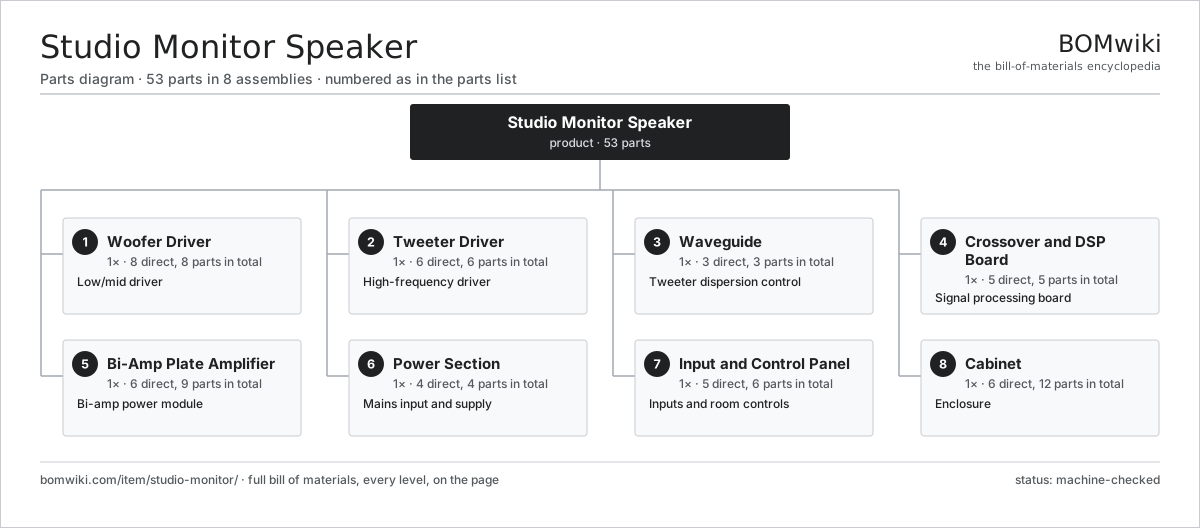
| # | Part | Qty | What it does |
|---|---|---|---|
| 1 | Woofer Driver 8 parts | 1× | Low/mid driver |
| 2 | Tweeter Driver 6 parts | 1× | High-frequency driver |
| 3 | Waveguide 3 parts | 1× | Tweeter dispersion control |
| 4 | Crossover and DSP Board 5 parts | 1× | Signal processing board |
| 5 | Bi-Amp Plate Amplifier 6 parts | 1× | Bi-amp power module |
| 6 | Power Section 4 parts | 1× | Mains input and supply |
| 7 | Input and Control Panel 5 parts | 1× | Inputs and room controls |
| 8 | Cabinet 6 parts | 1× | Enclosure |
3D model
No 3D model yet. Have a CAD file of this? Add a 3D model — STL renders right on this page; STEP, FreeCAD, and OpenSCAD sources are welcome too (openly licensed, like all 3D models on BOMwiki).
Build & assembly graph
expand / collapse · shared sub-assemblies converge · links to related products · est. labourTap an assembly to expand/collapse · tap a part to open it · use “Open page” for any node · drag to pan, scroll to zoom.
Bill of materials for Studio Monitor Speaker
8 top-level lines · 51 rows shown · 53 parts total · indented to 3 levels| # | Item / sub-assembly | Part no. | Qty/assy | Ext. qty | Parts | Type |
|---|---|---|---|---|---|---|
| 1 | Woofer Driver 8 parts | studio-monitor-woofer | 1× | 1 | 8 | assembly |
| 1.1 | Woofer Cone | studio-monitor-woofer-cone | 1× | 1 | · | part |
| 1.2 | Surround | studio-monitor-woofer-surround | 1× | 1 | · | part |
| 1.3 | Spider | studio-monitor-spider | 1× | 1 | · | part |
| 1.4 | Voice Coil Former | studio-monitor-voice-coil-former | 1× | 1 | · | part |
| 1.5 | Copper Winding | copper-winding | 1× | 1 | · | part |
| 1.6 | Neodymium Magnet | neodymium-magnet | 1× | 1 | · | part |
| 1.7 | Driver Basket | studio-monitor-driver-basket | 1× | 1 | · | part |
| 1.8 | Dust Cap | studio-monitor-dust-cap | 1× | 1 | · | part |
| 2 | Tweeter Driver 6 parts | studio-monitor-tweeter | 1× | 1 | 6 | assembly |
| 2.1 | Dome Diaphragm | studio-monitor-dome-diaphragm | 1× | 1 | · | part |
| 2.2 | Copper Winding | copper-winding | 1× | 1 | · | part |
| 2.3 | Neodymium Magnet | neodymium-magnet | 1× | 1 | · | part |
| 2.4 | Ferrofluid | studio-monitor-ferrofluid | 1× | 1 | · | part |
| 2.5 | Tweeter Faceplate | studio-monitor-tweeter-faceplate | 1× | 1 | · | part |
| 2.6 | Rear Chamber | studio-monitor-rear-chamber | 1× | 1 | · | part |
| 3 | Waveguide 3 parts | studio-monitor-waveguide | 1× | 1 | 3 | assembly |
| 3.1 | Waveguide Flare | studio-monitor-waveguide-flare | 1× | 1 | · | part |
| 3.2 | Waveguide Gasket | studio-monitor-waveguide-gasket | 1× | 1 | · | part |
| 3.3 | Fastener Set | fastener-set | 1× | 1 | · | part |
| 4 | Crossover and DSP Board 5 parts | studio-monitor-crossover-dsp | 1× | 1 | 5 | assembly |
| 4.1 | DSP Chip | studio-monitor-dsp-chip | 1× | 1 | · | part |
| 4.2 | Audio Codec | studio-monitor-audio-codec | 1× | 1 | · | part |
| 4.3 | Microcontroller | mcu | 1× | 1 | · | part |
| 4.4 | Bare PCB | pcb-bare | 1× | 1 | · | part |
| 4.5 | SMD Passive (R/C/L) | smd-passives | 1× | 1 | · | part |
| 5 | Bi-Amp Plate Amplifier 6 parts | studio-monitor-plate-amp | 1× | 1 | 9 | assembly |
| 5.1 | Woofer Amplifier Channel | studio-monitor-woofer-amp | 1× | 1 | · | part |
| 5.2 | Tweeter Amplifier Channel | studio-monitor-tweeter-amp | 1× | 1 | · | part |
| 5.3 | Heatsink Plate | studio-monitor-heatsink-plate | 1× | 1 | · | part |
| 5.4 | Power MOSFET | mosfet | 4× | 4 | · | part |
| 5.5 | Bare PCB | pcb-bare | 1× | 1 | · | part |
| 5.6 | SMD Passive (R/C/L) | smd-passives | 1× | 1 | · | part |
| 6 | Power Section 4 parts | studio-monitor-power-section | 1× | 1 | 4 | assembly |
| 6.1 | Power Supply | power-supply | 1× | 1 | · | part |
| 6.2 | Mains Inlet | studio-monitor-mains-inlet | 1× | 1 | · | part |
| 6.3 | Thermal Fuse | thermal-fuse | 1× | 1 | · | part |
| 6.4 | Wire Bundle | wire-bundle | 1× | 1 | · | part |
| 7 | Input and Control Panel 5 parts | studio-monitor-io-panel | 1× | 1 | 6 | assembly |
| 7.1 | XLR Combo Input | studio-monitor-xlr-input | 1× | 1 | · | part |
| 7.2 | Connector | connector | 2× | 2 | · | part |
| 7.3 | Input Trim | studio-monitor-trim-control | 1× | 1 | · | part |
| 7.4 | Room EQ Switches | studio-monitor-eq-switches | 1× | 1 | · | part |
| 7.5 | Bare PCB | pcb-bare | 1× | 1 | · | part |
| 8 | Cabinet 6 parts | studio-monitor-cabinet | 1× | 1 | 12 | assembly |
| 8.1 | Sheet Metal Panel | sheet-panel | 6× | 6 | · | part |
| 8.2 | Front Baffle | studio-monitor-front-baffle | 1× | 1 | · | part |
| 8.3 | Bass Reflex Port | studio-monitor-reflex-port | 1× | 1 | · | part |
| 8.4 | Damping Fill | studio-monitor-damping-fill | 1× | 1 | · | part |
| 8.5 | Cabinet Brace | studio-monitor-brace | 2× | 2 | · | part |
| 8.6 | Fastener Set | fastener-set | 1× | 1 | · | part |
Related products
same domain, ranked by shared parts Projector
482 parts · shares 4 with this page
Active PA Speaker
602 parts · shares 4 with this page
Motorized Curtain Track
210 parts · shares 3 with this page
Projector
482 parts · shares 4 with this page
Active PA Speaker
602 parts · shares 4 with this page
Motorized Curtain Track
210 parts · shares 3 with this page
 Revolving Stage
61 parts · shares 3 with this page
Revolving Stage
61 parts · shares 3 with this page
 PTZ Camera
499 parts · shares 4 with this page
Studio Jib Arm
106 parts · shares 4 with this page
PTZ Camera
499 parts · shares 4 with this page
Studio Jib Arm
106 parts · shares 4 with this page
Sourcing: possible vendors
Prices, MOQ, and lead times are algorithmic estimates, not quotes, and not claims about these companies. Company mappings are curated by keyword; est. price band $50–$3k. How estimates work| Vendor | HQ | Specialty | MOQ | Lead time |
|---|---|---|---|---|
|
🇯🇵Sony
sony.com ↗
|
Tokyo, JP | Consumer electronics | 1,000 units | 8–12 wks |
| samsung.com ↗ | Suwon, KR | Electronics & displays | 1,000 units | 8–12 wks |
|
🇺🇸Harman
harman.com ↗
|
Stamford, US | Audio (JBL, AKG) | 1,000 units | 8–12 wks |
|
🇺🇸Bose
bose.com ↗
|
Framingham, US | Audio | 1,000 units | 8–12 wks |
| yamaha.com ↗ | Hamamatsu, JP | Audio & instruments | 1,000 units | 8–12 wks |
772-word article