Supercapacitor Bank
ProductOverview
A Supercapacitor Bank is an ultracapacitor energy storage system designed for bridging power gaps and stabilizing voltage on distribution networks. Unlike battery systems, supercapacitors deliver exceptional power density (100+ kW/kg cell material) but lower energy density (40–60 Wh/kg), making them ideal for frequent charge–discharge cycling and burst power applications.
This module stacks eight 3.3V cells in series to reach 26.4V nominal, with integrated Balancing Board circuits that actively prevent individual cell overvoltage. Voltage imbalance typically occurs in series-connected ultracapacitors because cell leakage currents differ by 5–10%, causing some cells to charge faster than others. The active balancing topology uses shunt resistors and MOSFET Switch Module to reroute charge from higher cells to lower ones, keeping all cells within 0.1V of each other.
How it works
When the Supercapacitor Bank charges, current flows through the Cell Stack Assembly, which consists of cylindrical 3.3V 3000F modules connected in series by copper interconnect bars. Each cell stores energy as an electrostatic field in a double-layer capacitor interface. The Balancing Board monitors voltages across four parallel groups (two cells per group) via precision sensing inputs. If one group drifts above nominal (say, 3.5V), the Microcontroller fires a MOSFET Switch Module gate pulse, allowing that group's charge to bleed through a Shunt Resistor to the lowest group.
Power flows through the Bus Bars and Terminals, which consist of oxygen-free copper rails rated for 1000A peak. The Enclosure and Frame houses all subassemblies and provides thermal management via Thermal Management: two Blower Motor fans and aluminum Heatsink Assembly units that dissipate heat from the shunt resistor losses during balancing. A Monitoring Module module displays real-time voltage, current, and temperature on a touchscreen and logs all fault events.
The Disconnect Switches section includes a remotely-operated main Main Contactor and a manual Manual Disconnect Switch safety switch for maintenance isolation.
Charging and Discharging Curves
Charging is exponential: voltage rises from 0V to 26.4V following V(t) = 26.4(1 − e^(−t/RC)), where the RC time constant is 20–30 seconds at moderate charge currents (500A). Full charge to 99% takes roughly 90 seconds. Discharging is nearly linear due to constant-power loads: a 50 kW load draws the bank from 26.4V to ~13V in 10 seconds.
Balancing and Cell Safety
Cell voltage limits are 3.65V absolute maximum (beyond which the electrolyte begins to decompose). The Balancing Board uses a simple feedback loop: every 100 ms, the Microcontroller samples all four group voltages; if any exceeds 3.6V, it gates on that group's MOSFET Switch Module to shunt current through the resistor string. This drains the high group and raises the low group's voltage through resistive coupling, converging to equilibrium in 5–10 cycles. Continuous operation with this circuit adds <5% power loss.
Applications
Supercapacitor banks are used in three main domains: (1) grid-tied renewable buffers that store excess wind or solar for 5–20 second smoothing; (2) UPS and data-center ride-through, where they bridge the gap until a diesel generator spins up; (3) industrial regenerative braking, capturing kinetic energy from conveyor or elevator loads. Because supercapacitors do not age chemically like batteries, they tolerate millions of shallow cycles without degradation, making them superior for high-frequency micro-cycling.
Thermal Considerations
During a 100 kW discharge pulse lasting 10 seconds, the shunt resistor network dissipates approximately 200 W (assuming 5% internal losses). If the bank sits idle at 26.4V, leakage current through each cell (typically 1 mA per 1000F) causes passive thermal drift. The Thermal Management system is sized to maintain cell temperature below 60°C; in typical indoor environments (20°C ambient), passive convection alone is sufficient, but the fans activate if internal temperature sensors on the Balancing Board exceed 50°C.
Maintenance and Lifecycle
Supercapacitors exhibit virtually zero capacity fade over 1 million cycles if operated within voltage and temperature ratings. The main wear-out mechanism is electrolyte evaporation, which is negligible in sealed cylindrical cells. Annual maintenance consists of: (1) verifying Monitoring Module logs show no voltage imbalance trend; (2) checking Thermal Management fan operation; (3) visual inspection of Bus Bars and Terminals and Compression Lug Terminal for corrosion (unlikely with tin-plated copper, but verify).
Integration
The module connects to external circuits via a single Disconnect Switches pair of posts: positive and negative. A 500 µH series inductor (external) protects against fault transients. The Monitoring Module module includes a Modbus RTU or Ethernet gateway option for remote status integration with energy management systems.
Supercapacitor Bank parts and their functions
7 top-level parts · 58 parts in total · full bill of materials below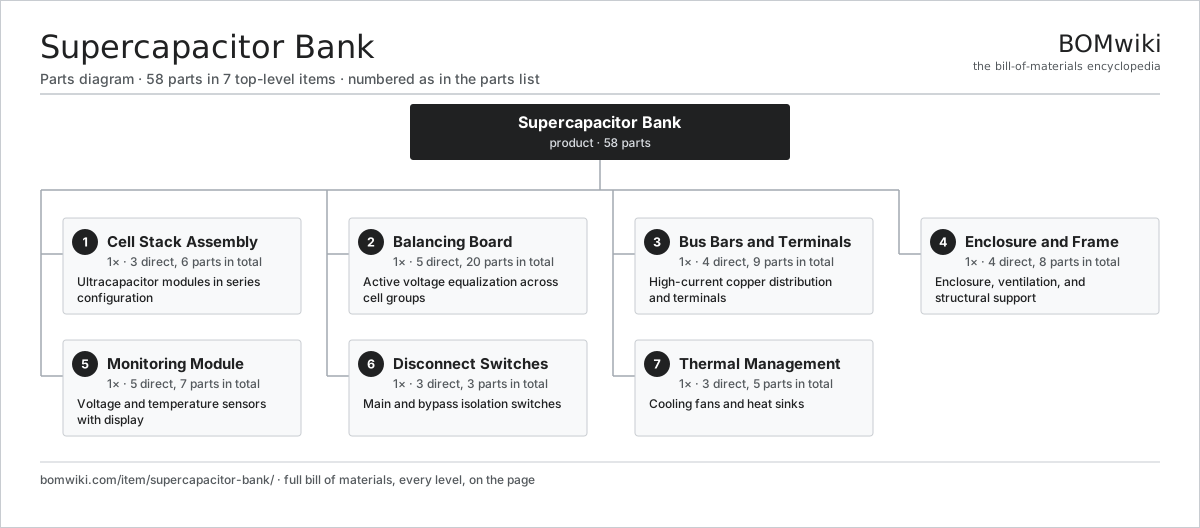
| # | Part | Qty | What it does |
|---|---|---|---|
| 1 | Cell Stack Assembly 3 parts | 1× | Ultracapacitor modules in series configuration |
| 2 | Balancing Board 5 parts | 1× | Active voltage equalization across cell groups |
| 3 | Bus Bars and Terminals 4 parts | 1× | High-current copper distribution and terminals |
| 4 | Enclosure and Frame 4 parts | 1× | Enclosure, ventilation, and structural support |
| 5 | Monitoring Module 5 parts | 1× | Voltage and temperature sensors with display |
| 6 | Disconnect Switches 3 parts | 1× | Main and bypass isolation switches |
| 7 | Thermal Management 3 parts | 1× | Cooling fans and heat sinks |
3D model
No 3D model yet. Have a CAD file of this? Add a 3D model. STL renders right on this page; STEP, FreeCAD, and OpenSCAD sources are welcome too (openly licensed, like all 3D models on BOMwiki).
Build & assembly graph
expand / collapse · shared sub-assemblies converge · links to related products · est. labourTap an assembly to expand/collapse · tap a part to open it · use “Open page” for any node · drag to pan, scroll to zoom.
Bill of materials for Supercapacitor Bank
7 top-level lines · 34 rows shown · 58 parts total · indented to 3 levels| # | Item / sub-assembly | Part no. | Qty/assy | Ext. qty | Parts | Type |
|---|---|---|---|---|---|---|
| 1 | Cell Stack Assembly 3 parts | supercapacitor-bank-cell-stack | 1× | 1 | 6 | assembly |
| 1.1 | Ultracapacitor Module | supercapacitor-bank-cell-module | 4× | 4 | · | part |
| 1.2 | Series Interconnect Bars | supercapacitor-bank-interconnect-bars | 1× | 1 | · | part |
| 1.3 | Fastener Set | fastener-set | 1× | 1 | · | part |
| 2 | Balancing Board 5 parts | supercapacitor-bank-balancing-board | 1× | 1 | 20 | assembly |
| 2.1 | Bare PCB | pcb-bare | 1× | 1 | · | part |
| 2.2 | Shunt Resistor | supercapacitor-bank-shunt-resistors | 8× | 8 | · | part |
| 2.3 | MOSFET Switch Module | supercapacitor-bank-mosfet-switches | 8× | 8 | · | part |
| 2.4 | Microcontroller | mcu | 1× | 1 | · | part |
| 2.5 | Connector | connector | 2× | 2 | · | part |
| 3 | Bus Bars and Terminals 4 parts | supercapacitor-bank-bus-bars | 1× | 1 | 9 | assembly |
| 3.1 | Positive Bus Bar | supercapacitor-bank-positive-bar | 1× | 1 | · | part |
| 3.2 | Negative Bus Bar | supercapacitor-bank-negative-bar | 1× | 1 | · | part |
| 3.3 | Compression Lug Terminal | supercapacitor-bank-lugs | 6× | 6 | · | part |
| 3.4 | Fastener Set | fastener-set | 1× | 1 | · | part |
| 4 | Enclosure and Frame 4 parts | supercapacitor-bank-cabinet | 1× | 1 | 8 | assembly |
| 4.1 | Steel Frame Assembly | supercapacitor-bank-frame-steel | 1× | 1 | · | part |
| 4.2 | Sheet Metal Panel | sheet-panel | 4× | 4 | · | part |
| 4.3 | DIN Mounting Rail | supercapacitor-bank-mounting-rails | 2× | 2 | · | part |
| 4.4 | Fastener Set | fastener-set | 1× | 1 | · | part |
| 5 | Monitoring Module 5 parts | supercapacitor-bank-monitoring | 1× | 1 | 7 | assembly |
| 5.1 | Bare PCB | pcb-bare | 1× | 1 | · | part |
| 5.2 | Microcontroller | mcu | 1× | 1 | · | part |
| 5.3 | Pressure Sensor | pressure-sensor | 3× | 3 | · | part |
| 5.4 | LCD Panel | lcd-panel | 1× | 1 | · | part |
| 5.5 | Wire Bundle | wire-bundle | 1× | 1 | · | part |
| 6 | Disconnect Switches 3 parts | supercapacitor-bank-disconnects | 1× | 1 | 3 | assembly |
| 6.1 | Main Contactor | supercapacitor-bank-main-contactor | 1× | 1 | · | part |
| 6.2 | Manual Disconnect Switch | supercapacitor-bank-manual-disconnect | 1× | 1 | · | part |
| 6.3 | Fastener Set | fastener-set | 1× | 1 | · | part |
| 7 | Thermal Management 3 parts | supercapacitor-bank-thermal-mgmt | 1× | 1 | 5 | assembly |
| 7.1 | Blower Motor | blower-motor | 2× | 2 | · | part |
| 7.2 | Heatsink Assembly | supercapacitor-bank-heatsink-assy | 2× | 2 | · | part |
| 7.3 | Connector | connector | 1× | 1 | · | part |
Something wrong in this list? Report a problem with this BOM.
Related products
same domain, ranked by shared parts Fuel Dispenser
71 parts · shares 5 with this page
Biogas Generator (CHP)
338 parts · shares 4 with this page
Active Harmonic Filter
81 parts · shares 4 with this page
Fuel Dispenser
71 parts · shares 5 with this page
Biogas Generator (CHP)
338 parts · shares 4 with this page
Active Harmonic Filter
81 parts · shares 4 with this page
 Automatic Voltage Regulator
83 parts · shares 4 with this page
Automatic Voltage Regulator
83 parts · shares 4 with this page
 DC Fast Charger
1,097 parts · shares 4 with this page
DC Fast Charger
1,097 parts · shares 4 with this page
 Home Battery Storage
292 parts · shares 4 with this page
Home Battery Storage
292 parts · shares 4 with this page
Sourcing: possible vendors
Browse the supplier directory → Prices, MOQ, and lead times are algorithmic estimates, not quotes, and not claims about these companies. Company mappings are curated by keyword; est. price band $5k–$50M. How estimates work| Vendor | HQ | Specialty | MOQ | Lead time |
|---|---|---|---|---|
| gevernova.com ↗ | Cambridge, US | Power generation | made to order | 20–40 wks |
| siemens-energy.com ↗ | Munich, DE | Power & grid | made to order | 20–40 wks |
| hitachienergy.com ↗ | Zurich, CH | Grid & transformers | made to order | 20–40 wks |
|
🇨🇭ABB
abb.com ↗
|
Zurich, CH | Electrification & automation | made to order | 20–40 wks |
| se.com ↗ | Rueil-Malmaison, FR | Electrical & automation | made to order | 20–40 wks |
795-word article