Syringe Pump
ProductOverview
A syringe pump delivers drugs in small, exact volumes by slowly pushing a syringe plunger at a programmed rate. It is the tool of choice when the dose matters down to the microliter, vasopressors, sedatives, insulin, neonatal infusions, where a free-dripping IV or a coarser volumetric pump would be too imprecise. The clinician loads a standard syringe, enters a rate or a dose, and the pump advances the plunger until the syringe empties or an alarm stops it.
The syringe seats in the Syringe Clamp, which holds the barrel and reports its size. The Plunger Drive pushes the plunger forward through a lead screw, and the Force / Occlusion Sensor watches the force on that plunger to catch a blocked line. A Control Board runs the infusion math and motor control, the User Interface takes rate entry and raises alarms, and a Backup Battery backed by a medical Power Supply keeps it running through transport and power loss. Everything sits in a sealed Housing that clamps to an IV pole.
How it works
Flow rate is set by how fast the plunger moves, and that motion comes from the Plunger Drive. A Drive Stepper Motor turns through reduction gearing into a Ball Screw, converting rotation into the slow linear travel of the plunger head. Because the screw advances a fixed distance per motor micro-step, the pump knows the delivered volume precisely, but only if it also knows the syringe diameter, because a wide 50 mL barrel pushes far more fluid per millimeter than a narrow 5 mL one. The Syringe Size Sensor in the clamp measures that diameter so the controller scales travel into the correct flow.
Safety hinges on the Force / Occlusion Sensor. If the line kinks or a stopcock closes, the plunger meets resistance and the force on the drive climbs; a load cell and Pressure Sensor track that force, and when it crosses the selected occlusion threshold the pump halts and alarms before pressure builds to a dangerous bolus. The Control Board carries two MCUs, one runs the infusion, the second independently cross-checks rate and force so a single fault cannot silently over-deliver. The User Interface presents rate, volume infused, and time remaining, and its alarm speaker calls a nurse on occlusion, near-end-of-syringe, or low battery.
Syringe Pump parts and their functions
8 top-level parts · 252 parts in total · full bill of materials below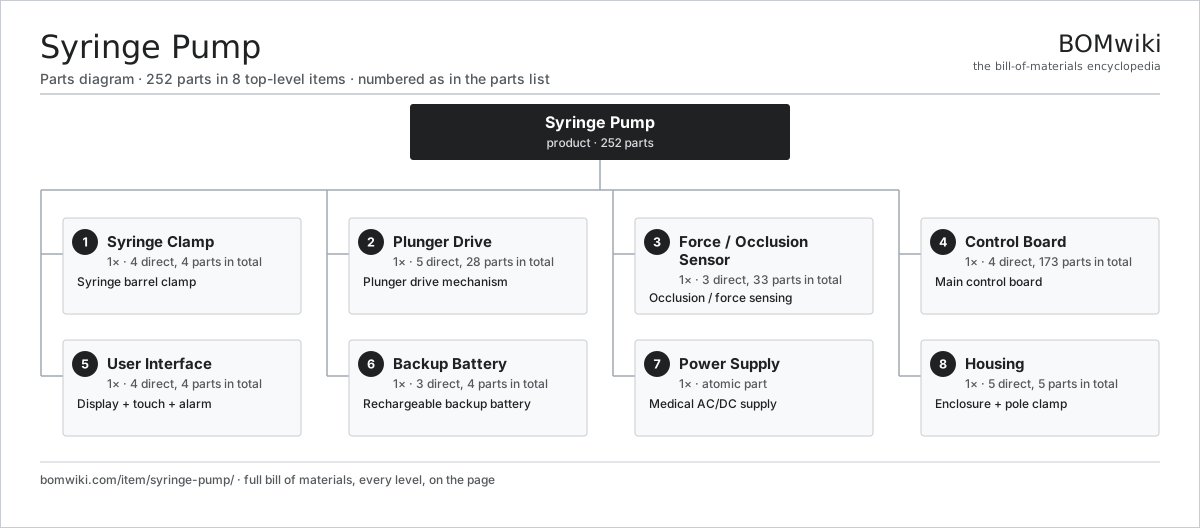
| # | Part | Qty | What it does |
|---|---|---|---|
| 1 | Syringe Clamp 4 parts | 1× | Syringe barrel clamp |
| 2 | Plunger Drive 5 parts | 1× | Plunger drive mechanism |
| 3 | Force / Occlusion Sensor 3 parts | 1× | Occlusion / force sensing |
| 4 | Control Board 4 parts | 1× | Main control board |
| 5 | User Interface 4 parts | 1× | Display + touch + alarm |
| 6 | Backup Battery 3 parts | 1× | Rechargeable backup battery |
| 7 | Power Supply | 1× | Medical AC/DC supply |
| 8 | Housing 5 parts | 1× | Enclosure + pole clamp |
3D model
No 3D model yet. Have a CAD file of this? Add a 3D model. STL renders right on this page; STEP, FreeCAD, and OpenSCAD sources are welcome too (openly licensed, like all 3D models on BOMwiki).
Build & assembly graph
expand / collapse · shared sub-assemblies converge · links to related products · est. labourTap an assembly to expand/collapse · tap a part to open it · use “Open page” for any node · drag to pan, scroll to zoom.
Bill of materials for Syringe Pump
8 top-level lines · 41 rows shown · 252 parts total · indented to 3 levels| # | Item / sub-assembly | Part no. | Qty/assy | Ext. qty | Parts | Type |
|---|---|---|---|---|---|---|
| 1 | Syringe Clamp 4 parts | syringe-pump-clamp | 1× | 1 | 4 | assembly |
| 1.1 | Barrel Cradle | syringe-pump-barrel-cradle | 1× | 1 | · | part |
| 1.2 | Coil Spring | coil-spring | 1× | 1 | · | part |
| 1.3 | Syringe Size Sensor | syringe-pump-size-sensor | 1× | 1 | · | part |
| 1.4 | Flange Grip | syringe-pump-flange-grip | 1× | 1 | · | part |
| 2 | Plunger Drive 5 parts | syringe-pump-drive | 1× | 1 | 28 | assembly |
| 2.1 | Drive Stepper Motor 3 parts | syringe-pump-stepper | 1× | 1 | 23 | assembly |
| 2.1.1 | Stator Assembly 3 parts + deeper › | stator-assembly | 1× | 1 | 3 | assembly |
| 2.1.2 | Rotor Assembly 4 parts + deeper › | rotor-assembly | 1× | 1 | 19 | assembly |
| 2.1.3 | Motor Housing | motor-housing | 1× | 1 | · | part |
| 2.2 | Helical Gear Pair | gear-pair | 1× | 1 | · | part |
| 2.3 | Ball Screw | ball-screw | 1× | 1 | · | part |
| 2.4 | Plunger Pusher Head | syringe-pump-plunger-head | 1× | 1 | · | part |
| 2.5 | Ball Bearing | ball-bearing | 2× | 2 | · | part |
| 3 | Force / Occlusion Sensor 3 parts | syringe-pump-force-sensor | 1× | 1 | 33 | assembly |
| 3.1 | Pressure Sensor | pressure-sensor | 1× | 1 | · | part |
| 3.2 | Plunger Load Cell | syringe-pump-load-cell | 1× | 1 | · | part |
| 3.3 | Sensor Front-End Board 2 parts | syringe-pump-afe | 1× | 1 | 31 | assembly |
| 3.3.1 | Bare PCB | pcb-bare | 1× | 1 | · | part |
| 3.3.2 | SMD Passive (R/C/L) | smd-passives | 30× | 30 | · | part |
| 4 | Control Board 4 parts | syringe-pump-control-board | 1× | 1 | 173 | assembly |
| 4.1 | Bare PCB | pcb-bare | 1× | 1 | · | part |
| 4.2 | Microcontroller | mcu | 2× | 2 | · | part |
| 4.3 | SMD Passive (R/C/L) | smd-passives | 160× | 160 | · | part |
| 4.4 | Connector | connector | 10× | 10 | · | part |
| 5 | User Interface 4 parts | syringe-pump-ui | 1× | 1 | 4 | assembly |
| 5.1 | LCD Panel | lcd-panel | 1× | 1 | · | part |
| 5.2 | Touch Digitizer | touch-digitizer | 1× | 1 | · | part |
| 5.3 | Membrane Keypad | syringe-pump-keypad | 1× | 1 | · | part |
| 5.4 | Speaker | speaker | 1× | 1 | · | part |
| 6 | Backup Battery 3 parts | syringe-pump-battery | 1× | 1 | 4 | assembly |
| 6.1 | LiPo Cell | lipo-cell | 2× | 2 | · | part |
| 6.2 | BMS Board | bms-board | 1× | 1 | · | part |
| 6.3 | Wire Bundle | wire-bundle | 1× | 1 | · | part |
| 7 | Power Supply | power-supply | 1× | 1 | · | part |
| 8 | Housing 5 parts | syringe-pump-housing | 1× | 1 | 5 | assembly |
| 8.1 | Front Shell | syringe-pump-shell-front | 1× | 1 | · | part |
| 8.2 | Rear Shell | syringe-pump-shell-back | 1× | 1 | · | part |
| 8.3 | IV Pole Clamp | syringe-pump-pole-clamp | 1× | 1 | · | part |
| 8.4 | O-Ring Set | oring-set | 1× | 1 | · | part |
| 8.5 | Fastener Set | fastener-set | 1× | 1 | · | part |
Something wrong in this list? Report a problem with this BOM.
Related products
same domain, ranked by shared parts Fetal Monitor
312 parts · shares 18 with this page
Fetal Monitor
312 parts · shares 18 with this page
 Vital Signs Monitor
499 parts · shares 17 with this page
Vital Signs Monitor
499 parts · shares 17 with this page
 Hospital Bed
186 parts · shares 15 with this page
Hospital Bed
186 parts · shares 15 with this page
 ECMO Machine
142 parts · shares 18 with this page
ECMO Machine
142 parts · shares 18 with this page
 Anesthesia Machine
562 parts · shares 17 with this page
Rehabilitation Robot Arm
467 parts · shares 17 with this page
Anesthesia Machine
562 parts · shares 17 with this page
Rehabilitation Robot Arm
467 parts · shares 17 with this page
Sourcing: possible vendors
Browse the supplier directory → Prices, MOQ, and lead times are algorithmic estimates, not quotes, and not claims about these companies. Company mappings are curated by keyword; est. price band $500–$3M. How estimates work| Vendor | HQ | Specialty | MOQ | Lead time |
|---|---|---|---|---|
| gehealthcare.com ↗ | Chicago, US | Medical imaging & devices | 100 units | 12–20 wks |
| siemens-healthineers.com ↗ | Erlangen, DE | Medical systems | 100 units | 12–20 wks |
|
🇳🇱Philips
philips.com ↗
|
Amsterdam, NL | Health technology | 100 units | 12–20 wks |
| medtronic.com ↗ | Minneapolis, US | Medical devices | 100 units | 12–20 wks |
|
🇨🇳Mindray
mindray.com ↗
|
Shenzhen, CN | Medical devices | 100 units | 12–20 wks |
401-word article