Tab Welding Machine
ProductOverview
A tab welding machine bonds aluminum or copper tabs to cell terminals (electrodes), establishing low-resistance electrical contacts between individual cells and external terminals in a battery pack. The machine uses high-frequency mechanical vibration (ultrasonic welding) or focused laser energy to fuse the tab to the foil without soldering or adhesives.
Ultrasonic welding is the industry standard for pouch cells: the Ultrasonic or Laser Weld Head horn vibrates at 20–40 kHz, breaking surface oxide films and causing plastic deformation that bonds the metals. The process is fast (0.5–2 seconds), produces minimal heat, and requires no flux or solder. Laser welding (less common, more expensive) offers precision for specialty applications but requires fiber-optic delivery.
The machine automatically positions each cell, clamps it, detects the tab location via vision, adjusts the weld head position, applies ultrasonic energy, and monitors weld quality in real-time, all in 2–5 seconds per tab. Production lines achieve 600–1500 cells per hour (multiple machines in parallel).
How It Works
A cell arrives at the Cell Clamping Vise, a precision vise with XY adjustability. The cell is positioned and clamped by a pneumatic or motorized lower jaw, gripping the cell edges with 5–20 N force (monitored by Weld Force Load-Cell).
The Tab Detection Camera camera detects the tab location (a small aluminum conductor on the cell surface, typically 5×10 mm). The controller calculates the weld head offset (XY error), and commands the XYZ Positioning Stage stepper or servo motors to position the Ultrasonic or Laser Weld Head directly above the tab, within ±50 µm.
Once positioned, a pneumatic Weld Pressure Actuator solenoid or proportional valve pressurizes the weld head down, applying the target clamping force (5–20 N). The load-cell monitors actual force and adjusts proportional valve to correct any overshoot.
Once clamped, the Weld Control Microcontroller triggers the Ultrasonic Driver Amplifier, which excites the Piezo Ultrasonic Transducer at its resonant frequency (20–40 kHz). The piezo stack vibrates at the resonance peak (typically ~100 µm amplitude), transmitting vibrations down the Weld Horn Tip.
The horn tip (aluminum or titanium) vibrates against the tab surface, creating frictional heating and plastic deformation. Surface oxides (Al₂O₃ film) break up, allowing direct metal-to-metal contact. The ultrasonic vibration hammers the tab and foil into intimate contact, forming a cold-weld bond.
The ultrasonic power is sustained for 0.5–2 seconds (typically 1 second). During this time, the Weld Quality Sensor measures the weld impedance (contact resistance), which decreases as the weld area increases and oxide film is removed. A good weld drops impedance from ~100 mΩ to <20 mΩ.
At the end of the dwell, the ultrasonic driver stops. The weld head retracts vertically within 0.5 seconds. The cell is unclamped and moves to the next position for the second tab weld (most cells have two tabs: anode and cathode).
Ultrasonic Welding Physics
Ultrasonic welding relies on three mechanisms:
Acoustic softening: The high-frequency vibration (20–40 kHz) temporarily reduces the effective yield strength of the metals, enabling localized plastic deformation at lower stresses than static loading would require.
Oxide film disruption: The 100–200 µm amplitude vibration shears the aluminum oxide layer and surface contaminants, exposing fresh metal underneath.
Thermal assistance: Frictional heating (I²R and mechanical damping) raises local temperature to 100–200°C, further reducing yield strength and facilitating interdiffusion of atoms across the interface.
The result is a solid-state bond, no melting occurs, just plastic deformation and atomic-scale bonding. This preserves the metallurgical properties of the tab and foil.
Tab Material and Terminal Design
Tabs are typically stamped from pure aluminum (99.99% Al) or copper, 1–3 mm thick, 5–10 mm wide. One end of the tab is welded to the cell electrode foil; the other end protrudes for external connection to the battery pack terminals (via bus bar, connector, or solder).
Terminal design is critical for pack assembly: tabs must be straight, burr-free, and positioned consistently (within ±1 mm) to simplify downstream pack assembly and reduce connection failures.
Contact Resistance and Reliability
A poor weld leaves residual oxide film (Al₂O₃, contact resistance >50 mΩ) or incomplete coverage (partial weld area). Under pack operation (high current pulses), poor welds heat up (I²R loss), accelerating oxidation and further increasing resistance. This thermal runaway can fail a cell in a single charge cycle.
The Weld Quality Sensor detects poor welds in real-time: if impedance after the ultrasonic pulse remains >30 mΩ, the weld is rejected. The cell is either re-welded or scrapped depending on the application and defect severity.
Target contact resistance is <20 mΩ per tab, <40 mΩ for a complete cell with two tabs. This ensures Joule heating at 100 A is <0.4 W, acceptable for thermal management.
Multi-Tab and Series Weld Strategies
Cells have typically 2 tabs (anode and cathode). The machine first welds one tab, then rotates the XYZ Positioning Stage or indexes the Cell Clamping Vise to position the second tab under the horn, and repeats.
High-power packs may require multiple tabs per cell (4–6 tabs) to distribute current and reduce individual tab heating. The weld sequence is automated: clamp cell, weld tab 1, release and index, weld tab 2, release cell.
Vision-Based Alignment and Feedback
The Tab Detection Camera camera captures the cell before clamping. Software detects the tab edges (often marked with a contrasting color or barcode), and calculates the tab center position. The controller compares this to the expected weld head position and issues a correction command to the XY stages.
This closed-loop correction eliminates mechanical drift and tolerances in the clamping fixture, ensuring consistent weld placement even if cell position varies ±2 mm due to fixture wear or handling variations.
Alternative: Laser Welding
Laser welding uses focused infrared (fiber-coupled laser, 1–5 kW) to melt and fuse the tab to foil. Advantages: no acoustic transducer wear, faster weld cycles (<0.3 seconds), and ability to weld non-conductive materials. Disadvantages: higher equipment cost (~500 kEUR vs. 100 kEUR for ultrasonic), eye-safety interlocks required, and risk of melting or vaporizing if power is misaligned.
Laser welding is used for high-speed production (>2000 cells/hour) or specialty tabs (copper, stainless steel) that ultrasonic struggles with.
Production Throughput and Scaling
A single Tab Welding Machine cycles one cell at 2–5 seconds per tab, or ~30 cells/hour (two tabs per cell). To achieve 500+ cells/hour, production lines use parallel machines:
- 8–16 machines in a line, load-balanced.
- Multi-spindle designs (4–6 independent weld heads on a single chassis), sharing a central power supply and vision system.
Typical production line: 12 welders × 30 cells/hour per welder ÷ 2 (load balancing) = ~180 cells/hour per line. High-volume facilities operate 3–5 such lines in parallel.
Maintenance and Reliability
The Weld Horn Tip wears due to repeated contact; tips are replaced or resurfaced (honed) every 5,000–10,000 welds. A new horn costs ~500–2000 USD; resurfacing costs ~100–300 USD per cycle.
The Piezo Ultrasonic Transducer and Resonance Tracking Circuit are tuned at factory. Transducer frequency can drift ±1% over 5 years due to aging of the piezo ceramic; the frequency-locked loop compensates automatically.
Stepper or servo motors on the XYZ Positioning Stage have ~10,000-hour bearing life; replacement is routine maintenance every 2–3 years for high-volume lines.
Safety interlocks prevent operator contact with the moving horn and clamping fixture. Emergency stop triggers immediate pneumatic vent (all air solenoids de-energize within <50 ms).
Tab Welding Machine parts and their functions
8 top-level parts · 32 parts in total · full bill of materials below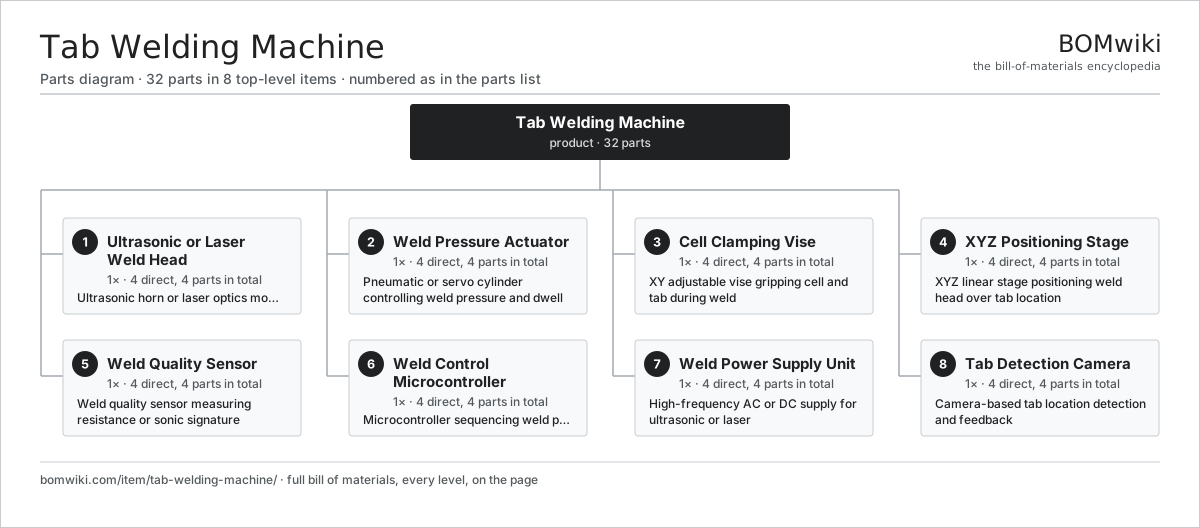
| # | Part | Qty | What it does |
|---|---|---|---|
| 1 | Ultrasonic or Laser Weld Head 4 parts | 1× | Ultrasonic horn or laser optics module |
| 2 | Weld Pressure Actuator 4 parts | 1× | Pneumatic or servo cylinder controlling weld pressure and dwell |
| 3 | Cell Clamping Vise 4 parts | 1× | XY adjustable vise gripping cell and tab during weld |
| 4 | XYZ Positioning Stage 4 parts | 1× | XYZ linear stage positioning weld head over tab location |
| 5 | Weld Quality Sensor 4 parts | 1× | Weld quality sensor measuring resistance or sonic signature |
| 6 | Weld Control Microcontroller 4 parts | 1× | Microcontroller sequencing weld pulse, pressure, and hold time |
| 7 | Weld Power Supply Unit 4 parts | 1× | High-frequency AC or DC supply for ultrasonic or laser |
| 8 | Tab Detection Camera 4 parts | 1× | Camera-based tab location detection and feedback |
3D model
No 3D model yet. Have a CAD file of this? Add a 3D model. STL renders right on this page; STEP, FreeCAD, and OpenSCAD sources are welcome too (openly licensed, like all 3D models on BOMwiki).
Build & assembly graph
expand / collapse · shared sub-assemblies converge · links to related products · est. labourTap an assembly to expand/collapse · tap a part to open it · use “Open page” for any node · drag to pan, scroll to zoom.
Bill of materials for Tab Welding Machine
8 top-level lines · 40 rows shown · 32 parts total · indented to 3 levels| # | Item / sub-assembly | Part no. | Qty/assy | Ext. qty | Parts | Type |
|---|---|---|---|---|---|---|
| 1 | Ultrasonic or Laser Weld Head 4 parts | tab-welding-machine-weld-head | 1× | 1 | 4 | assembly |
| 1.1 | Piezo Ultrasonic Transducer | tab-welding-machine-ultrasonic-transducer | 1× | 1 | · | part |
| 1.2 | Weld Horn Tip | tab-welding-machine-horn-tip | 1× | 1 | · | part |
| 1.3 | Transducer-Horn Coupler | tab-welding-machine-coupler | 1× | 1 | · | part |
| 1.4 | Horn Backing Support | tab-welding-machine-backing-plate | 1× | 1 | · | part |
| 2 | Weld Pressure Actuator 4 parts | tab-welding-machine-weld-actuator | 1× | 1 | 4 | assembly |
| 2.1 | Solenoid Control Valve | tab-welding-machine-solenoid-valve | 1× | 1 | · | part |
| 2.2 | Proportional Pressure Regulator | tab-welding-machine-pressure-regulator | 1× | 1 | · | part |
| 2.3 | Weld Force Load-Cell | tab-welding-machine-load-cell | 1× | 1 | · | part |
| 2.4 | Pneumatic Actuator Cylinder | tab-welding-machine-cylinder | 1× | 1 | · | part |
| 3 | Cell Clamping Vise 4 parts | tab-welding-machine-clamping-fixture | 1× | 1 | 4 | assembly |
| 3.1 | Precision Vise Body | tab-welding-machine-vise-body | 1× | 1 | · | part |
| 3.2 | Upper Vise Jaw | tab-welding-machine-vise-jaw-upper | 1× | 1 | · | part |
| 3.3 | Lower Vise Jaw | tab-welding-machine-vise-jaw-lower | 1× | 1 | · | part |
| 3.4 | Jaw Clamp Motor | tab-welding-machine-clamp-actuator | 1× | 1 | · | part |
| 4 | XYZ Positioning Stage 4 parts | tab-welding-machine-positioning-stage | 1× | 1 | 4 | assembly |
| 4.1 | X-Axis Positioning Motor | tab-welding-machine-stage-x-motor | 1× | 1 | · | part |
| 4.2 | Y-Axis Positioning Motor | tab-welding-machine-stage-y-motor | 1× | 1 | · | part |
| 4.3 | Z-Axis (Vertical) Motor | tab-welding-machine-stage-z-motor | 1× | 1 | · | part |
| 4.4 | Positioning Stage Frame | tab-welding-machine-stage-frame | 1× | 1 | · | part |
| 5 | Weld Quality Sensor 4 parts | tab-welding-machine-impedance-monitor | 1× | 1 | 4 | assembly |
| 5.1 | Impedance Transducer | tab-welding-machine-impedance-sensor | 1× | 1 | · | part |
| 5.2 | Acoustic Emission Sensor | tab-welding-machine-acoustic-sensor | 1× | 1 | · | part |
| 5.3 | Bare PCB | pcb-bare | 1× | 1 | · | part |
| 5.4 | SMD Passive (R/C/L) | smd-passives | 1× | 1 | · | part |
| 6 | Weld Control Microcontroller 4 parts | tab-welding-machine-controller | 1× | 1 | 4 | assembly |
| 6.1 | Microcontroller | mcu | 1× | 1 | · | part |
| 6.2 | Ultrasonic Driver Amplifier | tab-welding-machine-ultrasonic-driver | 1× | 1 | · | part |
| 6.3 | Resonance Tracking Circuit | tab-welding-machine-frequency-locked-loop | 1× | 1 | · | part |
| 6.4 | Power Supply | power-supply | 1× | 1 | · | part |
| 7 | Weld Power Supply Unit 4 parts | tab-welding-machine-power-supply | 1× | 1 | 4 | assembly |
| 7.1 | High-Frequency Inverter | tab-welding-machine-hf-inverter | 1× | 1 | · | part |
| 7.2 | Impedance Matching Transformer | tab-welding-machine-transformer | 1× | 1 | · | part |
| 7.3 | High-Voltage Capacitor Array | tab-welding-machine-capacitor-bank | 1× | 1 | · | part |
| 7.4 | Power Supply | power-supply | 1× | 1 | · | part |
| 8 | Tab Detection Camera 4 parts | tab-welding-machine-vision-alignment | 1× | 1 | 4 | assembly |
| 8.1 | CMOS Image Sensor | image-sensor | 1× | 1 | · | part |
| 8.2 | Lens Assembly | camera-lens | 1× | 1 | · | part |
| 8.3 | LED Ring Illuminator | tab-welding-machine-led-ring | 1× | 1 | · | part |
| 8.4 | Bare PCB | pcb-bare | 1× | 1 | · | part |
Something wrong in this list? Report a problem with this BOM.
Related products
same domain, ranked by shared parts Pouch Sealing Machine
38 parts · shares 4 with this page
Pouch Sealing Machine
38 parts · shares 4 with this page
Sourcing: possible vendors
Browse the supplier directory → Prices, MOQ, and lead times are algorithmic estimates, not quotes, and not claims about these companies. Company mappings are curated by keyword; est. price band $5k–$2M. How estimates work| Vendor | HQ | Specialty | MOQ | Lead time |
|---|---|---|---|---|
| atlascopco.com ↗ | Stockholm, SE | Compressors & industrial | 10 units | 12–20 wks |
|
🇦🇹Andritz
andritz.com ↗
|
Graz, AT | Process plants & machinery | 10 units | 12–20 wks |
| buhlergroup.com ↗ | Uzwil, CH | Food & materials processing | 10 units | 12–20 wks |
| gea.com ↗ | Düsseldorf, DE | Process technology | 10 units | 12–20 wks |
| mhi.com ↗ | Tokyo, JP | Heavy machinery | 10 units | 12–20 wks |
1,311-word article