TENS Unit
ProductOverview
Transcutaneous electrical nerve stimulation (TENS) applies low-voltage, biphasic pulsed current through surface electrodes to manage pain and reduce muscle spasticity. The mechanism of pain relief operates through the "gate control theory": stimulation of large-diameter A-beta sensory fibers inhibits C-fiber nociceptor signaling at the spinal dorsal horn, effectively "closing the gate" on pain transmission to the brain. TENS units are widely used for chronic musculoskeletal pain, post-operative pain, neuropathic pain, and sports injuries. The Pulse Generator Module produces frequency-adjustable biphasic current; dual Dual Channel Output Module allow independent stimulation of two separate body regions (e.g., left shoulder and right knee) simultaneously.
Pulse waveform and stimulation parameters
The Pulse Generator Module delivers biphasic rectangular current pulses: a positive current phase, a zero-current phase (interstimulus interval), and a negative phase of equal amplitude and duration. This symmetrical biphasic waveform prevents charge imbalance and sustained depolarization, which would cause tissue irritation and electrochemical burns. Typical frequency ranges for TENS are conventional (50–150 Hz, lower amplitude 10–50 mA) for acute pain or acupuncture-like (2–10 Hz, higher amplitude up to 50 mA) for chronic pain; the user adjusts frequency and amplitude via Control Interface knobs to find comfortable but effective stimulation sensation.
Electrode placement and skin contact
The Electrode Pads are self-adhesive conductive pads applied directly to skin over or adjacent to the pain site. Placement follows physiological principles: pads are positioned to bracket the pain region or placed along dermatomes corresponding to pain distribution. The underlying Pad Conductive Substrate is conductive foam or gel-impregnated cloth providing low impedance (~500–2,000 Ω at the skin interface) to ensure uniform current distribution and prevent localized hot spots. The Medical Adhesive Backing medical-grade acrylic backing adheres securely for 8–12 hours; used pads are discarded and replaced with fresh adhesive pads.
Constant-current delivery and safety
Unlike older constant-voltage TENS units (which risk excessive current during low-impedance contacts), the H-Bridge Output Driver H-bridge maintains constant output current regardless of electrode impedance variation. This design prevents skin burns due to pad impedance drops (from sweat, movement, or repeated application) and ensures consistent therapeutic stimulation. The Battery Management System battery management system prevents overcharge (limiting cell voltage to 4.2V per Li-ion cell) and deep discharge (shutoff <3.0V), extending battery lifespan to >500 charge cycles.
Clinical pain management protocol
A patient with chronic lower-back pain (lumbar strain) applies the two electrode pads on either side of the lumbar spine at the level of maximum tenderness. The TENS unit is set to conventional frequency (100 Hz) and amplitude adjusted until the patient perceives a gentle tingling sensation without muscle contractions; 20–30 mA current is typical. The stimulation timer is set for 30 minutes; the patient relaxes and allows the gate-control effect to suppress pain. After 30 minutes, the timer auto-shuts off; pain relief typically lasts 15–60 minutes after stimulation ceases. For acupuncture-like TENS (useful for chronic neuropathic pain), frequency is reduced to 5 Hz and amplitude is increased until visible muscle twitching occurs; stimulation duration is 20–30 minutes, and the lower frequency often produces deeper pain modulation.
Muscle re-education and recovery applications
TENS at higher frequencies (100–150 Hz) and lower amplitudes reduces pain, while lower frequencies (2–10 Hz) with higher amplitudes can elicit visible muscle contractions (functional electrical stimulation, or FES). Physical therapists sometimes use TENS to reduce pain during rehabilitation, allowing patients to perform active-assisted exercises with less pain inhibition. The Dual Channel Output Module dual-channel design allows simultaneous stimulation of antagonist muscle groups, useful in post-stroke rehabilitation to re-establish motor coordination patterns.
Home use and adherence
TENS units are portable and battery-powered, enabling patients to use them at home, work, or while exercising. The Carrying Case and Accessories protects the device and stores spare Electrode Pads and charging cables. Electrode pads are consumables requiring replacement after 5–8 applications; cost of pads (~$1–3 per application) is offset by reduced pain medication use. Patients often develop routine stimulation schedules: 30 minutes upon waking, 30 minutes post-activity, and optional evening sessions. Effectiveness plateaus after 2–4 weeks of regular use, though varying frequency and pad placement (termed "parameter modulation") can restore efficacy.
Clinical efficacy and limitations
Randomized controlled trials demonstrate that TENS provides short-term pain relief superior to placebo for acute and subacute musculoskeletal pain (post-operative pain, acute ankle sprain); evidence for chronic pain management is mixed. Some patients experience complete pain relief during and shortly after stimulation (responders), while others report minimal benefit (non-responders), likely due to individual differences in spinal cord inhibitory neurotransmitter availability and sensory gating. Habituation (tolerance) develops in 15–30% of chronic users, requiring parameter adjustment to maintain efficacy. TENS is contraindicated in patients with cardiac pacemakers due to risk of electromagnetic interference, and should be used cautiously in pregnant women and over the anterior neck (risk of laryngeal stimulation).
Typical patient scenario
An elderly patient with arthritis in the right knee applies TENS pads on medial and lateral knee, just above and below the joint line. Frequency is set to 80 Hz (conventional range), amplitude is increased to 25 mA until the patient feels comfortable tingling without muscle contraction. The timer is set for 20 minutes. During stimulation, the patient's pain rating decreases from 6/10 to 2/10. After the timer expires, pain relief persists for 45 minutes. The patient repeats this routine twice daily, morning and evening, achieving sustained daily activity and better sleep. Over 6 weeks, the patient reduces opioid pain medication from 10 mg/day to 5 mg/day with improved functional status.
TENS Unit parts and their functions
6 top-level parts · 73 parts in total · full bill of materials below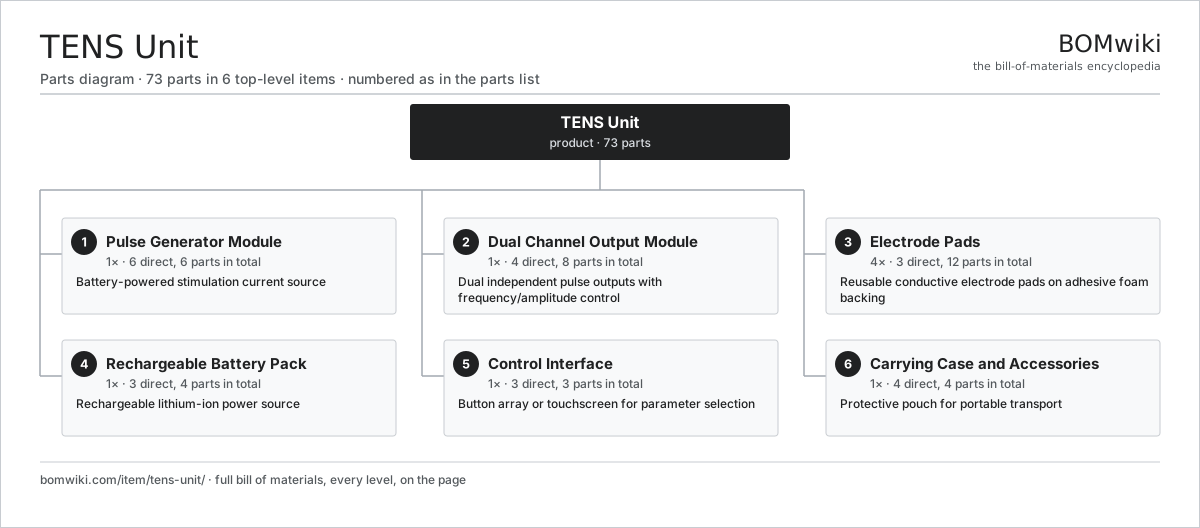
| # | Part | Qty | What it does |
|---|---|---|---|
| 1 | Pulse Generator Module 6 parts | 1× | Battery-powered stimulation current source |
| 2 | Dual Channel Output Module 4 parts | 1× | Dual independent pulse outputs with frequency/amplitude control |
| 3 | Electrode Pads 3 parts | 4× | Reusable conductive electrode pads on adhesive foam backing |
| 4 | Rechargeable Battery Pack 3 parts | 1× | Rechargeable lithium-ion power source |
| 5 | Control Interface 3 parts | 1× | Button array or touchscreen for parameter selection |
| 6 | Carrying Case and Accessories 4 parts | 1× | Protective pouch for portable transport |
3D model
No 3D model yet. Have a CAD file of this? Add a 3D model. STL renders right on this page; STEP, FreeCAD, and OpenSCAD sources are welcome too (openly licensed, like all 3D models on BOMwiki).
Build & assembly graph
expand / collapse · shared sub-assemblies converge · links to related products · est. labourTap an assembly to expand/collapse · tap a part to open it · use “Open page” for any node · drag to pan, scroll to zoom.
Bill of materials for TENS Unit
6 top-level lines · 29 rows shown · 73 parts total · indented to 3 levels| # | Item / sub-assembly | Part no. | Qty/assy | Ext. qty | Parts | Type |
|---|---|---|---|---|---|---|
| 1 | Pulse Generator Module 6 parts | tens-unit-pulse-generator | 1× | 1 | 6 | assembly |
| 1.1 | Microcontroller Board | tens-unit-mcu-board | 1× | 1 | · | part |
| 1.2 | H-Bridge Output Driver | tens-unit-output-stage | 1× | 1 | · | part |
| 1.3 | Frequency Oscillator | tens-unit-frequency-oscillator | 1× | 1 | · | part |
| 1.4 | Current DAC | tens-unit-amplitude-dac | 1× | 1 | · | part |
| 1.5 | Voltage Regulators | tens-unit-power-regulation | 1× | 1 | · | part |
| 1.6 | Bare PCB | pcb-bare | 1× | 1 | · | part |
| 2 | Dual Channel Output Module 4 parts | tens-unit-channel-outputs | 1× | 1 | 8 | assembly |
| 2.1 | Channel On/Off Switch | tens-unit-channel-switch | 2× | 2 | · | part |
| 2.2 | Amplitude Control Knob | tens-unit-amp-knob | 2× | 2 | · | part |
| 2.3 | Frequency Control Knob | tens-unit-freq-knob | 2× | 2 | · | part |
| 2.4 | Output Connector Jack | tens-unit-output-jack | 2× | 2 | · | part |
| 3 | Electrode Pads 3 parts | tens-unit-electrode-pads | 4× | 4 | 12 | assembly |
| 3.1 | Pad Conductive Substrate | tens-unit-pad-substrate | 4× | 16 | · | part |
| 3.2 | Medical Adhesive Backing | tens-unit-pad-adhesive | 4× | 16 | · | part |
| 3.3 | Lead Connector | tens-unit-lead-connector | 4× | 16 | · | part |
| 4 | Rechargeable Battery Pack 3 parts | tens-unit-battery | 1× | 1 | 4 | assembly |
| 4.1 | Li-ion Cell, 18650 | li-cell-18650 | 2× | 2 | · | part |
| 4.2 | Battery Management System | tens-unit-bms-circuit | 1× | 1 | · | part |
| 4.3 | USB Charging Port | tens-unit-usb-charging-port | 1× | 1 | · | part |
| 5 | Control Interface 3 parts | tens-unit-control-interface | 1× | 1 | 3 | assembly |
| 5.1 | Button Array | tens-unit-button-array | 1× | 1 | · | part |
| 5.2 | LCD Display | tens-unit-lcd-display | 1× | 1 | · | part |
| 5.3 | Auditory Feedback Buzzer | tens-unit-buzzer | 1× | 1 | · | part |
| 6 | Carrying Case and Accessories 4 parts | tens-unit-carrying-case | 1× | 1 | 4 | assembly |
| 6.1 | Protective Pouch | tens-unit-case-material | 1× | 1 | · | part |
| 6.2 | Electrode Storage Pocket | tens-unit-accessory-pocket | 1× | 1 | · | part |
| 6.3 | Charging Cable | tens-unit-charging-cable | 1× | 1 | · | part |
| 6.4 | User Manual | tens-unit-instruction-sheet | 1× | 1 | · | part |
Something wrong in this list? Report a problem with this BOM.
Related products
same domain, ranked by shared parts Blood Pressure Monitor
173 parts · shares 1 with this page
Blood Pressure Monitor
173 parts · shares 1 with this page
 Defibrillator
677 parts · shares 1 with this page
Defibrillator
677 parts · shares 1 with this page
 Fetal Doppler
41 parts · shares 1 with this page
Fetal Doppler
41 parts · shares 1 with this page
 Holter ECG Monitor
55 parts · shares 1 with this page
Infant Scale
66 parts · shares 1 with this page
Holter ECG Monitor
55 parts · shares 1 with this page
Infant Scale
66 parts · shares 1 with this page
Sourcing: possible vendors
Browse the supplier directory → Prices, MOQ, and lead times are algorithmic estimates, not quotes, and not claims about these companies. Company mappings are curated by keyword; est. price band $500–$3M. How estimates work| Vendor | HQ | Specialty | MOQ | Lead time |
|---|---|---|---|---|
| gehealthcare.com ↗ | Chicago, US | Medical imaging & devices | 100 units | 12–20 wks |
| siemens-healthineers.com ↗ | Erlangen, DE | Medical systems | 100 units | 12–20 wks |
|
🇳🇱Philips
philips.com ↗
|
Amsterdam, NL | Health technology | 100 units | 12–20 wks |
| medtronic.com ↗ | Minneapolis, US | Medical devices | 100 units | 12–20 wks |
|
🇨🇳Mindray
mindray.com ↗
|
Shenzhen, CN | Medical devices | 100 units | 12–20 wks |
966-word article