Theremin
ProductOverview
The theremin is the only widely played instrument controlled without physical contact. The player stands before two antennas: the right hand, moving near the vertical Pitch Antenna Assembly, controls pitch continuously; the left hand, above the horizontal Volume Antenna Assembly, controls loudness down to silence. Leon Theremin (Lev Sergeyevich Termen) demonstrated it in Petrograd in 1920 as a by-product of Soviet proximity-sensor research and patented it in the United States in 1928, where RCA briefly manufactured it. Robert Moog's kit and Etherwave instruments, from the 1950s onward, made it a standard product; the Etherwave remains the reference design.
Because there is no fingerboard, fret, or key, every pitch and every transition between pitches is the player's responsibility, which gives the instrument its gliding, vocal character and its reputation for difficulty.
How it works
The instrument is a heterodyne radio receiver turned inside out. On the Oscillator Board, two LC oscillators run in the hundreds of kilohertz: the Fixed Oscillator at a constant reference frequency, and the Variable Oscillator, whose resonant tank includes the pitch antenna. The Pitch Antenna Rod and the player's hand form a capacitor of a fraction of a picofarad; moving the hand changes that capacitance and pulls the variable oscillator a few hundred to a few thousand hertz. The Mixer-Detector multiplies the two RF signals and filters out everything but their difference, which falls in the audio band. A 0.5 pF hand movement is thus translated directly into an audible glide; the closer the hand, the higher the note.
Raw hand-to-antenna capacitance varies roughly with inverse distance, which would cram the high octaves into the last few centimeters. The chain of Linearization Coils in series with the antenna resonates near the operating frequency and reshapes this response so that musical intervals correspond to more nearly equal hand displacements across the whole field, the key playability refinement of the Moog designs.
Volume works on the same physics with a different readout. The Volume Antenna Loop detunes the Volume Oscillator against its Volume Resonant Coil; the resulting amplitude change is rectified into a DC control voltage that drives the Voltage-Controlled Amplifier in the Audio Output Stage. Hand down, the voltage falls and the note fades to silence, which is how thereminists articulate: the left hand shapes every attack and release. The Waveshaper adds controlled harmonics to the near-sinusoidal difference tone, and the Output Amplifier drives a standard Output Jack; the instrument needs an external amplifier.
Calibration and construction
Zero beat, the point where both pitch oscillators match and the output is silent, is set with the Pitch Knob so that it falls at the player's relaxed arm distance; the Volume Knob places the silence point of the left-hand field, while Waveform Knob and Brightness Knob set timbre. Inside, each Oscillator Coil is slug-tuned at the factory and drifts with temperature, so instruments warm up for several minutes before the tuning settles. Supply ripple modulates oscillator frequency audibly, so the Power Section regulation matters more than its few watts suggest.
The Cabinet is functional rather than decorative: the Enclosure Shell fixes the geometry between antennas, electronics, and ground, the Shield Plate keeps the player's body from coupling into the oscillators except through the antennas, and a Stand Flange mounts the instrument on a microphone stand. Antennas are nickel-plated brass or stainless tube, mounted on insulated Antenna Mount sockets; they are electrodes, not radio antennas, and the instrument emits negligible RF.
Repertoire and players
Clara Rockmore, trained as a violinist, defined classical theremin technique in the 1930s with a system of aerial fingering that breaks the glide into discrete intervals. The instrument's film career began with Miklós Rózsa's scores for Spellbound and The Lost Weekend (1945) and Bernard Herrmann's The Day the Earth Stood Still (1951). The Beach Boys' "Good Vibrations" used the related electro-theremin, played by slide. Modern players including Carolina Eyck have extended technique on digital-analog hybrids such as the Moog Claravox, while the basic two-antenna heterodyne architecture remains exactly Theremin's.
Theremin parts and their functions
7 top-level parts · 47 parts in total · full bill of materials below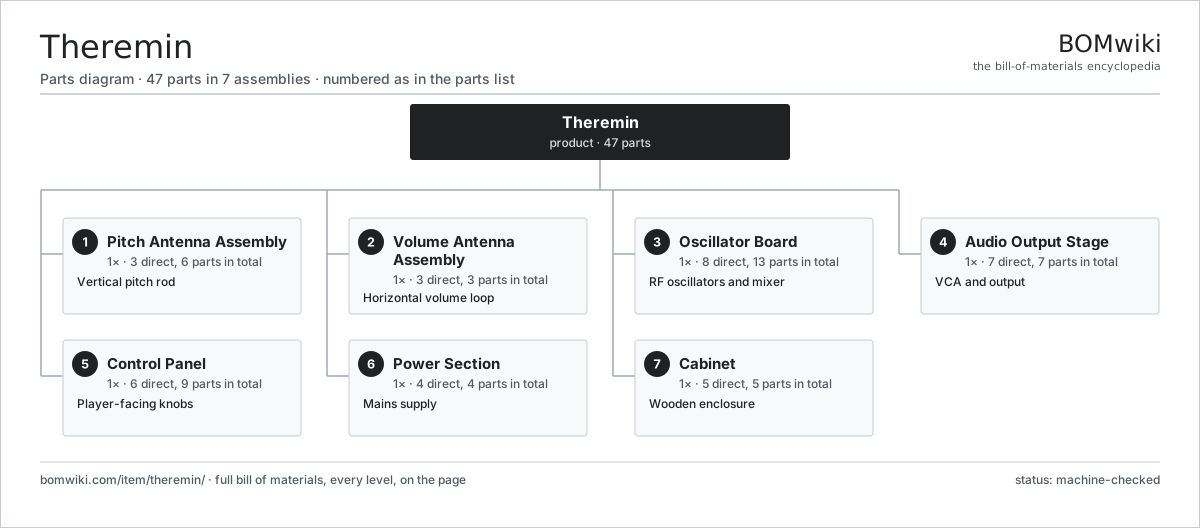
| # | Part | Qty | What it does |
|---|---|---|---|
| 1 | Pitch Antenna Assembly 3 parts | 1× | Vertical pitch rod |
| 2 | Volume Antenna Assembly 3 parts | 1× | Horizontal volume loop |
| 3 | Oscillator Board 8 parts | 1× | RF oscillators and mixer |
| 4 | Audio Output Stage 7 parts | 1× | VCA and output |
| 5 | Control Panel 6 parts | 1× | Player-facing knobs |
| 6 | Power Section 4 parts | 1× | Mains supply |
| 7 | Cabinet 5 parts | 1× | Wooden enclosure |
3D model
No 3D model yet. Have a CAD file of this? Add a 3D model — STL renders right on this page; STEP, FreeCAD, and OpenSCAD sources are welcome too (openly licensed, like all 3D models on BOMwiki).
Build & assembly graph
expand / collapse · shared sub-assemblies converge · links to related products · est. labourTap an assembly to expand/collapse · tap a part to open it · use “Open page” for any node · drag to pan, scroll to zoom.
Bill of materials for Theremin
7 top-level lines · 43 rows shown · 47 parts total · indented to 3 levels| # | Item / sub-assembly | Part no. | Qty/assy | Ext. qty | Parts | Type |
|---|---|---|---|---|---|---|
| 1 | Pitch Antenna Assembly 3 parts | theremin-pitch-antenna-assembly | 1× | 1 | 6 | assembly |
| 1.1 | Pitch Antenna Rod | theremin-pitch-rod | 1× | 1 | · | part |
| 1.2 | Antenna Mount | theremin-antenna-mount | 1× | 1 | · | part |
| 1.3 | Linearization Coil | theremin-linearization-coil | 4× | 4 | · | part |
| 2 | Volume Antenna Assembly 3 parts | theremin-volume-antenna-assembly | 1× | 1 | 3 | assembly |
| 2.1 | Volume Antenna Loop | theremin-volume-loop | 1× | 1 | · | part |
| 2.2 | Antenna Mount | theremin-antenna-mount | 1× | 1 | · | part |
| 2.3 | Volume Resonant Coil | theremin-volume-resonant-coil | 1× | 1 | · | part |
| 3 | Oscillator Board 8 parts | theremin-oscillator-board | 1× | 1 | 13 | assembly |
| 3.1 | Bare PCB | pcb-bare | 1× | 1 | · | part |
| 3.2 | Fixed Oscillator | theremin-fixed-oscillator | 1× | 1 | · | part |
| 3.3 | Variable Oscillator | theremin-variable-oscillator | 1× | 1 | · | part |
| 3.4 | Volume Oscillator | theremin-volume-oscillator | 1× | 1 | · | part |
| 3.5 | Mixer-Detector | theremin-mixer-detector | 1× | 1 | · | part |
| 3.6 | Oscillator Coil | theremin-oscillator-coil | 5× | 5 | · | part |
| 3.7 | SMD Passive (R/C/L) | smd-passives | 1× | 1 | · | part |
| 3.8 | Connector | connector | 2× | 2 | · | part |
| 4 | Audio Output Stage 7 parts | theremin-audio-stage | 1× | 1 | 7 | assembly |
| 4.1 | Bare PCB | pcb-bare | 1× | 1 | · | part |
| 4.2 | Voltage-Controlled Amplifier | theremin-vca | 1× | 1 | · | part |
| 4.3 | Waveshaper | theremin-waveshaper | 1× | 1 | · | part |
| 4.4 | Output Amplifier | theremin-output-amp | 1× | 1 | · | part |
| 4.5 | Output Jack | theremin-output-jack | 1× | 1 | · | part |
| 4.6 | SMD Passive (R/C/L) | smd-passives | 1× | 1 | · | part |
| 4.7 | Wire Bundle | wire-bundle | 1× | 1 | · | part |
| 5 | Control Panel 6 parts | theremin-control-panel | 1× | 1 | 9 | assembly |
| 5.1 | Pitch Knob | theremin-pitch-knob | 1× | 1 | · | part |
| 5.2 | Volume Knob | theremin-volume-knob | 1× | 1 | · | part |
| 5.3 | Waveform Knob | theremin-waveform-knob | 1× | 1 | · | part |
| 5.4 | Brightness Knob | theremin-brightness-knob | 1× | 1 | · | part |
| 5.5 | Potentiometer | theremin-potentiometer | 4× | 4 | · | part |
| 5.6 | Power Switch | theremin-power-switch | 1× | 1 | · | part |
| 6 | Power Section 4 parts | theremin-power-section | 1× | 1 | 4 | assembly |
| 6.1 | Power Supply | power-supply | 1× | 1 | · | part |
| 6.2 | Power Inlet | theremin-power-inlet | 1× | 1 | · | part |
| 6.3 | Wire Bundle | wire-bundle | 1× | 1 | · | part |
| 6.4 | Connector | connector | 1× | 1 | · | part |
| 7 | Cabinet 5 parts | theremin-cabinet | 1× | 1 | 5 | assembly |
| 7.1 | Enclosure Shell | theremin-enclosure-shell | 1× | 1 | · | part |
| 7.2 | Front Panel | theremin-front-panel | 1× | 1 | · | part |
| 7.3 | Shield Plate | theremin-shield-plate | 1× | 1 | · | part |
| 7.4 | Stand Flange | theremin-stand-flange | 1× | 1 | · | part |
| 7.5 | Fastener Set | fastener-set | 1× | 1 | · | part |
Related products
same domain, ranked by shared parts Digital Piano
689 parts · shares 5 with this page
Digital Piano
689 parts · shares 5 with this page
 Electronic Drum Kit
336 parts · shares 5 with this page
Electronic Drum Kit
336 parts · shares 5 with this page
 Guitar Amplifier
439 parts · shares 5 with this page
Guitar Amplifier
439 parts · shares 5 with this page
 Synthesizer
425 parts · shares 5 with this page
Synthesizer
425 parts · shares 5 with this page
 Pipe Organ
12,901 parts · shares 4 with this page
Pipe Organ
12,901 parts · shares 4 with this page
 Guitar Multi-Effects Processor
70 parts · shares 4 with this page
Guitar Multi-Effects Processor
70 parts · shares 4 with this page
Sourcing: possible vendors
Prices, MOQ, and lead times are algorithmic estimates, not quotes, and not claims about these companies. Company mappings are curated by keyword; est. price band $50–$5k. How estimates work| Vendor | HQ | Specialty | MOQ | Lead time |
|---|---|---|---|---|
| yamaha.com ↗ | Hamamatsu, JP | Audio & instruments | 200 units | 8–14 wks |
|
🇺🇸Fender
fender.com ↗
|
Los Angeles, US | Guitars & amps | 200 units | 8–14 wks |
|
🇺🇸Gibson
gibson.com ↗
|
Nashville, US | Guitars | 200 units | 8–14 wks |
|
🇯🇵Roland
roland.com ↗
|
Hamamatsu, JP | Electronic instruments | 200 units | 8–14 wks |
| steinway.com ↗ | New York, US | Pianos | 200 units | 8–14 wks |
711-word article