Tofu Maker
ProductOverview
A tofu maker is an integrated cooking and pressing system automating the traditional process of making tofu (soy curd) from soybeans. Tofu is made by curdling soy milk, similar to cheese production from dairy, and pressing the curds into blocks. The traditional process requires soaking dried soybeans, grinding with water, boiling the slurry, straining out solids (okara), coagulating the liquid with nigari (magnesium chloride) or gypsum, and hand-pressing curds into molds.
Countertop electric tofu makers condense these steps into a fully automated process: the Soy Milk Cooking Chamber heats soy milk to proper temperature, a Milk Transfer Pump transfers milk to the Coagulation Vessel & Insulation, and the Tofu Pressing Mold & Frame applies controlled load. A Main Controller & Logic Board MCU orchestrates timing and temperatures, requiring only that the operator add soaked soybeans, coagulant, and water at the start.
How It Works
Soybean Cooking and Milk Preparation
Dried soybeans (200–400 g) are soaked overnight in water, then drained. The softened beans and fresh water (≈2 L) are added to the Soy Milk Cooking Chamber. The Heating Element energizes, bringing the slurry to a boil (≈100°C) in 15–20 minutes.
Boiling serves two purposes: it deactivates "trypsin inhibitors" (anti-nutritional compounds in raw soy) and reduces the characteristic grassy "beany" odor present in raw soy milk. The Pressure Sensor monitors temperature, and the Main Controller & Logic Board MCU signals the heater to cut at 100°C setpoint via the Heating Relay Module.
Straining and Milk Extraction
Once the slurry cools to ≈85°C, it's poured into the Soybean Solids Strainer, a fine-mesh screen lined with cheesecloth. The solids (okara, ground soybean pulp) are pressed by hand, extracting all liquid milk into a collection vessel below. Okara is discarded or reserved for animal feed or compost.
The filtered soy milk (≈2 L per batch) is clear and slightly sweet, pH ≈6.5, ready for coagulation.
Coagulation and Curd Formation
The hot soy milk (≈80°C) is transferred via the Milk Transfer Pump to the Coagulation Vessel & Insulation. Coagulant (nigari, naturally occurring magnesium chloride, or food-grade gypsum, ≈2–5 g) is dissolved and stirred into the milk. Within seconds, the milk begins to curdle: protein strands precipitate and aggregate, separating from a clear golden liquid (whey).
The Coagulation Vessel & Insulation's Thermal Jacket maintains temperature at 70–75°C via hot-water circulation (often from the residual heat of the cooker). At this temperature, curd formation progresses steadily over 15–30 minutes, allowing for complete coagulation without excess whey loss.
The Main Controller & Logic Board MCU logs the coagulation timer on the LCD Control & Display, signaling "Coagulating: 22 min remaining" every minute.
Pressing and Tofu Solidification
Once coagulation is complete, the curd-whey mixture is carefully scooped into the Tofu Pressing Mold & Frame, a perforated stainless-steel box lined with cheesecloth. The Pressing Weight Lid, initially light (0.5 kg), is placed on top.
Over the next 15–45 minutes, the adjustable Weight Rail channels allow gradual increase of pressing weight:
- Soft tofu: 0.5 kg, 15 min → spongy, delicate texture
- Regular tofu: 1 kg, 30 min → firm but tender texture
- Firm tofu: 2 kg, 45 min → dense, sliceable texture
Whey drains through the mold's perforations into the Whey Drip Tray and is typically discarded (though it can be used in soups or animal feed).
The tofu-maker-beeper sounds when pressing is complete, alerting the operator. The tofu block is removed from the mold, cooled in fresh water, and is ready to eat. Total elapsed time from soaked beans to finished tofu block: ≈2 hours.
Coagulant Chemistry and Effect
Nigari (magnesium chloride) works by disrupting the electrostatic repulsion that keeps soy protein particles dispersed. At ≈1% concentration in the milk, divalent Mg²⁺ ions bind to negatively charged protein groups, allowing proteins to precipitate and aggregate into curd.
Gypsum (calcium sulfate) operates similarly but more slowly, producing a slightly silkier texture. Different coagulants result in subtle taste and texture variations; nigari-coagulated tofu is slightly bitter and softer; gypsum-coagulated tofu is sweeter and firmer.
Thermal Management and Insulation
The Coagulation Vessel & Insulation uses a double-wall design with Foam Insulation foam between inner and outer shells. This design maintains coagulation temperature (70–75°C) for 30+ minutes without active heating, reducing power consumption and thermal stress on curds.
Some advanced tofu makers include a second heater jacket on the coagulation vessel, allowing independent temperature control of coagulation and cooking steps.
Design Variants and Advanced Features
Two-batch systems: Larger units allow two pressing molds to cure simultaneously, doubling output per heating cycle.
Nigari or gypsum hoppers: Automated dispensers meter coagulant precisely, eliminating manual measurement and improving batch consistency.
Integrated okara chute: Okara (spent solids) is automatically discharged into a collection bin, reducing handling.
Multiple programs: Presets for soft, regular, and firm tofu; Asian-style (nigari) vs. Western-style (gypsum); recipe scaling for 200 g vs. 400 g soybean input.
Cold-press variants: Some manufacturers offer cold-soak tofu systems using enzymes instead of heat to coagulate, preserving more volatile flavors and reducing energy consumption to <500W.
Maintenance and Hygiene
Food-contact surfaces (the Coagulation Pot Inner, Strainer Mesh, Pressing Mold Box) are stainless steel or food-grade plastic and are removable for daily washing. The heating element and coagulation jacket should be descaled monthly with citric acid to prevent mineral deposits from hard water.
Typical service intervals: sensor calibration annually, heating-element replacement every 2–3 years depending on water hardness.
Tofu Maker parts and their functions
8 top-level parts · 40 parts in total · full bill of materials below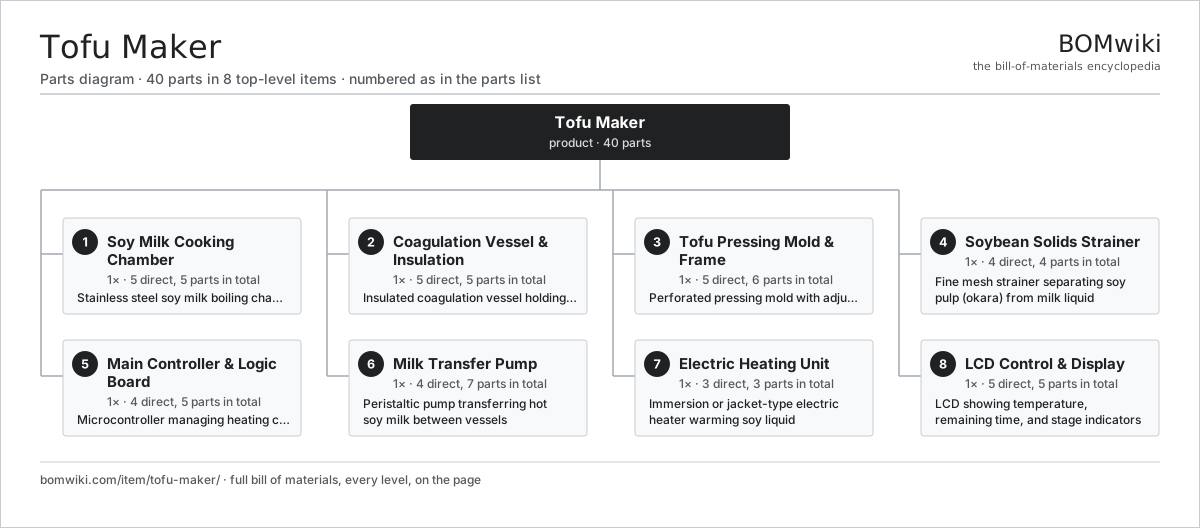
| # | Part | Qty | What it does |
|---|---|---|---|
| 1 | Soy Milk Cooking Chamber 5 parts | 1× | Stainless steel soy milk boiling chamber with heating element |
| 2 | Coagulation Vessel & Insulation 5 parts | 1× | Insulated coagulation vessel holding curdled milk during setting |
| 3 | Tofu Pressing Mold & Frame 5 parts | 1× | Perforated pressing mold with adjustable weight lid and drip tray |
| 4 | Soybean Solids Strainer 4 parts | 1× | Fine mesh strainer separating soy pulp (okara) from milk liquid |
| 5 | Main Controller & Logic Board 4 parts | 1× | Microcontroller managing heating cycles and coagulation timing |
| 6 | Milk Transfer Pump 4 parts | 1× | Peristaltic pump transferring hot soy milk between vessels |
| 7 | Electric Heating Unit 3 parts | 1× | Immersion or jacket-type electric heater warming soy liquid |
| 8 | LCD Control & Display 5 parts | 1× | LCD showing temperature, remaining time, and stage indicators |
3D model
No 3D model yet. Have a CAD file of this? Add a 3D model. STL renders right on this page; STEP, FreeCAD, and OpenSCAD sources are welcome too (openly licensed, like all 3D models on BOMwiki).
Build & assembly graph
expand / collapse · shared sub-assemblies converge · links to related products · est. labourTap an assembly to expand/collapse · tap a part to open it · use “Open page” for any node · drag to pan, scroll to zoom.
Bill of materials for Tofu Maker
8 top-level lines · 43 rows shown · 40 parts total · indented to 3 levels| # | Item / sub-assembly | Part no. | Qty/assy | Ext. qty | Parts | Type |
|---|---|---|---|---|---|---|
| 1 | Soy Milk Cooking Chamber 5 parts | tofu-maker-cooker-vessel | 1× | 1 | 5 | assembly |
| 1.1 | Cooking Pot Inner Shell | tofu-maker-pot-body | 1× | 1 | · | part |
| 1.2 | Heating Jacket | tofu-maker-heating-jacket | 1× | 1 | · | part |
| 1.3 | Temperature Probe Pocket | tofu-maker-thermometer-pocket | 1× | 1 | · | part |
| 1.4 | Drain Ball Valve | tofu-maker-drain-valve | 1× | 1 | · | part |
| 1.5 | Pressure Sensor | pressure-sensor | 1× | 1 | · | part |
| 2 | Coagulation Vessel & Insulation 5 parts | tofu-maker-coagulation-container | 1× | 1 | 5 | assembly |
| 2.1 | Coagulation Pot Inner | tofu-maker-coagulation-pot | 1× | 1 | · | part |
| 2.2 | Thermal Jacket | tofu-maker-thermal-jacket | 1× | 1 | · | part |
| 2.3 | Jacket Water Inlet | tofu-maker-jacket-fill-port | 1× | 1 | · | part |
| 2.4 | Foam Insulation | tofu-maker-insulation-material | 1× | 1 | · | part |
| 2.5 | False-Bottom Mesh | tofu-maker-drain-mesh | 1× | 1 | · | part |
| 3 | Tofu Pressing Mold & Frame 5 parts | tofu-maker-pressing-mold | 1× | 1 | 6 | assembly |
| 3.1 | Pressing Mold Box | tofu-maker-mold-frame-body | 1× | 1 | · | part |
| 3.2 | Mold Liner Cloth | tofu-maker-cheesecloth-liner | 1× | 1 | · | part |
| 3.3 | Pressing Weight Lid | tofu-maker-mold-weight-lid | 1× | 1 | · | part |
| 3.4 | Weight Rail | tofu-maker-weight-slider-rail | 2× | 2 | · | part |
| 3.5 | Whey Drip Tray | tofu-maker-drip-tray | 1× | 1 | · | part |
| 4 | Soybean Solids Strainer 4 parts | tofu-maker-strainer-basket | 1× | 1 | 4 | assembly |
| 4.1 | Strainer Frame | tofu-maker-strainer-frame | 1× | 1 | · | part |
| 4.2 | Strainer Mesh | tofu-maker-strainer-mesh | 1× | 1 | · | part |
| 4.3 | Strainer Handle | tofu-maker-strainer-handle | 1× | 1 | · | part |
| 4.4 | Strainer Cloth Layers | tofu-maker-strainer-liner-cloth | 1× | 1 | · | part |
| 5 | Main Controller & Logic Board 4 parts | tofu-maker-controller | 1× | 1 | 5 | assembly |
| 5.1 | Microcontroller | mcu | 1× | 1 | · | part |
| 5.2 | Relay | relay | 2× | 2 | · | part |
| 5.3 | Bare PCB | pcb-bare | 1× | 1 | · | part |
| 5.4 | SMD Passive (R/C/L) | smd-passives | 1× | 1 | · | part |
| 6 | Milk Transfer Pump 4 parts | tofu-maker-pump | 1× | 1 | 7 | assembly |
| 6.1 | Pump Motor | tofu-maker-pump-motor | 1× | 1 | · | part |
| 6.2 | Pump Head | tofu-maker-pump-head | 1× | 1 | · | part |
| 6.3 | Food-Safe Pump Tubing | tofu-maker-pump-tubing | 2× | 2 | · | part |
| 6.4 | Connector | connector | 3× | 3 | · | part |
| 7 | Electric Heating Unit 3 parts | tofu-maker-heating-element | 1× | 1 | 3 | assembly |
| 7.1 | Heating Element | heating-element | 1× | 1 | · | part |
| 7.2 | Thermostat Switch | tofu-maker-thermostat-switch | 1× | 1 | · | part |
| 7.3 | Heating Relay Module | tofu-maker-heating-relay | 1× | 1 | · | part |
| 8 | LCD Control & Display 5 parts | tofu-maker-display-panel | 1× | 1 | 5 | assembly |
| 8.1 | LCD Panel | lcd-panel | 1× | 1 | · | part |
| 8.2 | Pushbutton Keypad | tofu-maker-keypad | 1× | 1 | · | part |
| 8.3 | Piezo Buzzer | tofu-maker-buzzer | 1× | 1 | · | part |
| 8.4 | Bare PCB | pcb-bare | 1× | 1 | · | part |
| 8.5 | SMD Passive (R/C/L) | smd-passives | 1× | 1 | · | part |
Something wrong in this list? Report a problem with this BOM.
Related products
same domain, ranked by shared parts Electric Multicooker
151 parts · shares 3 with this page
Herbal Infusion Machine
34 parts · shares 3 with this page
Electric Multicooker
151 parts · shares 3 with this page
Herbal Infusion Machine
34 parts · shares 3 with this page
 Sous Vide Immersion Circulator
294 parts · shares 3 with this page
Super-Automatic Espresso Machine
293 parts · shares 3 with this page
Sous Vide Immersion Circulator
294 parts · shares 3 with this page
Super-Automatic Espresso Machine
293 parts · shares 3 with this page
Sourcing: possible vendors
Browse the supplier directory → Prices, MOQ, and lead times are algorithmic estimates, not quotes, and not claims about these companies. Company mappings are curated by keyword; est. price band $20–$600. How estimates work| Vendor | HQ | Specialty | MOQ | Lead time |
|---|---|---|---|---|
|
🇦🇺Breville
breville.com ↗
|
Sydney, AU | Kitchen appliances | 2,000 units | 6–10 wks |
| groupeseb.com ↗ | Écully, FR | Cookware & small appliances | 2,000 units | 6–10 wks |
| hamiltonbeach.com ↗ | Glen Allen, US | Small appliances | 2,000 units | 6–10 wks |
| panasonic.com ↗ | Osaka, JP | Electronics & appliances | 2,000 units | 6–10 wks |
|
🇨🇳Midea
midea.com ↗
|
Foshan, CN | Home appliances | 2,000 units | 6–10 wks |
935-word article