Ophthalmic Tonometer
ProductOverview
A tonometer measures intraocular pressure (IOP), the fluid pressure inside the eye. Normal IOP runs 10–21 mmHg; sustained elevation is the principal modifiable risk factor for glaucoma, so tonometry is part of every routine eye examination. The reference method, Goldmann applanation, touches a flat prism to the anesthetized cornea. The non-contact (air-puff) tonometer described here reaches the same physical endpoint, corneal applanation, without contact: it flattens the cornea with a brief pulse of air and records the pressure required to do so. No anesthetic is needed and nothing touches the eye, which makes it the standard screening instrument in optometric practice.
The instrument combines the Air Pulse Mechanism mechanism that generates the pulse, the Applanation Detection Optics optics that sense the instant of flattening, the Alignment & Fixation Optics and Motorized Positioning Stage that put the nozzle precisely on the corneal apex, and the Chin Rest Assembly that holds the patient. Results appear on the Operator Console and print from the Thermal Result Printer.
Measurement principle
Both Goldmann and air-puff tonometry rest on the Imbert-Fick relation: for a thin spherical membrane, the force needed to flatten (applanate) a fixed area is proportional to the internal pressure. The air-puff instrument applies the force pneumatically. The Pulse Solenoid Driver pushes the Piston & Air Cylinder with a controlled current ramp, so pressure in the chamber, and in the jet leaving the Discharge Nozzle, rises smoothly over roughly 20 ms. A Pressure Sensor samples the chamber at kilohertz rates throughout the pulse.
Detection is optical. The IR Applanation Emitter shines a collimated infrared beam obliquely onto the cornea through a Collimating Lens; while the cornea is curved it scatters the beam, but at the instant the central 3.6 mm flattens it acts as a plane mirror and reflects the full beam through the Detection Aperture Stop onto the Applanation Photodetector. The detector signal therefore spikes sharply at applanation. The Microcontroller timestamps the spike against the chamber-pressure record, and the pressure at that instant maps to IOP through a factory calibration curve traceable to Goldmann readings per ISO 8612. The pulse is cut off immediately after the peak, which is why a properly working instrument delivers a much softer puff than its reputation suggests.
A second applanation event occurs as the cornea rebounds through flat on recovery; comparing the inbound and outbound pressures gives some instruments a corneal-hysteresis estimate, since a stiffer cornea dissipates more energy.
Alignment and tracking
The reading is only valid if the pulse hits the corneal apex perpendicular to the surface at the calibrated 11 mm working distance. The Alignment & Fixation Optics view the eye coaxially through the nozzle: an CMOS Image Sensor behind a Lens Assembly watches the corneal reflections of the Alignment Mire LED mires, with the Dichroic Beamsplitter separating the IR sensing paths from the patient's visible view of the Internal Fixation Target. From the mire positions the controller computes X/Y offset and Z distance, drives the three Servo Motor axes of the Motorized Positioning Stage through their Ball Screw leadscrews, and fires automatically once the apex sits within tolerance, typically under ±0.1 mm. The operator can override with the Alignment Joystick for poorly fixating patients.
Patient positioning comes first: the Chin Rest Leadscrew raises the Chin Cup until the outer canthus lines up with the Canthus Height Marker, and the Forehead Rest Band fixes axial distance. Paper pads on the chin cup are replaced between patients.
Electronics and readout
The Control Electronics split duties between a Compute SoC Module handling image processing, tracking and the touchscreen UI, and a real-time Microcontroller sequencing the solenoid through a Power MOSFET H-bridge and capturing the pressure/photodetector pair at full rate. Three valid readings per eye are taken and averaged, since IOP varies a few mmHg with the ocular pulse; the Operator Console flags outliers and displays per-eye means on the LCD Panel.
Accuracy and limitations
Air-puff readings agree with Goldmann within about ±2 mmHg across the normal range, but both methods share a systematic weakness: corneal biomechanics. A thick or stiff cornea resists flattening and reads high; a thin or post-LASIK cornea reads low. Clinics therefore pair tonometry with pachymetry (corneal thickness measurement) and confirm elevated screening readings by Goldmann applanation. The instrument self-checks daily by firing into a calibration test chamber, and the O-Ring Set seals in the pulse mechanism are the usual service item when readings drift.
Ophthalmic Tonometer parts and their functions
8 top-level parts · 505 parts in total · full bill of materials below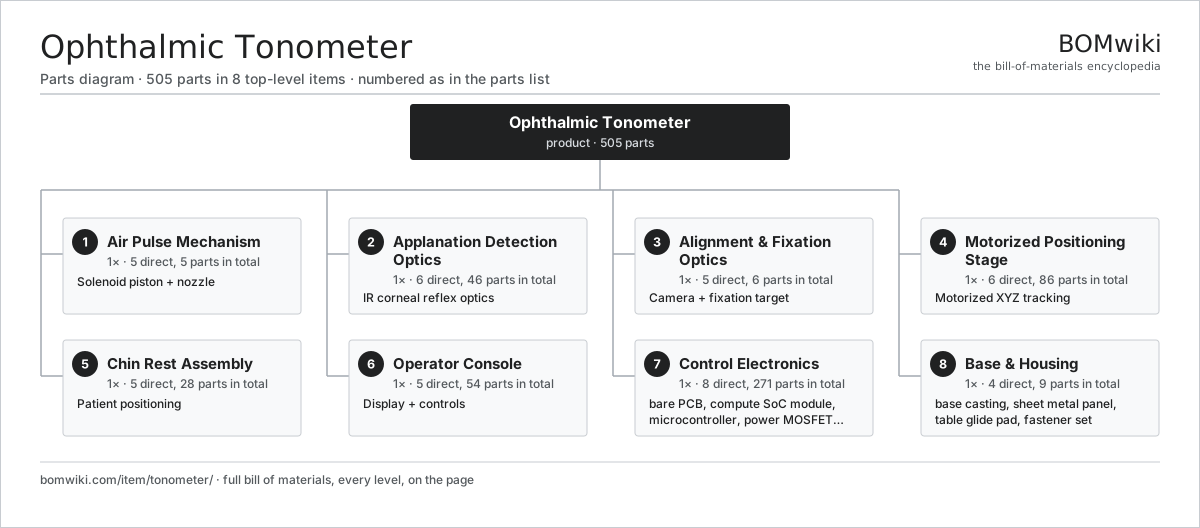
| # | Part | Qty | What it does |
|---|---|---|---|
| 1 | Air Pulse Mechanism 5 parts | 1× | Solenoid piston + nozzle |
| 2 | Applanation Detection Optics 6 parts | 1× | IR corneal reflex optics |
| 3 | Alignment & Fixation Optics 5 parts | 1× | Camera + fixation target |
| 4 | Motorized Positioning Stage 6 parts | 1× | Motorized XYZ tracking |
| 5 | Chin Rest Assembly 5 parts | 1× | Patient positioning |
| 6 | Operator Console 5 parts | 1× | Display + controls |
| 7 | Control Electronics 8 parts | 1× | Main board correlating chamber pressure with the applanation instant, running eye tracking, and sequencing the solenoid firing. |
| 8 | Base & Housing 4 parts | 1× | Cast base with friction-glide table pads and molded covers over the optical head and stage. |
3D model
No 3D model yet. Have a CAD file of this? Add a 3D model. STL renders right on this page; STEP, FreeCAD, and OpenSCAD sources are welcome too (openly licensed, like all 3D models on BOMwiki).
Build & assembly graph
expand / collapse · shared sub-assemblies converge · links to related products · est. labourTap an assembly to expand/collapse · tap a part to open it · use “Open page” for any node · drag to pan, scroll to zoom.
Bill of materials for Ophthalmic Tonometer
8 top-level lines · 60 rows shown · 505 parts total · indented to 3 levels| # | Item / sub-assembly | Part no. | Qty/assy | Ext. qty | Parts | Type |
|---|---|---|---|---|---|---|
| 1 | Air Pulse Mechanism 5 parts | tonometer-air-pulse | 1× | 1 | 5 | assembly |
| 1.1 | Pulse Solenoid Driver | tonometer-solenoid-driver | 1× | 1 | · | part |
| 1.2 | Piston & Air Cylinder | tonometer-piston-cylinder | 1× | 1 | · | part |
| 1.3 | Discharge Nozzle | tonometer-discharge-nozzle | 1× | 1 | · | part |
| 1.4 | Pressure Sensor | pressure-sensor | 1× | 1 | · | part |
| 1.5 | O-Ring Set | oring-set | 1× | 1 | · | part |
| 2 | Applanation Detection Optics 6 parts | tonometer-applanation-detect | 1× | 1 | 46 | assembly |
| 2.1 | IR Applanation Emitter | tonometer-ir-emitter | 1× | 1 | · | part |
| 2.2 | Applanation Photodetector | tonometer-photodetector | 1× | 1 | · | part |
| 2.3 | Collimating Lens | tonometer-collimating-lens | 2× | 2 | · | part |
| 2.4 | Detection Aperture Stop | tonometer-detect-aperture | 1× | 1 | · | part |
| 2.5 | Bare PCB | pcb-bare | 1× | 1 | · | part |
| 2.6 | SMD Passive (R/C/L) | smd-passives | 40× | 40 | · | part |
| 3 | Alignment & Fixation Optics 5 parts | tonometer-alignment-optics | 1× | 1 | 6 | assembly |
| 3.1 | CMOS Image Sensor | image-sensor | 1× | 1 | · | part |
| 3.2 | Lens Assembly | camera-lens | 1× | 1 | · | part |
| 3.3 | Internal Fixation Target | tonometer-fixation-target | 1× | 1 | · | part |
| 3.4 | Alignment Mire LED | tonometer-alignment-led | 2× | 2 | · | part |
| 3.5 | Dichroic Beamsplitter | tonometer-dichroic-mirror | 1× | 1 | · | part |
| 4 | Motorized Positioning Stage 6 parts | tonometer-positioning-stage | 1× | 1 | 86 | assembly |
| 4.1 | Servo Motor 4 parts | servo-motor | 3× | 3 | 24 | assembly |
| 4.1.1 | Stator Assembly 3 parts + deeper › | stator-assembly | 1× | 3 | 3 | assembly |
| 4.1.2 | Rotor Assembly 4 parts + deeper › | rotor-assembly | 1× | 3 | 19 | assembly |
| 4.1.3 | Encoder | encoder | 1× | 3 | · | part |
| 4.1.4 | Motor Housing | motor-housing | 1× | 3 | · | part |
| 4.2 | Ball Screw | ball-screw | 3× | 3 | · | part |
| 4.3 | Hall Sensor | hall-sensor | 3× | 3 | · | part |
| 4.4 | Measuring Head Carriage | tonometer-stage-carriage | 1× | 1 | · | part |
| 4.5 | Alignment Joystick | tonometer-joystick | 1× | 1 | · | part |
| 4.6 | Ball Bearing | ball-bearing | 6× | 6 | · | part |
| 5 | Chin Rest Assembly 5 parts | tonometer-chin-rest | 1× | 1 | 28 | assembly |
| 5.1 | Chin Cup | tonometer-chin-cup | 1× | 1 | · | part |
| 5.2 | Forehead Rest Band | tonometer-forehead-band | 1× | 1 | · | part |
| 5.3 | Chin Rest Leadscrew | tonometer-chinrest-leadscrew | 1× | 1 | · | part |
| 5.4 | Servo Motor 4 parts | servo-motor | 1× | 1 | 24 | assembly |
| 5.4.1 | Stator Assembly 3 parts + deeper › | stator-assembly | 1× | 1 | 3 | assembly |
| 5.4.2 | Rotor Assembly 4 parts + deeper › | rotor-assembly | 1× | 1 | 19 | assembly |
| 5.4.3 | Encoder | encoder | 1× | 1 | · | part |
| 5.4.4 | Motor Housing | motor-housing | 1× | 1 | · | part |
| 5.5 | Canthus Height Marker | tonometer-canthus-marker | 1× | 1 | · | part |
| 6 | Operator Console 5 parts | tonometer-console | 1× | 1 | 54 | assembly |
| 6.1 | LCD Panel | lcd-panel | 1× | 1 | · | part |
| 6.2 | Touch Digitizer | touch-digitizer | 1× | 1 | · | part |
| 6.3 | Thermal Result Printer | tonometer-thermal-printer | 1× | 1 | · | part |
| 6.4 | Bare PCB | pcb-bare | 1× | 1 | · | part |
| 6.5 | SMD Passive (R/C/L) | smd-passives | 50× | 50 | · | part |
| 7 | Control Electronics 8 parts | tonometer-electronics | 1× | 1 | 271 | assembly |
| 7.1 | Bare PCB | pcb-bare | 1× | 1 | · | part |
| 7.2 | Compute SoC Module | soc-module | 1× | 1 | · | part |
| 7.3 | Microcontroller | mcu | 1× | 1 | · | part |
| 7.4 | Power MOSFET | mosfet | 4× | 4 | · | part |
| 7.5 | Power Supply | power-supply | 1× | 1 | · | part |
| 7.6 | Connector | connector | 12× | 12 | · | part |
| 7.7 | SMD Passive (R/C/L) | smd-passives | 250× | 250 | · | part |
| 7.8 | Wire Bundle | wire-bundle | 1× | 1 | · | part |
| 8 | Base & Housing 4 parts | tonometer-base-housing | 1× | 1 | 9 | assembly |
| 8.1 | Base Casting | tonometer-base-casting | 1× | 1 | · | part |
| 8.2 | Sheet Metal Panel | sheet-panel | 4× | 4 | · | part |
| 8.3 | Table Glide Pad | tonometer-glide-pad | 3× | 3 | · | part |
| 8.4 | Fastener Set | fastener-set | 1× | 1 | · | part |
Something wrong in this list? Report a problem with this BOM.
Related products
same domain, ranked by shared parts Autorefractor
513 parts · shares 22 with this page
Heart-Lung Machine
298 parts · shares 21 with this page
Autorefractor
513 parts · shares 22 with this page
Heart-Lung Machine
298 parts · shares 21 with this page
 ECMO Machine
142 parts · shares 21 with this page
ECMO Machine
142 parts · shares 21 with this page
 Surgical Robot
2,740 parts · shares 20 with this page
Surgical Robot
2,740 parts · shares 20 with this page
 PET-CT Scanner
514 parts · shares 19 with this page
Surgical Suction Unit
232 parts · shares 17 with this page
PET-CT Scanner
514 parts · shares 19 with this page
Surgical Suction Unit
232 parts · shares 17 with this page
Sourcing: possible vendors
Browse the supplier directory → Prices, MOQ, and lead times are algorithmic estimates, not quotes, and not claims about these companies. Company mappings are curated by keyword; est. price band $500–$3M. How estimates work| Vendor | HQ | Specialty | MOQ | Lead time |
|---|---|---|---|---|
| gehealthcare.com ↗ | Chicago, US | Medical imaging & devices | 100 units | 12–20 wks |
| siemens-healthineers.com ↗ | Erlangen, DE | Medical systems | 100 units | 12–20 wks |
|
🇳🇱Philips
philips.com ↗
|
Amsterdam, NL | Health technology | 100 units | 12–20 wks |
| medtronic.com ↗ | Minneapolis, US | Medical devices | 100 units | 12–20 wks |
|
🇨🇳Mindray
mindray.com ↗
|
Shenzhen, CN | Medical devices | 100 units | 12–20 wks |
749-word article