Toothbrush Tufting Machine
ProductOverview
Toothbrush tufting machines automate the insertion, anchoring, trimming, and finishing of nylon bristle bundles into brush head blanks. These high-speed systems integrate filament feed, a rotating tufting head with anchor wire or staple driving, precise trimming, bristle-end rounding (via sanding or flame), and carousel-based indexing of brush heads through all operations. Modern machines achieve 150–300 finished toothbrushes per minute with tight control over bristle length uniformity, anchor strength, and surface finish. The process combines mechanical rotation, pneumatic actuation, and precision indexing to create the millions of toothbrushes consumed globally each year.
The tufting process requires constant filament tension (to prevent slack bundles), synchronized blade speed (to avoid bristle fraying), rapid carousel timing, and consistent pressing force (to ensure anchor security). Dust collection is critical, as continuous nylon trimming generates fine fibers that can clog machinery and compromise air quality.
How It Works
Filament Supply and Tension Control
The Filament Feed and Tensioning station holds multiple spools of nylon filament on a rotating rack. Each spool is threaded through ceramic Guide Eyelet Ring that route the filament bundles in parallel toward the tufting head. A Tension Dancer Arm, a weighted lever with contact rollers, continuously adjusts position to maintain constant filament tension (±5% variance). An Encoder senses dancer-arm position and alerts the controller if tension drifts, reducing tufting quality.
Tufting Head Operation
The Tufting Head Assembly assembly centers on a High-Speed Tufting Spindle rotating at 1200–1800 rpm. As the spindle rotates, a Anchor Wire Feed System feed mechanism supplies continuous stainless steel wire, bending and forming it into U-shaped anchors or loops that wrap around the filament bundles. Simultaneously, a Pressing Cylinder (pneumatic, 10–20 bar) descends, pressing the filament bundle with its wire anchor firmly into pre-drilled holes in the brush head blank held in the Brush Head Chuck.
The Pressure Sensor in the tufting head monitors pressing force; if force drops below threshold, the controller flags the tufting as incomplete and may reject the brush head.
Staple Driving (Alternative to Wire)
In machines using staple locking instead of wire anchors, the Staple Feed and Driver assembly takes over after filament insertion. A Staple Bowl Feeder vibration feeder orients pre-formed U-shaped staples and meters them one per cycle. A solenoid-driven Staple Impact Punch delivers 200–500 J of impact energy, driving the staple through the bristle anchor points and into the Staple Anvil Die anvil. This permanently locks the bristles in place.
Filament Trimming
Once the bristle bundle is anchored, the Trimming Head head comes into play. A high-speed Trimmer Blade Spindle (3000–5000 rpm) rotates a Trimming Blade, a hardened stainless steel helical or circular cutter with micro-serrated edge. The brush head is presented to the blade at a precise angle; the rotating blade cuts all bristles to a uniform length (typically 18–22 mm) in a single pass. A Blower Motor immediately evacuates the trimmed nylon fibers, preventing them from fouling the brush head or machinery.
Bristle End Rounding and Softening
Raw-cut bristles have sharp edges that can irritate gums. The Bristle End Rounding station rounds and softens the bristle tips via one of two methods:
Abrasive Sanding: A rotating Sanding Drum coated with 120–180 grit sandpaper gently rounds the bristle ends. The brush head is held in a Rounding Cage with bristles protruding through mesh or slots, allowing even contact with the sanding drum.
Thermal Flaming: A natural gas burner or electric heater briefly exposes bristle tips to 800–1000 °C, melting them to a depth of 0.5–1 mm and creating soft, rounded edges.
Vacuum suction and air jets maintain bristle alignment throughout this operation.
Handle Indexing and Station Sequencing
Brush heads are loaded onto a Handle Carousel and Indexing carousel turret, typically with 6–12 fixtures holding brush heads at various stages. A Carousel Drive Motor (stepper or servo with gearbox) rotates the carousel by one pitch (60–90°) at the start of each cycle. Each Brush Head Fixture Block block positions a brush head using mechanical Fastener Set alignment pins and pneumatic clamp pads. An Encoder confirms carousel position before the next operation begins.
Dust and Air Management
The Vacuum and Dust System system continuously captures nylon trim, fibers, and dust using a Vacuum Pump Unit (rotary vane or centrifugal, 10–50 cfm). A Vacuum Filter Cartridge cartridge (HEPA, 0.3 micron) traps fine particles, protecting air quality and preventing re-contamination of finished brushes. Compressed-air Bristle Alignment Air Jet at strategic locations assist in bristle alignment and fluffing after thermal treatment.
Synchronized Control
The Control and Drive System unit orchestrates all operations. A Microcontroller (programmable controller) manages:
- Filament spool motor speed (constant-tension mode via dancer-arm feedback)
- Tufting spindle on/off and speed regulation
- Press cylinder solenoid activation and dwell time
- Staple punch or anchor-wire trigger timing
- Trimmer blade spindle on/off and feed speed
- Carousel indexing via stepper motor pulses
- Vacuum pump and air-jet activation
- Rounding station (sanding drum or flame) dwell
Relay outputs switch high-power motors and solenoids; Encoder inputs track carousel position, filament tension, and tufting pressure.
Engineering Considerations
Filament Tension Uniformity: Slack filament causes loose tufts; excessive tension breaks fibers. The dancer-arm system must respond quickly (within 1–2 seconds) to load changes.
Trimming Blade Wear: High-speed cutting of nylon dulls the blade within 100,000–200,000 cuts. Dull blades produce fraying; regular inspection and blade replacement are critical quality controls.
Anchor Security: Whether using wire or staples, insufficient pressing force allows bristles to slip out during brushing. Pressure sensors and force feedback loops help maintain consistent anchoring.
Bristle Uniformity: Variations in filament diameter (±0.02 mm) create visible differences in bristle stiffness and appearance. Suppliers must maintain tight denier tolerances.
Thermal Flaming Control: Over-exposure melts bristles too deep, reducing stiffness; under-exposure leaves sharp edges. Dwell time and flame intensity require careful calibration.
Production Metrics
A typical 12-position carousel machine with a 4-second cycle (1 second per station) produces 900 toothbrushes per hour. Machines with faster indexes or more stations achieve 150–300 per minute (9000–18000/hour). Power consumption is 8–15 kW; pneumatic demand is 80–150 L/min at 6 bar. Changeover between brush sizes or bristle lengths requires fixture adjustment (5–15 minutes) and potential trimmer blade replacement.
Toothbrush Tufting Machine parts and their functions
8 top-level parts · 48 parts in total · full bill of materials below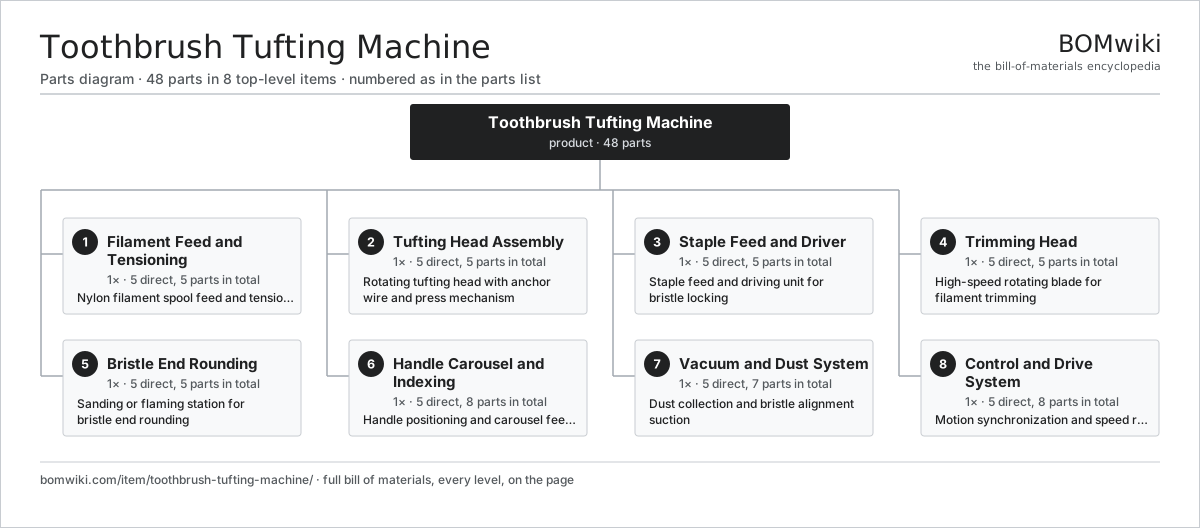
| # | Part | Qty | What it does |
|---|---|---|---|
| 1 | Filament Feed and Tensioning 5 parts | 1× | Nylon filament spool feed and tension control |
| 2 | Tufting Head Assembly 5 parts | 1× | Rotating tufting head with anchor wire and press mechanism |
| 3 | Staple Feed and Driver 5 parts | 1× | Staple feed and driving unit for bristle locking |
| 4 | Trimming Head 5 parts | 1× | High-speed rotating blade for filament trimming |
| 5 | Bristle End Rounding 5 parts | 1× | Sanding or flaming station for bristle end rounding |
| 6 | Handle Carousel and Indexing 5 parts | 1× | Handle positioning and carousel feed system |
| 7 | Vacuum and Dust System 5 parts | 1× | Dust collection and bristle alignment suction |
| 8 | Control and Drive System 5 parts | 1× | Motion synchronization and speed regulation |
3D model
No 3D model yet. Have a CAD file of this? Add a 3D model. STL renders right on this page; STEP, FreeCAD, and OpenSCAD sources are welcome too (openly licensed, like all 3D models on BOMwiki).
Build & assembly graph
expand / collapse · shared sub-assemblies converge · links to related products · est. labourTap an assembly to expand/collapse · tap a part to open it · use “Open page” for any node · drag to pan, scroll to zoom.
Bill of materials for Toothbrush Tufting Machine
8 top-level lines · 48 rows shown · 48 parts total · indented to 3 levels| # | Item / sub-assembly | Part no. | Qty/assy | Ext. qty | Parts | Type |
|---|---|---|---|---|---|---|
| 1 | Filament Feed and Tensioning 5 parts | toothbrush-tufting-machine-filament | 1× | 1 | 5 | assembly |
| 1.1 | Spool Carousel | toothbrush-tufting-machine-spool-rack | 1× | 1 | · | part |
| 1.2 | Tension Dancer Arm | toothbrush-tufting-machine-dancer-arm | 1× | 1 | · | part |
| 1.3 | Guide Eyelet Ring | toothbrush-tufting-machine-guide-eyelets | 1× | 1 | · | part |
| 1.4 | Encoder | encoder | 1× | 1 | · | part |
| 1.5 | Fastener Set | fastener-set | 1× | 1 | · | part |
| 2 | Tufting Head Assembly 5 parts | toothbrush-tufting-machine-tufting | 1× | 1 | 5 | assembly |
| 2.1 | High-Speed Tufting Spindle | toothbrush-tufting-machine-spindle | 1× | 1 | · | part |
| 2.2 | Anchor Wire Feed System | toothbrush-tufting-machine-anchor-wire | 1× | 1 | · | part |
| 2.3 | Pressing Cylinder | toothbrush-tufting-machine-press-cylinder | 1× | 1 | · | part |
| 2.4 | Brush Head Chuck | toothbrush-tufting-machine-brush-chuck | 1× | 1 | · | part |
| 2.5 | Pressure Sensor | pressure-sensor | 1× | 1 | · | part |
| 3 | Staple Feed and Driver 5 parts | toothbrush-tufting-machine-staple | 1× | 1 | 5 | assembly |
| 3.1 | Staple Bowl Feeder | toothbrush-tufting-machine-staple-hopper | 1× | 1 | · | part |
| 3.2 | Staple Impact Punch | toothbrush-tufting-machine-staple-punch | 1× | 1 | · | part |
| 3.3 | Staple Anvil Die | toothbrush-tufting-machine-staple-die | 1× | 1 | · | part |
| 3.4 | Connector | connector | 1× | 1 | · | part |
| 3.5 | O-Ring Set | oring-set | 1× | 1 | · | part |
| 4 | Trimming Head 5 parts | toothbrush-tufting-machine-trimmer | 1× | 1 | 5 | assembly |
| 4.1 | Trimmer Blade Spindle | toothbrush-tufting-machine-blade-spindle | 1× | 1 | · | part |
| 4.2 | Trimming Blade | toothbrush-tufting-machine-blade | 1× | 1 | · | part |
| 4.3 | Blade Holder Block | toothbrush-tufting-machine-blade-support | 1× | 1 | · | part |
| 4.4 | Blower Motor | blower-motor | 1× | 1 | · | part |
| 4.5 | Pressure Sensor | pressure-sensor | 1× | 1 | · | part |
| 5 | Bristle End Rounding 5 parts | toothbrush-tufting-machine-rounding | 1× | 1 | 5 | assembly |
| 5.1 | Sanding Drum | toothbrush-tufting-machine-sanding-drum | 1× | 1 | · | part |
| 5.2 | Rounding Cage | toothbrush-tufting-machine-rounding-cage | 1× | 1 | · | part |
| 5.3 | Bristle Flaming Unit | toothbrush-tufting-machine-flame-torch | 1× | 1 | · | part |
| 5.4 | Blower Motor | blower-motor | 1× | 1 | · | part |
| 5.5 | Encoder | encoder | 1× | 1 | · | part |
| 6 | Handle Carousel and Indexing 5 parts | toothbrush-tufting-machine-indexer | 1× | 1 | 8 | assembly |
| 6.1 | Indexing Carousel Turret | toothbrush-tufting-machine-carousel | 1× | 1 | · | part |
| 6.2 | Carousel Drive Motor | toothbrush-tufting-machine-indexer-motor | 1× | 1 | · | part |
| 6.3 | Brush Head Fixture Block | toothbrush-tufting-machine-fixture | 4× | 4 | · | part |
| 6.4 | Encoder | encoder | 1× | 1 | · | part |
| 6.5 | Fastener Set | fastener-set | 1× | 1 | · | part |
| 7 | Vacuum and Dust System 5 parts | toothbrush-tufting-machine-vacuum | 1× | 1 | 7 | assembly |
| 7.1 | Vacuum Pump Unit | toothbrush-tufting-machine-vacuum-pump | 1× | 1 | · | part |
| 7.2 | Vacuum Filter Cartridge | toothbrush-tufting-machine-filter | 1× | 1 | · | part |
| 7.3 | Bristle Alignment Air Jet | toothbrush-tufting-machine-air-jets | 2× | 2 | · | part |
| 7.4 | Connector | connector | 2× | 2 | · | part |
| 7.5 | Blower Motor | blower-motor | 1× | 1 | · | part |
| 8 | Control and Drive System 5 parts | toothbrush-tufting-machine-control | 1× | 1 | 8 | assembly |
| 8.1 | Microcontroller | mcu | 1× | 1 | · | part |
| 8.2 | Bare PCB | pcb-bare | 1× | 1 | · | part |
| 8.3 | Relay | relay | 4× | 4 | · | part |
| 8.4 | Power Supply | power-supply | 1× | 1 | · | part |
| 8.5 | Encoder | encoder | 1× | 1 | · | part |
Something wrong in this list? Report a problem with this BOM.
Related products
same domain, ranked by shared parts Brush Making Machine
50 parts · shares 7 with this page
Brush Making Machine
50 parts · shares 7 with this page
 Chalk Extrusion Machine
47 parts · shares 7 with this page
Crayon Molding Machine
56 parts · shares 7 with this page
Chalk Extrusion Machine
47 parts · shares 7 with this page
Crayon Molding Machine
56 parts · shares 7 with this page
 Pencil Making Machine
43 parts · shares 7 with this page
Hammer Mill
790 parts · shares 6 with this page
Binder Jetting Printer
112 parts · shares 6 with this page
Pencil Making Machine
43 parts · shares 7 with this page
Hammer Mill
790 parts · shares 6 with this page
Binder Jetting Printer
112 parts · shares 6 with this page
Sourcing: possible vendors
Browse the supplier directory → Prices, MOQ, and lead times are algorithmic estimates, not quotes, and not claims about these companies. Company mappings are curated by keyword; est. price band $5k–$2M. How estimates work| Vendor | HQ | Specialty | MOQ | Lead time |
|---|---|---|---|---|
| atlascopco.com ↗ | Stockholm, SE | Compressors & industrial | 10 units | 12–20 wks |
|
🇦🇹Andritz
andritz.com ↗
|
Graz, AT | Process plants & machinery | 10 units | 12–20 wks |
| buhlergroup.com ↗ | Uzwil, CH | Food & materials processing | 10 units | 12–20 wks |
| gea.com ↗ | Düsseldorf, DE | Process technology | 10 units | 12–20 wks |
| mhi.com ↗ | Tokyo, JP | Heavy machinery | 10 units | 12–20 wks |
1,099-word article