Record Player
ProductAlso known as: turntable, vinyl record player, phonograph, belt-drive turntable
Overview
A record player has eight main parts and a job that sounds impossible: read a groove a few hundredths of a millimetre wide, wobbling at up to 20,000 times a second, with a diamond point, and turn that motion into music without adding any of its own. The Plinth & Chassis is the foundation that keeps vibration out, the Platter Assembly carries the record and spins it on a precision bearing, the Drive System turns the platter at exactly 33⅓ or 45 revolutions a minute, the Tonearm Assembly holds the Phono Cartridge over the groove at a precise force, and the Phono Preamp Board lifts the cartridge's tiny signal to line level. A Dust Cover and the Power Section complete the machine.
"Turntable" and "record player" are used interchangeably here. Strictly, a turntable is the rotating deck and arm alone, and a record player is a turntable with a built-in amplifier and speakers; the belt-drive deck on this page, with its onboard phono preamp but no speakers, sits in between and is what most people buy today.
The parts of a record player and what each does
Plinth. The Plinth & Chassis is the base, a Plinth Body of dense MDF or layered composite that everything else bolts to. Its mass is the point: a heavy, dead base does not ring when the motor hums or a footstep crosses the floor. It stands on three or four Isolation Foot pads, rubber or sorbothane cones that decouple the deck from the shelf so that vibration from the speakers does not reach the stylus and come back out as feedback.
Platter and bearing. The Platter Assembly is the rotating disc the record sits on. The Platter itself is aluminium, acrylic or glass, a few kilograms on a good deck; that mass acts as a flywheel and smooths out tiny speed variations. It spins on the Spindle Shaft, a hardened, polished steel pin running in a bronze Bearing Sleeve on a single Ball Bearing at its foot. This main bearing is the most precise part of the machine: any play in it becomes rumble, a low-frequency noise under the music. A Slip Mat of felt, rubber or cork sits between platter and record to grip the disc and damp its ringing.
Drive system. The Drive System spins the platter. On a belt-drive deck a small Synchronous Drive Motor, a synchronous AC motor whose speed is locked to a reference frequency, carries a stepped Motor Pulley with two diameters, one for each speed. An elastomer Drive Belt runs from the pulley around the platter's rim or inner hub. The belt is a filter: it isolates the platter from the motor's vibration and evens out its cogging. Speed is set on the Speed Control Board, which on modern decks generates the reference frequency electronically so the motor is independent of mains frequency. Direct-drive decks, common in DJ use, mount the platter straight onto a low-speed motor instead and give up the belt's isolation for instant start-up and unshakeable speed.
Tonearm. The Tonearm Assembly carries the cartridge across the record. The Arm Tube is a stiff, light tube of aluminium or carbon fibre, pivoted in a gimbal on a pair of Ball Bearing sets so it moves freely up and down and side to side. At its front the removable Headshell holds the cartridge; at its back the Counterweight is screwed along a thread to balance the arm and then set the tracking force, typically 1.5 to 2.5 grams, that presses the stylus into the groove. An anti-skate device, a small weight or Coil Spring, applies a slight outward pull to cancel the inward force the spinning record puts on the arm. The Cueing Lift is a damped lever that lowers the arm gently onto the record, and the Tonearm Wiring is the set of four hair-thin wires that carry the signal from the cartridge pins down the tube to the deck.
Cartridge and stylus. The Phono Cartridge is the transducer, the part that turns groove motion into electricity. Its Diamond Stylus is a tiny cut and polished diamond, conical or elliptical in profile, mounted at the tip of a Cantilever, an aluminium or boron rod a few millimetres long. In a moving-magnet cartridge a small Neodymium Magnet is fixed to the other end of the cantilever inside the Cartridge Body; as the groove walls push the stylus left, right, up and down, the magnet moves between two Generator Coil windings and induces a voltage in each. The two channels of a stereo record are cut at 45 degrees to the surface, and the two coils are arranged to read one each. The output is a few millivolts, a thousand times smaller than a line signal.
Phono preamp. The Phono Preamp Board does two things to that tiny signal. It amplifies it by about 40 dB, and it applies the RIAA equalisation curve, boosting the bass and cutting the treble in exactly the inverse of the curve used when the record was cut, so the result is flat. On this deck the stage is built on a Bare PCB with a low-noise Phono Op-Amp, precision SMD Passive (R/C/L) that set the curve, a pair of RCA Output Jack jacks and a Ground Terminal that bonds the deck's chassis to the amplifier to stop hum. A switch bypasses the stage for amplifiers that have their own phono input.
Dust cover. The Dust Cover is a clear Acrylic Lid lid of acrylic on two damped Cover Hinge fittings. Dust is the enemy of both records and stylus, and most decks are played with the lid down or removed entirely, since a lid can also pick up airborne vibration.
Power section. The Power Section is the Power Inlet & Supply with its low-voltage supply for the motor board and preamp, plus the internal Wire Bundle and Connector hardware.
How a record player works
The motor turns the platter at a fixed speed through the belt. The record rides on the platter, and its groove, a single spiral 500 to 800 metres long on an LP side, passes under the stylus at a steady rate. The groove walls are not smooth: they are modulated with the waveform of the recording, and they push the stylus from side to side and up and down as they pass. The cantilever transmits that motion to the magnet, the coils turn it into two small alternating voltages, the tonearm wiring carries them to the preamp, and the preamp equalises and amplifies them into a signal an amplifier can use. The tonearm's only job through all of this is to hold the cartridge steady at the right force and let it follow the groove inward across the record without adding motion of its own. Every design choice on the deck, the heavy plinth, the massive platter, the belt, the isolation feet, exists to keep vibration that is not the groove away from the stylus.
Materials
Plinths are MDF, plywood, acrylic or aluminium; platters are aluminium, acrylic, glass or steel; arm tubes are aluminium, carbon fibre or magnesium. The stylus is industrial diamond, the cantilever aluminium or boron, the cartridge magnet neodymium. Bearings are hardened steel in bronze. The choice in each case is the same trade: stiffness and mass where vibration must be resisted, low mass where the part must move freely.
Common failures
The stylus wears; a diamond tip lasts 500 to 1,000 hours of play before it starts damaging records and is replaced, either on its own on a moving-magnet cartridge or with the whole cartridge on a moving-coil one. Belts stretch and slip, giving slow or wandering speed, and are replaced every few years. Tracking force drifts if the counterweight is knocked. Hum usually means the ground wire is loose. A platter that wobbles or rumbles points to a worn main bearing, the one repair that needs a technician.
Common questions
What are the parts of a record player called?
Plinth (base), platter, spindle and main bearing, slip mat, motor, belt and pulley, speed control, tonearm with headshell, counterweight, anti-skate and cueing lever, cartridge with stylus and cantilever, phono preamp, dust cover, and the power supply.
What is the difference between a turntable and a record player?
A turntable is the deck: platter, drive, arm and cartridge, needing a separate amplifier and speakers. A record player has amplifier and speakers built in. Many modern turntables include a phono preamp, which lets them plug into any amplifier or powered speaker.
What is the needle on a record player called?
The stylus. It is a shaped diamond tip on a cantilever, and together with the body that holds the magnet and coils it forms the cartridge. "Needle" survives from the steel needles of early gramophones.
Belt drive or direct drive?
Belt drive isolates the platter from motor vibration and is preferred for home listening. Direct drive couples the platter straight to a slow motor, starts instantly and holds speed under a hand on the platter, which is why DJs use it.
Why does a record player need a preamp?
A cartridge puts out a few millivolts, far below the roughly one volt an amplifier expects, and records are cut with the RIAA equalisation curve that has to be reversed on playback. The phono preamp does both. Without it the sound is faint and thin.
Record Player parts and their functions
8 top-level parts · 215 parts in total · full bill of materials below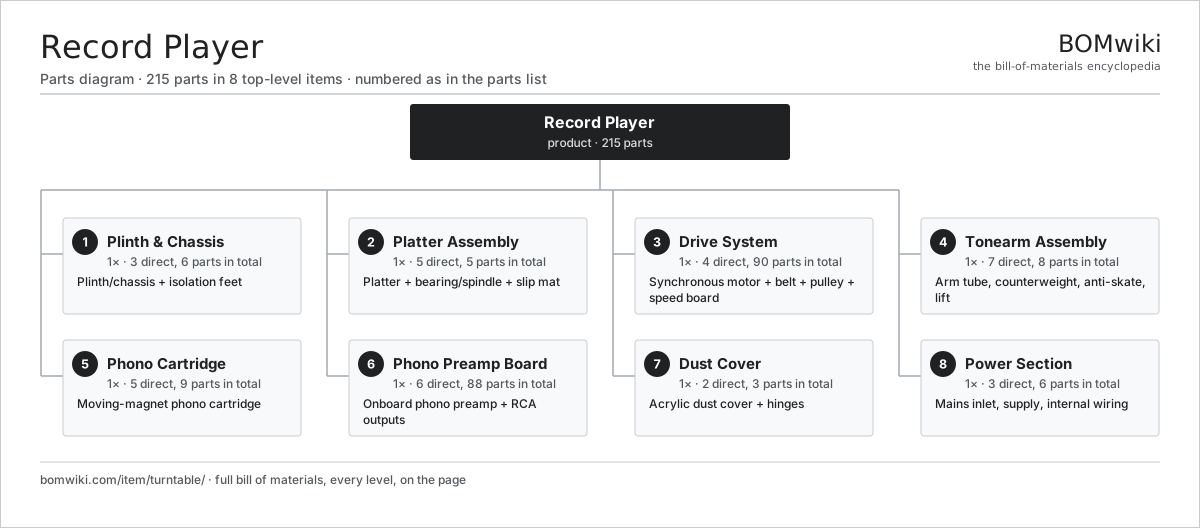
| # | Part | Qty | What it does |
|---|---|---|---|
| 1 | Plinth & Chassis 3 parts | 1× | Plinth/chassis + isolation feet |
| 2 | Platter Assembly 5 parts | 1× | Platter + bearing/spindle + slip mat |
| 3 | Drive System 4 parts | 1× | Synchronous motor + belt + pulley + speed board |
| 4 | Tonearm Assembly 7 parts | 1× | Arm tube, counterweight, anti-skate, lift |
| 5 | Phono Cartridge 5 parts | 1× | Moving-magnet phono cartridge |
| 6 | Phono Preamp Board 6 parts | 1× | Onboard phono preamp + RCA outputs |
| 7 | Dust Cover 2 parts | 1× | Acrylic dust cover + hinges |
| 8 | Power Section 3 parts | 1× | Mains inlet, supply, internal wiring |
3D model
No 3D model yet. Have a CAD file of this? Add a 3D model. STL renders right on this page; STEP, FreeCAD, and OpenSCAD sources are welcome too (openly licensed, like all 3D models on BOMwiki).
Build & assembly graph
expand / collapse · shared sub-assemblies converge · links to related products · est. labourTap an assembly to expand/collapse · tap a part to open it · use “Open page” for any node · drag to pan, scroll to zoom.
Bill of materials for Record Player
8 top-level lines · 50 rows shown · 215 parts total · indented to 3 levels| # | Item / sub-assembly | Part no. | Qty/assy | Ext. qty | Parts | Type |
|---|---|---|---|---|---|---|
| 1 | Plinth & Chassis 3 parts | turntable-plinth | 1× | 1 | 6 | assembly |
| 1.1 | Plinth Body | turntable-plinth-body | 1× | 1 | · | part |
| 1.2 | Isolation Foot | turntable-isolation-foot | 4× | 4 | · | part |
| 1.3 | Fastener Set | fastener-set | 1× | 1 | · | part |
| 2 | Platter Assembly 5 parts | turntable-platter-assembly | 1× | 1 | 5 | assembly |
| 2.1 | Platter | turntable-platter | 1× | 1 | · | part |
| 2.2 | Spindle Shaft | turntable-spindle-shaft | 1× | 1 | · | part |
| 2.3 | Bearing Sleeve | turntable-bearing-sleeve | 1× | 1 | · | part |
| 2.4 | Ball Bearing | ball-bearing | 1× | 1 | · | part |
| 2.5 | Slip Mat | turntable-slip-mat | 1× | 1 | · | part |
| 3 | Drive System 4 parts | turntable-drive-system | 1× | 1 | 90 | assembly |
| 3.1 | Synchronous Drive Motor 3 parts | turntable-drive-motor | 1× | 1 | 24 | assembly |
| 3.1.1 | Stator Assembly 3 parts + deeper › | stator-assembly | 1× | 1 | 3 | assembly |
| 3.1.2 | Rotor Assembly 4 parts + deeper › | rotor-assembly | 1× | 1 | 19 | assembly |
| 3.1.3 | Neodymium Magnet | neodymium-magnet | 2× | 2 | · | part |
| 3.2 | Motor Pulley | turntable-motor-pulley | 1× | 1 | · | part |
| 3.3 | Drive Belt | drive-belt | 1× | 1 | · | part |
| 3.4 | Speed Control Board 4 parts | turntable-speed-control-board | 1× | 1 | 64 | assembly |
| 3.4.1 | Bare PCB | pcb-bare | 1× | 1 | · | part |
| 3.4.2 | Microcontroller | mcu | 1× | 1 | · | part |
| 3.4.3 | SMD Passive (R/C/L) | smd-passives | 60× | 60 | · | part |
| 3.4.4 | Connector | connector | 2× | 2 | · | part |
| 4 | Tonearm Assembly 7 parts | turntable-tonearm-assembly | 1× | 1 | 8 | assembly |
| 4.1 | Arm Tube | turntable-arm-tube | 1× | 1 | · | part |
| 4.2 | Headshell | turntable-headshell | 1× | 1 | · | part |
| 4.3 | Counterweight | turntable-counterweight | 1× | 1 | · | part |
| 4.4 | Coil Spring | coil-spring | 1× | 1 | · | part |
| 4.5 | Ball Bearing | ball-bearing | 2× | 2 | · | part |
| 4.6 | Cueing Lift | turntable-cueing-lift | 1× | 1 | · | part |
| 4.7 | Tonearm Wiring | turntable-tonearm-wiring | 1× | 1 | · | part |
| 5 | Phono Cartridge 5 parts | turntable-cartridge | 1× | 1 | 9 | assembly |
| 5.1 | Cartridge Body | turntable-cartridge-body | 1× | 1 | · | part |
| 5.2 | Diamond Stylus | turntable-stylus | 1× | 1 | · | part |
| 5.3 | Cantilever | turntable-cantilever | 1× | 1 | · | part |
| 5.4 | Neodymium Magnet | neodymium-magnet | 2× | 2 | · | part |
| 5.5 | Generator Coil | turntable-generator-coil | 4× | 4 | · | part |
| 6 | Phono Preamp Board 6 parts | turntable-preamp-board | 1× | 1 | 88 | assembly |
| 6.1 | Bare PCB | pcb-bare | 1× | 1 | · | part |
| 6.2 | Phono Op-Amp | turntable-phono-opamp | 2× | 2 | · | part |
| 6.3 | SMD Passive (R/C/L) | smd-passives | 80× | 80 | · | part |
| 6.4 | RCA Output Jack | turntable-rca-output | 2× | 2 | · | part |
| 6.5 | Ground Terminal | turntable-ground-terminal | 1× | 1 | · | part |
| 6.6 | Connector | connector | 2× | 2 | · | part |
| 7 | Dust Cover 2 parts | turntable-dust-cover-assembly | 1× | 1 | 3 | assembly |
| 7.1 | Acrylic Lid | turntable-dust-cover | 1× | 1 | · | part |
| 7.2 | Cover Hinge | turntable-cover-hinge | 2× | 2 | · | part |
| 8 | Power Section 3 parts | turntable-power-section | 1× | 1 | 6 | assembly |
| 8.1 | Power Inlet & Supply | turntable-power-inlet | 1× | 1 | · | part |
| 8.2 | Wire Bundle | wire-bundle | 1× | 1 | · | part |
| 8.3 | Connector | connector | 4× | 4 | · | part |
Something wrong in this list? Report a problem with this BOM.
Related products
same domain, ranked by shared parts Broadcast Pedestal
83 parts · shares 10 with this page
 PTZ Camera
499 parts · shares 10 with this page
Studio Jib Arm
106 parts · shares 10 with this page
Motorized Curtain Track
210 parts · shares 9 with this page
 Projector
482 parts · shares 9 with this page
 Revolving Stage
61 parts · shares 9 with this page
Sourcing: possible vendors
Browse the supplier directory → Prices, MOQ, and lead times are algorithmic estimates, not quotes, and not claims about these companies. Company mappings are curated by keyword; est. price band $50–$3k. How estimates work| Vendor | HQ | Specialty | MOQ | Lead time |
|---|---|---|---|---|
| audio-technica.com ↗ | Tokyo, JP | Audio equipment | 1,000 units | 8–12 wks |
|
🇦🇹Pro-Ject
project-audio.com ↗
|
Vienna, AT | Turntables | 1,000 units | 8–12 wks |
|
🇬🇧Rega
rega.co.uk ↗
|
Southend-on-Sea, GB | Turntables & hi-fi | 1,000 units | 8–12 wks |
|
🇯🇵Technics
technics.com ↗
|
Osaka, JP | Hi-fi audio | 1,000 units | 8–12 wks |
1,614-word article