Two-Roll Mill
ProductOverview
A two-roll mill is a mechanical contraption that cools, blends, and sheets mixed rubber into uniform bands. It consists of two counter-rotating chrome-plated cylinders (Roll Assembly) separated by an adjustable gap (nip). Raw rubber compound, hot from a Banbury Internal Mixer, is charged onto the front roll, where the rotating surfaces grab it and pull it through the nip, working the material like a giant pasta roller. The rubber emerges as a thin, flexible sheet that cools as water sprays the roll surface.
Unlike a Banbury mixer (which generates tremendous heat), a two-roll mill cools rubber, allowing time for chemical curing to proceed in a controlled manner. The output is a cooled, uniform "banded" sheet ready for extrusion or next-stage processing. Mills are found in all rubber factories and are nearly universal in tire compound prep.
How it works
An operator cuts a ~20–30 kg chunk of hot compound (160–170 °C from the Banbury Internal Mixer) and places it onto the front roll. The nip between front and rear rolls is set at 3–5 mm gap via the Nip Adjustment.
The Friction Drive runs the front roll at, say, 50 rpm and the rear roll at 40 rpm (a 1.25:1 ratio). The rubber is immediately gripped by the faster front roll and pulled into the nip. At the nip, the slower rear roll stretches the rubber laterally, causing the compound to thin and spread across the roll width (typically 600–1000 mm). The rubber is thus both sheared and extended, further dispersing unmixed ingredients and breaking down polymer chains residually.
As the rubber passes through the nip under Nip Gauge pressure (adjustable 200–2000 kN depending on compound stiffness), it emerges as a thin, uniform sheet. Simultaneously, Spray Nozzles spray cooling water (40–60 °C) onto both roll surfaces. The Circulation Manifold circulates hot water from the roll jacket through a Water Cooler (a chiller or heat exchanger) and returns cool water continuously. This water exchange cools the rubber as it travels around the rolls.
The rubber sheet continuously peels off the rear roll surface and accumulates on the table behind the mill, forming a large folded "bale" or is fed directly into a wind-up reel. Operators periodically fold the sheet back onto the front roll (called "banding") to ensure even temperature distribution and prevent surface cooling that could cause stiffness.
The cycle repeats: every 2–5 minutes, a ~30 kg piece enters, and a cooled, uniform 30 kg sheet emerges. Over an 8-hour shift, one mill processes 300–500 kg/hour, producing 2500–4000 kg cooled compound.
Friction Ratio and Roll Speed Control
The key to good mill operation is the Friction Drive friction ratio: the speed ratio between front and rear rolls.
Why two speeds? If both rolls turned at the same speed, rubber would just circulate; it wouldn't stretch. The faster front roll pulls rubber faster than the slower rear roll can follow, causing the material to be drawn and extended across the nip. This differential motion:
- Thins the rubber (increases roll width coverage)
- Stretches the compound (further disperses unmixed additives)
- Prevents stalling and pack-up (rubber continuously flows)
Typical ratio: 1.2:1 to 1.5:1 (front:rear). For a 30 kW front motor and 25 kW rear motor, both driven by independent frequency drives, the operator sets:
- Front roll: 50 rpm
- Rear roll: 40 rpm
- Ratio: 1.25:1
Roll speeds are adjusted via VFD without changing gearbox ratios, making modern mills very flexible. Old mills used mechanical gear shifters to achieve different ratios, but modern mills use dual VFDs for infinite ratio control.
Temperature Management
The Heating Jacket carries hot water (80–100 °C) to initially soften stiff rubber. The Spray Nozzles then spray cool water (40–60 °C) onto the surface, creating a temperature gradient:
- Roll core: 80–100 °C (inner diameter)
- Roll surface: 50–70 °C (where water spray contacts)
- Extruded sheet: Cools further as it peels off, reaching ~40 °C by the time it's removed
This gradient allows the rubber to remain workable (soft) at the nip while cooling as it exits, preventing sticking and allowing the sheet to cool without cracking (thermal shock).
Nip Pressure and Material Hardness
The Nip Adjustment hydraulic cylinders set nip force. Softer compounds (lower viscosity) need lower nip force (300–600 kN); stiffer compounds (higher viscosity, filled with carbon black) need higher force (1000–2000 kN) to prevent stalling.
If nip pressure is too low:
- Rubber slips and doesn't thin uniformly; sheet edges are thick.
- Risk of material pack-up (stalling in nip).
If nip pressure is too high:
- Rubber extrudes too thin; local temperature spikes.
- Excess power draw; motor overload.
A safety Pressure Relief Valve valve limits hydraulic pressure to a preset value (e.g., 200 bar), protecting the system from over-pressure.
Safety Features
Rubber mills are hazardous. A hand or loose clothing caught in the nip can be drawn in and crushed in milliseconds. Modern mills include:
Safety Trip System: A spring-loaded Trip Sensing Roller on the nip senses any foreign object (or operator contact) and triggers the Trip Solenoid, which vents nip hydraulic pressure. The springs push the rolls apart in <100 ms.
Safety Guard: A mesh or polycarbonate barrier surrounds the nip zone, preventing easy hand access but allowing material feeding.
Motor Brake: A spring-applied brake on the Drive Motor & Gearbox stops rolls instantly if power is lost.
Despite these features, rubber mill accidents remain significant in tire factories. Many plants now use fully automated systems that feed mill with extruded strips or pellets, eliminating manual nip feeding.
Output and Cooling
A typical mill produces:
- 300–500 kg/hour per machine
- Sheet thickness: 3–5 mm
- Sheet temperature after mill: 40–50 °C
- Sheet packaged as a bale or wound on spool
The cooled compound is then:
- Fed to extruders as raw stock for tread extrusion
- Pelletized for storage and re-mixing later
- Shipped to tire-building-machine tread applicators
- Used for special extrusions (sidewall, seal compounds, etc.)
A 500-ton/day tire plant typically operates 3–5 mills continuously to supply all downstream extruders and builders with cooled, uniform compound.
Two-Roll Mill parts and their functions
8 top-level parts · 64 parts in total · full bill of materials below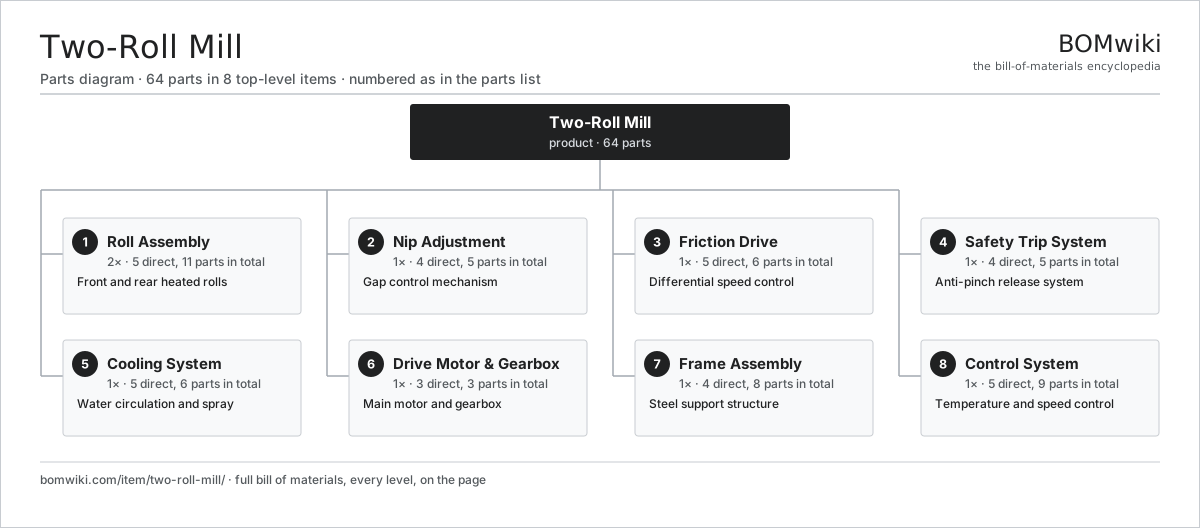
| # | Part | Qty | What it does |
|---|---|---|---|
| 1 | Roll Assembly 5 parts | 2× | Front and rear heated rolls |
| 2 | Nip Adjustment 4 parts | 1× | Gap control mechanism |
| 3 | Friction Drive 5 parts | 1× | Differential speed control |
| 4 | Safety Trip System 4 parts | 1× | Anti-pinch release system |
| 5 | Cooling System 5 parts | 1× | Water circulation and spray |
| 6 | Drive Motor & Gearbox 3 parts | 1× | Main motor and gearbox |
| 7 | Frame Assembly 4 parts | 1× | Steel support structure |
| 8 | Control System 5 parts | 1× | Temperature and speed control |
3D model
No 3D model yet. Have a CAD file of this? Add a 3D model. STL renders right on this page; STEP, FreeCAD, and OpenSCAD sources are welcome too (openly licensed, like all 3D models on BOMwiki).
Build & assembly graph
expand / collapse · shared sub-assemblies converge · links to related products · est. labourTap an assembly to expand/collapse · tap a part to open it · use “Open page” for any node · drag to pan, scroll to zoom.
Bill of materials for Two-Roll Mill
8 top-level lines · 46 rows shown · 64 parts total · indented to 3 levels| # | Item / sub-assembly | Part no. | Qty/assy | Ext. qty | Parts | Type |
|---|---|---|---|---|---|---|
| 1 | Roll Assembly 5 parts | two-roll-mill-roll-assembly | 2× | 2 | 11 | assembly |
| 1.1 | Roll Body | two-roll-mill-roll-body | 1× | 2 | · | part |
| 1.2 | Roll Bearing 3 parts | two-roll-mill-roll-bearing | 2× | 4 | 3 | assembly |
| 1.2.1 | Ball Bearing | ball-bearing | 1× | 4 | · | part |
| 1.2.2 | Bearing Outer Cup | two-roll-mill-bearing-outer-race | 1× | 4 | · | part |
| 1.2.3 | Bearing Cage | two-roll-mill-bearing-cage | 1× | 4 | · | part |
| 1.3 | Roll Journal | two-roll-mill-roll-journal | 2× | 4 | · | part |
| 1.4 | Heating Jacket | two-roll-mill-roll-heating-jacket | 1× | 2 | · | part |
| 1.5 | Roll Seal Assembly | two-roll-mill-roll-seal-assembly | 1× | 2 | · | part |
| 2 | Nip Adjustment 4 parts | two-roll-mill-nip-adjustment | 1× | 1 | 5 | assembly |
| 2.1 | Nip Cylinder | two-roll-mill-nip-cylinder | 2× | 2 | · | part |
| 2.2 | Nip Gauge | two-roll-mill-nip-gauge | 1× | 1 | · | part |
| 2.3 | Hand Adjustment Wheel | two-roll-mill-hand-wheel | 1× | 1 | · | part |
| 2.4 | Pressure Relief Valve | two-roll-mill-pressure-relief | 1× | 1 | · | part |
| 3 | Friction Drive 5 parts | two-roll-mill-friction-drive | 1× | 1 | 6 | assembly |
| 3.1 | Front Roll Motor | two-roll-mill-front-motor | 1× | 1 | · | part |
| 3.2 | Rear Roll Motor | two-roll-mill-rear-motor | 1× | 1 | · | part |
| 3.3 | Front Motor VFD | two-roll-mill-vfd-front | 1× | 1 | · | part |
| 3.4 | Rear Motor VFD | two-roll-mill-vfd-rear | 1× | 1 | · | part |
| 3.5 | Motor Coupling | two-roll-mill-motor-coupling | 2× | 2 | · | part |
| 4 | Safety Trip System 4 parts | two-roll-mill-safety-trip | 1× | 1 | 5 | assembly |
| 4.1 | Trip Sensing Roller | two-roll-mill-trip-roller | 1× | 1 | · | part |
| 4.2 | Trip Solenoid | two-roll-mill-trip-solenoid | 1× | 1 | · | part |
| 4.3 | Trip Spring | two-roll-mill-trip-spring | 2× | 2 | · | part |
| 4.4 | Safety Guard | two-roll-mill-trip-guard | 1× | 1 | · | part |
| 5 | Cooling System 5 parts | two-roll-mill-cooling-system | 1× | 1 | 6 | assembly |
| 5.1 | Cooling Pump | two-roll-mill-water-pump | 1× | 1 | · | part |
| 5.2 | Water Cooler | two-roll-mill-water-cooler | 1× | 1 | · | part |
| 5.3 | Circulation Manifold | two-roll-mill-water-circulation-block | 1× | 1 | · | part |
| 5.4 | Spray Nozzle | two-roll-mill-water-spray-nozzle | 2× | 2 | · | part |
| 5.5 | Water Reservoir | two-roll-mill-water-tank | 1× | 1 | · | part |
| 6 | Drive Motor & Gearbox 3 parts | two-roll-mill-drive-motor | 1× | 1 | 3 | assembly |
| 6.1 | Main Motor | two-roll-mill-main-motor | 1× | 1 | · | part |
| 6.2 | Reduction Gearbox | two-roll-mill-gearbox | 1× | 1 | · | part |
| 6.3 | Motor Brake | two-roll-mill-motor-brake | 1× | 1 | · | part |
| 7 | Frame Assembly 4 parts | two-roll-mill-frame | 1× | 1 | 8 | assembly |
| 7.1 | Frame Body | two-roll-mill-frame-body | 1× | 1 | · | part |
| 7.2 | Saddle Block | two-roll-mill-saddle-block | 2× | 2 | · | part |
| 7.3 | Nip Adjustment Screw | two-roll-mill-nip-screw-shaft | 1× | 1 | · | part |
| 7.4 | Vibration Isolator | two-roll-mill-vibration-isolator | 4× | 4 | · | part |
| 8 | Control System 5 parts | two-roll-mill-control-system | 1× | 1 | 9 | assembly |
| 8.1 | Microcontroller | mcu | 1× | 1 | · | part |
| 8.2 | LCD Panel | lcd-panel | 1× | 1 | · | part |
| 8.3 | Encoder | encoder | 2× | 2 | · | part |
| 8.4 | Relay | relay | 4× | 4 | · | part |
| 8.5 | Bare PCB | pcb-bare | 1× | 1 | · | part |
Something wrong in this list? Report a problem with this BOM.
Related products
same domain, ranked by shared parts All-Electric Injection Molding Machine
851 parts · shares 4 with this page
Automated Paint Spray Line
2,003 parts · shares 4 with this page
Banbury Internal Mixer
64 parts · shares 4 with this page
Binder Jetting Printer
112 parts · shares 4 with this page
Blown Film Extrusion Line
436 parts · shares 4 with this page
All-Electric Injection Molding Machine
851 parts · shares 4 with this page
Automated Paint Spray Line
2,003 parts · shares 4 with this page
Banbury Internal Mixer
64 parts · shares 4 with this page
Binder Jetting Printer
112 parts · shares 4 with this page
Blown Film Extrusion Line
436 parts · shares 4 with this page
Sourcing: possible vendors
Browse the supplier directory → Prices, MOQ, and lead times are algorithmic estimates, not quotes, and not claims about these companies. Company mappings are curated by keyword; est. price band $5k–$2M. How estimates work| Vendor | HQ | Specialty | MOQ | Lead time |
|---|---|---|---|---|
| atlascopco.com ↗ | Stockholm, SE | Compressors & industrial | 10 units | 12–20 wks |
|
🇦🇹Andritz
andritz.com ↗
|
Graz, AT | Process plants & machinery | 10 units | 12–20 wks |
| buhlergroup.com ↗ | Uzwil, CH | Food & materials processing | 10 units | 12–20 wks |
| gea.com ↗ | Düsseldorf, DE | Process technology | 10 units | 12–20 wks |
| mhi.com ↗ | Tokyo, JP | Heavy machinery | 10 units | 12–20 wks |
1,125-word article