Tympanometer
ProductOverview
A tympanometer is an audiological instrument that measures how stiff or compliant (floppy) the eardrum and middle ear are by applying a small air pressure to the ear canal while playing a low-frequency test tone. The device measures how much of the tone is reflected back by the eardrum versus how much is absorbed by the middle ear. A healthy eardrum reflects a typical amount at a normal middle ear pressure; a stiff eardrum (from ear wax, fluid behind the drum, or otosclerosis) reflects more; and a flaccid eardrum (from a perforation or ossicular discontinuity) reflects less. The resulting graph, called a tympanogram, is a unique diagnostic fingerprint that lets an audiologist identify middle ear dysfunction in seconds without any subjective response from the patient, making it invaluable in newborn hearing screening, pediatric assessment, and objective documentation of ear health.
The Probe Headset Assembly inserts into the ear canal, creating an airtight seal. The Tone Generator Speaker emits a continuous 226 Hz test tone, and the Probe Microphone listens for the echo. Simultaneously, the Pressure Pump & Valve sweeps the air pressure from negative to positive daPa (decapascals, a unit of pressure equal to 0.1 pascal). At each pressure step, the processor measures the intensity of the returned tone and calculates the admittance (how much sound is absorbed). The resulting curve, admittance plotted against pressure, is the tympanogram.
How it works
The Probe Headset Assembly contains three channels: one delivers the 226 Hz test tone from the Tone Generator Speaker, one returns the reflected sound to the Probe Microphone, and one connects to the Pressure Pump & Valve to apply pressure. When the probe seals the ear canal, the entire canal volume becomes a closed acoustic system. The test tone travels down the canal, strikes the tympanum, and some of it bounces back. How much bounces back depends on the compliance of the eardrum and the pressure in the middle ear space behind it.
The Pressure Pump & Valve is controlled by the Signal Processing Unit, which commands the Small Air Pump Motor to pressurize the canal. Typically, the pressure starts at -600 daPa (a partial vacuum) and ramps up to +200 daPa at a rate of 50 daPa/second. At each pressure point, the processor collects data from the microphone and calculates acoustic admittance (Y), measured in millimhos (mmho, or millisiemens), which is the inverse of impedance. Admittance increases as the eardrum becomes more compliant; it peaks when the eardrum is most compliant, which normally occurs near zero daPa (atmospheric pressure in the middle ear).
The Signal Processing Unit performs a running spectral analysis: it compares the amplitude and phase of the returned 226 Hz tone to the reference (the outgoing tone). From this comparison, it extracts the absorbance of that frequency. Modern tympanometers often measure not just the 226 Hz admittance but also higher frequencies (typically 1000 Hz) to improve diagnostic sensitivity for certain middle ear pathologies. The multi-frequency approach is called wideband tympanometry.
Three key measurements define the tympanogram:
- Peak compliance or admittance (Ytm or Ca): how much the middle ear absorbs at its most compliant point
- Middle ear pressure (Pm or Me): the pressure at which peak compliance occurs
- Ear canal volume (V or Vea): the air in the canal itself
These are interpreted using a simple classification system (Types A, B, C, As, Ad) that lets an audiologist immediately recognize common pathologies:
- Type A: Normal (peak near 0 daPa, compliance 0.3–1.5 mmho)
- Type As: Stiff middle ear (shallow peak, normal pressure), suggests otosclerosis or ossicular fixation
- Type Ad: Flaccid eardrum (very tall peak), suggests ossicular discontinuity
- Type B: Flat tympanogram, suggests fluid behind eardrum or TM perforation
- Type C: Normal compliance but negative pressure, suggests Eustachian tube dysfunction
The Display & Control Console plots the tympanogram curve in real time as the pressure is swept. Once the curve is complete (usually within 5 seconds), the Thermal Printer automatically prints the results on thermal paper, or the data is transmitted via USB to an electronic health record. The Signal Processing Unit labels the curve with type classification and numerical values.
Calibration uses Calibration Cavity Set sealed cavities of known compliance: a 1 mL cavity (very stiff, used to check the low end) and a 5 mL cavity (very compliant, checking the high end). Each day before clinical use, the probe is attached to these calibration cavities and a test run is performed. The results should match stored reference values; if they drift, the system alerts the operator and may lock out testing until recalibration.
The entire measurement is objective: it requires no behavioral response from the patient, making it especially valuable in pediatric populations (infants and toddlers) and patients who cannot communicate reliably (developmentally delayed, comatose, or non-verbal individuals). Newborn hearing screening protocols routinely use tympanometry to rule out conductive hearing loss (which would affect behavioral thresholds) and identify middle ear pathology that could explain a failed screening.
Tympanometer parts and their functions
9 top-level parts · 55 parts in total · full bill of materials below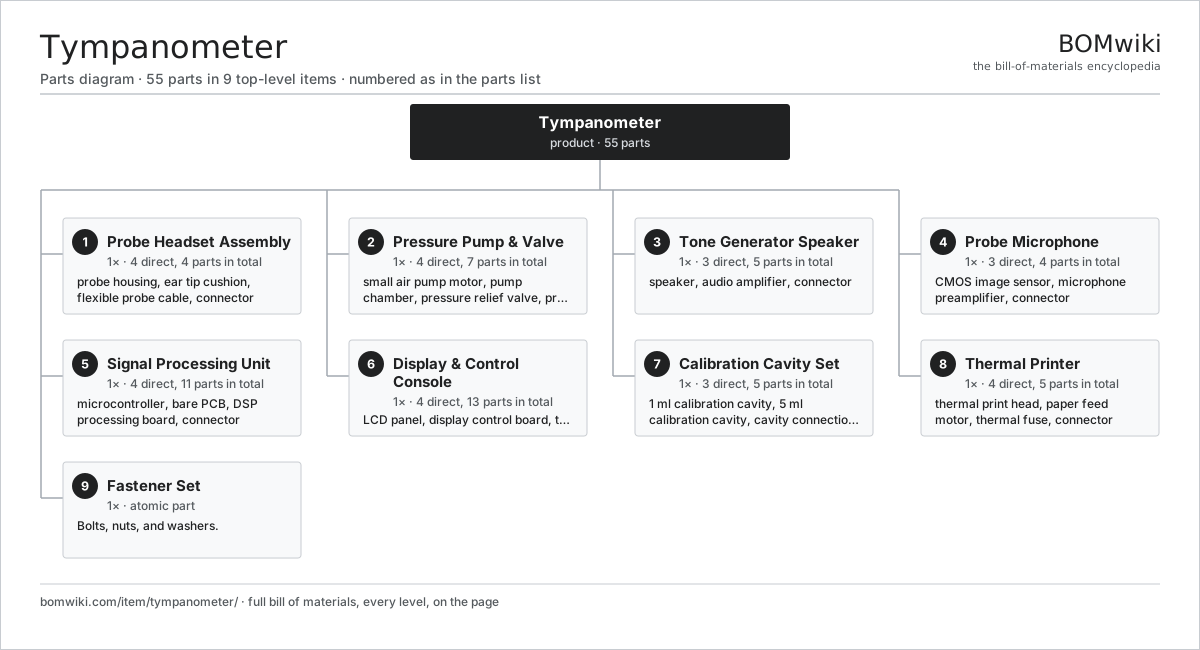
| # | Part | Qty | What it does |
|---|---|---|---|
| 1 | Probe Headset Assembly 4 parts | 1× | Handheld or clip-on probe inserting into the external ear canal. |
| 2 | Pressure Pump & Valve 4 parts | 1× | Air pump that builds and releases pressure in the ear canal from -600 to +200 daPa. |
| 3 | Tone Generator Speaker 3 parts | 1× | Produces 226 Hz reference tone into the ear canal. |
| 4 | Probe Microphone 3 parts | 1× | Measures sound reflected from the tympanic membrane back to the probe. |
| 5 | Signal Processing Unit 4 parts | 1× | Digitizes speaker and microphone signals, calculates admittance (Y) and impedance (Z). |
| 6 | Display & Control Console 4 parts | 1× | LCD screen showing tympanogram curve, compliance/admittance, and middle ear pressure. |
| 7 | Calibration Cavity Set 3 parts | 1× | Two or more known-compliance cavities for daily calibration verification. |
| 8 | Thermal Printer 4 parts | 1× | Prints tympanogram curves and test results on thermal paper. |
| 9 | Fastener Set | 1× | Bolts, nuts, and washers. |
3D model
No 3D model yet. Have a CAD file of this? Add a 3D model. STL renders right on this page; STEP, FreeCAD, and OpenSCAD sources are welcome too (openly licensed, like all 3D models on BOMwiki).
Build & assembly graph
expand / collapse · shared sub-assemblies converge · links to related products · est. labourTap an assembly to expand/collapse · tap a part to open it · use “Open page” for any node · drag to pan, scroll to zoom.
Bill of materials for Tympanometer
9 top-level lines · 58 rows shown · 55 parts total · indented to 3 levels| # | Item / sub-assembly | Part no. | Qty/assy | Ext. qty | Parts | Type |
|---|---|---|---|---|---|---|
| 1 | Probe Headset Assembly 4 parts | tympanometer-probe-unit | 1× | 1 | 4 | assembly |
| 1.1 | Probe Housing | tympanometer-probe-body | 1× | 1 | · | part |
| 1.2 | Ear Tip Cushion | tympanometer-tip-cushion | 1× | 1 | · | part |
| 1.3 | Flexible Probe Cable | tympanometer-cable-flex | 1× | 1 | · | part |
| 1.4 | Connector | connector | 1× | 1 | · | part |
| 2 | Pressure Pump & Valve 4 parts | tympanometer-pump-system | 1× | 1 | 7 | assembly |
| 2.1 | Small Air Pump Motor 2 parts | tympanometer-pump-motor | 1× | 1 | 2 | assembly |
| 2.1.1 | Blower Motor | blower-motor | 1× | 1 | · | part |
| 2.1.2 | Motor Housing | motor-housing | 1× | 1 | · | part |
| 2.2 | Pump Chamber | tympanometer-pump-chamber | 1× | 1 | · | part |
| 2.3 | Pressure Relief Valve | tympanometer-relief-valve | 1× | 1 | · | part |
| 2.4 | Pressure Regulator 2 parts | tympanometer-regulator | 1× | 1 | 3 | assembly |
| 2.4.1 | Solenoid Proportional Valve | tympanometer-solenoid-valve | 2× | 2 | · | part |
| 2.4.2 | Relay | relay | 1× | 1 | · | part |
| 3 | Tone Generator Speaker 3 parts | tympanometer-speaker-driver | 1× | 1 | 5 | assembly |
| 3.1 | Speaker | speaker | 1× | 1 | · | part |
| 3.2 | Audio Amplifier 3 parts | tympanometer-tone-driver | 1× | 1 | 3 | assembly |
| 3.2.1 | Bare PCB | pcb-bare | 1× | 1 | · | part |
| 3.2.2 | SMD Passive (R/C/L) | smd-passives | 1× | 1 | · | part |
| 3.2.3 | Microcontroller | mcu | 1× | 1 | · | part |
| 3.3 | Connector | connector | 1× | 1 | · | part |
| 4 | Probe Microphone 3 parts | tympanometer-microphone | 1× | 1 | 4 | assembly |
| 4.1 | CMOS Image Sensor | image-sensor | 1× | 1 | · | part |
| 4.2 | Microphone Preamplifier 2 parts | tympanometer-preamp | 1× | 1 | 2 | assembly |
| 4.2.1 | Bare PCB | pcb-bare | 1× | 1 | · | part |
| 4.2.2 | SMD Passive (R/C/L) | smd-passives | 1× | 1 | · | part |
| 4.3 | Connector | connector | 1× | 1 | · | part |
| 5 | Signal Processing Unit 4 parts | tympanometer-processor-unit | 1× | 1 | 11 | assembly |
| 5.1 | Microcontroller | mcu | 1× | 1 | · | part |
| 5.2 | Bare PCB | pcb-bare | 1× | 1 | · | part |
| 5.3 | DSP Processing Board 3 parts | tympanometer-dsp-board | 1× | 1 | 3 | assembly |
| 5.3.1 | Bare PCB | pcb-bare | 1× | 1 | · | part |
| 5.3.2 | Compute SoC Module | soc-module | 1× | 1 | · | part |
| 5.3.3 | SMD Passive (R/C/L) | smd-passives | 1× | 1 | · | part |
| 5.4 | Connector | connector | 6× | 6 | · | part |
| 6 | Display & Control Console 4 parts | tympanometer-display-console | 1× | 1 | 13 | assembly |
| 6.1 | LCD Panel | lcd-panel | 1× | 1 | · | part |
| 6.2 | Display Control Board 3 parts | tympanometer-display-board | 1× | 1 | 3 | assembly |
| 6.2.1 | Microcontroller | mcu | 1× | 1 | · | part |
| 6.2.2 | Bare PCB | pcb-bare | 1× | 1 | · | part |
| 6.2.3 | SMD Passive (R/C/L) | smd-passives | 1× | 1 | · | part |
| 6.3 | Test Control Buttons 3 parts | tympanometer-control-buttons | 1× | 1 | 6 | assembly |
| 6.3.1 | Bare PCB | pcb-bare | 1× | 1 | · | part |
| 6.3.2 | Pushbutton Switch | tympanometer-button-switch | 4× | 4 | · | part |
| 6.3.3 | Connector | connector | 1× | 1 | · | part |
| 6.4 | Connector | connector | 3× | 3 | · | part |
| 7 | Calibration Cavity Set 3 parts | tympanometer-calibration-module | 1× | 1 | 5 | assembly |
| 7.1 | 1 mL Calibration Cavity | tympanometer-cavity-1ml | 1× | 1 | · | part |
| 7.2 | 5 mL Calibration Cavity | tympanometer-cavity-5ml | 1× | 1 | · | part |
| 7.3 | Cavity Connection Plug | tympanometer-cavity-plug | 3× | 3 | · | part |
| 8 | Thermal Printer 4 parts | tympanometer-printer | 1× | 1 | 5 | assembly |
| 8.1 | Thermal Print Head | tympanometer-print-head | 1× | 1 | · | part |
| 8.2 | Paper Feed Motor 2 parts | tympanometer-paper-feed-motor | 1× | 1 | 2 | assembly |
| 8.2.1 | Blower Motor | blower-motor | 1× | 1 | · | part |
| 8.2.2 | Motor Housing | motor-housing | 1× | 1 | · | part |
| 8.3 | Thermal Fuse | thermal-fuse | 1× | 1 | · | part |
| 8.4 | Connector | connector | 1× | 1 | · | part |
| 9 | Fastener Set | fastener-set | 1× | 1 | · | part |
Something wrong in this list? Report a problem with this BOM.
Related products
same domain, ranked by shared parts CT Scanner
336 parts · shares 6 with this page
CT Scanner
336 parts · shares 6 with this page
 PET-CT Scanner
514 parts · shares 6 with this page
PET-CT Scanner
514 parts · shares 6 with this page
 Infant Incubator
234 parts · shares 5 with this page
Heart-Lung Machine
298 parts · shares 6 with this page
Rehabilitation Robot Arm
467 parts · shares 6 with this page
Infant Incubator
234 parts · shares 5 with this page
Heart-Lung Machine
298 parts · shares 6 with this page
Rehabilitation Robot Arm
467 parts · shares 6 with this page
 X-Ray Machine
205 parts · shares 5 with this page
X-Ray Machine
205 parts · shares 5 with this page
Sourcing: possible vendors
Browse the supplier directory → Prices, MOQ, and lead times are algorithmic estimates, not quotes, and not claims about these companies. Company mappings are curated by keyword; est. price band $500–$3M. How estimates work| Vendor | HQ | Specialty | MOQ | Lead time |
|---|---|---|---|---|
| gehealthcare.com ↗ | Chicago, US | Medical imaging & devices | 100 units | 12–20 wks |
| siemens-healthineers.com ↗ | Erlangen, DE | Medical systems | 100 units | 12–20 wks |
|
🇳🇱Philips
philips.com ↗
|
Amsterdam, NL | Health technology | 100 units | 12–20 wks |
| medtronic.com ↗ | Minneapolis, US | Medical devices | 100 units | 12–20 wks |
|
🇨🇳Mindray
mindray.com ↗
|
Shenzhen, CN | Medical devices | 100 units | 12–20 wks |
828-word article