Underwater Pool Light
ProductOverview
An underwater pool light illuminates a swimming pool from a niche cast into the wall below the waterline. The modern form is a sealed LED unit drawing 20 to 70 watts, replacing the 300–500 W incandescent fixtures of earlier decades, and fed at 12 volts from an isolating transformer so that no part of the wet environment ever carries mains potential. The fixture is built around two ideas: absolute exclusion of water from the electronics, and electrical safety by isolation rather than by insulation alone.
The light divides into a wet-side Optical Assembly, the LED Module and Control Electronics inside the Sealed Enclosure, the Power Interface running back to the deck, and the Niche Housing permanently built into the pool wall.
Electrical safety architecture
Pool lighting is one of the most safety-constrained corners of luminaire design, governed by IEC 60598-2-18 and, in North America, NEC Article 680. The core measure is SELV supply: a safety isolating transformer steps mains down to 12 V at the Transformer Terminal, with the secondary winding isolated from both primary and earth. Even a complete failure of the fixture's insulation then cannot impose a dangerous voltage on the water. The transformer and the Junction Box sit on the deck, at least 200 mm above water level, and the long Supply Cord is the only conductor that enters the pool environment.
The second measure is equipotential bonding. The metal Niche Shell connects through the Bonding Lug into the pool's bonding grid, rebar, ladder cups, rails, and pump, with solid copper conductor, so a swimmer cannot bridge a voltage gradient between any two touchable surfaces. The niche is a "wet niche": it floods with pool water by design, and the fixture sits inside it as a sealed object rather than relying on the niche for dryness.
Sealing
The fixture is rated IP68 for indefinite submersion at its design depth, where it sees roughly 0.1–0.2 bar of water pressure. The primary barrier is the Face Gasket compressed between the Front Lens and the Rear Shell by the Clamp Ring; gasket relaxation and uneven clamp-screw torque account for most field leaks. Chlorinated water is chemically aggressive, chloramines attack many stainless grades and most elastomers, so bodies are 316 stainless, bronze, or glass-filled polymer, gaskets are EPDM or silicone, and exposed fasteners are 316 stainless from the Fastener Set.
Defense in depth continues inside. The driver board is encased in Potting Compound, so even if the lens seal fails the electronics survive long enough for the Moisture Sensor to detect conductivity between its probes and shut the unit down. The Cord Entry Seal where the cord enters the body is molded at the factory and is deliberately not field-serviceable; a repairable joint would be a permanent leak risk.
Light engine and thermal design
The RGBW LED Emitters sit on a Metal-Core PCB whose aluminum core conducts heat through a Thermal Interface Pad into the shell. Thermal design is unusually easy underwater: pool water at 25–30 °C is an effectively infinite heatsink, and junction temperatures run far below those of an equivalent dry fixture, one reason submerged LED lights routinely reach their 30,000–50,000 hour rated life. The same physics imposes the standard warning against running the light out of water: in air, the shell that the water normally cools will overheat the emitters within minutes, and many controllers derate or shut down on the internal temperature reading.
Per-emitter LED Lenses spread the beam to 100–120°, and the Front Lens often adds prismatic ribs to stretch light along the pool's length. Color comes from current-ratio mixing across the four channels by the Constant-Current Drivers and Power MOSFET PWM switches, giving saturated colors for effect and a high-CRI white for ordinary night swimming.
Control and installation
Most pool lights receive no data wire, only switched 12 V. The Toggle Decoder therefore reads intent from the power switch itself: cycling power off and on within a second or two steps the Microcontroller through fixed colors and pre-programmed shows, and a defined toggle sequence re-synchronizes several lights to the same program. Higher-end systems superimpose RF or app control at the transformer end instead.
Installation explains the long cord. The Conduit Hub routes the cord through buried conduit to the deck box, and 15–30 m of slack is coiled behind the fixture in the niche. To service the light, a technician removes the single Retaining Screw, lifts the fixture out of the flooded niche, and floats it up onto the deck on its own cord, the pool is never drained, and no connection is opened underwater.
Underwater Pool Light parts and their functions
6 top-level parts · 82 parts in total · full bill of materials below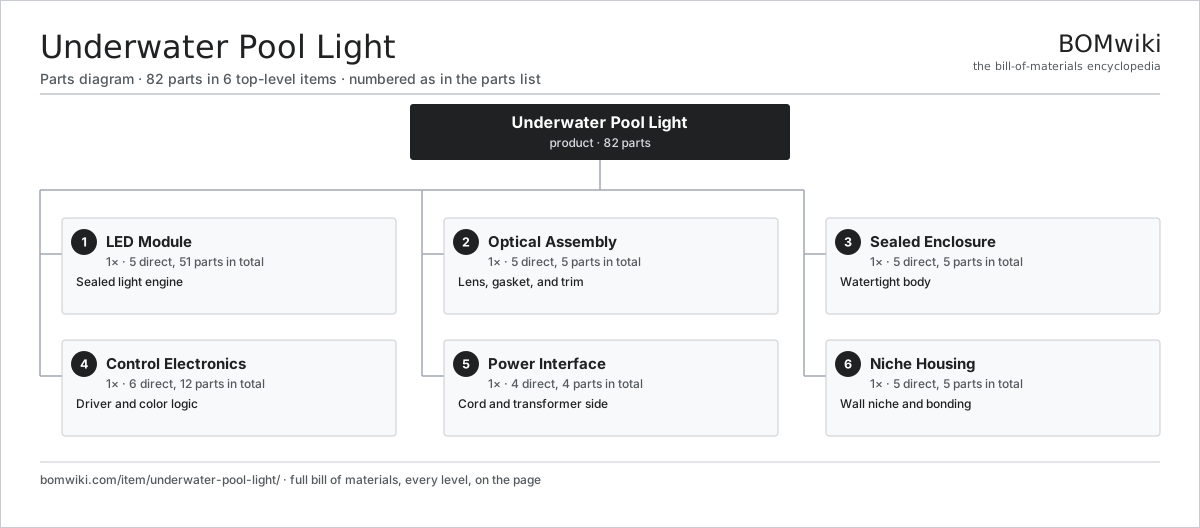
| # | Part | Qty | What it does |
|---|---|---|---|
| 1 | LED Module 5 parts | 1× | Sealed light engine |
| 2 | Optical Assembly 5 parts | 1× | Lens, gasket, and trim |
| 3 | Sealed Enclosure 5 parts | 1× | Watertight body |
| 4 | Control Electronics 6 parts | 1× | Driver and color logic |
| 5 | Power Interface 4 parts | 1× | Cord and transformer side |
| 6 | Niche Housing 5 parts | 1× | Wall niche and bonding |
3D model
No 3D model yet. Have a CAD file of this? Add a 3D model. STL renders right on this page; STEP, FreeCAD, and OpenSCAD sources are welcome too (openly licensed, like all 3D models on BOMwiki).
Build & assembly graph
expand / collapse · shared sub-assemblies converge · links to related products · est. labourTap an assembly to expand/collapse · tap a part to open it · use “Open page” for any node · drag to pan, scroll to zoom.
Bill of materials for Underwater Pool Light
6 top-level lines · 36 rows shown · 82 parts total · indented to 3 levels| # | Item / sub-assembly | Part no. | Qty/assy | Ext. qty | Parts | Type |
|---|---|---|---|---|---|---|
| 1 | LED Module 5 parts | underwater-pool-light-led-module | 1× | 1 | 51 | assembly |
| 1.1 | RGBW LED Emitters | underwater-pool-light-rgbw-emitters | 24× | 24 | · | part |
| 1.2 | Metal-Core PCB | underwater-pool-light-mcpcb | 1× | 1 | · | part |
| 1.3 | Thermal Interface Pad | underwater-pool-light-thermal-pad | 1× | 1 | · | part |
| 1.4 | LED Lenses | underwater-pool-light-led-lenses | 24× | 24 | · | part |
| 1.5 | Connector | connector | 1× | 1 | · | part |
| 2 | Optical Assembly 5 parts | underwater-pool-light-optical-assembly | 1× | 1 | 5 | assembly |
| 2.1 | Front Lens | underwater-pool-light-front-lens | 1× | 1 | · | part |
| 2.2 | Face Gasket | underwater-pool-light-face-gasket | 1× | 1 | · | part |
| 2.3 | Clamp Ring | underwater-pool-light-clamp-ring | 1× | 1 | · | part |
| 2.4 | Trim Bezel | underwater-pool-light-trim-bezel | 1× | 1 | · | part |
| 2.5 | Fastener Set | fastener-set | 1× | 1 | · | part |
| 3 | Sealed Enclosure 5 parts | underwater-pool-light-sealed-enclosure | 1× | 1 | 5 | assembly |
| 3.1 | Rear Shell | underwater-pool-light-rear-shell | 1× | 1 | · | part |
| 3.2 | Potting Compound | underwater-pool-light-potting-compound | 1× | 1 | · | part |
| 3.3 | Cord Entry Seal | underwater-pool-light-cord-seal | 1× | 1 | · | part |
| 3.4 | O-Ring Set | oring-set | 1× | 1 | · | part |
| 3.5 | Moisture Sensor | underwater-pool-light-moisture-sensor | 1× | 1 | · | part |
| 4 | Control Electronics 6 parts | underwater-pool-light-control-electronics | 1× | 1 | 12 | assembly |
| 4.1 | Microcontroller | mcu | 1× | 1 | · | part |
| 4.2 | Bare PCB | pcb-bare | 1× | 1 | · | part |
| 4.3 | Constant-Current Drivers | underwater-pool-light-cc-drivers | 4× | 4 | · | part |
| 4.4 | Toggle Decoder | underwater-pool-light-toggle-decoder | 1× | 1 | · | part |
| 4.5 | SMD Passive (R/C/L) | smd-passives | 1× | 1 | · | part |
| 4.6 | Power MOSFET | mosfet | 4× | 4 | · | part |
| 5 | Power Interface 4 parts | underwater-pool-light-power-interface | 1× | 1 | 4 | assembly |
| 5.1 | Supply Cord | underwater-pool-light-supply-cord | 1× | 1 | · | part |
| 5.2 | Transformer Terminal | underwater-pool-light-transformer-terminal | 1× | 1 | · | part |
| 5.3 | Junction Box | underwater-pool-light-junction-box | 1× | 1 | · | part |
| 5.4 | Wire Bundle | wire-bundle | 1× | 1 | · | part |
| 6 | Niche Housing 5 parts | underwater-pool-light-niche-housing | 1× | 1 | 5 | assembly |
| 6.1 | Niche Shell | underwater-pool-light-niche-shell | 1× | 1 | · | part |
| 6.2 | Conduit Hub | underwater-pool-light-conduit-hub | 1× | 1 | · | part |
| 6.3 | Bonding Lug | underwater-pool-light-bonding-lug | 1× | 1 | · | part |
| 6.4 | Retaining Screw | underwater-pool-light-mounting-screw | 1× | 1 | · | part |
| 6.5 | Fastener Set | fastener-set | 1× | 1 | · | part |
Something wrong in this list? Report a problem with this BOM.
Related products
same domain, ranked by shared parts Aviation Obstruction Light
192 parts · shares 3 with this page
Aviation Obstruction Light
192 parts · shares 3 with this page
 Heliport Beacon
39 parts · shares 3 with this page
Heliport Beacon
39 parts · shares 3 with this page
 Tactical Flashlight
31 parts · shares 3 with this page
Airfield Runway Light
174 parts · shares 2 with this page
Industrial UV Curing Lamp
300 parts · shares 2 with this page
Lighthouse Rotating Beacon
250 parts · shares 2 with this page
Tactical Flashlight
31 parts · shares 3 with this page
Airfield Runway Light
174 parts · shares 2 with this page
Industrial UV Curing Lamp
300 parts · shares 2 with this page
Lighthouse Rotating Beacon
250 parts · shares 2 with this page
Sourcing: possible vendors
Browse the supplier directory → Prices, MOQ, and lead times are algorithmic estimates, not quotes, and not claims about these companies. Company mappings are curated by keyword; est. price band $3–$2k. How estimates work| Vendor | HQ | Specialty | MOQ | Lead time |
|---|---|---|---|---|
|
🇳🇱Signify
signify.com ↗
|
Eindhoven, NL | Lighting (Philips Hue) | 2,000 units | 6–10 wks |
| acuitybrands.com ↗ | Atlanta, US | Lighting & controls | 2,000 units | 6–10 wks |
|
🇦🇹Zumtobel
zumtobelgroup.com ↗
|
Dornbirn, AT | Lighting | 2,000 units | 6–10 wks |
| creelighting.com ↗ | Racine, US | LED lighting | 2,000 units | 6–10 wks |
|
🇮🇳Havells
havells.com ↗
|
Noida, IN | Electrical & lighting | 2,000 units | 6–10 wks |
863-word article