Vehicle Alternator
ProductOverview
A vehicle alternator is an AC electrical generator that converts mechanical energy from the engine into direct current (DC) electrical power, supplying the battery charging system and all vehicle electrical loads. Unlike automotive starters (which draw short bursts of high current), the alternator runs continuously while the engine operates, providing steady-state power for lighting, ignition systems, fuel injectors, climate control, and auxiliary accessories.
The alternator employs a rotating magnetic field generated by the rotor, which induces three-phase AC current in the stator windings. Internal diodes (the rectifier bridge) convert this AC to DC, while an electronic voltage regulator holds output steady at 13.5–14.5V, preventing battery overcharge and protecting vehicle electronics. Modern alternators integrate the regulator into the unit itself, communicating with the vehicle's battery management system via CAN-bus or simple voltage feedback.
How It Works
The alternator couples to the engine crankshaft via a serpentine belt and pulley system, typically at a 3:1 to 4:1 ratio. As the engine spins, the Serpentine Belt Pulley drives the Rotor Assembly at 1000–15,000 rpm depending on engine speed.
The rotor houses a field coil (200–500 turns of copper wire) wound around two interlocking claw poles, one north, one south. A small DC current (the field current, typically 2–5A) is supplied via Slip Ring Assembly from the Voltage Regulator. This current magnetizes the claw poles, creating a strong rotating magnetic flux that sweeps past the Stator Assembly.
The stator is fixed to the housing and contains three independent AC windings (U, V, W phases), each offset 120° around the circumference. As the rotor's magnetic poles rotate, they induce changing magnetic flux through these windings, generating a three-phase AC voltage (80–200V peak depending on rpm and field current). Each phase produces a sinusoid 120° out of phase with the others.
The three stator phase outputs feed into the Rectifier Diode Bridge, six high-power diodes arranged so that at any instant, one pair conducts, delivering only positive-polarity current to the output. This full-wave rectification converts the three-phase AC into a rippled but unidirectional DC output, nominally 12V when the engine idles and rising to 14.5V under load.
The Voltage Regulator continuously monitors the battery voltage via a sense line. If voltage rises above 14.5V, the regulator reduces field current, weakening the rotor's magnetic field and lowering output voltage. Conversely, if voltage drops below 13.5V, field current increases, boosting output to recharge the battery. This closed-loop control keeps the alternator output within ±0.3V, protecting battery and electronics.
Cooling occurs passively: the rotor-mounted Cooling Fan acts as an impeller, drawing ambient air through the aluminum Housing and Frame with integrated cooling fins. At high rpm, airflow is substantial (100+ m³/h), shedding 50–100W of waste heat that inevitably arises from diode losses and winding resistance.
Electrical Characteristics
At idle (600–900 rpm), the alternator may output 30–50A at 13.5V. Under load (headlights, wipers, rear window defroster active), engine speed rises to 2000+ rpm, and alternator output climbs to 80–150A depending on the unit's rating. Modern vehicles typically use 100A or 150A alternators to support additional accessory loads.
The rectifier diodes dissipate power proportional to current squared: at 150A, diode loss alone can exceed 50W. The Rectifier Heatsink thermally couples the diodes to the housing, allowing the aluminum fins to reject heat into the engine bay.
The regulator circuit responds in milliseconds. A burst of high load causes voltage to sag; the regulator immediately boosts field current. Conversely, coasting downhill with minimal load causes voltage to rise; the regulator cuts field current to hold voltage steady. This prevents battery overcharge (which damages battery plates) and overvoltage damage to sensitive electronics (engine control computers, infotainment systems).
Mechanical Design
The Rotor Shaft rotates on two deep-groove ball bearings, typically a 6203 series (inner bore 17 mm, outer bore 40 mm) at the front and a 6205 (inner bore 25 mm, outer bore 52 mm) at the rear, supporting the rotor against radial and axial loads from belt tension.
The claw poles (north and south) are ferromagnetic steel with machine-formed finger structures that interleave, creating a compact rotor with uniform air gap around the circumference. This geometry maximizes flux linkage into the stator while minimizing rotor mass and inertia.
The stator core is laminated silicon steel, punched into a radial-vane structure and compressed to form a rigid cylinder. Lamination (0.35–0.5 mm thick) minimizes eddy-current losses in the core. Windings (0.8–1.2 mm copper wire) are wound into closed slots, then the end connections are formed and soldered to the three phase terminals.
Maintenance and Failure Modes
The Slip Ring Assembly and brushes are the primary wear component. Brushes (carbon contacts) press against the slip rings with light force (0.5–1 N), sliding across them as the rotor turns. After 100,000–150,000 miles, brush wear reaches a critical point where contact resistance rises sharply, field current drops, and alternator output fails. This is the most common alternator failure mode in older vehicles.
Bearing wear (grinding noise) indicates the rotor shaft is beginning to rock, allowing internal contact between rotor claw poles and stator windings, eventually causing short circuits and catastrophic failure.
Diode failure (silent but sudden loss of charging) occurs when a diode becomes reverse-biased permanently due to voltage overshoot (from a disconnected battery during the alternator running, causing voltage spikes) or overheating. A failed diode effectively removes one path from the rectifier bridge, causing severe voltage ripple and partial output loss.
Corrosion of slip-ring contacts in high-humidity environments can increase resistance, starving the field coil. Cleaning or replacement extends life.
Variants and Modern Features
Three-phase brushless alternators eliminate slip rings by using a stationary field coil and a rotating permanent magnet rotor with an internal rectifier. These are increasingly common in hybrid and electric vehicles but are more complex to service.
Integrated regulators with CAN-bus communication allow the vehicle's battery management system to request higher or lower charging rates based on battery state of charge, vehicle speed, and auxiliary loads. Smart charging algorithms extend battery life and improve fuel economy by avoiding unnecessary high-current charging.
High-output alternators (180A+) designed for extended-idle vehicles (police, emergency services) employ larger claw poles and heavier field coils, consuming 8–10A field current and generating significant heat.
Vehicle Alternator parts and their functions
8 top-level parts · 25 parts in total · full bill of materials below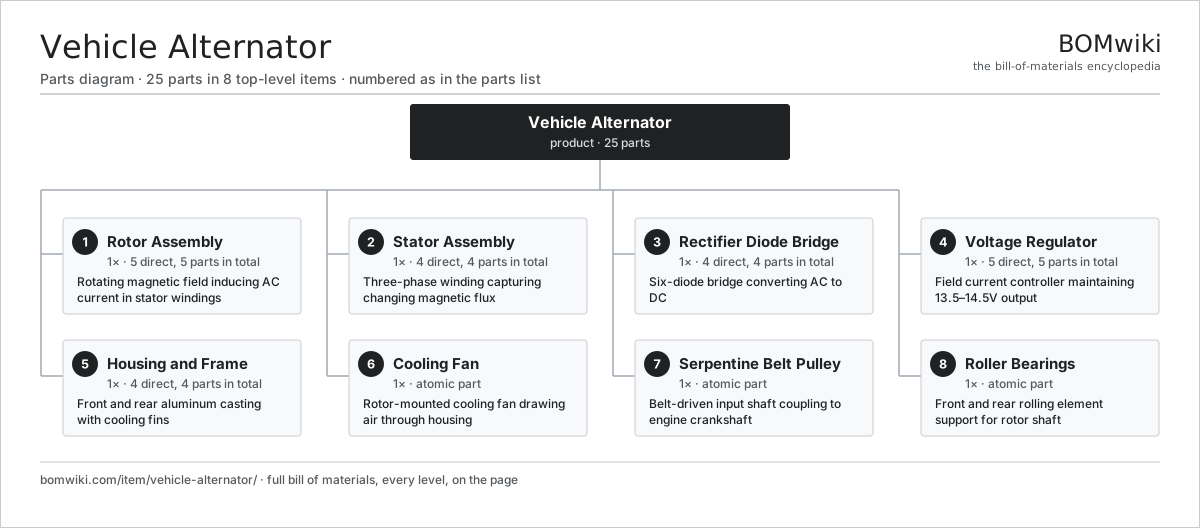
| # | Part | Qty | What it does |
|---|---|---|---|
| 1 | Rotor Assembly 5 parts | 1× | Rotating magnetic field inducing AC current in stator windings |
| 2 | Stator Assembly 4 parts | 1× | Three-phase winding capturing changing magnetic flux |
| 3 | Rectifier Diode Bridge 4 parts | 1× | Six-diode bridge converting AC to DC |
| 4 | Voltage Regulator 5 parts | 1× | Field current controller maintaining 13.5–14.5V output |
| 5 | Housing and Frame 4 parts | 1× | Front and rear aluminum casting with cooling fins |
| 6 | Cooling Fan | 1× | Rotor-mounted cooling fan drawing air through housing |
| 7 | Serpentine Belt Pulley | 1× | Belt-driven input shaft coupling to engine crankshaft |
| 8 | Roller Bearings | 1× | Front and rear rolling element support for rotor shaft |
3D model
No 3D model yet. Have a CAD file of this? Add a 3D model. STL renders right on this page; STEP, FreeCAD, and OpenSCAD sources are welcome too (openly licensed, like all 3D models on BOMwiki).
Build & assembly graph
expand / collapse · shared sub-assemblies converge · links to related products · est. labourTap an assembly to expand/collapse · tap a part to open it · use “Open page” for any node · drag to pan, scroll to zoom.
Bill of materials for Vehicle Alternator
8 top-level lines · 30 rows shown · 25 parts total · indented to 3 levels| # | Item / sub-assembly | Part no. | Qty/assy | Ext. qty | Parts | Type |
|---|---|---|---|---|---|---|
| 1 | Rotor Assembly 5 parts | vehicle-alternator-rotor-assembly | 1× | 1 | 5 | assembly |
| 1.1 | Rotor Shaft | vehicle-alternator-rotor-shaft | 1× | 1 | · | part |
| 1.2 | North-Pole Claw | vehicle-alternator-claw-pole-north | 1× | 1 | · | part |
| 1.3 | South-Pole Claw | vehicle-alternator-claw-pole-south | 1× | 1 | · | part |
| 1.4 | Field Winding | vehicle-alternator-field-coil | 1× | 1 | · | part |
| 1.5 | Slip Ring Assembly | vehicle-alternator-slip-rings | 1× | 1 | · | part |
| 2 | Stator Assembly 4 parts | vehicle-alternator-stator-assembly | 1× | 1 | 4 | assembly |
| 2.1 | Laminated Stator Core | vehicle-alternator-stator-core | 1× | 1 | · | part |
| 2.2 | Copper Winding | copper-winding | 1× | 1 | · | part |
| 2.3 | Winding Insulation Liner | vehicle-alternator-insulation-liner | 1× | 1 | · | part |
| 2.4 | Stator Phase Terminals | vehicle-alternator-phase-terminal | 1× | 1 | · | part |
| 3 | Rectifier Diode Bridge 4 parts | vehicle-alternator-rectifier-bridge | 1× | 1 | 4 | assembly |
| 3.1 | Positive Rectifier Diodes | vehicle-alternator-positive-diodes | 1× | 1 | · | part |
| 3.2 | Negative Rectifier Diodes | vehicle-alternator-negative-diodes | 1× | 1 | · | part |
| 3.3 | Rectifier Heatsink | vehicle-alternator-rectifier-heatsink | 1× | 1 | · | part |
| 3.4 | B+ Output Terminal | vehicle-alternator-diode-terminal | 1× | 1 | · | part |
| 4 | Voltage Regulator 5 parts | vehicle-alternator-voltage-regulator | 1× | 1 | 5 | assembly |
| 4.1 | Microcontroller | mcu | 1× | 1 | · | part |
| 4.2 | Voltage Sense Network | vehicle-alternator-voltage-sense-circuit | 1× | 1 | · | part |
| 4.3 | Field Drive Transistor | vehicle-alternator-field-driver | 1× | 1 | · | part |
| 4.4 | SMD Passive (R/C/L) | smd-passives | 1× | 1 | · | part |
| 4.5 | Bare PCB | pcb-bare | 1× | 1 | · | part |
| 5 | Housing and Frame 4 parts | vehicle-alternator-housing-assembly | 1× | 1 | 4 | assembly |
| 5.1 | Front Housing | vehicle-alternator-front-housing | 1× | 1 | · | part |
| 5.2 | Rear Housing | vehicle-alternator-rear-housing | 1× | 1 | · | part |
| 5.3 | Fastener Set | fastener-set | 1× | 1 | · | part |
| 5.4 | Housing Seal Gasket | vehicle-alternator-seal-gasket | 1× | 1 | · | part |
| 6 | Cooling Fan | vehicle-alternator-fan | 1× | 1 | · | part |
| 7 | Serpentine Belt Pulley | vehicle-alternator-pulley | 1× | 1 | · | part |
| 8 | Roller Bearings | vehicle-alternator-bearings | 1× | 1 | · | part |
Something wrong in this list? Report a problem with this BOM.
Related products
same domain, ranked by shared parts City Car
436 parts · shares 3 with this page
City Car
436 parts · shares 3 with this page
 Convertible Car
1,727 parts · shares 3 with this page
Convertible Car
1,727 parts · shares 3 with this page
 Coupe Car
1,617 parts · shares 3 with this page
Coupe Car
1,617 parts · shares 3 with this page
 Crew Cab Pickup
1,009 parts · shares 3 with this page
Crew Cab Pickup
1,009 parts · shares 3 with this page
 Crossover SUV
1,653 parts · shares 3 with this page
Crossover SUV
1,653 parts · shares 3 with this page
 Electric Car
2,677 parts · shares 3 with this page
Electric Car
2,677 parts · shares 3 with this page
Sourcing: possible vendors
Browse the supplier directory → Prices, MOQ, and lead times are algorithmic estimates, not quotes, and not claims about these companies. Company mappings are curated by keyword; est. price band $8k–$90k. How estimates work| Vendor | HQ | Specialty | MOQ | Lead time |
|---|---|---|---|---|
|
🇯🇵Toyota
global.toyota ↗
|
Toyota City, JP | Automaker | made to order | 16–28 wks |
| volkswagen-group.com ↗ | Wolfsburg, DE | Automaker | made to order | 16–28 wks |
| gm.com ↗ | Detroit, US | Automaker | made to order | 16–28 wks |
| hyundai.com ↗ | Seoul, KR | Automaker | made to order | 16–28 wks |
|
🇨🇳BYD
byd.com ↗
|
Shenzhen, CN | EV & battery manufacturer | made to order | 16–28 wks |
1,103-word article