Vertical Ergonomic Mouse
ProductOverview
A vertical ergonomic mouse is a pointing device designed to minimize repetitive strain injury (RSI) by keeping the user's wrist in a neutral, extended position rather than the pronated (palm-down) grip required by traditional mice. Instead of twisting the forearm inward 80 degrees to manipulate a standard mouse, a vertical mouse maintains the arm and wrist in a natural alignment closer to a handshake. Long-term users report significant reductions in wrist pain, tennis elbow symptoms, and carpal tunnel discomfort.
The vertical orientation typically angles the grip 70–80 degrees from horizontal, creating a gentle slope that the hand rests against naturally. Buttons are positioned along the vertical face rather than on top, requiring only finger flexion rather than combined wrist rotation and finger movement. A good vertical mouse weighs 140–180 grams and exhibits the same optical tracking precision as conventional mice, 3200 DPI sensors are standard, making the ergonomic benefit transparent to the user's workflow.
How it Works
The Optical Sensor Module uses infrared LED light to illuminate a mousepad or desk surface, capturing a continuous stream of texture images via an optical photodiode array. The Optical Sensor Chip chip (typically PMW3320) runs a real-time pattern-matching algorithm, correlating sequential images to detect displacement. At 50 Hz sampling (once every 20 ms), a mouse moving at typical working speed (10 cm/s) produces a new pattern every 2 pixels, providing smooth cursor acceleration with minimal latency.
The Microcontroller Unit reads displacement vectors from the optical sensor, debounces button presses, and packages motion and click data into USB HID reports. For wireless operation via Bluetooth LE SoC, the MCU encodes reports using Bluetooth LE HID-over-GATT protocol, broadcasting at 100–1000 Hz depending on motion speed and user settings.
Vertical grip reduces pronation torque on the forearm. When clicking, the user flexes fingers downward, a movement that requires minimal wrist involvement. Scrolling via the encoder also uses pure finger motion without wrist rotation, further reducing strain. Over an 8-hour workday, this prevents the cumulative micro-abrasions inside the carpal tunnel that lead to inflammation and eventual pain.
Optical Sensor Mechanics
The infrared LED emits light at 850 nm, a wavelength invisible to the human eye but readily detected by the sensor's photodiode array. A plastic objective lens focuses the LED light onto the surface, creating a small illuminated area (typically 2–4 mm diameter) beneath the mouse. The scratch-resistant window (sapphire or hardened polymer) protects the lens from debris and repeated friction against mousepads.
The Optical Sensor Chip contains a 16×16 photodiode array, each element sampled at 1600–3200 samples per second. The on-chip signal processor converts analog light intensity into a digital grayscale image of the surface texture. A correlation engine compares the current frame with the previous frame, computing the best 2D translation that minimizes pixel differences. The result is a sub-pixel displacement vector reported to the Microcontroller Unit.
At 3200 DPI, the sensor achieves approximately 0.008 mm (8 micrometers) per count. This allows precise positioning in spreadsheets, code editors, and CAD software. Acceleration curves in firmware amplify fast movements, enabling rapid screen traversal without sacrificing precision for fine work.
Button and Scroll Interface
The left-click switch is typically a Cherry MX mechanical switch rated for 50 million actuations. Mechanical switches provide auditory and tactile feedback, reducing the ambiguity of whether a click registered, important for users who might have reduced sensitivity due to repetitive stress. The right-click switch is identical, mounted alongside. Two side buttons on the left edge handle browser back/forward navigation, eliminating the need to reach across the mouse body.
The Scroll Encoder Module is a mechanical encoder with precisely machined detents. As the user rotates the wheel, the encoder IC generates incremental pulses, typically 24 detents per revolution, meaning each notch scrolls one line. This discrete stepping helps users with hand tremors maintain line-by-line reading rhythm. A click-detect switch recognizes downward pressure on the wheel, enabling middle-click for paste-on-middle-click workflows common in Linux environments.
Wireless Power and Battery
Most vertical ergonomic mice use a single AA or AAA alkaline cell for weight balance and durability. A low-dropout LDO regulator converts the nominal 1.5 V battery voltage to the stable 3.3 V required by the Microcontroller Unit and wireless module. At typical usage (3 hours per day, 50% time idle), an AA cell lasts 8–12 months before depletion. The nRF52840 Bluetooth LE SoC implements aggressive power modes: the radio idles with the transmitter disabled, waking only when motion is detected by the accelerometer or a button is pressed.
Battery contact is maintained by a stainless steel spring in the compartment door, ensuring low contact resistance even after repeated insertions. The Battery Cover is typically a friction-fit plastic or aluminum panel that the user removes without tools.
Ergonomic Impact and Limitations
Clinical studies comparing vertical and traditional mice show 30–50% reduction in forearm pronation torque and measurable decrease in flexor carpi radialis muscle activation. For users with existing carpal tunnel syndrome or epicondylitis, the vertical orientation provides significant relief. However, vertical mice are not a panacea: RSI is multifactorial, including keyboard posture, desk height, break frequency, and overall workload. A vertical mouse is most effective as part of a comprehensive ergonomic strategy.
The learning curve is 2–4 weeks. Users accustomed to traditional mice require time to adjust cursor speed expectations and finger reach patterns. Once adapted, most users report the vertical grip feels more natural than their previous mouse. One limitation is gaming: the reduced precision feel and lack of quick lateral movements makes vertical mice suboptimal for high-speed gaming tasks, though competitive esports players have successfully adapted.
Wireless Technology
Bluetooth LE is the modern standard, supporting multiple simultaneous pairings with phones, tablets, and computers. The nRF52840 module implements full HID over Bluetooth Generic Attribute Profile (GATT), appearing to the host OS as a standard USB HID device without drivers. Connection latency is 2–10 ms, imperceptible to the user.
Proprietary 2.4 GHz RF solutions (using chips like the nRF24L01) offer better range (30 meters vs. 10 meters for Bluetooth LE) and lower latency in congested RF environments. However, they require a host USB dongle, adding a physical connector and consuming a USB port.
Vertical Ergonomic Mouse parts and their functions
8 top-level parts · 37 parts in total · full bill of materials below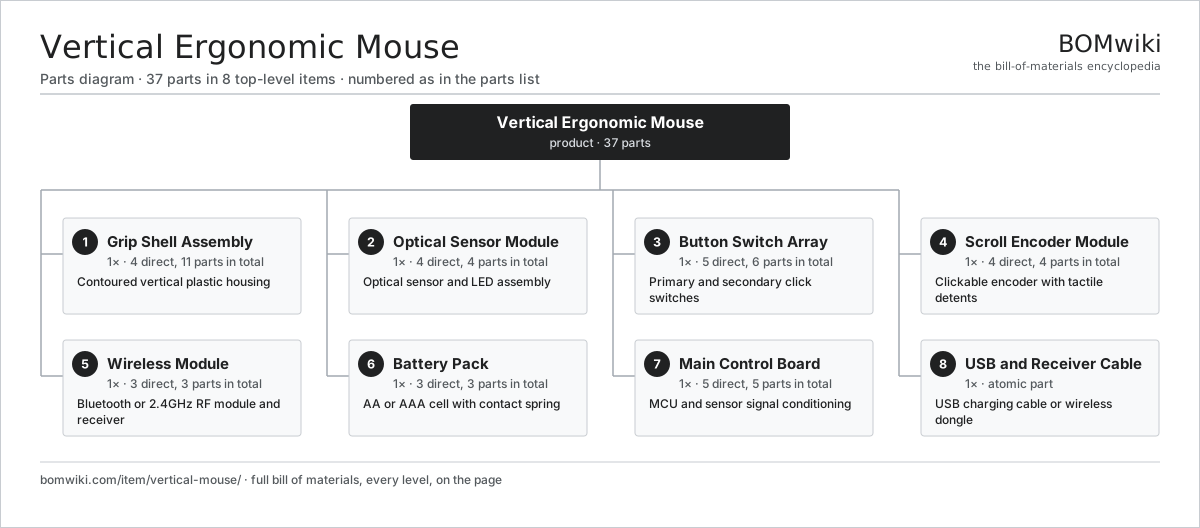
| # | Part | Qty | What it does |
|---|---|---|---|
| 1 | Grip Shell Assembly 4 parts | 1× | Contoured vertical plastic housing |
| 2 | Optical Sensor Module 4 parts | 1× | Optical sensor and LED assembly |
| 3 | Button Switch Array 5 parts | 1× | Primary and secondary click switches |
| 4 | Scroll Encoder Module 4 parts | 1× | Clickable encoder with tactile detents |
| 5 | Wireless Module 3 parts | 1× | Bluetooth or 2.4GHz RF module and receiver |
| 6 | Battery Pack 3 parts | 1× | AA or AAA cell with contact spring |
| 7 | Main Control Board 5 parts | 1× | MCU and sensor signal conditioning |
| 8 | USB and Receiver Cable | 1× | USB charging cable or wireless dongle |
3D model
No 3D model yet. Have a CAD file of this? Add a 3D model. STL renders right on this page; STEP, FreeCAD, and OpenSCAD sources are welcome too (openly licensed, like all 3D models on BOMwiki).
Build & assembly graph
expand / collapse · shared sub-assemblies converge · links to related products · est. labourTap an assembly to expand/collapse · tap a part to open it · use “Open page” for any node · drag to pan, scroll to zoom.
Bill of materials for Vertical Ergonomic Mouse
8 top-level lines · 36 rows shown · 37 parts total · indented to 3 levels| # | Item / sub-assembly | Part no. | Qty/assy | Ext. qty | Parts | Type |
|---|---|---|---|---|---|---|
| 1 | Grip Shell Assembly 4 parts | vertical-mouse-grip-shell | 1× | 1 | 11 | assembly |
| 1.1 | Upper Shell Cover | vertical-mouse-shell-upper | 1× | 1 | · | part |
| 1.2 | Lower Shell Enclosure | vertical-mouse-shell-lower | 1× | 1 | · | part |
| 1.3 | Grip Coating | vertical-mouse-grip-texture | 1× | 1 | · | part |
| 1.4 | Brass Inserts | vertical-mouse-mounting-posts | 8× | 8 | · | part |
| 2 | Optical Sensor Module 4 parts | vertical-mouse-sensor | 1× | 1 | 4 | assembly |
| 2.1 | Optical Sensor Chip | vertical-mouse-sensor-ic | 1× | 1 | · | part |
| 2.2 | Infrared LED | vertical-mouse-led | 1× | 1 | · | part |
| 2.3 | Sensor Lens | vertical-mouse-lens | 1× | 1 | · | part |
| 2.4 | Scratch-Resistant Window | vertical-mouse-sensing-window | 1× | 1 | · | part |
| 3 | Button Switch Array 5 parts | vertical-mouse-button-mechanism | 1× | 1 | 6 | assembly |
| 3.1 | Primary Button Switch | vertical-mouse-primary-switch | 1× | 1 | · | part |
| 3.2 | Secondary Button Switch | vertical-mouse-secondary-switch | 1× | 1 | · | part |
| 3.3 | Navigation Buttons | vertical-mouse-side-buttons | 2× | 2 | · | part |
| 3.4 | Button Routing Board | vertical-mouse-button-pcb | 1× | 1 | · | part |
| 3.5 | Fastener Set | fastener-set | 1× | 1 | · | part |
| 4 | Scroll Encoder Module 4 parts | vertical-mouse-scroll-wheel | 1× | 1 | 4 | assembly |
| 4.1 | Rotary Encoder | vertical-mouse-encoder-ic | 1× | 1 | · | part |
| 4.2 | Scroll Wheel | vertical-mouse-wheel-body | 1× | 1 | · | part |
| 4.3 | Encoder Return Spring | vertical-mouse-encoder-spring | 1× | 1 | · | part |
| 4.4 | Scroll Click Switch | vertical-mouse-push-switch | 1× | 1 | · | part |
| 5 | Wireless Module 3 parts | vertical-mouse-wireless | 1× | 1 | 3 | assembly |
| 5.1 | Bluetooth LE SoC | vertical-mouse-ble-chip | 1× | 1 | · | part |
| 5.2 | Wireless Antenna | vertical-mouse-antenna | 1× | 1 | · | part |
| 5.3 | RF Matching Network | vertical-mouse-matching-network | 1× | 1 | · | part |
| 6 | Battery Pack 3 parts | vertical-mouse-battery | 1× | 1 | 3 | assembly |
| 6.1 | Alkaline Battery Cell | vertical-mouse-battery-cell | 1× | 1 | · | part |
| 6.2 | Battery Contact Spring | vertical-mouse-battery-spring | 1× | 1 | · | part |
| 6.3 | Battery Cover | vertical-mouse-battery-door | 1× | 1 | · | part |
| 7 | Main Control Board 5 parts | vertical-mouse-electronics | 1× | 1 | 5 | assembly |
| 7.1 | Microcontroller Unit | vertical-mouse-mcu | 1× | 1 | · | part |
| 7.2 | Sensor Amplifier | vertical-mouse-sensor-conditioning | 1× | 1 | · | part |
| 7.3 | Voltage Regulator | vertical-mouse-power-distribution | 1× | 1 | · | part |
| 7.4 | Bare PCB | pcb-bare | 1× | 1 | · | part |
| 7.5 | SMD Passive (R/C/L) | smd-passives | 1× | 1 | · | part |
| 8 | USB and Receiver Cable | vertical-mouse-cable | 1× | 1 | · | part |
Something wrong in this list? Report a problem with this BOM.
Sourcing: possible vendors
Browse the supplier directory → Prices, MOQ, and lead times are algorithmic estimates, not quotes, and not claims about these companies. Company mappings are curated by keyword; est. price band $20–$3k. How estimates work| Vendor | HQ | Specialty | MOQ | Lead time |
|---|---|---|---|---|
| dell.com ↗ | Round Rock, US | Computers & infrastructure | 1,000 units | 8–14 wks |
|
🇺🇸HP
hp.com ↗
|
Palo Alto, US | Computers & printers | 1,000 units | 8–14 wks |
|
🇨🇳Lenovo
lenovo.com ↗
|
Beijing, CN | Computers | 1,000 units | 8–14 wks |
|
🇹🇼ASUS
asus.com ↗
|
Taipei, TW | Computers & components | 1,000 units | 8–14 wks |
|
🇨🇳Foxconn
foxconn.com ↗
|
Shenzhen, CN | Electronics contract mfg | 1,000 units | 8–14 wks |
1,120-word article