Video Production Switcher
ProductOverview
A broadcast video production switcher is the nerve center of a live television control room, where a director orchestrates the flow of video from multiple sources, studio cameras, graphics, pre-recorded packages, remote feeds, into a single program output. The Video Production Switcher is a signal router with effects: it selects which camera feeds the program output, applies transitions and special effects, overlays graphics and titles, and feeds program video to transmission or recording while simultaneously feeding a preview bus to the director and a multiviewer bank so everyone in the truck can see all inputs at once.
The core is the Processing Frame, a 19-inch rack chassis that houses input and output cards, Mix-Effects units, and a master transition control. The operator sits at the Control Panel, where banks of faders and illuminated buttons let them punch video sources, dissolve between shots, and trigger pre-programmed effects in sync with the director's calls. The Multiviewer Monitor is a large wall-mounted or truck-mounted display that shows a live grid of all input feeds plus the program and preview outputs, letting the director see what is on-air and what is coming next.
How it works
Every video input, from a studio camera, a graphics server, a remote uplink, feeds an Single Input Card. The card receives the SDI (Serial Digital Interface) signal, decodes it, performs any color correction or aspect-ratio fitting, and presents the signal to the internal video matrix. The matrix is a digital cross-bar switch: when the operator presses a button labeled "Camera 1," a mux in the backplane routes that camera's video to the program bus. When they press "Camera 2," the mux switches. The Transition Timing Module can insert a dissolve: instead of a hard cut, the ME unit gradually blends Camera 1 to black, then Camera 2 up from black, over the duration set by the transition timer (typically 500 ms to 2 seconds).
More complex effects come from the Mix-Effects units. Each ME unit has two video inputs that can be mixed together (a 50/50 dissolve), and a Keyer Module that can key one video source over another based on a color (chroma key, for green-screen effects) or luminance. A common use is overlaying a graphic over the program feed: the graphic server feeds one input, the camera feeds another, and the keyer makes the graphic's white pixels transparent so the camera shows through, while the graphic's colored pixels appear opaque on top. The FPGA Chip performs all the pixel math, performing millions of key decisions per frame.
The director sits in the truck and watches the Multiviewer Monitor, which is fed by a Multiviewer Scaler Card that takes all the input feeds and arranges them into a grid. In the corner are two boxes: one shows the current program output (what the audience at home is watching), and one shows the preview bus (what the next camera shot will be). This is how the director thinks: "I see Camera 1 on program, and I want to go to Camera 3 next." They call to the operator (often just "Camera 3"), the operator presses the Camera 3 button on the switcher, and Camera 3 lights up in the preview box. When the director says "take," the operator presses the "Take" button, and Camera 3 cuts to program.
The Control Panel faders control the mix effect: the left fader might crossfade between Camera 1 and Camera 2, so the operator can ride the fader smoothly from one to the other, creating a slow dissolve. For live interviews or game shows, the operator often memorizes the camera sequence, "wide shot, then Camera 1 guest, then Camera 2 host, then two-shot", and is ready to punch the buttons in sequence without needing the director to call every cut.
Tally and studio coordination
The Tally Light Control drives red and green lights mounted on each studio camera. Green means "you are on program," and red means "you are in preview" (next to go on air). A camera operator in the studio watches their tally light: if it's red, they know they are coming up next and should be ready. This prevents the studio camera from drifting or zooming in the middle of a shot that is not supposed to be on-air. The tally system works because the switcher knows exactly which cameras are in which bus at every instant, and the Tally Light Control relay drivers sink the DC tally circuits on the camera cables.
Multiviewer and communication
The Multiviewer Monitor is not just a monitor; it is a communications hub. Video feeds from remote locations (a satellite truck, a weather radar feed, a news bureau remote) are brought into the multiviewer grid so the director and producer can monitor incoming feeds in real time. The Audio Module handles intercom and cue circuits: the director can talk to the floor manager ("tell Camera 1 to tilt down"), and the floor manager hears it on an in-ear monitor powered by a wireless IFB (interruptible fold-back) system. Some switchers integrate the intercom router with the video matrix, so pressing a button to select a camera also routes the associated wireless IFB channel.
Video Production Switcher parts and their functions
11 top-level parts · 3,640 parts in total · full bill of materials below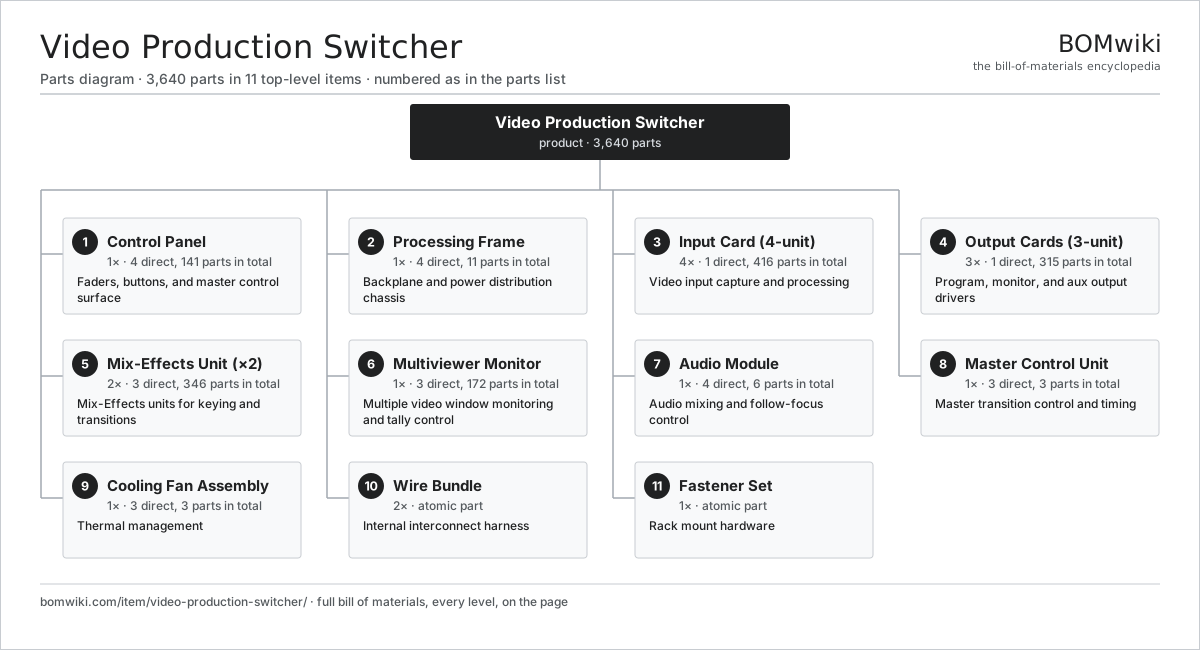
| # | Part | Qty | What it does |
|---|---|---|---|
| 1 | Control Panel 4 parts | 1× | Faders, buttons, and master control surface |
| 2 | Processing Frame 4 parts | 1× | Backplane and power distribution chassis |
| 3 | Input Card (4-unit) 1 parts | 4× | Video input capture and processing |
| 4 | Output Cards (3-unit) 1 parts | 3× | Program, monitor, and aux output drivers |
| 5 | Mix-Effects Unit (×2) 3 parts | 2× | Mix-Effects units for keying and transitions |
| 6 | Multiviewer Monitor 3 parts | 1× | Multiple video window monitoring and tally control |
| 7 | Audio Module 4 parts | 1× | Audio mixing and follow-focus control |
| 8 | Master Control Unit 3 parts | 1× | Master transition control and timing |
| 9 | Cooling Fan Assembly 3 parts | 1× | Thermal management |
| 10 | Wire Bundle | 2× | Internal interconnect harness |
| 11 | Fastener Set | 1× | Rack mount hardware |
Diagrams & photos

.jpg)
3D model
No 3D model yet. Have a CAD file of this? Add a 3D model. STL renders right on this page; STEP, FreeCAD, and OpenSCAD sources are welcome too (openly licensed, like all 3D models on BOMwiki).
Build & assembly graph
expand / collapse · shared sub-assemblies converge · links to related products · est. labourTap an assembly to expand/collapse · tap a part to open it · use “Open page” for any node · drag to pan, scroll to zoom.
Bill of materials for Video Production Switcher
11 top-level lines · 68 rows shown · 3,640 parts total · indented to 3 levels| # | Item / sub-assembly | Part no. | Qty/assy | Ext. qty | Parts | Type |
|---|---|---|---|---|---|---|
| 1 | Control Panel 4 parts | switcher-control-panel | 1× | 1 | 141 | assembly |
| 1.1 | Fader Bank (8–16 channels) 2 parts | switcher-fader-bank | 1× | 1 | 9 | assembly |
| 1.1.1 | Fader Slider | switcher-fader-slider | 8× | 8 | · | part |
| 1.1.2 | Fader Sensor PCB | switcher-fader-pcb | 1× | 1 | · | part |
| 1.2 | Button Array 2 parts | switcher-button-array | 2× | 2 | 64 | assembly |
| 1.2.1 | Momentary Button | switcher-button | 32× | 64 | · | part |
| 1.2.2 | Button Backlight LED | switcher-button-led | 32× | 64 | · | part |
| 1.3 | Joystick Controller 2 parts | switcher-joystick | 1× | 1 | 3 | assembly |
| 1.3.1 | Joystick Base | switcher-joystick-base | 1× | 1 | · | part |
| 1.3.2 | Joystick Encoder | switcher-joystick-encoder | 2× | 2 | · | part |
| 1.4 | Panel Frame & Bezel | switcher-panel-frame | 1× | 1 | · | part |
| 2 | Processing Frame 4 parts | switcher-processing-frame | 1× | 1 | 11 | assembly |
| 2.1 | Video Backplane | switcher-backplane | 1× | 1 | · | part |
| 2.2 | Power Supply | power-supply | 1× | 1 | · | part |
| 2.3 | Card Slot Assembly | switcher-card-slot | 8× | 8 | · | part |
| 2.4 | Cooling Ducting | switcher-cooling-ducting | 1× | 1 | · | part |
| 3 | Input Card (4-unit) 1 parts | switcher-input-cards | 4× | 4 | 416 | assembly |
| 3.1 | Single Input Card 5 parts | switcher-input-card | 4× | 16 | 104 | assembly |
| 3.1.1 | Bare PCB | pcb-bare | 1× | 16 | · | part |
| 3.1.2 | SDI Receiver IC | switcher-sdi-receiver | 1× | 16 | · | part |
| 3.1.3 | Input A/D Converter | switcher-input-adc | 1× | 16 | · | part |
| 3.1.4 | SMD Passive (R/C/L) | smd-passives | 100× | 1,600 | · | part |
| 3.1.5 | Connector | connector | 1× | 16 | · | part |
| 4 | Output Cards (3-unit) 1 parts | switcher-output-cards | 3× | 3 | 315 | assembly |
| 4.1 | Single Output Card 5 parts | switcher-output-card | 3× | 9 | 105 | assembly |
| 4.1.1 | Bare PCB | pcb-bare | 1× | 9 | · | part |
| 4.1.2 | Video D/A Converter | switcher-dac-chip | 1× | 9 | · | part |
| 4.1.3 | SDI Line Driver | switcher-sdi-driver | 1× | 9 | · | part |
| 4.1.4 | SMD Passive (R/C/L) | smd-passives | 100× | 900 | · | part |
| 4.1.5 | Connector | connector | 2× | 18 | · | part |
| 5 | Mix-Effects Unit (×2) 3 parts | switcher-me-unit | 2× | 2 | 346 | assembly |
| 5.1 | ME Video Processor 3 parts | switcher-me-processor | 1× | 2 | 202 | assembly |
| 5.1.1 | Bare PCB | pcb-bare | 1× | 2 | · | part |
| 5.1.2 | FPGA Chip | switcher-fpga | 1× | 2 | · | part |
| 5.1.3 | SMD Passive (R/C/L) | smd-passives | 200× | 400 | · | part |
| 5.2 | Keyer Module 3 parts | switcher-me-keyer | 1× | 2 | 82 | assembly |
| 5.2.1 | Bare PCB | pcb-bare | 1× | 2 | · | part |
| 5.2.2 | Keyer Processor Chip | switcher-keyer-processor | 1× | 2 | · | part |
| 5.2.3 | SMD Passive (R/C/L) | smd-passives | 80× | 160 | · | part |
| 5.3 | Transition Timing Module 3 parts | switcher-transition-control | 1× | 2 | 62 | assembly |
| 5.3.1 | Bare PCB | pcb-bare | 1× | 2 | · | part |
| 5.3.2 | Microcontroller | mcu | 1× | 2 | · | part |
| 5.3.3 | SMD Passive (R/C/L) | smd-passives | 60× | 120 | · | part |
| 6 | Multiviewer Monitor 3 parts | switcher-multiviewer | 1× | 1 | 172 | assembly |
| 6.1 | LCD Panel | lcd-panel | 1× | 1 | · | part |
| 6.2 | Multiviewer Scaler Card 3 parts | switcher-multiviewer-scaler | 1× | 1 | 122 | assembly |
| 6.2.1 | Bare PCB | pcb-bare | 1× | 1 | · | part |
| 6.2.2 | Window Scaling Processor | switcher-window-scaler-chip | 1× | 1 | · | part |
| 6.2.3 | SMD Passive (R/C/L) | smd-passives | 120× | 120 | · | part |
| 6.3 | Tally Light Control 3 parts | switcher-tally-output | 1× | 1 | 49 | assembly |
| 6.3.1 | Bare PCB | pcb-bare | 1× | 1 | · | part |
| 6.3.2 | Relay | relay | 8× | 8 | · | part |
| 6.3.3 | SMD Passive (R/C/L) | smd-passives | 40× | 40 | · | part |
| 7 | Audio Module 4 parts | switcher-audio-module | 1× | 1 | 6 | assembly |
| 7.1 | Bare PCB | pcb-bare | 1× | 1 | · | part |
| 7.2 | Audio Codec/Mixer Chip | switcher-audio-mixer-chip | 1× | 1 | · | part |
| 7.3 | Audio Input Jack | switcher-audio-input | 2× | 2 | · | part |
| 7.4 | Audio Output Jack | switcher-audio-output | 2× | 2 | · | part |
| 8 | Master Control Unit 3 parts | switcher-master-control | 1× | 1 | 3 | assembly |
| 8.1 | Master Panel | switcher-master-panel | 1× | 1 | · | part |
| 8.2 | Fade-to-Black Slider | switcher-ftb-slider | 1× | 1 | · | part |
| 8.3 | Transition Rate Timer | switcher-transition-timer | 1× | 1 | · | part |
| 9 | Cooling Fan Assembly 3 parts | switcher-cooling-fan | 1× | 1 | 3 | assembly |
| 9.1 | Blower Motor | blower-motor | 1× | 1 | · | part |
| 9.2 | Fan Shroud | switcher-fan-shroud | 1× | 1 | · | part |
| 9.3 | Fan Air Filter | switcher-air-filter | 1× | 1 | · | part |
| 10 | Wire Bundle | wire-bundle | 2× | 2 | · | part |
| 11 | Fastener Set | fastener-set | 1× | 1 | · | part |
Something wrong in this list? Report a problem with this BOM.
Related products
same domain, ranked by shared parts AV Receiver
1,097 parts · shares 4 with this page
AV Receiver
1,097 parts · shares 4 with this page
 Camera Control Unit
156 parts · shares 3 with this page
Camera Control Unit
156 parts · shares 3 with this page
 Loudspeaker Management Processor
42 parts · shares 3 with this page
Snow Effect Machine
115 parts · shares 3 with this page
Loudspeaker Management Processor
42 parts · shares 3 with this page
Snow Effect Machine
115 parts · shares 3 with this page
 Stage Lighting Console
163 parts · shares 3 with this page
Stage Lighting Console
163 parts · shares 3 with this page
 DMX Dimmer Rack
71 parts · shares 2 with this page
DMX Dimmer Rack
71 parts · shares 2 with this page
Sourcing: possible vendors
Browse the supplier directory → Prices, MOQ, and lead times are algorithmic estimates, not quotes, and not claims about these companies. Company mappings are curated by keyword; est. price band $50–$3k. How estimates work| Vendor | HQ | Specialty | MOQ | Lead time |
|---|---|---|---|---|
|
🇯🇵Sony
sony.com ↗
|
Tokyo, JP | Consumer electronics | 1,000 units | 8–12 wks |
| samsung.com ↗ | Suwon, KR | Electronics & displays | 1,000 units | 8–12 wks |
|
🇺🇸Harman
harman.com ↗
|
Stamford, US | Audio (JBL, AKG) | 1,000 units | 8–12 wks |
|
🇺🇸Bose
bose.com ↗
|
Framingham, US | Audio | 1,000 units | 8–12 wks |
| yamaha.com ↗ | Hamamatsu, JP | Audio & instruments | 1,000 units | 8–12 wks |
892-word article