Broadcast Video Router
ProductOverview
A broadcast video router is the traffic cop of a television station. In a facility with multiple cameras, graphics engines, satellite feeds, and replay servers, the router decides which video source goes to which destination, the transmission line, a monitor wall, a tape recorder, or a secondary path. Hundreds or thousands of connections might exist, but only a fraction are active at any moment. A modular rackmount system with a smart processor and a crosspoint switch matrix lets operators instantly reconfigure the video flow without manual patching or cable changes.
Crosspoint switching
At the heart is the crosspoint switch, an integrated circuit (or set of ICs) that acts like a telephone switchboard for video. Imagine a grid: rows are inputs (camera 1, camera 2, graphics, replay, etc.), columns are outputs (transmission, monitor wall, archive tape, etc.). Each intersection is a switch that can be turned on or off. When you close the switch at row 3, column 1, video from input 3 is routed to output 1.
The main processor manages this grid. An operator presses buttons on the operator panel or sends a command via Ethernet, saying "put input 5 on output 2." The processor updates the crosspoint matrix, closing the appropriate switches and opening others, all within a single frame time (16.7 ms at 60 Hz). To the viewer watching the transmission output, the switch is seamless, no flash, no glitch, just a cut from one camera to another.
Modular IO
Most large routers use plug-in input cards and output cards rather than fixed rear panels. This modular approach allows customization: install SDI cards for cameras, component cards for graphics, fiber cards for long-distance feeds. If a facility needs to add more cameras next year, just slide in a new input card. The backplane provides power and high-speed interconnect; all audio/video signals route through the crosspoint switch.
Synchronization
All video in the facility must sync to a master clock, typically a blackburst reference from the master control. The processor locks its frame timing to this reference, and the crosspoint switch changes state only during vertical blanking (the brief gap between frames). This ensures zero glitches when switching, the operator can cut between cameras on air without artifact.
Redundancy
Broadcast routers are mission-critical. A facility that loses video routing loses all on-air transmission. So modern systems are designed for fault tolerance:
- Dual power supplies with automatic failover
- Modular input/output cards so a single card failure doesn't take down the entire system
- Optional dual processors for hot-standby failover
- Watchdog timers that detect a processor hang and automatically switch to the backup
Some installations use dual routers in parallel, each capable of handling the full video load independently.
Control options
The button matrix on the front allows intuitive operation: press input 5, then press output 2, and the switch is made. Most routers also store preset configurations, e.g., "show opening," "show A," "show B", that instantly recall complex routing patterns with one button. Remote control via Ethernet and SNMP allows a master control room or even a remote facility to manage the router over the network.
Performance metrics
Video routing latency is critical for live production. The crosspoint switch introduces <1 frame of delay (typically 8–16 ms), which is imperceptible to viewers but noticeable to engineers watching multiple monitors. The input cards include optional cable equalizers to compensate for signal loss over long runs, and output drivers buffer the signal for distribution to multiple destination devices.
Optional features
High-end routers offer optional fiber optic backplanes for maximum EMI immunity and remote IO placement, downstream keyers for real-time graphics overlay, and integrated audio routing (synchronized with video so a lip-sync tie-up to a camera also brings its associated audio).
In small facilities, a single input card with a few cameras might suffice. Large broadcast centers run routers with 64+ input and 64+ output cards, switching terabytes of video daily.
Broadcast Video Router parts and their functions
11 top-level parts · 164 parts in total · full bill of materials below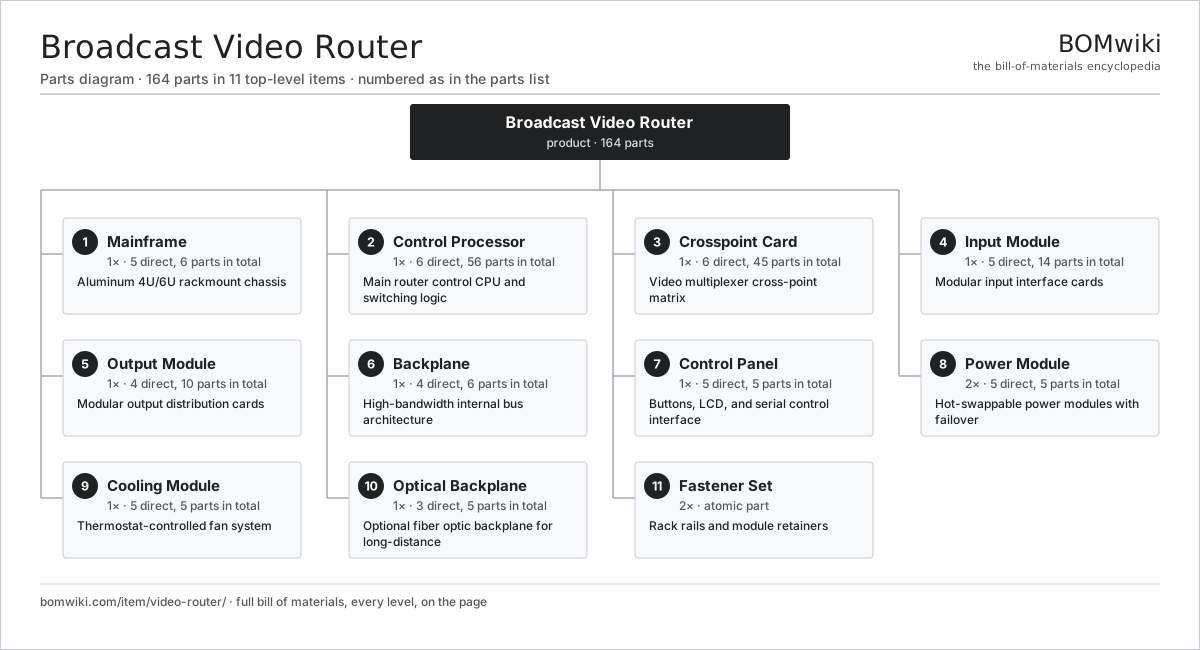
| # | Part | Qty | What it does |
|---|---|---|---|
| 1 | Mainframe 5 parts | 1× | Aluminum 4U/6U rackmount chassis |
| 2 | Control Processor 6 parts | 1× | Main router control CPU and switching logic |
| 3 | Crosspoint Card 6 parts | 1× | Video multiplexer cross-point matrix |
| 4 | Input Module 5 parts | 1× | Modular input interface cards |
| 5 | Output Module 4 parts | 1× | Modular output distribution cards |
| 6 | Backplane 4 parts | 1× | High-bandwidth internal bus architecture |
| 7 | Control Panel 5 parts | 1× | Buttons, LCD, and serial control interface |
| 8 | Power Module 5 parts | 2× | Hot-swappable power modules with failover |
| 9 | Cooling Module 5 parts | 1× | Thermostat-controlled fan system |
| 10 | Optical Backplane 3 parts | 1× | Optional fiber optic backplane for long-distance |
| 11 | Fastener Set | 2× | Rack rails and module retainers |
3D model
No 3D model yet. Have a CAD file of this? Add a 3D model. STL renders right on this page; STEP, FreeCAD, and OpenSCAD sources are welcome too (openly licensed, like all 3D models on BOMwiki).
Build & assembly graph
expand / collapse · shared sub-assemblies converge · links to related products · est. labourTap an assembly to expand/collapse · tap a part to open it · use “Open page” for any node · drag to pan, scroll to zoom.
Bill of materials for Broadcast Video Router
11 top-level lines · 59 rows shown · 164 parts total · indented to 3 levels| # | Item / sub-assembly | Part no. | Qty/assy | Ext. qty | Parts | Type |
|---|---|---|---|---|---|---|
| 1 | Mainframe 5 parts | video-router-mainframe | 1× | 1 | 6 | assembly |
| 1.1 | Frame Extrusion | video-router-frame-extrusion | 1× | 1 | · | part |
| 1.2 | Front Panel | video-router-front-panel | 1× | 1 | · | part |
| 1.3 | Rear Panel | video-router-rear-panel | 1× | 1 | · | part |
| 1.4 | Side Panels | video-router-side-panels | 2× | 2 | · | part |
| 1.5 | Fastener Set | fastener-set | 1× | 1 | · | part |
| 2 | Control Processor 6 parts | video-router-control-processor | 1× | 1 | 56 | assembly |
| 2.1 | Bare PCB | pcb-bare | 1× | 1 | · | part |
| 2.2 | Microcontroller | mcu | 1× | 1 | · | part |
| 2.3 | System RAM | video-router-system-ram | 1× | 1 | · | part |
| 2.4 | Flash Storage | video-router-flash-storage | 1× | 1 | · | part |
| 2.5 | Connector | connector | 2× | 2 | · | part |
| 2.6 | SMD Passive (R/C/L) | smd-passives | 50× | 50 | · | part |
| 3 | Crosspoint Card 6 parts | video-router-crosspoint-card | 1× | 1 | 45 | assembly |
| 3.1 | Crosspoint Switch IC | video-router-crosspoint-switch-ic | 1× | 1 | · | part |
| 3.2 | Video DAC | video-router-video-dac | 1× | 1 | · | part |
| 3.3 | Buffer Amplifier | video-router-buffer-amp | 1× | 1 | · | part |
| 3.4 | Bare PCB | pcb-bare | 1× | 1 | · | part |
| 3.5 | SMD Passive (R/C/L) | smd-passives | 40× | 40 | · | part |
| 3.6 | Connector | connector | 1× | 1 | · | part |
| 4 | Input Module 5 parts | video-router-input-module | 1× | 1 | 14 | assembly |
| 4.1 | Input Connector | video-router-input-connector | 4× | 4 | · | part |
| 4.2 | Cable Equalizer | video-router-equalizer-ic | 4× | 4 | · | part |
| 4.3 | ADC IC | video-router-adc-ic | 4× | 4 | · | part |
| 4.4 | Input PCB | video-router-input-pcb | 1× | 1 | · | part |
| 4.5 | Connector | connector | 1× | 1 | · | part |
| 5 | Output Module 4 parts | video-router-output-module | 1× | 1 | 10 | assembly |
| 5.1 | Output Driver | video-router-output-driver | 4× | 4 | · | part |
| 5.2 | Output Connector | video-router-output-connector | 4× | 4 | · | part |
| 5.3 | Output PCB | video-router-output-pcb | 1× | 1 | · | part |
| 5.4 | Connector | connector | 1× | 1 | · | part |
| 6 | Backplane 4 parts | video-router-backplane | 1× | 1 | 6 | assembly |
| 6.1 | Backplane PCB | video-router-backplane-pcb | 1× | 1 | · | part |
| 6.2 | Connector Frame | video-router-connector-frame | 1× | 1 | · | part |
| 6.3 | Ribbon Cable | video-router-ribbon-cable | 3× | 3 | · | part |
| 6.4 | Fastener Set | fastener-set | 1× | 1 | · | part |
| 7 | Control Panel 5 parts | video-router-control-panel | 1× | 1 | 5 | assembly |
| 7.1 | Button Matrix | video-router-button-matrix | 1× | 1 | · | part |
| 7.2 | Panel LCD | video-router-panel-lcd | 1× | 1 | · | part |
| 7.3 | Panel PCB | video-router-panel-pcb | 1× | 1 | · | part |
| 7.4 | Serial Port | video-router-serial-connector | 1× | 1 | · | part |
| 7.5 | Connector | connector | 1× | 1 | · | part |
| 8 | Power Module 5 parts | video-router-redundant-power-supply | 2× | 2 | 5 | assembly |
| 8.1 | PFC Stage | video-router-pfc-stage | 1× | 2 | · | part |
| 8.2 | Main Converter | video-router-main-converter | 1× | 2 | · | part |
| 8.3 | Transformer | video-router-isolation-transformer | 1× | 2 | · | part |
| 8.4 | Output Filter | video-router-output-filter | 1× | 2 | · | part |
| 8.5 | Connector | connector | 1× | 2 | · | part |
| 9 | Cooling Module 5 parts | video-router-cooling-module | 1× | 1 | 5 | assembly |
| 9.1 | Blower Motor | blower-motor | 1× | 1 | · | part |
| 9.2 | Thermal Sensor | video-router-thermal-sensor | 1× | 1 | · | part |
| 9.3 | Fan Controller | video-router-fan-controller | 1× | 1 | · | part |
| 9.4 | Air Filter | video-router-air-filter | 1× | 1 | · | part |
| 9.5 | Fastener Set | fastener-set | 1× | 1 | · | part |
| 10 | Optical Backplane 3 parts | video-router-optical-bus | 1× | 1 | 5 | assembly |
| 10.1 | Optical Transceiver | video-router-optical-transceiver | 2× | 2 | · | part |
| 10.2 | Optical Coupler | video-router-optical-coupler | 1× | 1 | · | part |
| 10.3 | Fiber Connector | video-router-fiber-connector | 2× | 2 | · | part |
| 11 | Fastener Set | fastener-set | 2× | 2 | · | part |
Something wrong in this list? Report a problem with this BOM.
Related products
same domain, ranked by shared parts AV Receiver
1,097 parts · shares 1 with this page
AV Receiver
1,097 parts · shares 1 with this page
 Camera Control Unit
156 parts · shares 1 with this page
Cinema Sound Processor
839 parts · shares 1 with this page
Camera Control Unit
156 parts · shares 1 with this page
Cinema Sound Processor
839 parts · shares 1 with this page
 DMX Dimmer Rack
71 parts · shares 1 with this page
DMX Dimmer Rack
71 parts · shares 1 with this page
 LED Video Wall
2,795 parts · shares 1 with this page
LED Video Wall
2,795 parts · shares 1 with this page
 Loudspeaker Management Processor
42 parts · shares 1 with this page
Loudspeaker Management Processor
42 parts · shares 1 with this page
Sourcing: possible vendors
Browse the supplier directory → Prices, MOQ, and lead times are algorithmic estimates, not quotes, and not claims about these companies. Company mappings are curated by keyword; est. price band $50–$3k. How estimates work| Vendor | HQ | Specialty | MOQ | Lead time |
|---|---|---|---|---|
|
🇯🇵Sony
sony.com ↗
|
Tokyo, JP | Consumer electronics | 1,000 units | 8–12 wks |
| samsung.com ↗ | Suwon, KR | Electronics & displays | 1,000 units | 8–12 wks |
|
🇺🇸Harman
harman.com ↗
|
Stamford, US | Audio (JBL, AKG) | 1,000 units | 8–12 wks |
|
🇺🇸Bose
bose.com ↗
|
Framingham, US | Audio | 1,000 units | 8–12 wks |
| yamaha.com ↗ | Hamamatsu, JP | Audio & instruments | 1,000 units | 8–12 wks |
764-word article