Wafer Dicing Saw
ProductOverview
Wafer dicing is the process of separating individual die from fully processed wafers after all electrical testing is complete. The wafer dicing saw is a high-precision tool that cuts wafers into individual die using a fast-spinning diamond-impregnated blade with coolant circulation for cooling and chip removal. The process is critical for yield: poor cut quality (chipping, cracking, or incomplete separation) leads to defective die and low packaging yield. Modern dicing saws are fully automated, with vision-guided alignment, CNC-like motion control, and spindle speeds up to 60,000 RPM enabling rapid, repeatable separation.
Dicing economics are significant. A single 300 mm wafer contains 500–2000 die; dicing time is 5–15 minutes per wafer depending on die count and edge exclusion zones. Dicing cost is typically $0.05–$0.20 per die, a substantial fraction of assembly cost for high-density dies or small die (e.g., MEMS). Dicing yield (good die separated without cracking) directly impacts overall manufacturing yield; chipping or cracking during dicing can destroy 5–20% of otherwise good die.
Cutting Mechanism and Blade Design
The Dicing Blade is a disk-shaped tool with diamond abrasive embedded in a metal, ceramic, or resin matrix. Blade thickness ranges from 150 to 400 μm; thinner blades minimize material loss (kerf) but are more fragile. Blade diameter (20–100 mm) is selected based on cut depth (wafer thickness, 400–700 μm) and tool geometry.
Diamond abrasive particles (1–10 μm size) bond to the blade matrix with controlled concentration. The bond strength and particle spacing are optimized for the target material: silicon wafers require different particle sizes and binders than GaAs or sapphire. The blade edge undergoes self-sharpening as it wears; outer abrasive particles fracture and dull particles are abraded away, continually exposing fresh cutting surfaces.
As the blade rotates at 20,000–60,000 RPM, it engages the wafer surface at a feed rate of 5–50 mm/sec. Cutting is mechanical abrasion and microchipping; particles are removed by blade impingement rather than melting. The Coolant System system is essential, circulating water or oil-based coolant at 10–30 LPM through the cut zone. Coolant removes heat (preventing wafer temperature rise >50 °C), flushes away chips, and reduces friction.
Precision Stages and Vision Alignment
The Stage Assembly position the wafer with sub-micron repeatability. XY ball-screw driven stages move the wafer under the stationary blade at programmed speeds and paths. The Vision System system detects alignment marks (fiducials) on the wafer and identifies scribe lines (paths to be cut) using edge detection algorithms. The system automatically adjusts for wafer-to-wafer registration errors (typically ±5 μm), compensating for variations in lithography processing.
The theta stage rotates the wafer to align scribe lines with the blade edge, typically within ±90° for complex geometries. After alignment on the first edge or corner, the system runs the cutting sequence: rapid XY moves to cut start, spindle start, feed motion at constant speed, then spindle stop and return. Modern systems execute 500–2000 cuts per wafer in a programmed sequence, minimizing stage motion and maximizing throughput.
Cutting Path Optimization and Die Separation
Cutting patterns vary by die geometry. Rectangular die are cut in two perpendicular directions (streets), separating rows and then columns. Complex shapes (e.g., hexagonal or triangular die) require custom cutting patterns, sometimes needing four or more cut directions. The Main Controller CNC system accepts design files (cut coordinate lists or vector paths) and translates them into stage motion and blade engagement sequences.
Kerf width, the material width removed by the blade, is typically 50–150 μm depending on blade thickness and bond line design. For closely spaced die (e.g., 100 μm spacing), kerf loss is significant; a 100 μm kerf removes half the bond line space. Die designers optimize bond line width (typically 80–150 μm) to balance kerf loss against structural integrity.
Wafer Handling and Edge Exclusion
The Wafer Collet vacuum chuck holds the wafer securely during cutting, preventing shift or slip. Vacuum is typically 8–15 inHg, sufficient for forces up to several kg. The chuck surface has escape grooves allowing coolant and chips to drain, and alignment pins index the wafer to a known orientation. An edge-exclusion zone (typically 2–5 mm from wafer edge) is left uncut, since die at the edge are damaged by handling and dicing anyway; edge exclusion zones are typically scrap.
Cut Quality and Defect Modes
Cut quality depends on blade sharpness, feed rate, spindle speed, and material properties. Good cuts produce smooth surfaces (0.4–1.6 μm Ra) with minimal chipping (<10 μm). Poor cuts exhibit large chips (>50 μm), fractured edges, or subsurface cracks that propagate during thermal cycling.
Silicon wafers are brittle and prone to chipping; shallow flakes detach from the cut edge if feed rate is too high or blade is dull. GaAs and InP are even more susceptible to chipping. Sapphire wafers used in power electronics are very hard and wear the blade rapidly. Process control is critical: blade wear is monitored by visual inspection or surface profilometry after every 100–500 cuts. Dull blades are removed and resharpened or replaced.
Microfractures below the cut surface, invisible at first, can propagate during subsequent thermal steps (reflow, cure). X-ray or ultrasonic inspection can detect subsurface damage, but these are done offline on a sampling basis (e.g., every 10th wafer) due to cost.
Coolant and Environmental Considerations
Cutting fluid accumulates abrasive debris and eventually loses cooling effectiveness. The Coolant Tank maintains a recirculating coolant system with cartridge filters (3–10 μm), settling chambers, and waste separation. Coolant is replaced every 2–4 weeks in high-volume operations or when coolant concentration drops below specification.
Dicing generates silica-based dust and aerosols; equipment must be enclosed or in a fume hood with local exhaust ventilation. Wafer scraps and blades are classified as hazardous waste (crystalline silica) and disposed appropriately. Eye and respiratory protection is required for maintenance personnel handling blades and coolant.
Blade Conditioning and Maintenance
Diamond blade life ranges from 500 to 5000 cuts before performance degrades. Blade sharpening (dressing) removes dulled particles and exposes fresh abrasive. Dressing can be done in-situ using a dressing tool (rotary dresser or diamond-impregnated stick) or offline via diamond impregnated grinding wheels. In-situ dressing adds 30–60 seconds to cycle time but maintains blade sharpness and reduces downtime.
High-end systems integrate automatic dressing; the system monitors cut quality (chip count, surface finish, vibration) and initiates dressing when performance degrades. This predictive maintenance approach minimizes blade waste and prevents quality escapes.
Process Variations and Advanced Techniques
Laser dicing is an emerging alternative, using focused laser (nanosecond or picosecond pulses) to melt or ablate wafer material. Laser dicing produces narrower kerfs (10–30 μm) and less chipping than mechanical dicing, but throughput is lower and equipment cost is higher ($2M+). Laser is most valuable for difficult materials (compound semiconductors, wide-bandgap) and ultra-high-density die.
Stealth dicing uses a sub-surface laser to create a region of microcracks along the desired path, then mechanical tapping breaks the wafer cleanly with no blade contact. This approach minimizes damage but is slow and primarily used in research.
For very fine die spacing (<100 μm), controlled-spalling techniques use a polymer tape to temporarily bond die together during dicing, then debond them afterward. This allows cuts at smaller spacing than mechanical dicing alone permits.
Integration with Assembly Flow
Modern fabs integrate dicing into fully automated assembly lines. Wafers flow from test, are diced, and die are sorted (good vs. scrap) via inline automated optical inspection (AOI). Good die are picked by robots and placed into die carriers (boats, tubes, or trays) for subsequent bonding. Some advanced facilities couple dicing and die attach into a single cell, minimizing intermediate storage and further reducing cycle time.
Wafer Dicing Saw parts and their functions
8 top-level parts · 44 parts in total · full bill of materials below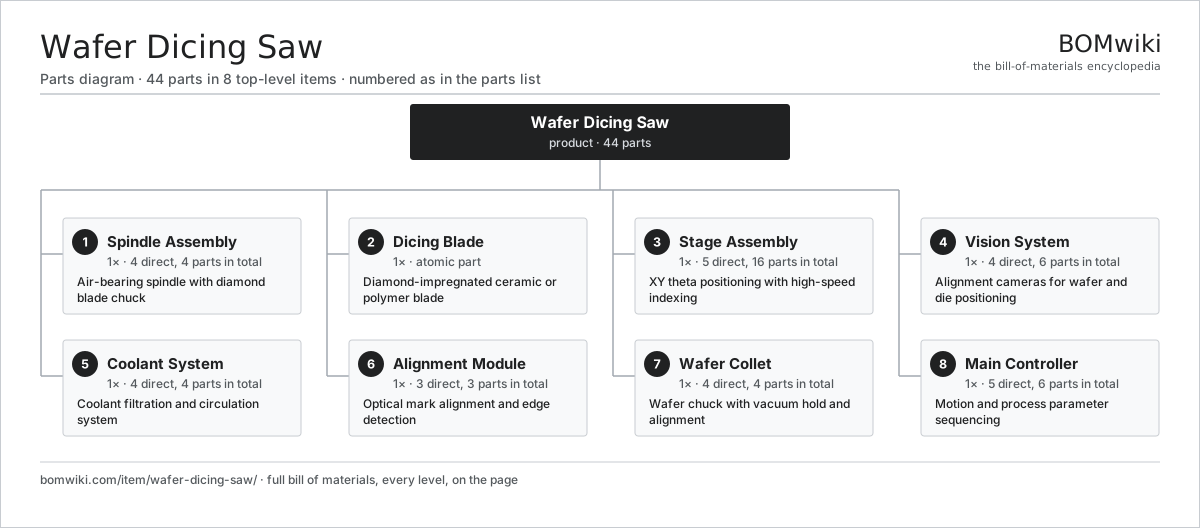
| # | Part | Qty | What it does |
|---|---|---|---|
| 1 | Spindle Assembly 4 parts | 1× | Air-bearing spindle with diamond blade chuck |
| 2 | Dicing Blade | 1× | Diamond-impregnated ceramic or polymer blade |
| 3 | Stage Assembly 5 parts | 1× | XY theta positioning with high-speed indexing |
| 4 | Vision System 4 parts | 1× | Alignment cameras for wafer and die positioning |
| 5 | Coolant System 4 parts | 1× | Coolant filtration and circulation system |
| 6 | Alignment Module 3 parts | 1× | Optical mark alignment and edge detection |
| 7 | Wafer Collet 4 parts | 1× | Wafer chuck with vacuum hold and alignment |
| 8 | Main Controller 5 parts | 1× | Motion and process parameter sequencing |
3D model
No 3D model yet. Have a CAD file of this? Add a 3D model. STL renders right on this page; STEP, FreeCAD, and OpenSCAD sources are welcome too (openly licensed, like all 3D models on BOMwiki).
Build & assembly graph
expand / collapse · shared sub-assemblies converge · links to related products · est. labourTap an assembly to expand/collapse · tap a part to open it · use “Open page” for any node · drag to pan, scroll to zoom.
Bill of materials for Wafer Dicing Saw
8 top-level lines · 37 rows shown · 44 parts total · indented to 3 levels| # | Item / sub-assembly | Part no. | Qty/assy | Ext. qty | Parts | Type |
|---|---|---|---|---|---|---|
| 1 | Spindle Assembly 4 parts | wafer-dicing-saw-spindle | 1× | 1 | 4 | assembly |
| 1.1 | Air-Bearing Motor | wafer-dicing-saw-air-motor | 1× | 1 | · | part |
| 1.2 | Bearing Block | wafer-dicing-saw-bearing-block | 1× | 1 | · | part |
| 1.3 | Blade Chuck | wafer-dicing-saw-blade-chuck | 1× | 1 | · | part |
| 1.4 | Air Supply Module | wafer-dicing-saw-spindle-drive | 1× | 1 | · | part |
| 2 | Dicing Blade | wafer-dicing-saw-blade | 1× | 1 | · | part |
| 3 | Stage Assembly 5 parts | wafer-dicing-saw-stages | 1× | 1 | 16 | assembly |
| 3.1 | Ball Screw | ball-screw | 2× | 2 | · | part |
| 3.2 | Encoder | encoder | 3× | 3 | · | part |
| 3.3 | Theta Drive Motor | wafer-dicing-saw-theta-drive | 1× | 1 | · | part |
| 3.4 | Ball Bearing | ball-bearing | 8× | 8 | · | part |
| 3.5 | Sheet Metal Panel | sheet-panel | 2× | 2 | · | part |
| 4 | Vision System 4 parts | wafer-dicing-saw-vision | 1× | 1 | 6 | assembly |
| 4.1 | CMOS Image Sensor | image-sensor | 2× | 2 | · | part |
| 4.2 | Lens Assembly | camera-lens | 2× | 2 | · | part |
| 4.3 | Lighting System | wafer-dicing-saw-light | 1× | 1 | · | part |
| 4.4 | Autofocus Servo | wafer-dicing-saw-focus-servo | 1× | 1 | · | part |
| 5 | Coolant System 4 parts | wafer-dicing-saw-coolant | 1× | 1 | 4 | assembly |
| 5.1 | Coolant Pump | wafer-dicing-saw-coolant-pump | 1× | 1 | · | part |
| 5.2 | Coolant Tank | wafer-dicing-saw-filter-tank | 1× | 1 | · | part |
| 5.3 | Spray Nozzle | wafer-dicing-saw-spray-nozzle | 1× | 1 | · | part |
| 5.4 | Drain System | wafer-dicing-saw-drain-return | 1× | 1 | · | part |
| 6 | Alignment Module 3 parts | wafer-dicing-saw-alignment | 1× | 1 | 3 | assembly |
| 6.1 | Mark Sensor | wafer-dicing-saw-mark-sensor | 1× | 1 | · | part |
| 6.2 | Edge Detector | wafer-dicing-saw-edge-detector | 1× | 1 | · | part |
| 6.3 | Alignment LED | wafer-dicing-saw-alignment-light | 1× | 1 | · | part |
| 7 | Wafer Collet 4 parts | wafer-dicing-saw-collet | 1× | 1 | 4 | assembly |
| 7.1 | Chuck Plate | wafer-dicing-saw-chuck-plate | 1× | 1 | · | part |
| 7.2 | Vacuum Supply | wafer-dicing-saw-vacuum-supply | 1× | 1 | · | part |
| 7.3 | Clamp Pins | wafer-dicing-saw-clamp-pins | 1× | 1 | · | part |
| 7.4 | Pressure Sensor | pressure-sensor | 1× | 1 | · | part |
| 8 | Main Controller 5 parts | wafer-dicing-saw-controller | 1× | 1 | 6 | assembly |
| 8.1 | Motion Controller | wafer-dicing-saw-cpu | 1× | 1 | · | part |
| 8.2 | Power Supply | power-supply | 2× | 2 | · | part |
| 8.3 | Motion Drivers | wafer-dicing-saw-motion-drivers | 1× | 1 | · | part |
| 8.4 | Air Control Module | wafer-dicing-saw-air-control | 1× | 1 | · | part |
| 8.5 | Bare PCB | pcb-bare | 1× | 1 | · | part |
Something wrong in this list? Report a problem with this BOM.
Related products
same domain, ranked by shared parts Wire Bonder
44 parts · shares 8 with this page
Die Bonder
44 parts · shares 7 with this page
Wire Bonder
44 parts · shares 8 with this page
Die Bonder
44 parts · shares 7 with this page
 SMT Pick-and-Place Machine
60 parts · shares 7 with this page
SMT Pick-and-Place Machine
60 parts · shares 7 with this page
 Mask Aligner
38 parts · shares 6 with this page
SMT Stencil Printer
43 parts · shares 6 with this page
Mask Aligner
38 parts · shares 6 with this page
SMT Stencil Printer
43 parts · shares 6 with this page
Sourcing: possible vendors
Browse the supplier directory → Prices, MOQ, and lead times are algorithmic estimates, not quotes, and not claims about these companies. Company mappings are curated by keyword; est. price band $5k–$2M. How estimates work| Vendor | HQ | Specialty | MOQ | Lead time |
|---|---|---|---|---|
| atlascopco.com ↗ | Stockholm, SE | Compressors & industrial | 10 units | 12–20 wks |
|
🇦🇹Andritz
andritz.com ↗
|
Graz, AT | Process plants & machinery | 10 units | 12–20 wks |
| buhlergroup.com ↗ | Uzwil, CH | Food & materials processing | 10 units | 12–20 wks |
| gea.com ↗ | Düsseldorf, DE | Process technology | 10 units | 12–20 wks |
| mhi.com ↗ | Tokyo, JP | Heavy machinery | 10 units | 12–20 wks |
1,328-word article