Wax Injector
ProductOverview
A wax injector is a specialized machine tool used in jewelry production and investment casting to create wax patterns, physical models of the final metal part. The machine heats paraffin, microcrystalline, or synthetic wax to 180–220°C, then injects the molten wax under pneumatic pressure (30–80 PSI) into cavities within a rubber mold. After brief cooling (30–90 seconds), the rubber mold is opened and the solidified wax pattern is removed, ready for assembly into a ceramic investment mold for metal casting.
This process is essential in the lost-wax casting workflow. Unlike direct carving or hand-modeling, injected wax patterns are identical and repeatable, permitting rapid production of multiple identical castings from a single rubber mold. A single rubber tool mold can produce 200–2000 patterns before wear, making the per-piece cost negligible. Wax injectors are found in every professional jewelry shop, dental laboratory, and fine art foundry that produces complex metal pieces.
How it works
The operator fills the heating pot with wax pellets or scrap, which the immersion heater melts and maintains at a setpoint temperature, typically 190–210°C. Wax at this temperature flows like light oil under modest pressure; if too cool, it solidifies before filling the mold cavity; if too hot, it oxidizes and yellows, weakening the pattern.
A rubber mold, typically silicone rubber or nitrile synthetic rubber, is clamped into the mold clamp assembly with the two halves aligned by a guide pin. The mold cavity (the inverse shape of the desired wax pattern) faces upward or toward the injection nozzle.
The operator starts the cycle on the control unit, which triggers a timed pneumatic injection. The solenoid valve opens briefly (typically 0.5–3 seconds), allowing compressed air at 30–80 PSI to push wax from the heating pot through a heated brass nozzle tube and out through a precision-drilled orifice into the mold cavity. The cartridge heater in the nozzle keeps the brass at 200–230°C, preventing the wax from solidifying in the delivery tip.
Once molten wax fills the cavity, the solenoid closes and compressed air is vented. The mold immediately enters the cooling tray, where chilled water spray or circulated coolant at 5–15°C rapidly solidifies the wax pattern. Solidification typically takes 30–90 seconds, depending on pattern size. The mold is then opened, the rubber halves separate and the solid wax pattern is ejected by hand or mechanical ejector pins.
The cycle time is typically 45–120 seconds end-to-end, permitting 20–40 patterns per hour from a single mold. A shop producing medium-volume costume jewelry might run 5–10 molds in rotation, generating 100–400 patterns per 8-hour shift.
Wax Types and Properties
Paraffin wax (petroleum byproduct) is the most common: low cost, excellent flowability, but soft and prone to warping under thermal stress. It is used for simpler patterns without undercuts.
Microcrystalline wax (heavier, less volatile paraffin fraction) is harder and more dimensionally stable; preferred for medium-complexity patterns requiring fine detail.
Synthetic blends (proprietary copolymer waxes) offer tuned melting points, reduced thermal expansion, and improved adhesion to rubber molds. These cost 2–3× paraffin but reduce pattern deformations and casting defects.
Different wax types require different injection temperatures: paraffin ≈190°C, microcrystalline ≈210°C, synthetics ≈200–220°C. A well-equipped shop maintains 3–5 heating pots, each dedicated to a wax type and temperature setpoint, rotating them as different patterns are produced.
Components and Engineering
The heating pot is a stainless steel or aluminum vessel typically 500–2000 cc capacity, with a low-watt-density immersion heater preventing local boiling or charring. The heater is thermostat-controlled, maintaining ±5°C stability using a mechanical bimetal thermostat or electronic PID controller. Heavy insulation (fiberglass or ceramic wool) around the pot reduces heating time and maintains temperature during short interruptions between injections. A hinged pot lid minimizes oxidation and heat loss.
The nozzle assembly is a precision-engineered brass or hardened-steel tube 2–3 inches long, with a cartridge heater embedded lengthwise. The orifice at the tip is a hardened steel or carbide insert drilled to 0.8–1.5 mm diameter; this small opening creates back-pressure (0.5–2 PSI) opposing the injection air, ensuring complete mold fill without air bubbles or incomplete patterns. A spring-loaded return spring retracts a needle valve inside the nozzle after each injection, closing off wax flow and allowing air to vent.
The mold clamp is typically a pneumatic or manual screw-actuated vice applying 200–500 lbf closing force. For small patterns, hand lever closure suffices; for production runs, a pneumatic clamp driven by the same air system saves operator effort. The clamp jaws are flat or contoured to match the rubber mold backing; alignment is ensured by a hardened steel guide pin (typically 0.5 inch diameter) fitting into holes in each mold half.
The air system includes a small piston or rotary screw compressor (1–3 hp) producing 5–10 CFM at 80–100 PSI, a receiver tank (10–30 gallons) smoothing pressure fluctuations, and a refrigerated or desiccant air dryer reducing moisture. Compressed air contains liquid water if not dried; water droplets entering the mold cause steam pockets in the wax, creating voids. The regulator allows the operator to set injection pressure (typically 40–60 PSI for medium-sized jewelry), with an integral pressure gauge. The solenoid valve is a simple 2/2 normally-closed design: when de-energized, it blocks air flow; when the timer circuit energizes it, air flows briefly through the nozzle.
The cooling system is either a stainless steel tray with overhead spray nozzles fed by a small thermoelectric or refrigeration chiller, or a simple immersion bath. Spray cooling is faster (30–45 seconds) but uses more water; bath cooling is slower (60–90 seconds) but simpler and less messy. Chilled water at 5–15°C is pumped through a manifold with 6–12 adjustable cone spray nozzles; a drain collects runoff and returns it to the chiller reservoir.
The frame is a welded or bolted steel structure supporting the pot at one height, the nozzle at a lower height (aligned with mold cavity), and the clamp assembly inline. The control panel displays injection pressure and temperature, and includes pushbuttons for start/stop and parameter adjustment (injection dwell time, pressure setpoint, cooling duration). Modern systems use a microcontroller to allow programmable cycles for different mold shapes.
Production Workflow and Economics
A typical jewelry shop production cycle: operator pre-charges the heating pot the evening before, allowing it to stabilize overnight. The next morning, molds are prepared and stacked. Five to ten molds are cycled through the injector in rotation, each producing one pattern per 45–120 second cycle. Patterns accumulate in a collection tray; at lunch or day's end, they are trimmed of excess wax (gates and runners) with a utility knife or hot-air tool, then assembled into a ceramic investment mold for casting.
The rubber molds themselves are made from master patterns (metal, resin, or 3D-printed) hand-poured with RTV (room-temperature vulcanizing) silicone rubber, then cured 24 hours. A single master pattern can generate 5–10 mold copies; each mold produces 200–2000 patterns before tearing or thermal degradation. At USD 50–200 per mold and 200–1000 patterns per mold, the mold cost amortizes to USD 0.05–1.00 per pattern, negligible compared to gold or silver material cost.
For fine jewelry using 14K gold or platinum, per-piece profit margins are 300–1000%, making even slow production economical. For costume jewelry, margins are tighter (50–200%), so cycle time and yield (%) defect-free patterns matter. A shop running 4–6 molds simultaneously and targeting 30-second cycles (using synthetic wax and optimized cooling) can produce 400–600 patterns per 8-hour shift; at even modest USD 5 per-pattern casting revenue, that scales to USD 2000–3000 daily shop throughput from a single injector.
Maintenance and Troubleshooting
Common issues include incomplete fill (wax too cool, low air pressure, orifice clogged), air bubbles (moisture in air, wax oxidized), and pattern sticking (rubber mold degraded, cooling insufficient). Orifice clogs occur if wax oxidizes; remedy is to heat the nozzle to 240°C and blow compressed air through to clear the blockage. Rubber molds degrade (swell, tear) after 200–500 cycles if exposed to excessive temperature or solvents; prevention is storing molds in cool, dry conditions and avoiding direct contact with hot wax drips. Regular inspection of pot insulation and heater leads for burning or fraying ensures safe operation.
Wax Injector parts and their functions
7 top-level parts · 41 parts in total · full bill of materials below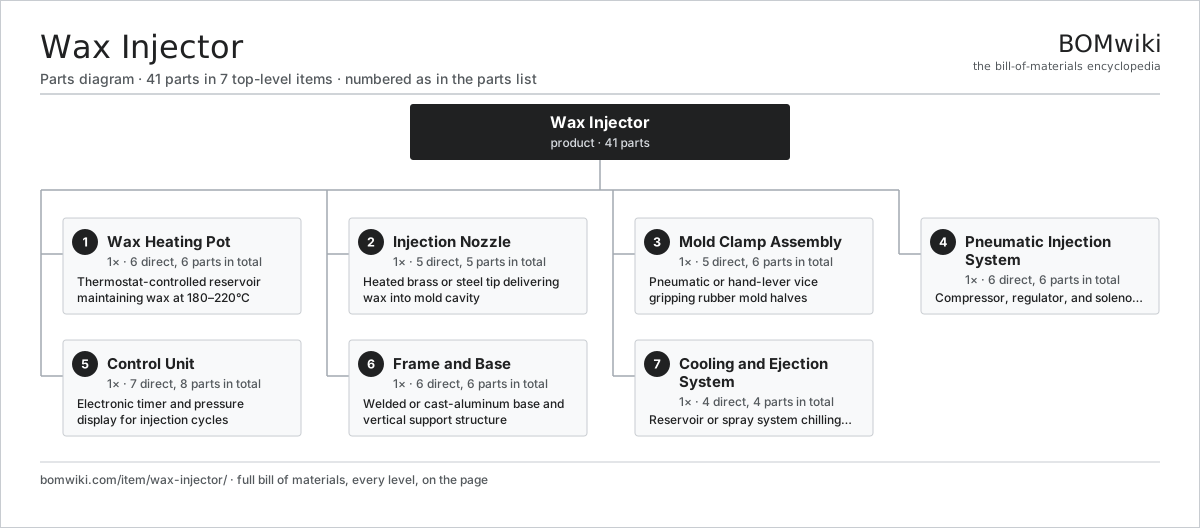
| # | Part | Qty | What it does |
|---|---|---|---|
| 1 | Wax Heating Pot 6 parts | 1× | Thermostat-controlled reservoir maintaining wax at 180–220°C |
| 2 | Injection Nozzle 5 parts | 1× | Heated brass or steel tip delivering wax into mold cavity |
| 3 | Mold Clamp Assembly 5 parts | 1× | Pneumatic or hand-lever vice gripping rubber mold halves |
| 4 | Pneumatic Injection System 6 parts | 1× | Compressor, regulator, and solenoid controlling injection pressure |
| 5 | Control Unit 7 parts | 1× | Electronic timer and pressure display for injection cycles |
| 6 | Frame and Base 6 parts | 1× | Welded or cast-aluminum base and vertical support structure |
| 7 | Cooling and Ejection System 4 parts | 1× | Reservoir or spray system chilling wax patterns for ejection |
3D model
No 3D model yet. Have a CAD file of this? Add a 3D model. STL renders right on this page; STEP, FreeCAD, and OpenSCAD sources are welcome too (openly licensed, like all 3D models on BOMwiki).
Build & assembly graph
expand / collapse · shared sub-assemblies converge · links to related products · est. labourTap an assembly to expand/collapse · tap a part to open it · use “Open page” for any node · drag to pan, scroll to zoom.
Bill of materials for Wax Injector
7 top-level lines · 46 rows shown · 41 parts total · indented to 3 levels| # | Item / sub-assembly | Part no. | Qty/assy | Ext. qty | Parts | Type |
|---|---|---|---|---|---|---|
| 1 | Wax Heating Pot 6 parts | wax-injector-heating-pot | 1× | 1 | 6 | assembly |
| 1.1 | Pot Body | wax-injector-pot-body | 1× | 1 | · | part |
| 1.2 | Immersion Heater | wax-injector-pot-heater | 1× | 1 | · | part |
| 1.3 | Temperature Thermostat | wax-injector-pot-thermostat | 1× | 1 | · | part |
| 1.4 | Pot Insulation Blanket | wax-injector-pot-insulation | 1× | 1 | · | part |
| 1.5 | Pot Lid | wax-injector-pot-lid | 1× | 1 | · | part |
| 1.6 | Fastener Set | fastener-set | 1× | 1 | · | part |
| 2 | Injection Nozzle 5 parts | wax-injector-injection-nozzle | 1× | 1 | 5 | assembly |
| 2.1 | Nozzle Body Tube | wax-injector-nozzle-body | 1× | 1 | · | part |
| 2.2 | Nozzle Tip Orifice | wax-injector-nozzle-tip | 1× | 1 | · | part |
| 2.3 | Nozzle Cartridge Heater | wax-injector-nozzle-heater | 1× | 1 | · | part |
| 2.4 | Nozzle Return Spring | wax-injector-nozzle-spring | 1× | 1 | · | part |
| 2.5 | Nozzle Seal O-ring | wax-injector-nozzle-seal | 1× | 1 | · | part |
| 3 | Mold Clamp Assembly 5 parts | wax-injector-mold-clamp | 1× | 1 | 6 | assembly |
| 3.1 | Clamp Frame Body | wax-injector-clamp-frame | 1× | 1 | · | part |
| 3.2 | Clamp Jaw Pair | wax-injector-clamp-jaws | 2× | 2 | · | part |
| 3.3 | Clamp Piston Rod | wax-injector-clamp-piston | 1× | 1 | · | part |
| 3.4 | Clamp Spring | wax-injector-clamp-spring | 1× | 1 | · | part |
| 3.5 | Mold Guide Pin | wax-injector-clamp-guide-pin | 1× | 1 | · | part |
| 4 | Pneumatic Injection System 6 parts | wax-injector-air-system | 1× | 1 | 6 | assembly |
| 4.1 | Air Compressor | wax-injector-air-compressor | 1× | 1 | · | part |
| 4.2 | Air Receiver Tank | wax-injector-air-tank | 1× | 1 | · | part |
| 4.3 | Air Dryer | wax-injector-air-dryer | 1× | 1 | · | part |
| 4.4 | Pressure Regulator | wax-injector-pressure-regulator | 1× | 1 | · | part |
| 4.5 | Injection Solenoid Valve | wax-injector-solenoid-valve | 1× | 1 | · | part |
| 4.6 | Air Supply Hose | wax-injector-air-hose | 1× | 1 | · | part |
| 5 | Control Unit 7 parts | wax-injector-control-unit | 1× | 1 | 8 | assembly |
| 5.1 | Microcontroller | mcu | 1× | 1 | · | part |
| 5.2 | Bare PCB | pcb-bare | 1× | 1 | · | part |
| 5.3 | SMD Passive (R/C/L) | smd-passives | 1× | 1 | · | part |
| 5.4 | Relay | relay | 2× | 2 | · | part |
| 5.5 | LCD Panel | lcd-panel | 1× | 1 | · | part |
| 5.6 | Control Panel Buttons | wax-injector-timer-buttons | 1× | 1 | · | part |
| 5.7 | Pressure Sensor | pressure-sensor | 1× | 1 | · | part |
| 6 | Frame and Base 6 parts | wax-injector-frame | 1× | 1 | 6 | assembly |
| 6.1 | Base Plate | wax-injector-base-plate | 1× | 1 | · | part |
| 6.2 | Vertical Post | wax-injector-vertical-post | 1× | 1 | · | part |
| 6.3 | Pot Mounting Bracket | wax-injector-pot-bracket | 1× | 1 | · | part |
| 6.4 | Nozzle Precision Mount | wax-injector-nozzle-mount | 1× | 1 | · | part |
| 6.5 | Clamp Mounting Bracket | wax-injector-clamp-bracket | 1× | 1 | · | part |
| 6.6 | Fastener Set | fastener-set | 1× | 1 | · | part |
| 7 | Cooling and Ejection System 4 parts | wax-injector-cooling-tray | 1× | 1 | 4 | assembly |
| 7.1 | Cooling Tray Body | wax-injector-cooling-tray-body | 1× | 1 | · | part |
| 7.2 | Spray Header Manifold | wax-injector-cooling-tray-spray-header | 1× | 1 | · | part |
| 7.3 | Drain Sump and Pump | wax-injector-cooling-tray-drain | 1× | 1 | · | part |
| 7.4 | Thermoelectric Chiller | wax-injector-chiller-unit | 1× | 1 | · | part |
Something wrong in this list? Report a problem with this BOM.
Related products
same domain, ranked by shared parts Cable Coiling Machine
36 parts · shares 4 with this page
Cable Coiling Machine
36 parts · shares 4 with this page
 Cable Extrusion Line
46 parts · shares 4 with this page
Coil Coating Line
1,767 parts · shares 4 with this page
Cable Extrusion Line
46 parts · shares 4 with this page
Coil Coating Line
1,767 parts · shares 4 with this page
Sourcing: possible vendors
Browse the supplier directory → Prices, MOQ, and lead times are algorithmic estimates, not quotes, and not claims about these companies. Company mappings are curated by keyword; est. price band $5k–$2M. How estimates work| Vendor | HQ | Specialty | MOQ | Lead time |
|---|---|---|---|---|
| atlascopco.com ↗ | Stockholm, SE | Compressors & industrial | 10 units | 12–20 wks |
|
🇦🇹Andritz
andritz.com ↗
|
Graz, AT | Process plants & machinery | 10 units | 12–20 wks |
| buhlergroup.com ↗ | Uzwil, CH | Food & materials processing | 10 units | 12–20 wks |
| gea.com ↗ | Düsseldorf, DE | Process technology | 10 units | 12–20 wks |
| mhi.com ↗ | Tokyo, JP | Heavy machinery | 10 units | 12–20 wks |
1,536-word article