Wire Bonder
ProductOverview
Wire bonding is the dominant method for electrically connecting semiconductor die to package leads or substrates in microelectronics assembly. The wire bonder is an automated precision machine that forms metal bonds, typically using gold or copper wire between 20 and 50 micrometers in diameter, by pressing a bonding tool (capillary) against the wire and substrate surface while imparting ultrasonic vibrations or heat. This creates a metallurgical weld at contact pads, establishing robust low-resistance connections capable of carrying current for the lifetime of the device.
Wire bonding accounts for approximately 70% of all die attach methods in semiconductor packaging. It remains the industry standard because of its flexibility (accommodates various pad geometries and pitches), reliability (bonds are reproducible across billions of cycles), and cost-effectiveness. Modern wire bonders deliver bonding rates of 1000–5000 bonds per hour across 48 to 200+ die per substrate, enabling high-volume production of consumer electronics, automotive, and industrial devices.
Bonding Mechanisms
Two primary bonding modes exist: ultrasonic bonding and thermocompression (TC) bonding. Ultrasonic bonding applies mechanical vibration (100–200 kHz) and normal force to break surface oxides and create intimate contact between wire and pad, forming a diffusion-free solid-state weld. The process occurs rapidly (50–100 ms per bond) at room temperature or modest heating (50–100 °C), making it suitable for temperature-sensitive components.
Thermocompression bonding combines heat (250–350 °C), pressure, and sometimes ultrasonic assistance to enable diffusion bonding and intermetallic formation between wire and substrate. This mode produces very strong bonds with minimal neck-down (weakening of wire diameter) but requires higher temperatures and longer dwell times, restricting use to parts tolerant of thermal excursions. Many modern production systems employ ultrasonic-thermocompression hybrid modes, applying ultrasound during initial contact and transitioning to sustained heat for final consolidation.
Wire Feed and Capillary System
The Wire Feed System supplies continuous gold or copper wire from a motorized spool at precise tension (typically 15–50 grams). The wire is straightened by ceramic guides, fed through the Capillary at the bondhead, and cut by a solenoid-actuated shear blade to create discrete wire segments for each bond. The capillary is a precision-machined tube (sapphire for gold, tungsten for copper) with an orifice matching the wire diameter; internal channels guide the wire while external surfaces contact the bond pads.
Over thousands of bonds, the capillary orifice degrades from repeated wire feeding and contact with pads, leading to wire deformation and poor bond quality. The ALD System monitors wire loop height in real time and initiates periodic Capillary Cleaner cycles to extend tool life. Some systems integrate ultrasonic capillary cleaning, removing microscopic debris and oxides in seconds. Capillaries typically survive 50,000–200,000 bonds before replacement.
Stage Positioning and Vision
The Stage Assembly positions the die or substrate with micron-level repeatability for each successive bond. The stage holds XY position to ±5 μm using ball screws driven by stepper or servo motors with encoder feedback. Theta rotation capability allows bonding on angled pad arrays (common in BGA and advanced packages). The stage is typically mounted on a base frame that can be removed for quick substrate changeover, minimizing downtime between product runs.
The Vision System includes a coaxial camera aligned with the capillary for real-time die detection and bond verification. The system automatically locates die edges and pad positions, compensating for substrate tilt and thermal expansion. A second side-view camera monitors wire loop shape and height during bonding, enabling feedback control of capillary position and bonding parameters. Modern vision systems use deep learning to classify bond quality (acceptable, weak, open) and flag defects in real time.
Workholder and Thermal Management
The Workholder Assembly consists of a heated vacuum chuck and mechanical clamping arms. The chuck, typically made from ceramic or aluminum, spreads heat uniformly across the substrate surface and maintains vacuum hold (5–10 inHg) to prevent part movement. For thermocompression bonding, the chuck is actively heated to 250–350 °C; thermocouples embedded in the chuck feed back to a PID controller that regulates heater power and compensates for thermal lag.
Heating is critical for bond quality in TC mode. Adequate temperature ensures low flow stress of the wire, good wetting of the intermetallic (gold-aluminum or copper-nickel), and strong diffusion bonding. Thermal uniformity across the chuck is essential; hot spots can cause thermal stress and lead to bond failures after thermal cycling in service. High-end systems add sub-zone temperature control, allowing precise temperature profiling during the bond dwell.
Bondhead Assembly and Force Control
The Bondhead Assembly is the most complex and precise subsystem. The capillary is mounted in a precision spindle and driven vertically by a stepper or servo motor (Z-axis) with nanometer resolution. Below the capillary is a Load Cell that measures the contact force between capillary and substrate in real time, feeding back to a closed-loop controller that maintains constant force throughout the dwell phase.
The Piezo Stack is the heart of ultrasonic bonding. A high-voltage amplifier (100–500 V) excites the PZT stack at the tuned frequency of the bondhead resonator, imparting lateral vibrations (20–50 μm amplitude) to the capillary. The amplitude and phase are tunable via the driver electronics, allowing recipes to adapt to different wire materials, pad geometries, and substrate stiffness. Energy dissipation during ultrasonic oscillation creates localized heating at the contact interface, lowering flow stress and promoting bond formation.
Control and Bonding Recipes
The Main Controller is a real-time embedded system or industrial PC running bonding recipe sequences. A recipe specifies for each bond position: ultrasonic power and duration, capillary force trajectory, heater setpoint, dwell time, wire loop height (ALD target), and vision search parameters. The controller loops continuously: move stage to pad coordinate, wait for vision confirmation, trigger bondhead down sequence, monitor force and temperature, trigger bondhead up, cut wire, and advance to next position.
Modern controllers support multi-site bonding (simultaneous bonding on multiple substrates or die) and recipe switching in seconds, enabling rapid product changeovers. Advanced systems learn from bond data, adjusting recipes in real time to minimize defects and maximize throughput. Machine-vision-based process monitoring logs images of every 100th or 1000th bond, enabling root-cause analysis of quality excursions.
Wire Materials and Reliability
Gold is the traditional wire bond material, chosen for excellent corrosion resistance and reliable intermetallic formation with aluminum pads. However, gold cost (500–1000 USD per kg) has driven adoption of copper wire for cost-sensitive applications. Copper bonds require slightly higher process temperatures (100–150 °C higher) and are more prone to oxidation, necessitating inert gas atmospheres and faster bonding cycles.
Copper wire diameter is typically smaller (15–25 μm vs. 20–50 μm for gold) for equivalent electrical resistance, increasing throughput. However, copper's higher strength requires tuned ultrasonic parameters to avoid wire breaking during bonding; excess force or vibration can snap the wire before a sound bond forms. Both materials exhibit neck-down (diameter reduction at the bond neck) due to plastic deformation; controlled geometry minimizes stress concentration and improves thermal-cycle reliability.
Yield and Defect Modes
Bonding defects fall into several categories: open bonds (poor electrical contact), weak bonds (inadequate strength), and corrosion-induced failures (latent opens after thermal stress or humidity exposure). Open bonds are caught by parametric test (daisy-chain resistance measurement across bonded modules); weak bonds may pass initial test but fail in service during thermal cycling or mechanical shock. Gold bonds are more robust; copper bonds require tighter process control and inert atmosphere discipline to achieve equivalent reliability.
Yield targets are typically 99.95%+ for high-volume applications. Achieving this requires statistical process control (SPC) monitoring of capillary life, heater calibration, and stage accuracy. Preventive maintenance includes capillary replacement every 50,000–100,000 bonds, periodic stage recalibration, and heating element inspection for drift.
Production Environment
Wire bonders operate in semiconductor assembly cleanrooms (ISO class 7–8) to minimize dust contamination of pads and open bonds. Humidity must be controlled to <10% RH to prevent copper oxidation and gold corrosion. Inert gas (nitrogen) flows continuously around the bondhead during operation, displacing oxygen and moisture. Temperature stability in the cleanroom (±2 °C) is critical to maintain capillary and stage alignment.
Substrates are loaded in tape-and-reel or tray formats and positioned by operators or automated handling systems. Modern fabs integrate wire bonders into fully automated assembly lines with pick-and-place, molding, and test operations, achieving sub-second operator interaction per unit.
Wire Bonder parts and their functions
8 top-level parts · 44 parts in total · full bill of materials below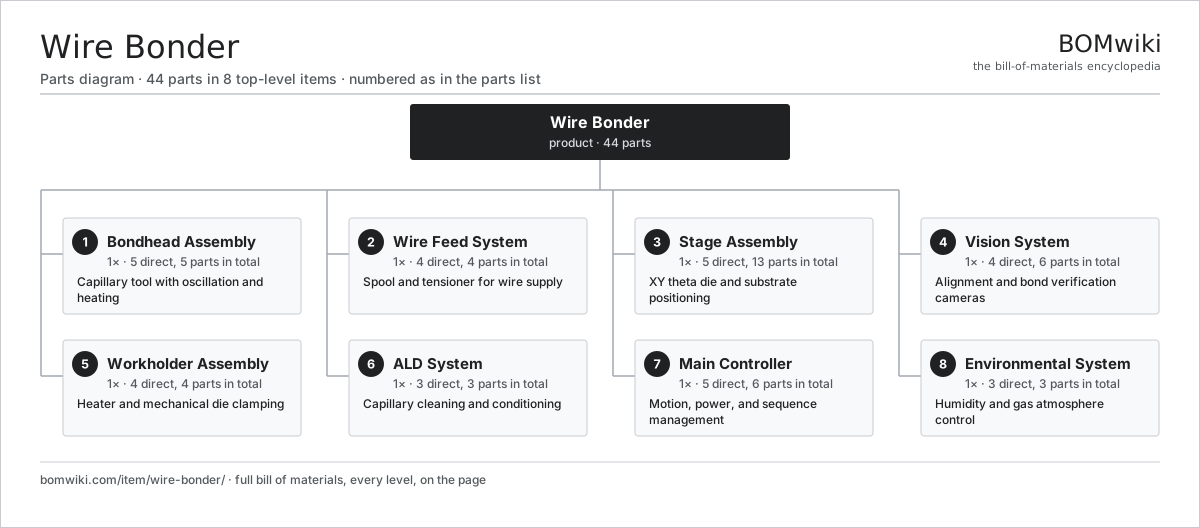
| # | Part | Qty | What it does |
|---|---|---|---|
| 1 | Bondhead Assembly 5 parts | 1× | Capillary tool with oscillation and heating |
| 2 | Wire Feed System 4 parts | 1× | Spool and tensioner for wire supply |
| 3 | Stage Assembly 5 parts | 1× | XY theta die and substrate positioning |
| 4 | Vision System 4 parts | 1× | Alignment and bond verification cameras |
| 5 | Workholder Assembly 4 parts | 1× | Heater and mechanical die clamping |
| 6 | ALD System 3 parts | 1× | Capillary cleaning and conditioning |
| 7 | Main Controller 5 parts | 1× | Motion, power, and sequence management |
| 8 | Environmental System 3 parts | 1× | Humidity and gas atmosphere control |
3D model
No 3D model yet. Have a CAD file of this? Add a 3D model. STL renders right on this page; STEP, FreeCAD, and OpenSCAD sources are welcome too (openly licensed, like all 3D models on BOMwiki).
Build & assembly graph
expand / collapse · shared sub-assemblies converge · links to related products · est. labourTap an assembly to expand/collapse · tap a part to open it · use “Open page” for any node · drag to pan, scroll to zoom.
Bill of materials for Wire Bonder
8 top-level lines · 41 rows shown · 44 parts total · indented to 3 levels| # | Item / sub-assembly | Part no. | Qty/assy | Ext. qty | Parts | Type |
|---|---|---|---|---|---|---|
| 1 | Bondhead Assembly 5 parts | wire-bonder-bondhead | 1× | 1 | 5 | assembly |
| 1.1 | Capillary | wire-bonder-capillary | 1× | 1 | · | part |
| 1.2 | Piezo Stack | wire-bonder-piezo-stack | 1× | 1 | · | part |
| 1.3 | Load Cell | wire-bonder-force-load-cell | 1× | 1 | · | part |
| 1.4 | Heater Cartridge | wire-bonder-heater-cartridge | 1× | 1 | · | part |
| 1.5 | Z-Axis Servo | wire-bonder-z-servo | 1× | 1 | · | part |
| 2 | Wire Feed System 4 parts | wire-bonder-wire-feed | 1× | 1 | 4 | assembly |
| 2.1 | Spool Motor | wire-bonder-spool-motor | 1× | 1 | · | part |
| 2.2 | Wire Tensioner | wire-bonder-tensioner | 1× | 1 | · | part |
| 2.3 | Wire Straightener | wire-bonder-straightener | 1× | 1 | · | part |
| 2.4 | Wire Cutter | wire-bonder-cutter | 1× | 1 | · | part |
| 3 | Stage Assembly 5 parts | wire-bonder-stage | 1× | 1 | 13 | assembly |
| 3.1 | Ball Screw | ball-screw | 2× | 2 | · | part |
| 3.2 | Encoder | encoder | 2× | 2 | · | part |
| 3.3 | Theta Rotation Stage | wire-bonder-theta-stage | 1× | 1 | · | part |
| 3.4 | Ball Bearing | ball-bearing | 6× | 6 | · | part |
| 3.5 | Sheet Metal Panel | sheet-panel | 2× | 2 | · | part |
| 4 | Vision System 4 parts | wire-bonder-vision-system | 1× | 1 | 6 | assembly |
| 4.1 | CMOS Image Sensor | image-sensor | 2× | 2 | · | part |
| 4.2 | Lens Assembly | camera-lens | 2× | 2 | · | part |
| 4.3 | Coaxial Lighting | wire-bonder-lighting | 1× | 1 | · | part |
| 4.4 | Vision Processor | wire-bonder-vision-processor | 1× | 1 | · | part |
| 5 | Workholder Assembly 4 parts | wire-bonder-workholder | 1× | 1 | 4 | assembly |
| 5.1 | Heated Chuck | wire-bonder-vacuum-chuck | 1× | 1 | · | part |
| 5.2 | Heating Element | heating-element | 1× | 1 | · | part |
| 5.3 | Clamp Arm | wire-bonder-clamp-arm | 1× | 1 | · | part |
| 5.4 | Pressure Sensor | pressure-sensor | 1× | 1 | · | part |
| 6 | ALD System 3 parts | wire-bonder-ald-system | 1× | 1 | 3 | assembly |
| 6.1 | ALD Sensor | wire-bonder-ald-sensor | 1× | 1 | · | part |
| 6.2 | Capillary Cleaner | wire-bonder-capillary-cleaner | 1× | 1 | · | part |
| 6.3 | ALD Controller | wire-bonder-ald-controller | 1× | 1 | · | part |
| 7 | Main Controller 5 parts | wire-bonder-controller | 1× | 1 | 6 | assembly |
| 7.1 | Main CPU | wire-bonder-main-cpu | 1× | 1 | · | part |
| 7.2 | Power Supply | power-supply | 2× | 2 | · | part |
| 7.3 | Ultrasonic Driver | wire-bonder-ultrasonic-driver | 1× | 1 | · | part |
| 7.4 | Motion Controller | wire-bonder-motion-cards | 1× | 1 | · | part |
| 7.5 | Bare PCB | pcb-bare | 1× | 1 | · | part |
| 8 | Environmental System 3 parts | wire-bonder-environment | 1× | 1 | 3 | assembly |
| 8.1 | Gas Flow Control | wire-bonder-gas-control | 1× | 1 | · | part |
| 8.2 | Humidity Sensor | wire-bonder-humidity-sensor | 1× | 1 | · | part |
| 8.3 | Relay | relay | 1× | 1 | · | part |
Something wrong in this list? Report a problem with this BOM.
Related products
same domain, ranked by shared parts Wafer Dicing Saw
44 parts · shares 8 with this page
SMT Stencil Printer
43 parts · shares 7 with this page
Wafer Dicing Saw
44 parts · shares 8 with this page
SMT Stencil Printer
43 parts · shares 7 with this page
 SMT Pick-and-Place Machine
60 parts · shares 7 with this page
SMT Pick-and-Place Machine
60 parts · shares 7 with this page
 Mask Aligner
38 parts · shares 6 with this page
Mask Aligner
38 parts · shares 6 with this page
Sourcing: possible vendors
Browse the supplier directory → Prices, MOQ, and lead times are algorithmic estimates, not quotes, and not claims about these companies. Company mappings are curated by keyword; est. price band $5k–$2M. How estimates work| Vendor | HQ | Specialty | MOQ | Lead time |
|---|---|---|---|---|
| atlascopco.com ↗ | Stockholm, SE | Compressors & industrial | 10 units | 12–20 wks |
|
🇦🇹Andritz
andritz.com ↗
|
Graz, AT | Process plants & machinery | 10 units | 12–20 wks |
| buhlergroup.com ↗ | Uzwil, CH | Food & materials processing | 10 units | 12–20 wks |
| gea.com ↗ | Düsseldorf, DE | Process technology | 10 units | 12–20 wks |
| mhi.com ↗ | Tokyo, JP | Heavy machinery | 10 units | 12–20 wks |
1,433-word article