Wire Straightening & Cutting Machine
ProductOverview
A wire straightening and cutting machine is a precision apparatus that feeds coiled wire stock through straightening rollers, measures the length in real-time, and cuts individual pieces to specification. The machine is ubiquitous in electrical, automotive, and telecommunications manufacturing, where hundreds of thousands of wire pieces of defined length are required daily.
Coiled wire arrives with "coil memory", the tendency to spring back into a curved shape due to the plastic deformation of being wound. Direct cutting from a coil produces curved pieces that are difficult to position in assemblies or feed into automation. The straightening process removes this memory by bending the wire alternately left and right through rotating dies, progressively reducing the residual curvature to <0.5 mm per meter, resulting in essentially straight pieces suitable for precise positioning.
Modern straightening-and-cutting machines are production workhorses. A harness plant producing automotive looms may operate dozens of these machines, each dedicated to a specific wire gauge and cut length. A single machine can produce 500–1000 cut pieces per hour, delivering the supply for multi-strand harness assembly on adjacent workstations.
How It Works
The process is a coordinated pipeline: (1) Wire is wound on a coil and mounted on the Payoff Reel Assembly, which is motorized and rotates at constant speed. A Tension Brake maintains consistent feed tension (typically 10–50 N, depending on wire stiffness). (2) Wire unwinds from the reel and immediately enters the Straightener Dies Assembly, a stack of 3–6 rotating cylindrical dies. The dies are arranged vertically in alternating upper-lower pairs. As the wire passes through, each die rotates and bends the wire slightly; the alternating bends (left, right, left, right) remove the coil memory. The Roller Dies rotates at 100–1000 rpm, determined by the feed speed and the degree of straightening required. (3) The straightened wire then passes through the Feed Roller Assembly, which grip the wire and advance it at constant, measurable speed (typically 50–500 m/min). The feed-roller Encoder counts rotations to measure linear travel. (4) The Length Measuring System accumulates the measured distance. When the accumulated length equals the preset cut length (e.g., 500 mm), the counter sends a trigger signal. (5) The Shear Blade Unit actuator receives the trigger and fires, causing the cutting blades to shear the wire cleanly. (6) The severed piece falls into the Collection and Discharge Assembly or onto a conveyor for bundle strapping and boxing. (7) The next cycle begins immediately, as the process is continuous.
The Control and Interface System orchestrates all timing and speeds via a PLC. The operator enters a preset cut length (e.g., 127 mm for automotive harness pieces, 50 mm for component leads) via the LCD Panel. The PLC then calculates the number of feed-roller rotations required to deliver that length and sets a software counter to trigger the shear at the precise moment.
Straightening Mechanics
The Straightener Dies Assembly work on a simple principle: coiled wire has been bent in one direction (around the coil radius). By bending it in the opposite direction (and then alternating), the plastic deformation is "cycled out" over successive bends.
The geometry of the die set matters: dies are spaced and angled such that:
- The first die bends wire upward.
- The second die bends it downward.
- The third bends it upward again (but more gently if it is a smoothing die).
- Additional dies may include adjustable-pressure smoothing dies to reduce final curvature to near-zero.
The final straightness is measured as deviation from a perfectly straight line: a good straightener achieves <0.5 mm per meter deviation. This is sufficient for most assembly applications. Some high-precision machines (e.g., for instrument-panel backlighting or flat-display wiring) may achieve <0.2 mm per meter.
The die rotational speed is inversely proportional to feed speed: if wire is advanced at 200 m/min = 3.33 m/s, and the die pitch (axial distance the wire travels per die rotation) is, say, 50 mm, the die must rotate at 3.33 m/s ÷ 0.05 m = 66.6 rpm. The control system automatically adjusts die speed based on the feed-speed setpoint to maintain the correct feed-rate-to-die-speed ratio.
Feed Roller Control and Precision
The Feed Roller Pair is the critical element for length measurement accuracy. The rollers are typically 50–100 mm diameter and are made of hardened steel with a textured or knurled surface for positive grip. They rotate in synchrony, driven by a single motor through a belt or gear drive.
The Encoder on the feed-roller shaft counts rotations. Knowing the roller diameter precisely, the PLC calculates linear travel distance from the rotation count. For example, a 60 mm diameter roller has a circumference of π × 60 ≈ 188.5 mm. Each rotation advances the wire 188.5 mm. If the PLC counts 2665 rotations, the wire has advanced 2665 × 188.5 mm = 502,772.5 mm ≈ 502.8 m. If the preset length is 500 m, the counter triggers the shear.
Accuracy is typically ±1 mm per cut due to several factors:
- Encoder quantization: If the encoder provides 360 pulses per rotation and the roller circumference is 188.5 mm, the measurement resolution is 188.5 mm / 360 ≈ 0.52 mm per pulse. Cuts ≤1000 mm will have ±0.52 mm quantization error.
- Roller wear: Over months of operation, the roller surface wears slightly, reducing effective diameter and introducing measurement drift. This is compensated by periodic calibration (re-measuring the roller diameter).
- Slip: If the feed rollers slip on the wire, the measured distance will not match actual travel. Slip is prevented by applying adequate pressure between the rollers (typically 50–100 N) and using textured roller surfaces.
Some machines implement a "floating measurement" mode: instead of a fixed preset, the operator defines the total wire required (e.g., 5000 m of 500 mm pieces = 10 pieces) and the machine counts pieces until the total is reached, adjusting for accumulated measurement drift.
Shear Blade Design and Cut Quality
The Cutting Blades are precision-ground hardened steel (typically Rc 60–62). The blades are arranged at a slight angle (typically 3–5 degrees) to each other; this allows the cutting force to be distributed over a slightly longer contact surface, preventing blade chip-out or crumbling under repeated impact.
The shear cuts cleanly without significant deformation of the wire end, producing a flat, square edge. A poor cut leaves a burr or deformed wire tip, making it difficult to insert into connectors or component lead holes. Shear blade condition is monitored: if >10% of cuts show burring or deformation, the blades are re-sharpened or replaced.
The cutting force (typically 200–1000 bar applied pneumatically or hydraulically) is just enough to sever the wire in a single quick stroke. Insufficient force results in incomplete shearing or bending of the wire rather than a clean cut. Excessive force accelerates blade wear and may damage the precision alignment of the shear mechanism.
Wire Material and Hardness Variations
The straightening and cutting process is sensitive to wire material and hardness:
- Annealed Copper: Soft, easily straightened and cut. Dead-soft annealed copper (hardness <Rb 30) straightens at 200–300 m/min.
- Half-Hard or Hard Copper: Requires slower feed speed (50–150 m/min) and more aggressive straightening dies (more die passes) to remove coil memory.
- Stainless Steel: Very hard, requires slow feed (30–100 m/min) and frequent blade maintenance. Straightening is less effective; residual curvature may be ±2–5 mm per meter.
- Aluminum: Soft and easily work-hardened; straightening must be gentle to avoid introducing work-hardening that increases brittleness. Feed speed is typically 100–300 m/min.
The operator must select the correct die set and feed speed for the material. Most machines have pre-programmed material profiles (copper, aluminum, stainless steel, etc.) selectable via the LCD Panel.
Coil Unwinding and Tension Control
The Payoff Reel Assembly must unwind coil wire smoothly without slack or excessive tension. The Tension Brake uses either a friction-band brake or a pneumatically actuated device that applies drag proportional to the wire feed rate. As the wire is pulled by the feed rollers, the payoff reel rotates freely, but the brake resists rotation, creating tension.
Ideal tension is approximately 10–30% of the wire's breaking load: enough to keep the wire taut and prevent bird-nesting (tangled coil sections), but not so much as to introduce permanent strain or cause wire breakage during payoff. A 1 mm copper wire typically has breaking load ~50 N; ideal payoff tension would be ~5–15 N.
The payoff motor speed is typically constant or slowly variable. If the feed speed changes, the payoff reel speed should also adjust to keep tension constant. Some machines use load-cell feedback on the brake to maintain constant tension automatically; simpler machines rely on fixed brake settings and assume operator adjustment for different wire types.
Production Integration and Automation
Straightening-and-cutting machines are often integrated into larger assembly lines. The cut-wire output feeds directly into automated harness-build stations or is bundled offline for batch processing. Some machines include integrated piece-counting (the Control and Interface System displays cumulative piece count) to allow production tracking and efficiency monitoring.
In high-volume plants, multiple straightening-cutting machines (often 6–12) run in parallel, each producing a different wire gauge or cut length, and all outputs are fed to a common bundling and strapping station. Barcode labels are applied to each bundle, enabling traceability.
Quality Testing and Verification
Finished cut pieces are sometimes sampled and tested for:
- Straightness: A sample is laid flat on a precision surface plate and measured for bow or deviation from a straight line.
- Cut Quality: Inspection for burrs, incomplete cuts, or wire bending at the cut end.
- Dimensional Accuracy: Measurement of cut length; a sample of 10 pieces is verified to ±1–2 mm.
If straightness or cut quality exceeds tolerance, the machine is serviced (die inspection, blade sharpening, straightening-speed adjustment).
Maintenance and Troubleshooting
Common issues and corrections:
- Poor straightness: Indicates worn dies or insufficient die rotational speed. Corrected by replacing dies and adjusting feed speed.
- Incomplete or poor-quality cuts: Caused by dull or misaligned blades, or insufficient cutting force. Corrected by blade inspection and sharpening or pressure-regulator adjustment.
- Length inaccuracy: Indicates roller wear, encoder malfunction, or slip. Corrected by re-measuring roller diameter, encoder inspection, and feed-pressure adjustment.
- Wire breakage during payoff: Often caused by excessive payoff tension or a sharp edge or burr on the payoff-reel flange. Corrected by brake pressure reduction and reel inspection.
Routine maintenance includes monthly die and blade inspection, quarterly roller surface cleaning and re-calibration, and semi-annual replacement of worn parts (dies, blades, and encoder sensor if applicable).
Wire Straightening & Cutting Machine parts and their functions
7 top-level parts · 41 parts in total · full bill of materials below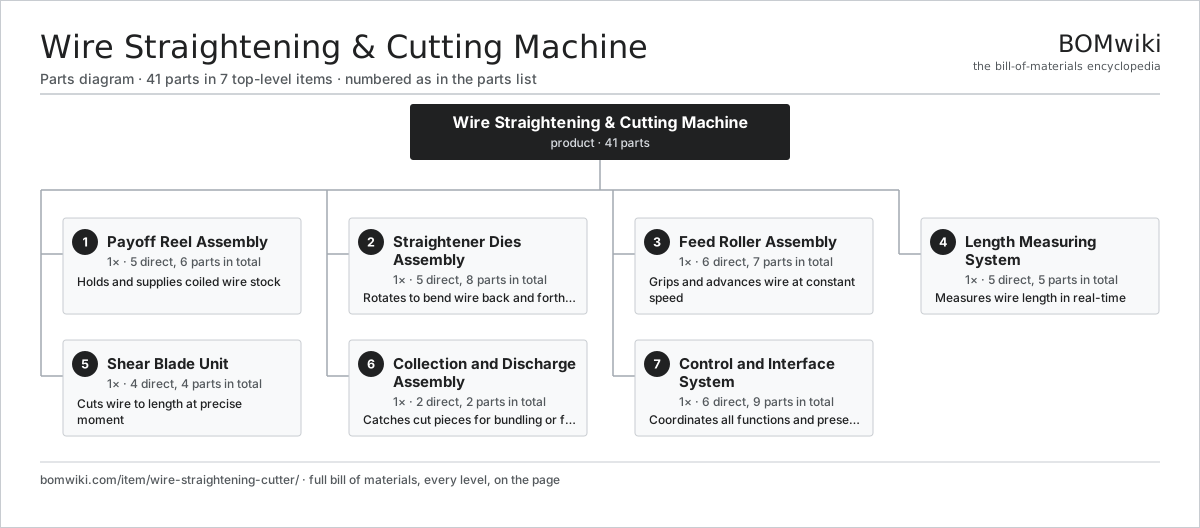
| # | Part | Qty | What it does |
|---|---|---|---|
| 1 | Payoff Reel Assembly 5 parts | 1× | Holds and supplies coiled wire stock |
| 2 | Straightener Dies Assembly 5 parts | 1× | Rotates to bend wire back and forth, removing coil memory |
| 3 | Feed Roller Assembly 6 parts | 1× | Grips and advances wire at constant speed |
| 4 | Length Measuring System 5 parts | 1× | Measures wire length in real-time |
| 5 | Shear Blade Unit 4 parts | 1× | Cuts wire to length at precise moment |
| 6 | Collection and Discharge Assembly 2 parts | 1× | Catches cut pieces for bundling or further processing |
| 7 | Control and Interface System 6 parts | 1× | Coordinates all functions and preset lengths |
3D model
No 3D model yet. Have a CAD file of this? Add a 3D model. STL renders right on this page; STEP, FreeCAD, and OpenSCAD sources are welcome too (openly licensed, like all 3D models on BOMwiki).
Build & assembly graph
expand / collapse · shared sub-assemblies converge · links to related products · est. labourTap an assembly to expand/collapse · tap a part to open it · use “Open page” for any node · drag to pan, scroll to zoom.
Bill of materials for Wire Straightening & Cutting Machine
7 top-level lines · 40 rows shown · 41 parts total · indented to 3 levels| # | Item / sub-assembly | Part no. | Qty/assy | Ext. qty | Parts | Type |
|---|---|---|---|---|---|---|
| 1 | Payoff Reel Assembly 5 parts | wire-straightening-cutter-payoff-reel | 1× | 1 | 6 | assembly |
| 1.1 | Blower Motor | blower-motor | 1× | 1 | · | part |
| 1.2 | Ball Bearing | ball-bearing | 2× | 2 | · | part |
| 1.3 | Reel Hub | wire-straightening-cutter-reel-hub | 1× | 1 | · | part |
| 1.4 | Tension Brake | wire-straightening-cutter-tension-brake | 1× | 1 | · | part |
| 1.5 | Fastener Set | fastener-set | 1× | 1 | · | part |
| 2 | Straightener Dies Assembly 5 parts | wire-straightening-cutter-straightener-dies | 1× | 1 | 8 | assembly |
| 2.1 | Roller Dies | wire-straightening-cutter-die-set | 1× | 1 | · | part |
| 2.2 | Blower Motor | blower-motor | 1× | 1 | · | part |
| 2.3 | Drive Belt | drive-belt | 1× | 1 | · | part |
| 2.4 | Ball Bearing | ball-bearing | 4× | 4 | · | part |
| 2.5 | Fastener Set | fastener-set | 1× | 1 | · | part |
| 3 | Feed Roller Assembly 6 parts | wire-straightening-cutter-feed-rollers | 1× | 1 | 7 | assembly |
| 3.1 | Blower Motor | blower-motor | 1× | 1 | · | part |
| 3.2 | Feed Roller Pair | wire-straightening-cutter-feed-roller-pair | 1× | 1 | · | part |
| 3.3 | Drive Belt | drive-belt | 1× | 1 | · | part |
| 3.4 | Encoder | encoder | 1× | 1 | · | part |
| 3.5 | Ball Bearing | ball-bearing | 2× | 2 | · | part |
| 3.6 | Fastener Set | fastener-set | 1× | 1 | · | part |
| 4 | Length Measuring System 5 parts | wire-straightening-cutter-length-counter | 1× | 1 | 5 | assembly |
| 4.1 | Encoder | encoder | 1× | 1 | · | part |
| 4.2 | Bare PCB | pcb-bare | 1× | 1 | · | part |
| 4.3 | LCD Panel | lcd-panel | 1× | 1 | · | part |
| 4.4 | Microcontroller | mcu | 1× | 1 | · | part |
| 4.5 | Relay | relay | 1× | 1 | · | part |
| 5 | Shear Blade Unit 4 parts | wire-straightening-cutter-shear-blade | 1× | 1 | 4 | assembly |
| 5.1 | Cutting Blades | wire-straightening-cutter-blade-pair | 1× | 1 | · | part |
| 5.2 | Shear Actuator | wire-straightening-cutter-shear-actuator | 1× | 1 | · | part |
| 5.3 | Pressure Sensor | pressure-sensor | 1× | 1 | · | part |
| 5.4 | Fastener Set | fastener-set | 1× | 1 | · | part |
| 6 | Collection and Discharge Assembly 2 parts | wire-straightening-cutter-collection-tray | 1× | 1 | 2 | assembly |
| 6.1 | Discharge Chute | wire-straightening-cutter-discharge-chute | 1× | 1 | · | part |
| 6.2 | Fastener Set | fastener-set | 1× | 1 | · | part |
| 7 | Control and Interface System 6 parts | wire-straightening-cutter-control-system | 1× | 1 | 9 | assembly |
| 7.1 | Microcontroller | mcu | 1× | 1 | · | part |
| 7.2 | Bare PCB | pcb-bare | 1× | 1 | · | part |
| 7.3 | Relay | relay | 2× | 2 | · | part |
| 7.4 | LCD Panel | lcd-panel | 1× | 1 | · | part |
| 7.5 | SMD Passive (R/C/L) | smd-passives | 1× | 1 | · | part |
| 7.6 | Connector | connector | 3× | 3 | · | part |
Something wrong in this list? Report a problem with this BOM.
Related products
same domain, ranked by shared parts Aluminum Extrusion Press
365 parts · shares 2 with this page
Bar Chamfering Machine
1,148 parts · shares 2 with this page
Aluminum Extrusion Press
365 parts · shares 2 with this page
Bar Chamfering Machine
1,148 parts · shares 2 with this page
 Bevel Gear Generator
201 parts · shares 2 with this page
Camshaft Grinder
489 parts · shares 2 with this page
Bevel Gear Generator
201 parts · shares 2 with this page
Camshaft Grinder
489 parts · shares 2 with this page
Sourcing: possible vendors
Browse the supplier directory → Prices, MOQ, and lead times are algorithmic estimates, not quotes, and not claims about these companies. Company mappings are curated by keyword; est. price band $10k–$1M. How estimates work| Vendor | HQ | Specialty | MOQ | Lead time |
|---|---|---|---|---|
|
🇩🇪DMG MORI
dmgmori.com ↗
|
Bielefeld, DE | Machine tools | 5 units | 12–20 wks |
|
🇯🇵Mazak
mazak.com ↗
|
Oguchi, JP | Machine tools | 5 units | 12–20 wks |
| haascnc.com ↗ | Oxnard, US | CNC machine tools | 5 units | 12–20 wks |
|
🇯🇵Okuma
okuma.com ↗
|
Niwa, JP | Machine tools | 5 units | 12–20 wks |
|
🇩🇪Trumpf
trumpf.com ↗
|
Ditzingen, DE | Laser & sheet-metal machines | 5 units | 12–20 wks |
1,840-word article