Wire Stranding Machine
ProductOverview
A wire stranding machine assembles multiple individual wires or wire strands into a single, compact multi-strand cable by rotating a cage of payoff bobbins around a central point while simultaneously pulling the combined strand through a closing die. The result is a geometrically regular cable used in power transmission, telecommunications, marine rigging, suspension bridges, and any application requiring high tensile strength, flexibility, or current-carrying capacity.
The physics of stranding is elegant: as the cage rotates around the central line, each bobbin's wire follows a helical path, and the twist angle and lay length (pitch) are controlled by the ratio of cage rotation speed to axial pull-through speed. Lay length, the axial distance for one complete helix cycle, directly determines cable stiffness and torque-resistance; tighter lays produce stiffer, higher-strength cables, while longer lays yield more flexible products.
Wire stranding is ubiquitous in infrastructure. Power transmission towers use high-strength steel stranded cables rated to 1000+ MPa tensile strength, manufactured with aluminum or aluminum-alloy outer strands for conductivity. Telecommunications cables blend steel for strength and copper for signal transmission. Suspension bridge cables (Golden Gate, Brooklyn Bridge) employ strands spun on massive machines with thousands of individual wires. Smaller-diameter stranded cables appear in automotive harnesses, marine anchor lines, and musical instrument strings.
How It Works
The fundamental cycle is orchestrated rotation and pull: (1) Individual wire bobbins (4–24 of them, depending on the desired cable structure) are mounted on the Bobbin Support Assembly, each free to rotate as wire unwinds. (2) Each bobbin's wire passes through a Guide Eyes, which smoothly directs the strands toward a central closure point. (3) The Rotating Cage Assembly, carrying bobbin-holding arms, rotates at a constant speed (10–500 rpm, set by the Drive Motor Assembly) around the centerline. (4) As the cage rotates, the bobbins orbit, pulling their wires into a helical twist pattern. (5) All strands converge at the Closing Die, where a precision grooved block compacts and shapes them into the final cylindrical cable form. (6) The Take-Up Drum winds the finished product at a speed synchronized to the strand formation rate (typically 10–100 m/min), and a length Encoder counts the output.
The lay length is computed as: Lay (mm) = (Pull Speed m/min / Cage RPM) × π × (Number of Bobbins - 1) × Bobbin Radius × Conversion Factor. For example, a 7-strand cable with bobbins orbiting at 200 rpm and pulled at 50 m/min will produce a lay of roughly 30 mm. This parameter is critical: telecommunications cables often specify lay length to within ±2%, because a change in lay affects impedance, capacitance, and mechanical handling. The control panel automatically adjusts cage speed and pull-through rate via proportional speed controllers to maintain lay setpoint within tolerance.
Tension uniformity is non-negotiable. If one bobbin feeds wire under higher tension than others, that strand will crimp or collapse during closure, weakening the cable and creating mechanical fatigue initiation sites. The Tension Regulation System uses adjustable Friction Rings (hardened steel discs pressed against each bobbin shaft) to apply drag equal to approximately 5–15% of the final cable's breaking load, divided equally among strands. Pneumatic or hydraulic cylinders adjusting ring pressure allow operators to fine-tune tension without stopping the line.
The Closing Die is precision-grooved: a 7-strand cable die will have 7 grooves arranged symmetrically, each shaped to compress and position one strand. The die block is hardened to Rc 58–62 to resist rapid wear, because millions of cycles per shift (200–2000 kg output/hour implies many thousand strand passages) will score a soft die. The Die Stripper (a spring-loaded or pneumatic ejector) gently pushes the formed cable out of the die without deformation.
Stranding Lay and Cable Geometry
Lay is the primary control parameter. Common lays for electrical cable:
- Close lay (10–20 mm): Produces compact, stiff cables; used for power transmission and mechanical strength where bend radius is less critical.
- Standard lay (30–50 mm): Balance of strength and flexibility; used in general-purpose power cables and most telecommunications.
- Long lay (60–100 mm): Highly flexible, softer handling; used in subsea cables, aircraft harnesses, and applications requiring frequent bending.
The number of strands also varies by application:
- 7-strand: Simplest structure; used in small-diameter control cables and bare copper ground wires.
- 19-strand: Standard for power transmission cables (Concentric Strand Compact or similar geometry).
- 37-strand and higher: Used in very fine-diameter wires (enameled copper for transformers) or ultra-flexible cables where the ratio of individual-wire-to-final-diameter must be minimal.
A typical 7-strand cable structure has 1 central strand surrounded by 6 outer strands in a hexagonal arrangement; a 19-strand structure has a 7-strand core surrounded by a 12-strand outer layer, and so on. The Closing Die is custom-grooved for each configuration.
Material and Conductor Grades
Stranding machines handle materials spanning a wide hardness range:
- Soft annealed copper: Used for power transmission; ductile and conductive, very easy to strand.
- Half-hard or hard-drawn copper: Used in enameled-wire applications (transformer windings), smaller diameter.
- Aluminum and aluminum-alloy (AAC, AAAC): Used in transmission lines for weight savings and cost reduction; less ductile than copper, requires careful tension control to prevent cracking.
- Steel: Used for strength in suspension bridges and high-strength cables; very stiff, requires high tension control to prevent crushing and careful lay-angle management.
- Stainless steel: Used in marine and chemical environments; harder than carbon steel, demanding on die wear and tension-ring friction.
Each material requires custom tooling and tension parameters. A mill running steel strand one shift and copper the next must swap dies, recalibrate bobbin tension, and adjust cage speed, typically a 1–2 hour changeover.
Integration with Cable Manufacturing
Stranding is often a mid-stage process in cable assembly. Upstream, individual wires are drawn (see Wire Straightening & Cutting Machine for fine-diameter products) and may be annealed to restore ductility. Downstream, stranded cables are often insulated by extrusion (see Cable Extrusion Line) or sheathed in additional armor (see Cable Armoring Machine) for multi-conductor bundles. Some products are also coiled (see Cable Coiling Machine) and tested for electrical continuity and tensile strength before shipment.
Industrial plants running multiple stranding lines (typically 2–6 per facility) maintain different lay and strand configurations in parallel. A high-volume telecommunications manufacturer might dedicate one line to 19-strand power-grade cables, another to 37-strand or finer enameled wire, and a third to specialized lay lengths for hybrid power-signal bundles.
Troubleshooting and Maintenance
Common issues encountered:
- Uneven lay: Indicates bobbin-tension imbalance or cage runout (bearing play). Corrected by readjusting friction rings and re-shimming cage bearings.
- Strand bunching: Occurs when pull-through speed lags relative to cage rotation; indicates weak motor, slipping capstan, or excessively high die pressure.
- Wire breakage: Caused by sharp guide-eye edges, misaligned bobbins, or excessive tension. Requires inspection and smoothing or replacement of worn guides.
- Die wear and chatter marks: Inevitable after millions of cycles; requires die replacement (typically every 3–6 months in high-volume production) and careful inspection of closure pressure to prevent accelerated wear.
Ball-bearing maintenance is critical in the Rotating Cage Assembly: the cage bearings experience centrifugal loading and require frequent lubrication to prevent premature failure and costly downtime.
Wire Stranding Machine parts and their functions
7 top-level parts · 45 parts in total · full bill of materials below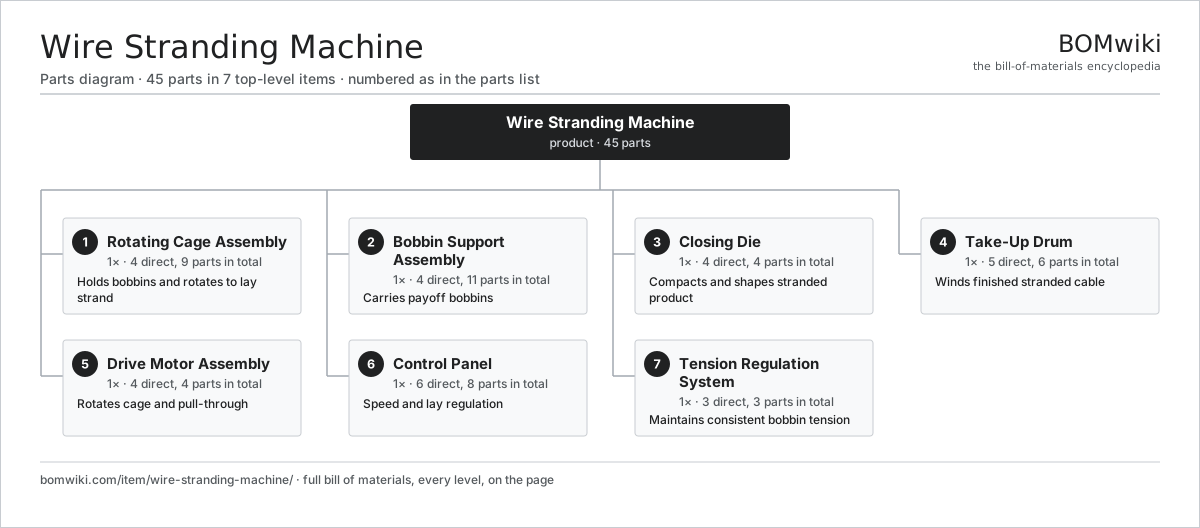
| # | Part | Qty | What it does |
|---|---|---|---|
| 1 | Rotating Cage Assembly 4 parts | 1× | Holds bobbins and rotates to lay strand |
| 2 | Bobbin Support Assembly 4 parts | 1× | Carries payoff bobbins |
| 3 | Closing Die 4 parts | 1× | Compacts and shapes stranded product |
| 4 | Take-Up Drum 5 parts | 1× | Winds finished stranded cable |
| 5 | Drive Motor Assembly 4 parts | 1× | Rotates cage and pull-through |
| 6 | Control Panel 6 parts | 1× | Speed and lay regulation |
| 7 | Tension Regulation System 3 parts | 1× | Maintains consistent bobbin tension |
3D model
No 3D model yet. Have a CAD file of this? Add a 3D model. STL renders right on this page; STEP, FreeCAD, and OpenSCAD sources are welcome too (openly licensed, like all 3D models on BOMwiki).
Build & assembly graph
expand / collapse · shared sub-assemblies converge · links to related products · est. labourTap an assembly to expand/collapse · tap a part to open it · use “Open page” for any node · drag to pan, scroll to zoom.
Bill of materials for Wire Stranding Machine
7 top-level lines · 37 rows shown · 45 parts total · indented to 3 levels| # | Item / sub-assembly | Part no. | Qty/assy | Ext. qty | Parts | Type |
|---|---|---|---|---|---|---|
| 1 | Rotating Cage Assembly 4 parts | wire-stranding-machine-rotating-cage | 1× | 1 | 9 | assembly |
| 1.1 | Ball Bearing | ball-bearing | 6× | 6 | · | part |
| 1.2 | Cage Frame | wire-stranding-machine-cage-frame | 1× | 1 | · | part |
| 1.3 | Cage Central Shaft | wire-stranding-machine-cage-shaft | 1× | 1 | · | part |
| 1.4 | Fastener Set | fastener-set | 1× | 1 | · | part |
| 2 | Bobbin Support Assembly 4 parts | wire-stranding-machine-bobbin-support | 1× | 1 | 11 | assembly |
| 2.1 | Ball Bearing | ball-bearing | 8× | 8 | · | part |
| 2.2 | Bobbin Shafts | wire-stranding-machine-bobbin-shafts | 1× | 1 | · | part |
| 2.3 | Guide Eyes | wire-stranding-machine-guide-eyes | 1× | 1 | · | part |
| 2.4 | Fastener Set | fastener-set | 1× | 1 | · | part |
| 3 | Closing Die 4 parts | wire-stranding-machine-closing-die | 1× | 1 | 4 | assembly |
| 3.1 | Die Block | wire-stranding-machine-die-block | 1× | 1 | · | part |
| 3.2 | Die Stripper | wire-stranding-machine-die-stripper | 1× | 1 | · | part |
| 3.3 | Pressure Sensor | pressure-sensor | 1× | 1 | · | part |
| 3.4 | Fastener Set | fastener-set | 1× | 1 | · | part |
| 4 | Take-Up Drum 5 parts | wire-stranding-machine-take-up-drum | 1× | 1 | 6 | assembly |
| 4.1 | Blower Motor | blower-motor | 1× | 1 | · | part |
| 4.2 | Drum Mandrel | wire-stranding-machine-drum-mandrel | 1× | 1 | · | part |
| 4.3 | Encoder | encoder | 1× | 1 | · | part |
| 4.4 | Ball Bearing | ball-bearing | 2× | 2 | · | part |
| 4.5 | Fastener Set | fastener-set | 1× | 1 | · | part |
| 5 | Drive Motor Assembly 4 parts | wire-stranding-machine-drive-motor | 1× | 1 | 4 | assembly |
| 5.1 | Blower Motor | blower-motor | 1× | 1 | · | part |
| 5.2 | Drive Belt | drive-belt | 1× | 1 | · | part |
| 5.3 | Encoder | encoder | 1× | 1 | · | part |
| 5.4 | Fastener Set | fastener-set | 1× | 1 | · | part |
| 6 | Control Panel 6 parts | wire-stranding-machine-control-panel | 1× | 1 | 8 | assembly |
| 6.1 | Microcontroller | mcu | 1× | 1 | · | part |
| 6.2 | SMD Passive (R/C/L) | smd-passives | 1× | 1 | · | part |
| 6.3 | Relay | relay | 2× | 2 | · | part |
| 6.4 | Bare PCB | pcb-bare | 1× | 1 | · | part |
| 6.5 | LCD Panel | lcd-panel | 1× | 1 | · | part |
| 6.6 | Connector | connector | 2× | 2 | · | part |
| 7 | Tension Regulation System 3 parts | wire-stranding-machine-tension-system | 1× | 1 | 3 | assembly |
| 7.1 | Friction Rings | wire-stranding-machine-friction-rings | 1× | 1 | · | part |
| 7.2 | Pressure Sensor | pressure-sensor | 1× | 1 | · | part |
| 7.3 | Fastener Set | fastener-set | 1× | 1 | · | part |
Something wrong in this list? Report a problem with this BOM.
Related products
same domain, ranked by shared parts Cable Coiling Machine
36 parts · shares 9 with this page
Cable Coiling Machine
36 parts · shares 9 with this page
 Cable Extrusion Line
46 parts · shares 9 with this page
Cable Extrusion Line
46 parts · shares 9 with this page
 Wire Rope Closing Machine
42 parts · shares 9 with this page
Hammer Mill
790 parts · shares 8 with this page
Binder Jetting Printer
112 parts · shares 8 with this page
Wire Rope Closing Machine
42 parts · shares 9 with this page
Hammer Mill
790 parts · shares 8 with this page
Binder Jetting Printer
112 parts · shares 8 with this page
Sourcing: possible vendors
Browse the supplier directory → Prices, MOQ, and lead times are algorithmic estimates, not quotes, and not claims about these companies. Company mappings are curated by keyword; est. price band $5k–$2M. How estimates work| Vendor | HQ | Specialty | MOQ | Lead time |
|---|---|---|---|---|
| atlascopco.com ↗ | Stockholm, SE | Compressors & industrial | 10 units | 12–20 wks |
|
🇦🇹Andritz
andritz.com ↗
|
Graz, AT | Process plants & machinery | 10 units | 12–20 wks |
| buhlergroup.com ↗ | Uzwil, CH | Food & materials processing | 10 units | 12–20 wks |
| gea.com ↗ | Düsseldorf, DE | Process technology | 10 units | 12–20 wks |
| mhi.com ↗ | Tokyo, JP | Heavy machinery | 10 units | 12–20 wks |
1,260-word article