Wireless DMX System
ProductOverview
Wireless DMX systems eliminate the need for long cable runs from a lighting console to remote lighting positions, dimmers, and effects equipment. In touring productions, outdoor concerts, and large venues with complex rigging, a cable backbone can represent thousands of feet of heavy gauge wire requiring installation labor and potential safety hazards. Wireless systems transmit DMX512 control signals over radio, freeing crews to deploy lighting rigs independently.
The Wireless DMX System uses frequency-hopping spread spectrum (FHSS) transmission to overcome the crowded 2.4 GHz ISM band, where WiFi, Bluetooth, and other systems operate. By rapidly hopping between 15 different channels on a pseudo-random schedule, the system maintains reliable communication even in environments with heavy RF interference.
RF Architecture and Frequency Hopping
The DMX Transmitter Unit converts incoming DMX512 frames into wireless packets via a TX Radio Module 2.4 GHz radio module. Rather than using a single fixed frequency, the radio's TX Microcontroller microcontroller manages a frequency-hopping schedule:
- Hop Sequence: 15 channels within the 2.4 GHz band, selected according to a pseudo-random pattern known only to paired TX and RX units.
- Dwell Time: 333 ms per channel (approximately 3 hops per second).
- Synchronization: All receivers paired to a transmitter hop in lockstep, maintaining frame-level synchronization.
For example:
- t=0 ms: TX transmits on Channel 1, RX1 and RX2 listen on Channel 1 (receive frame).
- t=333 ms: TX hops to Channel 5, RX1 and RX2 hop to Channel 5 (transmit next frame).
- t=666 ms: TX hops to Channel 12, RX1 and RX2 hop to Channel 12.
If a stray WiFi signal occupies Channel 5 during that 333 ms window, the hop sequence simply skips past it; the system is back on a clear channel within milliseconds.
Transmitter Design
The DMX Transmitter Unit is a hand-held or rack-mount unit that:
- Receives DMX512 serial frames via an XLR-3 DMX Input Connector connector at 250 kbaud.
- Buffers each 512-channel frame (approximately 23 ms arrival time).
- Encodes the frame into a wireless packet with error-correction codes (Reed-Solomon) and checksum.
- Transmits the packet via TX Antenna at the current hopping frequency.
The transmitter draws approximately 100 mW average power and operates for 8 hours on a pair of 2500 mAh AA NiMH batteries (2× 2.5 Wh = 5 Wh; 100 mW × 8 h = 0.8 Wh actual consumption). This provides significant margin for extended use without recharging.
Receiver Design and Antenna Diversity
Each DMX Receiver Unit unit independently pairs with the transmitter and maintains the same frequency-hopping schedule. Receivers are equipped with dual-antenna diversity to mitigate multipath fading (reflections from walls, metal objects, and structures that cause signal cancellation at certain locations).
The RX Radio Module dual-antenna receiver continuously monitors both antenna signals; if one antenna receives a weak or corrupted frame, the radio switches to the other antenna mid-reception, achieving a 3–5 dB signal-to-noise improvement. This diversity technique reduces packet loss from 5–10% (single antenna) to <1% in typical venues.
When a valid frame is received, the RX Microcontroller validates the checksum and outputs clean DMX512 data via an XLR-3 DMX Output Connector connector at 250 kbaud. If a frame is lost due to RF interference, the receiver holds the previous frame values (last-state hold), preventing jittery or erratic behavior of dimmers and lights.
Extended Range with Directional Antenna
For large venues or outdoor deployments requiring >300 feet range, the Antenna Assembly assembly provides directional transmission:
- Yagi Antenna: A 9-element directional antenna delivering 9 dBi gain in the forward direction.
- Low-Loss Cable: LMR-400 coaxial cable (0.2 dB/100 feet @ 2.4 GHz) minimizes signal loss between transmitter and antenna.
With a 9 dBi Yagi in the forward direction and a base TX power of +20 dBm, the effective radiated power becomes +29 dBm (approximately 800 mW), extending range to 800+ feet in optimal conditions (clear line-of-sight, minimal obstacles).
Pairing and Configuration
The Pairing and Config Unit is a desktop unit that:
- Establishes the hopping frequency pattern shared between TX and all RX units.
- Assigns each receiver a unique ID (for logging and diagnostic purposes).
- Configures TX power level (can be reduced to save battery or minimize RF spillage in crowded bands).
- Tests communication with each receiver (displays signal strength, packet loss rate).
Pairing is typically performed once, during system setup. The Config Microcontroller communicates via a secure handshake, and the hopping pattern is stored in non-volatile memory on each unit. During show operation, TX and RX units come online with the pre-stored hopping schedule, allowing immediate synchronization without requiring the pairing controller.
Latency and Synchronization
Total latency from a DMX input at the transmitter to DMX output at a receiver is:
- DMX frame arrival: 23 ms (512 channels at 250 kbaud)
- RF transmission + processing: 2–3 ms
- Receiver processing: 5 ms
- Total: 30–35 ms
At standard DMX update rate (44 Hz), this represents approximately 1.3 frames of latency, imperceptible to the audience. Lighting and effects changes appear to occur synchronously across wired and wireless channels.
Frequency Coordination and Interference
The 2.4 GHz band is shared with WiFi (802.11 b/g/n), Bluetooth, Zigbee, and cordless phones. The frequency-hopping approach provides inherent interference immunity:
- If WiFi transmits continuously on channels 6–8 (40 MHz bandwidth), the Wireless DMX System hops away from those channels every 333 ms.
- The Reed-Solomon error correction allows up to 15% packet corruption to be recovered; occasional bit errors from overlapping transmissions are corrected transparently.
However, in extremely crowded RF environments (e.g., a convention center with dozens of WiFi access points), the system may experience occasional packet loss. The receiver's last-state hold mitigates this: a single lost frame is invisible to the lighting operator because lights remain at their previous brightness level.
Typical Deployment
A touring concert uses three wireless receivers:
- RX1 (Stage Left Rig): Controls 6× moving lights and 4× color washers (32 DMX addresses).
- RX2 (Stage Right Rig): Controls 6× moving lights and 4× color washers (32 DMX addresses).
- RX3 (Upstage FOH): Controls 2× follow spots and 4× LED battens (16 DMX addresses).
The lighting console (located at front-of-house) outputs its DMX signal to both wired dimmers (traditional XLR cable to stage dimmer rack) and a wireless transmitter. As the show progresses, the operator controls all three wireless rigs identically to the wired system, no separate control interface needed.
Advantages:
- Eliminates 1000+ feet of DMX cable, improving load-in speed.
- Allows outdoor stage placement (30–50 feet from the mixing position) without cable trenches.
- Supports mobile rigs (truck-bed lighting arrays) that move between venues.
Battery Management and Field Deployment
The Power Management charging hub allows rapid battery rotation. A crew member:
- Before the show, installs fresh AA batteries into the transmitter (and any RX units on battery power).
- Docks dead batteries in the charging hub, which recharges them in 3–4 hours via mains AC.
- After the show, batteries are rotated back into inventory for the next day's operation.
This approach provides indefinite runtime: as long as spare battery sets are available and charging infrastructure is in place, the system operates continuously.
Safety and Regulatory Compliance
The Wireless DMX System operates under FCC regulations (Part 15 for unlicensed RF devices). The frequency-hopping spread spectrum modulation provides inherent coexistence with other ISM band users; the system is not required to provide "first-use" priority and must tolerate interference from WiFi and other systems. Users are responsible for:
- Placing transmitter/receiver antennas away from personnel (>2 feet minimum to comply with RF exposure limits).
- Monitoring for RF interference and relocating antennas if packet loss exceeds acceptable levels.
In some countries (EU, Australia), regulatory approval is required; the Wireless DMX System is available with region-locked firmware for compliance in different markets.
Troubleshooting and Maintenance
Common issues:
- Receivers not responding: Verify that all units are powered on and in-range. Signal strength display on the pairing controller should read >-85 dBm for reliable reception.
- Occasional packet loss: Reduce transmitter power (saves battery) or relocate RX antennas to different positions if multipath fading is suspected.
- DMX output shows latching values: Indicates receiver has lost sync; power-cycle the RX unit to re-pair with TX.
The Wireless DMX System requires minimal maintenance; batteries are the only consumable. The RF modules and antennas have indefinite operational life if kept dry and protected from physical damage.
Wireless DMX System parts and their functions
5 top-level parts · 38 parts in total · full bill of materials below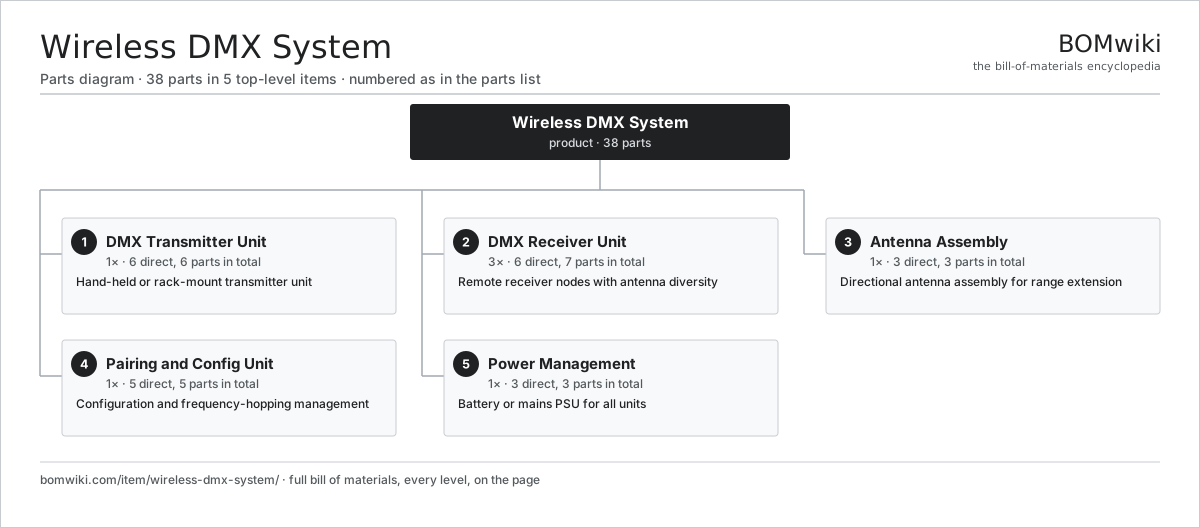
| # | Part | Qty | What it does |
|---|---|---|---|
| 1 | DMX Transmitter Unit 6 parts | 1× | Hand-held or rack-mount transmitter unit |
| 2 | DMX Receiver Unit 6 parts | 3× | Remote receiver nodes with antenna diversity |
| 3 | Antenna Assembly 3 parts | 1× | Directional antenna assembly for range extension |
| 4 | Pairing and Config Unit 5 parts | 1× | Configuration and frequency-hopping management |
| 5 | Power Management 3 parts | 1× | Battery or mains PSU for all units |
3D model
No 3D model yet. Have a CAD file of this? Add a 3D model. STL renders right on this page; STEP, FreeCAD, and OpenSCAD sources are welcome too (openly licensed, like all 3D models on BOMwiki).
Build & assembly graph
expand / collapse · shared sub-assemblies converge · links to related products · est. labourTap an assembly to expand/collapse · tap a part to open it · use “Open page” for any node · drag to pan, scroll to zoom.
Bill of materials for Wireless DMX System
5 top-level lines · 28 rows shown · 38 parts total · indented to 3 levels| # | Item / sub-assembly | Part no. | Qty/assy | Ext. qty | Parts | Type |
|---|---|---|---|---|---|---|
| 1 | DMX Transmitter Unit 6 parts | wireless-dmx-system-transmitter | 1× | 1 | 6 | assembly |
| 1.1 | TX Radio Module | wireless-dmx-system-tx-radio | 1× | 1 | · | part |
| 1.2 | TX Microcontroller | wireless-dmx-system-tx-mcu | 1× | 1 | · | part |
| 1.3 | DMX Input Connector | wireless-dmx-system-dmx-input | 1× | 1 | · | part |
| 1.4 | TX Antenna | wireless-dmx-system-tx-antenna | 1× | 1 | · | part |
| 1.5 | TX Battery Pack | wireless-dmx-system-tx-battery | 1× | 1 | · | part |
| 1.6 | Bare PCB | pcb-bare | 1× | 1 | · | part |
| 2 | DMX Receiver Unit 6 parts | wireless-dmx-system-receiver | 3× | 3 | 7 | assembly |
| 2.1 | RX Radio Module | wireless-dmx-system-rx-radio | 1× | 3 | · | part |
| 2.2 | RX Microcontroller | wireless-dmx-system-rx-mcu | 1× | 3 | · | part |
| 2.3 | DMX Output Connector | wireless-dmx-system-dmx-output | 1× | 3 | · | part |
| 2.4 | RX Diversity Antenna | wireless-dmx-system-rx-antenna | 2× | 6 | · | part |
| 2.5 | RX Power Supply | wireless-dmx-system-rx-battery | 1× | 3 | · | part |
| 2.6 | Bare PCB | pcb-bare | 1× | 3 | · | part |
| 3 | Antenna Assembly 3 parts | wireless-dmx-system-antenna | 1× | 1 | 3 | assembly |
| 3.1 | Yagi Antenna | wireless-dmx-system-directional-antenna | 1× | 1 | · | part |
| 3.2 | Antenna Coaxial Cable | wireless-dmx-system-antenna-cable | 1× | 1 | · | part |
| 3.3 | Antenna Mounting Bracket | wireless-dmx-system-antenna-mount | 1× | 1 | · | part |
| 4 | Pairing and Config Unit 5 parts | wireless-dmx-system-pairing-controller | 1× | 1 | 5 | assembly |
| 4.1 | Config Microcontroller | wireless-dmx-system-config-mcu | 1× | 1 | · | part |
| 4.2 | USB Interface | wireless-dmx-system-usb-interface | 1× | 1 | · | part |
| 4.3 | Status LCD | wireless-dmx-system-status-display | 1× | 1 | · | part |
| 4.4 | Bare PCB | pcb-bare | 1× | 1 | · | part |
| 4.5 | Config Battery | wireless-dmx-system-config-battery | 1× | 1 | · | part |
| 5 | Power Management 3 parts | wireless-dmx-system-power-distribution | 1× | 1 | 3 | assembly |
| 5.1 | Battery Charging Hub | wireless-dmx-system-charging-hub | 1× | 1 | · | part |
| 5.2 | AC Power Adapter | wireless-dmx-system-mains-psu | 1× | 1 | · | part |
| 5.3 | Connector | connector | 1× | 1 | · | part |
Something wrong in this list? Report a problem with this BOM.
Sourcing: possible vendors
Browse the supplier directory → Prices, MOQ, and lead times are algorithmic estimates, not quotes, and not claims about these companies. Company mappings are curated by keyword; est. price band $50–$3k. How estimates work| Vendor | HQ | Specialty | MOQ | Lead time |
|---|---|---|---|---|
|
🇯🇵Sony
sony.com ↗
|
Tokyo, JP | Consumer electronics | 1,000 units | 8–12 wks |
| samsung.com ↗ | Suwon, KR | Electronics & displays | 1,000 units | 8–12 wks |
|
🇺🇸Harman
harman.com ↗
|
Stamford, US | Audio (JBL, AKG) | 1,000 units | 8–12 wks |
|
🇺🇸Bose
bose.com ↗
|
Framingham, US | Audio | 1,000 units | 8–12 wks |
| yamaha.com ↗ | Hamamatsu, JP | Audio & instruments | 1,000 units | 8–12 wks |
1,458-word article