Wireless EV Charging Pad
ProductOverview
Wireless EV charging pads eliminate the need for plug connectors and cables by using magnetic induction to transfer power from a ground-mounted coil (primary) to a vehicle-mounted receiver coil (secondary). A driver simply parks their electric vehicle over a ground pad, and 7–15 kW of power begins flowing wirelessly within seconds. The technology is sometimes called "dynamic wireless charging" when deployed along highways to charge moving vehicles, or "static wireless charging" when used at home, work, or parking facilities.
The key advantage is convenience: no disconnection protocols, no weather-exposed connectors, and no need for trained operators at public charging sites. A secondary benefit is safety, no high-voltage connectors accessible to children or prone to corroded contacts. The primary tradeoff is lower power density compared to hardwired fast charging, and a strict parking tolerance (typically ±150 mm lateral) to maintain efficiency.
Technology Principles
Resonant Inductive Coupling
Wireless EV charging exploits magnetic resonance at 85 kHz, a frequency in the ISM (industrial, scientific, and medical) band that is globally unlicensed and relatively quiet in terms of ambient noise. The ground-side coil is tuned to resonate at exactly 85 kHz via a series/parallel capacitor bank. The vehicle receiver coil is also tuned to 85 kHz.
When the ground coil is driven with 85 kHz AC (via the power inverter), it generates an 85 kHz magnetic field. The vehicle coil, sitting 100–250 mm above, couples to this field and develops a voltage at the same frequency. The coupling coefficient is typically 0.4–0.6 (compared to >0.95 for physically touching transformers), but the resonant tuning on both sides amplifies the voltage gain such that overall system efficiency reaches 90–95%.
Power Conversion Flow
The utility provides 480 VAC three-phase power. The inverter stage accepts this input through a rectifier and DC link, then uses a three-level IGBT inverter to synthesize a ~600 VAC, 85 kHz AC waveform. This waveform drives the ground coil at 15 kW.
The vehicle coil receives the magnetic field as an AC voltage (typically 600 VAC RMS). A bridge rectifier converts this to DC, which is supplied to the vehicle's onboard charger (OBC), the same device used for wired Level 2 charging. The OBC then regulates the voltage and current to the battery pack (e.g., 400 V, 32 A for a 12 kW charge).
Alignment and Positioning
Because coupling efficiency drops sharply if coils are misaligned, from 95% at perfect alignment to 75% at ±200 mm offset, wireless chargers include alignment aids. Most modern systems use:
- Optical guidance: A camera-based system on the ground pad captures the vehicle's position and projects a crosshair or grid pattern onto the ground via LED lights.
- Driver feedback: A status display mounted on a parking sign shows real-time alignment guidance and charging progress.
- Automatic positioning (future): Some research platforms use vehicle-embedded steering adjustment to autonomously position the car within the alignment window.
Typical tolerance is ±150 mm lateral and ±100 mm longitudinal; most drivers achieve this within one or two parking attempts.
Safety and Foreign Object Detection
Because the 85 kHz magnetic field is not safely visible or tangible, wireless chargers must prevent hazardous scenarios:
- Foreign object detection (FOD): The control system continuously monitors the impedance (resistance and reactance) of the ground coil. If a metal object (key, coin, tools) falls between the coils, it couples to the magnetic field, shifting the impedance. The controller detects this shift within 100 ms and reduces power or stops charging.
- Overtemperature protection: Thermistors on both the ground and vehicle coils alert the system if coil windings exceed 85°C; charging is inhibited until temperature drops.
- Frequency detuning check: The inverter monitors the phase angle between drive voltage and current. If detuning occurs (indicating a partially metallic object or water between coils), power is reduced.
Testing has shown that a stainless steel coin dropped between coils is detected and charging halts within 50 milliseconds, long before any hazard.
Installation and Operations
A wireless charging pad installation includes three major pieces:
Ground installation: An excavation 1.2 m × 1.0 m × 0.2 m deep is prepared in a parking space or charging bay. The ground pad enclosure, a stainless steel or composite box, is recessed into this pit and sealed with a waterproof gasket. Inside are the Ground-Side Coil Assembly, Inverter and Power Control, and cooling system. A Drainage System prevents water pooling.
Utility connection: The ground pad connects to a 480 VAC, 30–40 A three-phase service (typically $2,000–$5,000 additional cost per location if not already available).
Vehicle retrofit: A Vehicle-Side Coil and Rectifier module, roughly 0.3 m × 0.3 m × 0.1 m, is mounted on the vehicle underbody (usually replacing a bumper-mounted tow eye). This module contains the receiver coil, rectifier, and DC connector that plugs into the vehicle's onboard charger input.
Charging operation is straightforward: park the vehicle, align using the optical guidance system, and plug the receiver connector into the vehicle's high-voltage socket (if the vehicle doesn't have a permanently mounted receiver). Charging begins automatically and delivers 7–15 kW depending on the vehicle's thermal headroom and grid constraints.
Energy Efficiency and Environmental Impact
Wireless charging loses 5–10% of input energy as heat in the magnetic field (radiated loss) and coil resistances. A wired Level 2 charger loses 3–5%, so wireless charging introduces an additional 2–5% loss. For a home charging scenario (10 kWh per day), this is 200–500 Wh/day of wasted energy, roughly $20–$50/year at typical rates.
However, wireless chargers enable opportunity charging at depots, rest areas, and workplaces. By topping up vehicles frequently with smaller sessions (5–10 kWh), overall battery cycling depth reduces, extending battery lifespan by 2–4 years. This avoided battery replacement ($10,000–$15,000) typically offsets the extra energy losses many times over.
From a grid perspective, wireless charging can be coordinated with demand response: when utilities signal peak demand, charging stations can pause or reduce power. The distributed nature (many small chargers rather than a few massive ones) provides better load granularity than traditional fast-charging hubs.
Standards and Interoperability
Wireless EV charging is governed by:
- SAE J2954: Standard for wireless power transfer for light-duty vehicles. Level 3 (defined in J2954-1) specifies 7.7 kW; Level 4 extends to 11 kW.
- Qi (Wireless Power Consortium): Standard for lower-power (<1 kW) inductive charging, not used for EVs.
- IEC 61980: International standard for wireless power transfer, mirroring SAE J2954.
- FCC Part 18: US regulatory limit of 0.2% of input power as radiated RF energy; wireless chargers operate well below this.
Most major EV manufacturers (Tesla, BMW, Mercedes, Hyundai) now support SAE J2954, though uptake remains limited due to the ecosystem maturity and upfront installation costs.
Future Directions
Dynamic wireless charging (roads that charge moving vehicles) is under development by some transit agencies. Highway segments are equipped with buried wireless chargers, and vehicles with compatible receivers maintain charge throughout their journey, enabling smaller onboard batteries. Trials show feasibility, but costs ($1M–$2M per mile of highway) remain prohibitively high for near-term deployment.
Bidirectional wireless charging (vehicle-to-grid) is emerging, allowing parked vehicles to discharge stored energy back to the grid during peak demand. This requires higher-power switches in the vehicle rectifier and more sophisticated communications, but early prototypes show 85%+ round-trip efficiency for power flows up to 11 kW.
Wireless EV Charging Pad parts and their functions
8 top-level parts · 53 parts in total · full bill of materials below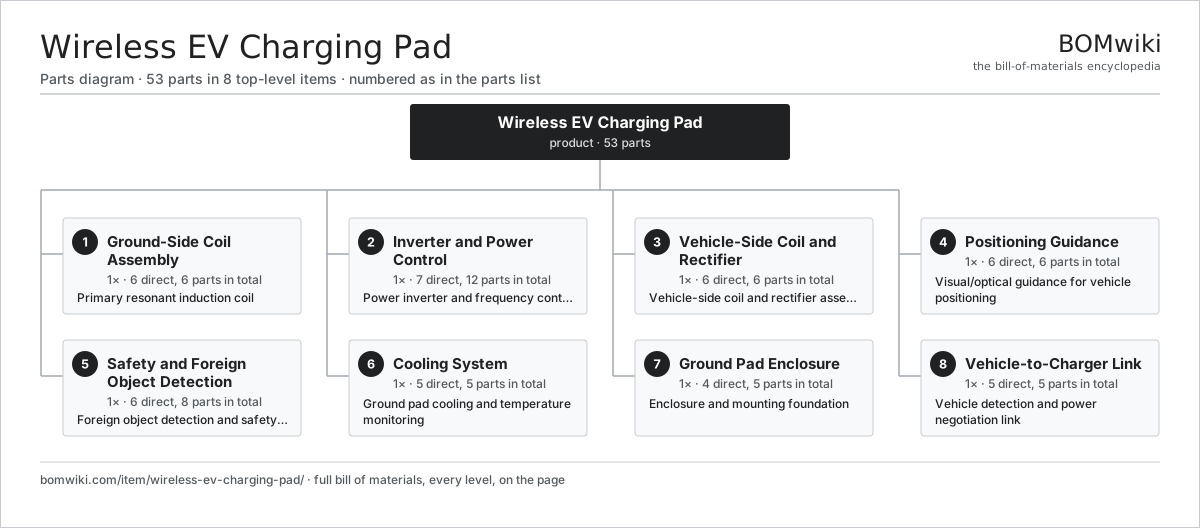
| # | Part | Qty | What it does |
|---|---|---|---|
| 1 | Ground-Side Coil Assembly 6 parts | 1× | Primary resonant induction coil |
| 2 | Inverter and Power Control 7 parts | 1× | Power inverter and frequency control |
| 3 | Vehicle-Side Coil and Rectifier 6 parts | 1× | Vehicle-side coil and rectifier assembly |
| 4 | Positioning Guidance 6 parts | 1× | Visual/optical guidance for vehicle positioning |
| 5 | Safety and Foreign Object Detection 6 parts | 1× | Foreign object detection and safety interlocks |
| 6 | Cooling System 5 parts | 1× | Ground pad cooling and temperature monitoring |
| 7 | Ground Pad Enclosure 4 parts | 1× | Enclosure and mounting foundation |
| 8 | Vehicle-to-Charger Link 5 parts | 1× | Vehicle detection and power negotiation link |
3D model
No 3D model yet. Have a CAD file of this? Add a 3D model. STL renders right on this page; STEP, FreeCAD, and OpenSCAD sources are welcome too (openly licensed, like all 3D models on BOMwiki).
Build & assembly graph
expand / collapse · shared sub-assemblies converge · links to related products · est. labourTap an assembly to expand/collapse · tap a part to open it · use “Open page” for any node · drag to pan, scroll to zoom.
Bill of materials for Wireless EV Charging Pad
8 top-level lines · 53 rows shown · 53 parts total · indented to 3 levels| # | Item / sub-assembly | Part no. | Qty/assy | Ext. qty | Parts | Type |
|---|---|---|---|---|---|---|
| 1 | Ground-Side Coil Assembly 6 parts | wireless-ev-charging-pad-ground-coil | 1× | 1 | 6 | assembly |
| 1.1 | Primary Winding | wireless-ev-charging-pad-copper-coil | 1× | 1 | · | part |
| 1.2 | Magnetic Core | wireless-ev-charging-pad-ferrite-core | 1× | 1 | · | part |
| 1.3 | Resonance Tuning Capacitors | wireless-ev-charging-pad-capacitor-array | 1× | 1 | · | part |
| 1.4 | Bare PCB | pcb-bare | 1× | 1 | · | part |
| 1.5 | Connector | connector | 1× | 1 | · | part |
| 1.6 | Fastener Set | fastener-set | 1× | 1 | · | part |
| 2 | Inverter and Power Control 7 parts | wireless-ev-charging-pad-power-electronics | 1× | 1 | 12 | assembly |
| 2.1 | IGBT Power Module | igbt-module | 6× | 6 | · | part |
| 2.2 | IGBT Gate Drive IC | wireless-ev-charging-pad-gate-driver | 1× | 1 | · | part |
| 2.3 | DC Link Capacitor | wireless-ev-charging-pad-capacitor-bank | 1× | 1 | · | part |
| 2.4 | Output Inductor | wireless-ev-charging-pad-choke | 1× | 1 | · | part |
| 2.5 | Bare PCB | pcb-bare | 1× | 1 | · | part |
| 2.6 | SMD Passive (R/C/L) | smd-passives | 1× | 1 | · | part |
| 2.7 | Heat Sink | heat-sink | 1× | 1 | · | part |
| 3 | Vehicle-Side Coil and Rectifier 6 parts | wireless-ev-charging-pad-vehicle-receiver | 1× | 1 | 6 | assembly |
| 3.1 | Secondary Winding | wireless-ev-charging-pad-receiver-coil | 1× | 1 | · | part |
| 3.2 | Three-Phase Rectifier | wireless-ev-charging-pad-rectifier-block | 1× | 1 | · | part |
| 3.3 | HV Battery Connector | wireless-ev-charging-pad-vehicle-connector | 1× | 1 | · | part |
| 3.4 | Vehicle-Side Ripple Filter | wireless-ev-charging-pad-receiver-capacitor | 1× | 1 | · | part |
| 3.5 | Receiver Pcb | wireless-ev-charging-pad-receiver-pcb | 1× | 1 | · | part |
| 3.6 | Fastener Set | fastener-set | 1× | 1 | · | part |
| 4 | Positioning Guidance 6 parts | wireless-ev-charging-pad-alignment-system | 1× | 1 | 6 | assembly |
| 4.1 | CMOS Image Sensor | image-sensor | 1× | 1 | · | part |
| 4.2 | Alignment Lights | wireless-ev-charging-pad-led-guides | 1× | 1 | · | part |
| 4.3 | Status Display | wireless-ev-charging-pad-display | 1× | 1 | · | part |
| 4.4 | Bare PCB | pcb-bare | 1× | 1 | · | part |
| 4.5 | SMD Passive (R/C/L) | smd-passives | 1× | 1 | · | part |
| 4.6 | Connector | connector | 1× | 1 | · | part |
| 5 | Safety and Foreign Object Detection 6 parts | wireless-ev-charging-pad-control-module | 1× | 1 | 8 | assembly |
| 5.1 | Microcontroller | mcu | 1× | 1 | · | part |
| 5.2 | Foreign Object Detector | wireless-ev-charging-pad-impedance-monitor | 1× | 1 | · | part |
| 5.3 | Thermistor Probe | wireless-ev-charging-pad-temperature-sensor | 2× | 2 | · | part |
| 5.4 | Bare PCB | pcb-bare | 1× | 1 | · | part |
| 5.5 | Relay | relay | 2× | 2 | · | part |
| 5.6 | SMD Passive (R/C/L) | smd-passives | 1× | 1 | · | part |
| 6 | Cooling System 5 parts | wireless-ev-charging-pad-thermal-management | 1× | 1 | 5 | assembly |
| 6.1 | Cooling Loop Tubing | wireless-ev-charging-pad-coolant-circuit | 1× | 1 | · | part |
| 6.2 | Coolant Pump | coolant-pump | 1× | 1 | · | part |
| 6.3 | Heat Exchanger | wireless-ev-charging-pad-radiator | 1× | 1 | · | part |
| 6.4 | Flow Control Valve | wireless-ev-charging-pad-thermostat | 1× | 1 | · | part |
| 6.5 | Fastener Set | fastener-set | 1× | 1 | · | part |
| 7 | Ground Pad Enclosure 4 parts | wireless-ev-charging-pad-installation-base | 1× | 1 | 5 | assembly |
| 7.1 | Ground Pad Housing | wireless-ev-charging-pad-enclosure | 1× | 1 | · | part |
| 7.2 | Weather Seal | wireless-ev-charging-pad-gasket | 1× | 1 | · | part |
| 7.3 | Drainage System | wireless-ev-charging-pad-drain | 1× | 1 | · | part |
| 7.4 | Fastener Set | fastener-set | 2× | 2 | · | part |
| 8 | Vehicle-to-Charger Link 5 parts | wireless-ev-charging-pad-comms-bridge | 1× | 1 | 5 | assembly |
| 8.1 | Vehicle Detection Radio | wireless-ev-charging-pad-rf-modem | 1× | 1 | · | part |
| 8.2 | Ground Antenna | wireless-ev-charging-pad-antenna-ground | 1× | 1 | · | part |
| 8.3 | Vehicle Antenna | wireless-ev-charging-pad-antenna-vehicle | 1× | 1 | · | part |
| 8.4 | Bare PCB | pcb-bare | 1× | 1 | · | part |
| 8.5 | SMD Passive (R/C/L) | smd-passives | 1× | 1 | · | part |
Something wrong in this list? Report a problem with this BOM.
Related products
same domain, ranked by shared parts DC Fast Charger
1,097 parts · shares 2 with this page
Pantograph Bus Charger
72 parts · shares 2 with this page
DC Fast Charger
1,097 parts · shares 2 with this page
Pantograph Bus Charger
72 parts · shares 2 with this page
 Diesel Generator
147 parts · shares 1 with this page
Natural Gas Generator
58 parts · shares 1 with this page
Active Harmonic Filter
81 parts · shares 1 with this page
Diesel Generator
147 parts · shares 1 with this page
Natural Gas Generator
58 parts · shares 1 with this page
Active Harmonic Filter
81 parts · shares 1 with this page
 Battery Swap Station
108 parts · shares 1 with this page
Battery Swap Station
108 parts · shares 1 with this page
Sourcing: possible vendors
Browse the supplier directory → Prices, MOQ, and lead times are algorithmic estimates, not quotes, and not claims about these companies. Company mappings are curated by keyword; est. price band $5k–$50M. How estimates work| Vendor | HQ | Specialty | MOQ | Lead time |
|---|---|---|---|---|
| gevernova.com ↗ | Cambridge, US | Power generation | made to order | 20–40 wks |
| siemens-energy.com ↗ | Munich, DE | Power & grid | made to order | 20–40 wks |
| hitachienergy.com ↗ | Zurich, CH | Grid & transformers | made to order | 20–40 wks |
|
🇨🇭ABB
abb.com ↗
|
Zurich, CH | Electrification & automation | made to order | 20–40 wks |
| se.com ↗ | Rueil-Malmaison, FR | Electrical & automation | made to order | 20–40 wks |
1,348-word article