Work-Class ROV
ProductOverview
Work-class remotely operated vehicles (ROVs) are the backbone of subsea construction, intervention, and maintenance in deep water. Unlike light-duty observation ROVs, work-class platforms integrate hydraulic power generation on the frame itself, enabling real-time tool operation without reliance on topside hydraulic supply. This self-contained architecture permits independent arm movement, precise position holding, and fault-tolerant operation during extended subsea tasks.
A typical work-class ROV weighs 12 tonnes wet, can operate to 3000 m depth, and carries dual 7-joint manipulator arms, integrated lighting, and a real-time sensor fusion computer. The propulsion vector, six horizontal thrusters plus two vertical, provides full six-degree-of-freedom (6-DOF) authority under topside joystick or autonomous waypoint guidance. Power arrives via a hybrid fiber-optic and three-phase electrical umbilical; subsea electronics convert 480 VAC to local hydraulic and 24 VDC housekeeping supply.
Design Architecture
The Frame Assembly is a welded aluminum extrusion chassis with modular hard points. Bolt-on planar mounting allows tool integration without redesign: camera suites, sonar, pressure gauges, and specialized cutters slide into the same couplers that hold the manipulators. A class-2 titanium Gripper on each arm achieves 5000 lbf grip force in under 2 seconds, suitable for severing umbilicals, recovering failed equipment, or stabilizing piping during hot work.
The Hydraulic System is the critical differentiator. A 55 kW variable-displacement pump, driven by a brushless electric motor submerged in transformer oil, generates flow on demand. A proportional Proportional Manifold with six integrated directional spools lets each manipulator joint respond independently to pilot pressure from the surface control console. Accumulators damp flow ripple and maintain pressure between pump strokes, reducing fatigue on subsea hose and reducing heating under dynamic loading.
Propulsion and Control
The Thruster Array vectored design uses individual electric thrusters mounted at skew angles. Six primary horizontal units provide surge, sway, and yaw; two vertical thrusters manage heave. Each motor is oil-filled, brushless, and coupled to a ducted shroud that increases static thrust by roughly 15% compared to open-water propellers. The subsea Control Electronics runs a 1 kHz PID loop, fusing fiber-optic AHRS (attitude) data, depth from Pressure Sensor nodes, and thruster encoder feedback. The result is station-keeping to within 0.5 m in a 2-knot current, essential when manipulating a flange or guiding a coiled line into a confined subsea structure.
Sensor Integration
High-definition Camera Suite with paired LED arrays provides 2000-lumen illumination and 4MP color video at 60 fps. Pan/tilt stabilization compensates for vehicle sway, so the pilot sees a steady worksite image. Additional Hall Sensor nodes in each manipulator joint feed back actual position, permitting closed-loop repetitive task sequences (e.g., bolt tightening to a precise torque, then retract and index).
Umbilical and Power Delivery
The Tether Management system uses a 24 mm composite umbilical: single-mode fiber for video and Ethernet downlink, three 0.75 mm² power conductors for 480 VAC, and control pair for signal. A Slip Ring rated 100 rpm allows tool rotation without tangling the umbilical. Topside, a primary power van supplies 480 VAC 100 A continuous; a fiber optic router carries compressed video, telemetry, and command uplink at 10 Mbps latency <100 ms.
Operational Envelope
Typical subsea tasks, emergency shut-in valve closure, umbilical repair, debris removal, execute within 8-hour Bottom Time windows to allow decompression. The Power Electronics and Control Electronics implement redundant depth/temperature cutouts: if hull pressure exceeds 310 bar (3100 m), the vehicle automatically initiates controlled ascent. Hydraulic relief and thermal fuses on IGBT Power Module drive stages prevent thruster runaway.
Work-class ROVs are heavy, slow, and expensive to operate, a single dive call-out with full-service vessel, saturated divers for anchor deployment, and support runs USD 500k+. But for critical subsea infrastructure, the capability of two hydraulic arms, precision station-keeping, and real-time video justifies the cost.
Work-Class ROV parts and their functions
8 top-level parts · 155 parts in total · full bill of materials below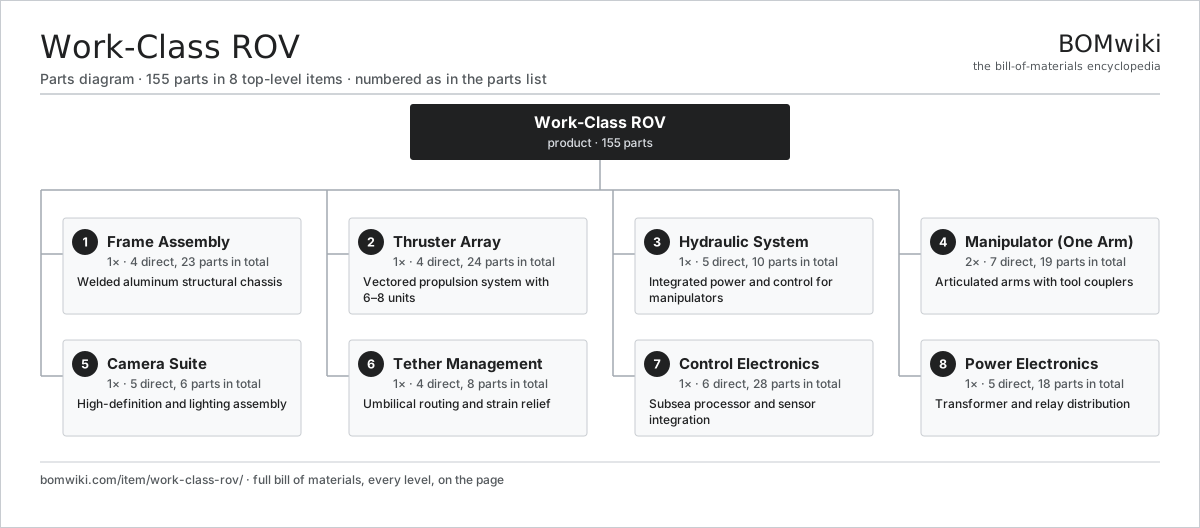
| # | Part | Qty | What it does |
|---|---|---|---|
| 1 | Frame Assembly 4 parts | 1× | Welded aluminum structural chassis |
| 2 | Thruster Array 4 parts | 1× | Vectored propulsion system with 6–8 units |
| 3 | Hydraulic System 5 parts | 1× | Integrated power and control for manipulators |
| 4 | Manipulator (One Arm) 7 parts | 2× | Articulated arms with tool couplers |
| 5 | Camera Suite 5 parts | 1× | High-definition and lighting assembly |
| 6 | Tether Management 4 parts | 1× | Umbilical routing and strain relief |
| 7 | Control Electronics 6 parts | 1× | Subsea processor and sensor integration |
| 8 | Power Electronics 5 parts | 1× | Transformer and relay distribution |
3D model
No 3D model yet. Have a CAD file of this? Add a 3D model. STL renders right on this page; STEP, FreeCAD, and OpenSCAD sources are welcome too (openly licensed, like all 3D models on BOMwiki).
Build & assembly graph
expand / collapse · shared sub-assemblies converge · links to related products · est. labourTap an assembly to expand/collapse · tap a part to open it · use “Open page” for any node · drag to pan, scroll to zoom.
Bill of materials for Work-Class ROV
8 top-level lines · 48 rows shown · 155 parts total · indented to 3 levels| # | Item / sub-assembly | Part no. | Qty/assy | Ext. qty | Parts | Type |
|---|---|---|---|---|---|---|
| 1 | Frame Assembly 4 parts | work-class-rov-frame | 1× | 1 | 23 | assembly |
| 1.1 | Frame Extrusion | work-class-rov-frame-extrusion | 6× | 6 | · | part |
| 1.2 | Hard Point Plate | work-class-rov-hard-point-plate | 12× | 12 | · | part |
| 1.3 | Fastener Set | fastener-set | 3× | 3 | · | part |
| 1.4 | Sheet Metal Panel | sheet-panel | 2× | 2 | · | part |
| 2 | Thruster Array 4 parts | work-class-rov-thruster-array | 1× | 1 | 24 | assembly |
| 2.1 | Thruster Unit | work-class-rov-thruster-unit | 6× | 6 | · | part |
| 2.2 | Vertical Thruster | work-class-rov-vertical-thruster | 2× | 2 | · | part |
| 2.3 | Thruster Motor | work-class-rov-thruster-motor | 8× | 8 | · | part |
| 2.4 | Thruster Duct | work-class-rov-thruster-duct | 8× | 8 | · | part |
| 3 | Hydraulic System 5 parts | work-class-rov-hydraulic-system | 1× | 1 | 10 | assembly |
| 3.1 | Hydraulic Pump | work-class-rov-pump | 1× | 1 | · | part |
| 3.2 | Proportional Manifold | work-class-rov-manifold | 1× | 1 | · | part |
| 3.3 | Accumulator | work-class-rov-accumulator | 2× | 2 | · | part |
| 3.4 | Pressure Sensor | pressure-sensor | 4× | 4 | · | part |
| 3.5 | O-Ring Set | oring-set | 2× | 2 | · | part |
| 4 | Manipulator (One Arm) 7 parts | work-class-rov-manipulator-pair | 2× | 2 | 19 | assembly |
| 4.1 | Shoulder Joint | work-class-rov-shoulder-joint | 1× | 2 | · | part |
| 4.2 | Elbow Joint | work-class-rov-elbow-joint | 1× | 2 | · | part |
| 4.3 | Wrist Pitch | work-class-rov-wrist-pitch | 1× | 2 | · | part |
| 4.4 | Wrist Roll | work-class-rov-wrist-roll | 1× | 2 | · | part |
| 4.5 | Gripper | work-class-rov-gripper | 1× | 2 | · | part |
| 4.6 | Ball Bearing | ball-bearing | 8× | 16 | · | part |
| 4.7 | Oil Seal | oil-seal | 6× | 12 | · | part |
| 5 | Camera Suite 5 parts | work-class-rov-camera-suite | 1× | 1 | 6 | assembly |
| 5.1 | Camera Head | work-class-rov-camera-head | 1× | 1 | · | part |
| 5.2 | LED Array | work-class-rov-led-array | 2× | 2 | · | part |
| 5.3 | Pan/Tilt Mount | work-class-rov-pan-tilt | 1× | 1 | · | part |
| 5.4 | Lens Assembly | camera-lens | 1× | 1 | · | part |
| 5.5 | Camera Dome | work-class-rov-camera-dome | 1× | 1 | · | part |
| 6 | Tether Management 4 parts | work-class-rov-tether-management | 1× | 1 | 8 | assembly |
| 6.1 | Slip Ring | work-class-rov-slip-ring | 1× | 1 | · | part |
| 6.2 | Tether Guard | work-class-rov-tether-guard | 4× | 4 | · | part |
| 6.3 | Fastener Set | fastener-set | 2× | 2 | · | part |
| 6.4 | Wire Bundle | wire-bundle | 1× | 1 | · | part |
| 7 | Control Electronics 6 parts | work-class-rov-control-electronics | 1× | 1 | 28 | assembly |
| 7.1 | CPU Module | work-class-rov-cpu-module | 1× | 1 | · | part |
| 7.2 | Bare PCB | pcb-bare | 2× | 2 | · | part |
| 7.3 | Microcontroller | mcu | 2× | 2 | · | part |
| 7.4 | Pressure Sensor | pressure-sensor | 3× | 3 | · | part |
| 7.5 | Hall Sensor | hall-sensor | 8× | 8 | · | part |
| 7.6 | Connector | connector | 12× | 12 | · | part |
| 8 | Power Electronics 5 parts | work-class-rov-power-electronics | 1× | 1 | 18 | assembly |
| 8.1 | Transformer | work-class-rov-transformer | 1× | 1 | · | part |
| 8.2 | IGBT Power Module | igbt-module | 4× | 4 | · | part |
| 8.3 | Power MOSFET | mosfet | 8× | 8 | · | part |
| 8.4 | Power Supply | power-supply | 1× | 1 | · | part |
| 8.5 | Thermal Fuse | thermal-fuse | 4× | 4 | · | part |
Something wrong in this list? Report a problem with this BOM.
Related products
same domain, ranked by shared parts Heavy-Lift Ship
40,014 parts · shares 8 with this page
Heavy-Lift Ship
40,014 parts · shares 8 with this page
 Dredger
34,730 parts · shares 7 with this page
Dredger
34,730 parts · shares 7 with this page
 Marine Radar
54 parts · shares 6 with this page
Marine Radar
54 parts · shares 6 with this page
 Polar Icebreaker
696,393 parts · shares 5 with this page
Zoo Habitat Filtration
99 parts · shares 6 with this page
Polar Icebreaker
696,393 parts · shares 5 with this page
Zoo Habitat Filtration
99 parts · shares 6 with this page
Sourcing: possible vendors
Browse the supplier directory → Prices, MOQ, and lead times are algorithmic estimates, not quotes, and not claims about these companies. Company mappings are curated by keyword; est. price band $2k–$500M. How estimates work| Vendor | HQ | Specialty | MOQ | Lead time |
|---|---|---|---|---|
| hd.com ↗ | Ulsan, KR | Shipbuilder | made to order | 52–104 wks |
| fincantieri.com ↗ | Trieste, IT | Shipbuilder | made to order | 52–104 wks |
| damen.com ↗ | Gorinchem, NL | Shipbuilder | made to order | 52–104 wks |
| brunswick.com ↗ | Mettawa, US | Marine & boats | made to order | 52–104 wks |
|
🇨🇳CSSC
cssc.net.cn ↗
|
Shanghai, CN | Shipbuilding conglomerate | made to order | 52–104 wks |
683-word article