Zoo Habitat Filtration
ProductOverview
Zoo habitat filtration systems provide comprehensive water quality management for large animal enclosures, combining mechanical filtration, biological nitrification, ultraviolet sterilization, and ozone oxidation. These systems serve zoological facilities, marine parks, and research institutions maintaining water clarity, pathogen control, and parameter stability for sensitive species.
The architecture consists of a primary circulation pump distributing flow across parallel treatment stages: mechanical sand/bead filters for particle removal, a rotating biofilter drum colonized by nitrifying bacteria, a UV sterilizer for pathogenic control, and ozone injection for oxidative disinfection. Water quality sensors continuously monitor pH, dissolved oxygen, temperature, and turbidity, while automated controllers manage pump cycles, chemical dosing, and alarm thresholds.
Large installations (10,000–50,000 L) require 50–150 GPM flow at manageable backpressure. The Mechanical Filtration Stage uses layered sand and bead media, providing both mechanical particle removal and biological surface area. The Biological Filter Media Drum drum rotates slowly to expose biofilm continuously to aerated water, converting ammonia to nitrate over 6–8 hours residence time. UV Sterilizer Module operates continuously or on timer schedules to suppress free-floating pathogens, while the Ozone Generation & Injection provides secondary oxidation and trace mineral breakdown.
Mechanical Filtration Stage
The Mechanical Filtration Stage serves as the first barrier, removing suspended solids, algae cells, and biological waste particles before biological treatment. Sand and bead layers are arranged from coarse to fine, with the Filter Sand Media providing 50–100 micron filtration and the Plastic Filter Beads offering high void ratio for low head loss. The Multiport Valve Head multiport valve enables backwashing without shutting down the system by reversing flow through the media beds, fluidizing particles and expelling them to drain.
Pressure differential across the filter bed increases as solids accumulate; operators manually trigger backwash cycles when differential pressure reaches 1.5–2.0 bar. A complete backwash cycle takes 3–5 minutes and wastes 5–10% of system volume, making frequency-reduction strategies (pre-filtration, settling tanks) economically important in marine parks.
Biological Nitrification
The Biological Filter Media Drum drum houses plastic media strands that provide ~1500 m² of surface area per 1000 L flow capacity. Nitrifying bacteria (Nitrosomonas and Nitrobacter) colonize the media surface within 2–4 weeks of system startup, catalyzing the nitrogen cycle: ammonia (NH₃) → nitrite (NO₂⁻) → nitrate (NO₃⁻). Nitrate remains in solution; it is controlled by water changes (typical 10–20% weekly) rather than further oxidation.
The Rotor Assembly rotates the drum at 10–20 rpm, contacting each media strand with aerated water 10–20 times per revolution. Dissolved oxygen from the Circulation Pump & Manifold circulation must remain above 6 mg/L to support nitrification; if oxygen drops below 4 mg/L, heterotrophic bacteria dominate and ammonia accumulates. This interdependency makes UV Sterilizer Module and Ozone Generation & Injection critical as oxygen-releasing stages.
UV Sterilization
The UV-C Lamp is a 40 W amalgam mercury lamp operating at 254 nm wavelength, the peak absorption wavelength for bacterial DNA. The UV Electronic Ballast maintains constant current through the lamp arc using a high-frequency inverter. The Quartz UV Sleeve isolates the lamp from water while transmitting UV; regular calcium/salt buildup on the sleeve reduces transmission and requires cleaning every 3–6 months.
UV dose is measured in watt-seconds per milliliter (W·s/mL). Zoo systems typically aim for 30–50 W·s/mL to suppress free-floating bacteria and viruses while remaining safe for large animals. The Hall Sensor measures flow rate through the UV chamber, and the Control & Automation System adjusts dose by throttling flow or extending contact time; if dose drops below 20 W·s/mL, ozone injection increases to compensate.
Ozone Generation and Injection
The Ozone Generator Cell produces ozone (O₃) via corona discharge, converting atmospheric oxygen into a trioxide molecule with strong oxidative properties. Typical output is 100 g/day at 20–50 mg/L concentration. The Ozone Venturi Injector injector draws ozone gas into the water stream using a Venturi pressure drop; precision orifices are sized to specific flow rates, so undersizing (and underdosing ozone) is common in mismatched systems.
Ozone is highly reactive with bacteria, viruses, organic compounds, and trace metals. Unlike chlorine, it decomposes to oxygen within 10–20 minutes, leaving no residual disinfectant. However, ozone excess in contact tanks causes oxidative stress to animals and gill damage. The Ozone Destructor Cartridge catalyst cartridge breaks down excess ozone in the vent stream to oxygen, preventing atmospheric release. Off-gas destruction is mandatory in zoo installations to protect staff and animals.
Chemical Dosing and Buffer Control
The Chemical Dosing Station station maintains water stability by injecting buffering agents, alkalinity builders, and trace minerals. Typical chemicals dosed include:
- pH buffer: alkalinity adjustments (sodium bicarbonate) to maintain pH 7.8–8.2 in marine systems
- Alkalinity: carbonate hardness (KH) replenishment to resist pH drift
- Trace minerals: iodine, strontium, molybdenum for animal tissue support
- Disinfectants: peroxide or iodine compounds when nitrification lags
Each Peristaltic Dosing Pump is calibrated to milliliter-per-minute precision and operates on stepper motor control; dosing frequency ranges from continuous (pH buffer) to once-weekly (trace minerals). The Dosing Reservoir Tank reservoirs are translucent to allow visual level monitoring, and Two-Way Solenoid Valve interlocks prevent overdosing if a pump line clogs.
Water Quality Monitoring
The Water Quality Monitoring sensor array continuously measures five key parameters:
- pH: pH Electrode with double-junction reference, ±0.1 accuracy
- Dissolved oxygen: Dissolved Oxygen Sensor optical fluorescence, independent of salinity
- Temperature: integrated thermistor for metabolic and bacterial rate compensation
- Turbidity: Turbidity Sensor nephelometric 0–1000 NTU
- Conductivity/TDS: Pressure Sensor adapted as salinity meter 0–50 mS/cm
The Sensor Mounting Block maintains sensor temperature within ±2°C by thermostat circulation, ensuring accurate readings. Sensor data feeds the Microcontroller controller, which triggers alarms if any parameter drifts outside user-set bounds (e.g., pH > 8.4, DO < 4 mg/L, turbidity > 10 NTU). Most zoo installations maintain a paper logbook of daily readings as backup to electronic records.
System Sequencing and Redundancy
The Control & Automation System PLC orchestrates a daily cycle:
- Morning: Mechanical filter backwash (reverse flow 3–5 min), then resume normal operation
- Continuous: UV on if dissolved oxygen > 5 mg/L, ozone on if turbidity > 5 NTU
- Hourly: Chemical dosing (pH, alkalinity) based on sensor feedback
- Daily: Manual water quality grab samples and logbook entry
- Weekly: Ozone destructor cartridge inspection, 10–20% water change
Large zoos often operate two filtration systems in parallel (duty/standby), with automatic switchover if primary pump pressure drops or if sensors detect rapid parameter drift. This redundancy is critical because system failure lasting more than 6 hours in a closed tank can lead to ammonia spike and animal death.
Installation and Sizing
Proper sizing requires estimating bioload (fish/animal waste, uneaten food) in kilograms per day and multiplying by design factor (typically 1.5–2.0). A rule of thumb: 1 kg bioload requires 100–150 L biological filter volume. A 50,000 L pool with 20 kg daily bioload thus requires a 3000–4000 L biofilter drum, roughly 40 × 300 mm diameter. Multiple smaller drums are often used for redundancy and ease of media replacement.
Mechanical filter sizing is typically 2–3 m² of filter bed area per 150 GPM, enabling 4–6 hour intervals between backwashes. UV dosing requires 50–100 W nominal power per 150 GPM. Ozone systems should be sized conservatively (50 g/day for 50,000 L) to prevent off-gas problems.
Commissioning includes 2–4 weeks of biofilter seeding, daily water quality checks, and adjustment of chemical dosing setpoints. Most zoo systems run stable for 5–7 years before major component replacement (pump seal, lamp, controller board).
Zoo Habitat Filtration parts and their functions
8 top-level parts · 99 parts in total · full bill of materials below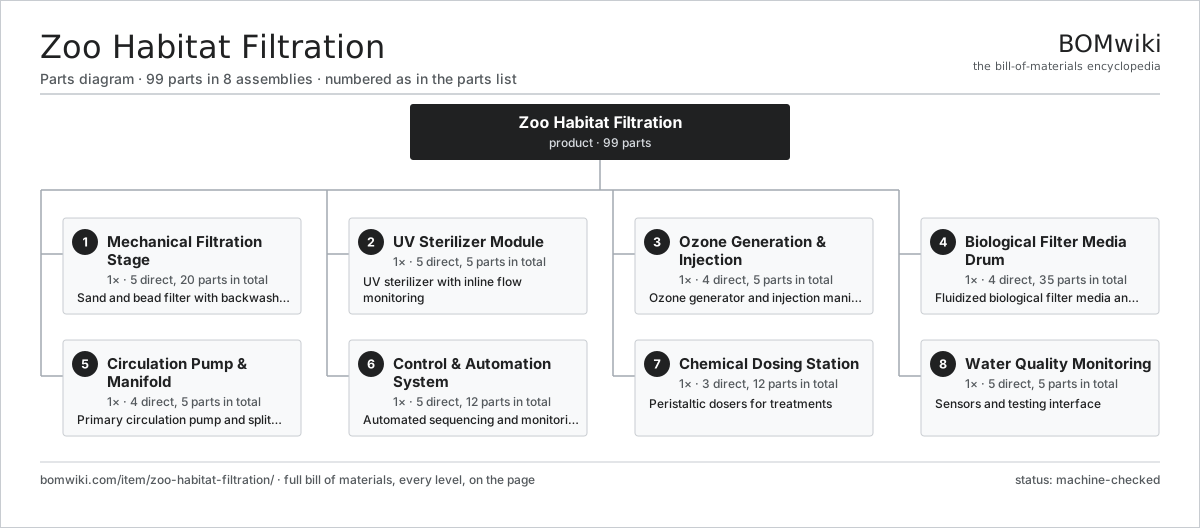
| # | Part | Qty | What it does |
|---|---|---|---|
| 1 | Mechanical Filtration Stage 5 parts | 1× | Sand and bead filter with backwash circuit |
| 2 | UV Sterilizer Module 5 parts | 1× | UV sterilizer with inline flow monitoring |
| 3 | Ozone Generation & Injection 4 parts | 1× | Ozone generator and injection manifold |
| 4 | Biological Filter Media Drum 4 parts | 1× | Fluidized biological filter media and drum |
| 5 | Circulation Pump & Manifold 4 parts | 1× | Primary circulation pump and split distribution |
| 6 | Control & Automation System 5 parts | 1× | Automated sequencing and monitoring |
| 7 | Chemical Dosing Station 3 parts | 1× | Peristaltic dosers for treatments |
| 8 | Water Quality Monitoring 5 parts | 1× | Sensors and testing interface |
3D model
No 3D model yet. Have a CAD file of this? Add a 3D model — STL renders right on this page; STEP, FreeCAD, and OpenSCAD sources are welcome too (openly licensed, like all 3D models on BOMwiki).
Build & assembly graph
expand / collapse · shared sub-assemblies converge · links to related products · est. labourTap an assembly to expand/collapse · tap a part to open it · use “Open page” for any node · drag to pan, scroll to zoom.
Bill of materials for Zoo Habitat Filtration
8 top-level lines · 50 rows shown · 99 parts total · indented to 3 levels| # | Item / sub-assembly | Part no. | Qty/assy | Ext. qty | Parts | Type |
|---|---|---|---|---|---|---|
| 1 | Mechanical Filtration Stage 5 parts | zoo-habitat-filtration-mechanical-stage | 1× | 1 | 20 | assembly |
| 1.1 | Gearbox Housing | gearbox-housing | 1× | 1 | · | part |
| 1.2 | Multiport Valve Head | zoo-habitat-filtration-filter-head | 1× | 1 | · | part |
| 1.3 | Filter Sand Media | zoo-habitat-filtration-media-sand | 8× | 8 | · | part |
| 1.4 | Plastic Filter Beads | zoo-habitat-filtration-media-beads | 6× | 6 | · | part |
| 1.5 | Sheet Metal Panel | sheet-panel | 4× | 4 | · | part |
| 2 | UV Sterilizer Module 5 parts | zoo-habitat-filtration-uv-system | 1× | 1 | 5 | assembly |
| 2.1 | UV-C Lamp | zoo-habitat-filtration-uv-lamp | 1× | 1 | · | part |
| 2.2 | UV Electronic Ballast | zoo-habitat-filtration-uv-ballast | 1× | 1 | · | part |
| 2.3 | Quartz UV Sleeve | zoo-habitat-filtration-uv-sleeve | 1× | 1 | · | part |
| 2.4 | UV Chamber Housing | zoo-habitat-filtration-uv-housing | 1× | 1 | · | part |
| 2.5 | Hall Sensor | hall-sensor | 1× | 1 | · | part |
| 3 | Ozone Generation & Injection 4 parts | zoo-habitat-filtration-ozone-injection | 1× | 1 | 5 | assembly |
| 3.1 | Ozone Generator Cell | zoo-habitat-filtration-ozone-generator | 1× | 1 | · | part |
| 3.2 | Ozone Venturi Injector | zoo-habitat-filtration-ozone-venturi | 1× | 1 | · | part |
| 3.3 | Ozone Destructor Cartridge | zoo-habitat-filtration-ozone-destructor | 1× | 1 | · | part |
| 3.4 | Connector | connector | 2× | 2 | · | part |
| 4 | Biological Filter Media Drum 4 parts | zoo-habitat-filtration-biofilter | 1× | 1 | 35 | assembly |
| 4.1 | Biofilter Drum Frame | zoo-habitat-filtration-drum-frame | 1× | 1 | · | part |
| 4.2 | Plastic Biofilm Media | zoo-habitat-filtration-biofilm-media | 12× | 12 | · | part |
| 4.3 | Stator Assembly 3 parts | stator-assembly | 1× | 1 | 3 | assembly |
| 4.3.1 | Stator Core (laminations) | stator-core | 1× | 1 | · | part |
| 4.3.2 | Copper Winding | copper-winding | 1× | 1 | · | part |
| 4.3.3 | Slot Insulation | stator-insulation | 1× | 1 | · | part |
| 4.4 | Rotor Assembly 4 parts | rotor-assembly | 1× | 1 | 19 | assembly |
| 4.4.1 | Rotor Shaft | rotor-shaft | 1× | 1 | · | part |
| 4.4.2 | Rotor Core | rotor-core | 1× | 1 | · | part |
| 4.4.3 | Neodymium Magnet | neodymium-magnet | 16× | 16 | · | part |
| 4.4.4 | Ball Bearing | ball-bearing | 1× | 1 | · | part |
| 5 | Circulation Pump & Manifold 4 parts | zoo-habitat-filtration-pump-manifold | 1× | 1 | 5 | assembly |
| 5.1 | Circulation Pump Motor | zoo-habitat-filtration-main-pump | 1× | 1 | · | part |
| 5.2 | Motor Housing | motor-housing | 1× | 1 | · | part |
| 5.3 | Flow Manifold Block | zoo-habitat-filtration-manifold-block | 1× | 1 | · | part |
| 5.4 | Fastener Set | fastener-set | 2× | 2 | · | part |
| 6 | Control & Automation System 5 parts | zoo-habitat-filtration-control-panel | 1× | 1 | 12 | assembly |
| 6.1 | Microcontroller | mcu | 1× | 1 | · | part |
| 6.2 | Relay | relay | 8× | 8 | · | part |
| 6.3 | Bare PCB | pcb-bare | 1× | 1 | · | part |
| 6.4 | LCD Panel | lcd-panel | 1× | 1 | · | part |
| 6.5 | Power Supply | power-supply | 1× | 1 | · | part |
| 7 | Chemical Dosing Station 3 parts | zoo-habitat-filtration-chemical-dosing | 1× | 1 | 12 | assembly |
| 7.1 | Peristaltic Dosing Pump | zoo-habitat-filtration-peristaltic-pump | 4× | 4 | · | part |
| 7.2 | Dosing Reservoir Tank | zoo-habitat-filtration-solution-tank | 4× | 4 | · | part |
| 7.3 | Two-Way Solenoid Valve | zoo-habitat-filtration-solenoid-valve | 4× | 4 | · | part |
| 8 | Water Quality Monitoring 5 parts | zoo-habitat-filtration-water-quality | 1× | 1 | 5 | assembly |
| 8.1 | pH Electrode | zoo-habitat-filtration-ph-probe | 1× | 1 | · | part |
| 8.2 | Dissolved Oxygen Sensor | zoo-habitat-filtration-do-sensor | 1× | 1 | · | part |
| 8.3 | Turbidity Sensor | zoo-habitat-filtration-turbidity-sensor | 1× | 1 | · | part |
| 8.4 | Pressure Sensor | pressure-sensor | 1× | 1 | · | part |
| 8.5 | Sensor Mounting Block | zoo-habitat-filtration-sensor-box | 1× | 1 | · | part |
Related products
same domain, ranked by shared parts Anchor Windlass
79 parts · shares 15 with this page
Submarine ROV
436 parts · shares 11 with this page
Anchor Windlass
79 parts · shares 15 with this page
Submarine ROV
436 parts · shares 11 with this page
 Catamaran Ferry
4,765 parts · shares 17 with this page
Catamaran Ferry
4,765 parts · shares 17 with this page
 Container Feeder Ship
2,496 parts · shares 17 with this page
Container Feeder Ship
2,496 parts · shares 17 with this page
Sourcing: possible vendors
Prices, MOQ, and lead times are algorithmic estimates, not quotes, and not claims about these companies. Company mappings are curated by keyword; est. price band $2k–$500M. How estimates work| Vendor | HQ | Specialty | MOQ | Lead time |
|---|---|---|---|---|
| hd.com ↗ | Ulsan, KR | Shipbuilder | made to order | 52–104 wks |
| fincantieri.com ↗ | Trieste, IT | Shipbuilder | made to order | 52–104 wks |
| damen.com ↗ | Gorinchem, NL | Shipbuilder | made to order | 52–104 wks |
| brunswick.com ↗ | Mettawa, US | Marine & boats | made to order | 52–104 wks |
|
🇨🇳CSSC
cssc.net.cn ↗
|
Shanghai, CN | Shipbuilding conglomerate | made to order | 52–104 wks |
1,335-word article