Amateur Radio Transceiver
ProductOverview
An amateur (ham) radio transceiver is a two-way radio operator's primary instrument for long-distance communication on high-frequency (HF) bands. This unit covers the standard amateur bands from 160 m (1.8 MHz) through 6 m (50 MHz), using single-sideband (SSB) voice and continuous-wave (CW) modulation. The design employs a superheterodyne receiver architecture for selectivity and a solid-state linear power amplifier capable of 100 W output into a 50 Ω antenna.
The core signal path splits into two branches. Received signals enter through the RF Front-End, are amplified and mixed down by the Receiver Chain to intermediate frequency (IF), then demodulated and sent to the speaker. Transmitted voice or keyed CW modulates a carrier generated by the Transmitter Chain, which drives the Power Amplifier to produce the final RF output. The Antenna Tuning Unit matches the PA output to the antenna impedance, and the Control Panel allows the operator to select frequency (via a Encoder), mode (SSB/CW), and transmit/receive switching.
How it works
Reception begins at the antenna input, where an Antenna Changeover Relay switches between transmit and receive paths. The RF Front-End applies band-specific filtering to reject out-of-band signals and unwanted images. An RF Preamplifier preamplifier boosts weak incoming signals while minimizing added noise.
The First Mixer combines the RF signal with a local oscillator (VCO) to produce an intermediate frequency (typically 9 MHz). This IF is then amplified by multiple IF Amplifier Stage stages and filtered by a narrow IF Crystal Filter (often a crystal lattice) for selectivity. The Product Detector (product detector) multiplies the IF signal by a beat oscillator to recover the original audio (voice or CW tone), which is then sent to the Speaker.
For transmission, voice from a microphone or CW from a keyer enters the Microphone Preamplifier, which conditions it for the SSB Modulator. This balanced modulator suppresses the carrier and generates a lower-sideband (LSB) or upper-sideband (USB) signal at audio frequencies. The modulated signal is then upconverted to RF by mixing with the Local Oscillator VCO, amplified by the Driver Stage, and finally boosted by the Power Amplifier.
The PA is a parallel MOSFET design, with two MOSFET Transistors operating in push-pull configuration to generate 100 W of RF power into a 50 Ω load. An Low-Pass Output Filter suppresses harmonics and spurious emissions. The Antenna Tuning Unit allows fine impedance matching when the antenna is not a pure 50 Ω resistor, adjusting both inductance and capacitance to cancel any reactance and maximize power transfer.
Control is handled by an Control Panel featuring a Encoder for frequency selection, a mode switch to choose SSB/CW, and a PTT (push-to-talk) button to toggle transmit/receive. The Display Module shows the operating frequency, mode, and RF power output in real time.
The Power Supply derives regulated DC rails (+13.8 V for RF stages, +12 V and lower rails for logic and audio) from a 12 V external supply, with on-board linear regulation and filtering to maintain clean power and minimize noise floor degradation.
Design rationale
Superheterodyne architecture has been the standard for transceivers since the 1920s because it decouples the frequency-selective and high-gain RF front-end from the fixed-frequency demodulator, avoiding oscillator pulling and enabling simultaneous reception and transmission without crosstalk. The use of a crystal filter at IF ensures excellent shape factor and stopband attenuation at a lower component cost than equivalent RF filtering.
Linear power amplifier design (push-pull MOSFET) was chosen over switching amplifiers because amateur regulations require distortion products to be at least 50 dB below the fundamental (for SSB), and linear stages inherently meet this without the complexity of envelope tracking or other digital correction loops.
The Antenna Tuning Unit is essential for portable or emergency operation because most antennas at HF are compromises or adjusted for one band only; the ability to tune impedance mismatch on the fly extends operating range and efficiency.
Amateur Radio Transceiver parts and their functions
11 top-level parts · 295 parts in total · full bill of materials below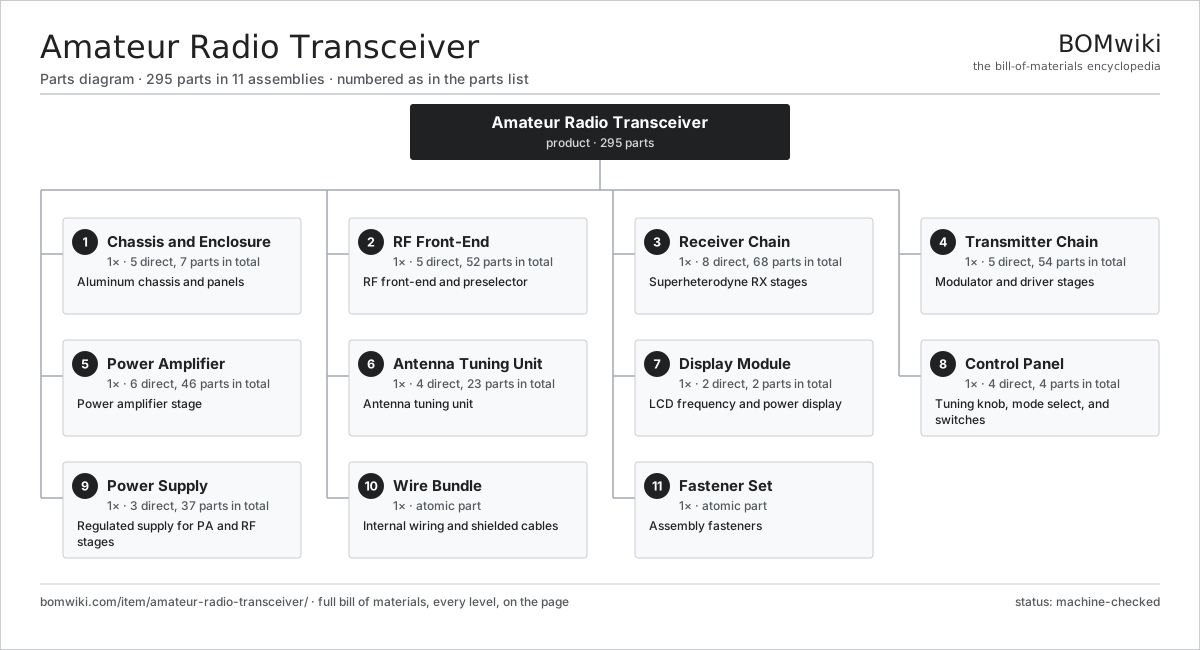
| # | Part | Qty | What it does |
|---|---|---|---|
| 1 | Chassis and Enclosure 5 parts | 1× | Aluminum chassis and panels |
| 2 | RF Front-End 5 parts | 1× | RF front-end and preselector |
| 3 | Receiver Chain 8 parts | 1× | Superheterodyne RX stages |
| 4 | Transmitter Chain 5 parts | 1× | Modulator and driver stages |
| 5 | Power Amplifier 6 parts | 1× | Power amplifier stage |
| 6 | Antenna Tuning Unit 4 parts | 1× | Antenna tuning unit |
| 7 | Display Module 2 parts | 1× | LCD frequency and power display |
| 8 | Control Panel 4 parts | 1× | Tuning knob, mode select, and switches |
| 9 | Power Supply 3 parts | 1× | Regulated supply for PA and RF stages |
| 10 | Wire Bundle | 1× | Internal wiring and shielded cables |
| 11 | Fastener Set | 1× | Assembly fasteners |
3D model
No 3D model yet. Have a CAD file of this? Add a 3D model — STL renders right on this page; STEP, FreeCAD, and OpenSCAD sources are welcome too (openly licensed, like all 3D models on BOMwiki).
Build & assembly graph
expand / collapse · shared sub-assemblies converge · links to related products · est. labourTap an assembly to expand/collapse · tap a part to open it · use “Open page” for any node · drag to pan, scroll to zoom.
Bill of materials for Amateur Radio Transceiver
11 top-level lines · 53 rows shown · 295 parts total · indented to 3 levels| # | Item / sub-assembly | Part no. | Qty/assy | Ext. qty | Parts | Type |
|---|---|---|---|---|---|---|
| 1 | Chassis and Enclosure 5 parts | amateur-radio-transceiver-housing | 1× | 1 | 7 | assembly |
| 1.1 | Front Panel | amateur-radio-transceiver-front-panel | 1× | 1 | · | part |
| 1.2 | Rear Panel | amateur-radio-transceiver-rear-panel | 1× | 1 | · | part |
| 1.3 | Side Panel | amateur-radio-transceiver-side-panel | 2× | 2 | · | part |
| 1.4 | Shielding Partition | amateur-radio-transceiver-shield-partition | 2× | 2 | · | part |
| 1.5 | Fastener Set | fastener-set | 1× | 1 | · | part |
| 2 | RF Front-End 5 parts | amateur-radio-transceiver-rf-front-end | 1× | 1 | 52 | assembly |
| 2.1 | Antenna Changeover Relay | amateur-radio-transceiver-antenna-relay | 1× | 1 | · | part |
| 2.2 | Band Filter Network | amateur-radio-transceiver-band-filter | 1× | 1 | · | part |
| 2.3 | Preselector Coil | amateur-radio-transceiver-preselector-inductor | 3× | 3 | · | part |
| 2.4 | SMD Passive (R/C/L) | smd-passives | 45× | 45 | · | part |
| 2.5 | Connector | connector | 2× | 2 | · | part |
| 3 | Receiver Chain 8 parts | amateur-radio-transceiver-receiver-chain | 1× | 1 | 68 | assembly |
| 3.1 | RF Preamplifier | amateur-radio-transceiver-rf-amp | 1× | 1 | · | part |
| 3.2 | First Mixer | amateur-radio-transceiver-mixer-1 | 1× | 1 | · | part |
| 3.3 | Local Oscillator VCO | amateur-radio-transceiver-local-osc | 1× | 1 | · | part |
| 3.4 | IF Amplifier Stage | amateur-radio-transceiver-if-amp | 2× | 2 | · | part |
| 3.5 | IF Crystal Filter | amateur-radio-transceiver-if-filter | 1× | 1 | · | part |
| 3.6 | Product Detector | amateur-radio-transceiver-detector | 1× | 1 | · | part |
| 3.7 | SMD Passive (R/C/L) | smd-passives | 60× | 60 | · | part |
| 3.8 | Microcontroller | mcu | 1× | 1 | · | part |
| 4 | Transmitter Chain 5 parts | amateur-radio-transceiver-transmitter-chain | 1× | 1 | 54 | assembly |
| 4.1 | Microphone Preamplifier | amateur-radio-transceiver-mic-amp | 1× | 1 | · | part |
| 4.2 | SSB Modulator | amateur-radio-transceiver-modulator | 1× | 1 | · | part |
| 4.3 | Driver Stage | amateur-radio-transceiver-driver-stage | 1× | 1 | · | part |
| 4.4 | SMD Passive (R/C/L) | smd-passives | 50× | 50 | · | part |
| 4.5 | Speaker | speaker | 1× | 1 | · | part |
| 5 | Power Amplifier 6 parts | amateur-radio-transceiver-pa-module | 1× | 1 | 46 | assembly |
| 5.1 | MOSFET Transistor | amateur-radio-transceiver-pa-mosfet | 2× | 2 | · | part |
| 5.2 | Output Transformer | amateur-radio-transceiver-output-transformer | 1× | 1 | · | part |
| 5.3 | Low-Pass Output Filter | amateur-radio-transceiver-output-filter | 1× | 1 | · | part |
| 5.4 | Radiator | radiator | 1× | 1 | · | part |
| 5.5 | SMD Passive (R/C/L) | smd-passives | 40× | 40 | · | part |
| 5.6 | Fastener Set | fastener-set | 1× | 1 | · | part |
| 6 | Antenna Tuning Unit 4 parts | amateur-radio-transceiver-atu | 1× | 1 | 23 | assembly |
| 6.1 | ATU Inductor Bank | amateur-radio-transceiver-atu-inductor | 1× | 1 | · | part |
| 6.2 | ATU Capacitor Bank | amateur-radio-transceiver-atu-capacitor | 1× | 1 | · | part |
| 6.3 | Tuning Relay | amateur-radio-transceiver-atu-switch | 1× | 1 | · | part |
| 6.4 | SMD Passive (R/C/L) | smd-passives | 20× | 20 | · | part |
| 7 | Display Module 2 parts | amateur-radio-transceiver-display | 1× | 1 | 2 | assembly |
| 7.1 | LCD Panel | lcd-panel | 1× | 1 | · | part |
| 7.2 | Display PCB | amateur-radio-transceiver-display-pcb | 1× | 1 | · | part |
| 8 | Control Panel 4 parts | amateur-radio-transceiver-control-panel | 1× | 1 | 4 | assembly |
| 8.1 | Encoder | encoder | 1× | 1 | · | part |
| 8.2 | Mode Selector Switch | amateur-radio-transceiver-mode-switch | 1× | 1 | · | part |
| 8.3 | PTT Pushbutton | amateur-radio-transceiver-ptt-switch | 1× | 1 | · | part |
| 8.4 | Power Button | amateur-radio-transceiver-power-button | 1× | 1 | · | part |
| 9 | Power Supply 3 parts | amateur-radio-transceiver-power-supply | 1× | 1 | 37 | assembly |
| 9.1 | Power Supply | power-supply | 1× | 1 | · | part |
| 9.2 | Regulator and Heatsink | amateur-radio-transceiver-heatsink-regulator | 1× | 1 | · | part |
| 9.3 | SMD Passive (R/C/L) | smd-passives | 35× | 35 | · | part |
| 10 | Wire Bundle | wire-bundle | 1× | 1 | · | part |
| 11 | Fastener Set | fastener-set | 1× | 1 | · | part |
Related products
same domain, ranked by shared parts CB Radio
228 parts · shares 4 with this page
CB Radio
228 parts · shares 4 with this page
 Digital Audio Player
267 parts · shares 3 with this page
Digital Audio Player
267 parts · shares 3 with this page
 Digital Photo Frame
31 parts · shares 4 with this page
Digital Photo Frame
31 parts · shares 4 with this page
 Portable AM/FM Radio
170 parts · shares 4 with this page
Portable AM/FM Radio
170 parts · shares 4 with this page
 Game Console
114 parts · shares 3 with this page
Game Console
114 parts · shares 3 with this page
 LED Television
737 parts · shares 3 with this page
LED Television
737 parts · shares 3 with this page
Sourcing: possible vendors
Prices, MOQ, and lead times are algorithmic estimates, not quotes, and not claims about these companies. Company mappings are curated by keyword; est. price band $50–$2k. How estimates work| Vendor | HQ | Specialty | MOQ | Lead time |
|---|---|---|---|---|
|
🇨🇳Foxconn
foxconn.com ↗
|
Shenzhen, CN | Electronics contract mfg | 1,000 units | 8–14 wks |
|
🇺🇸Jabil
jabil.com ↗
|
St. Petersburg, US | Electronics manufacturing | 1,000 units | 8–14 wks |
|
🇺🇸Flex
flex.com ↗
|
Austin, US | Electronics manufacturing | 1,000 units | 8–14 wks |
| celestica.com ↗ | Toronto, CA | Electronics manufacturing | 1,000 units | 8–14 wks |
|
🇺🇸Sanmina
sanmina.com ↗
|
San Jose, US | Electronics manufacturing | 1,000 units | 8–14 wks |
728-word article