Portable Cassette Player
ProductOverview
The portable cassette player is a battery-powered audio device designed for convenient replay of magnetic tape cassettes. Although cassette technology peaked in the 1980s–1990s and has been largely superseded by digital formats, cassette players remain in production for niche markets including retro enthusiasts, developing regions with limited digital infrastructure, and applications requiring mechanical simplicity and extreme durability (military, rescue operations). The Portable Cassette Player exemplifies minimal viable electronics: a single DC motor, passive magnetic playback head, analog amplifier, and speaker all powered by a single AA battery, requiring no digital processing or wireless connectivity.
The technology traces to the Compact Cassette standard introduced by Philips in 1963, which specified a 1.875 inch/second tape speed, track width, and head geometry. A standard C-60 cassette holds approximately 30 minutes of stereo audio per side; the Motor Drive System plays an entire side continuously from a single battery, providing hours of entertainment on minimal power.
How it works
The electrical circuit is purely analog. When the user inserts a cassette into the deck and presses the Pushbuttons Play button, current flows from the 1.5 V AA Battery Compartment through the Power Switch, energizing the DC Motor at approximately 1.3 V (a series resistor limits current to control motor speed). The motor shaft drives a small Motor Pulley, which turns the Drive Belt, a simple rubber O-ring, coupled to the larger Capstan Drive Pulley. The stepping ratio (small motor pulley to larger capstan pulley) reduces motor RPM from roughly 5000 rpm to 60–80 rpm at the capstan, matching the IEC standard tape speed of 1.875 in/s.
The Capstan Shaft, a hardened steel shaft, rotates against a spring-loaded Pinch Roller. The tape passes between capstan and roller: the roller is pressed against the capstan with a constant 600 g force provided by a Pinch Roller Spring, which pinches the tape firmly enough to prevent slipping but not so tight as to crease or stretch it. The Tape Tension Spring maintains consistent tension across the two cassette spools (supply and take-up), preventing tape sag or bunching.
As tape travels across the Playback Head Assembly, the recorded magnetic flux patterns on the tape pass through the Ferrite Head Core, a soft ferrite C-core with a 3–4 micrometer gap between its pole faces. The changing magnetic flux induces a tiny voltage (microvolts to millivolts) in the Head Coil, a 1000-turn copper coil wound around the core. This analog signal is incredibly weak and requires amplification.
The signal feeds into a Preamp IC, a low-noise operational amplifier providing 50 dB (×316) voltage gain. The preamp output passes through an Equalization Network, a passive RC network of resistors and capacitors, that applies equalization (EQ) correction. Cassette recording and playback use standardized preemphasis/deemphasis curves (RIAA curve for tape) to counteract tape speed flutter, head nonlinearity, and frequency-dependent signal loss; the EQ network inverts these distortions, restoring flat frequency response.
The equalized signal then enters a Power Amplifier, a low-power class-AB amplifier capable of 0.5 W output into an 8 Ω load, sufficient to drive the small integrated Speaker Cone to moderately loud listening levels (around 85 dB SPL). An Output Coupling Capacitor capacitor blocks DC bias from the amplifier, ensuring only the AC audio signal reaches the speaker.
Alternatively, if the user plugs headphones into the 3.5 mm Headphone Jack, the speaker automatically mutes (via an internal switch contact in the jack), and the amplifier output is routed to the headphone output at a reduced level (around 100 mV RMS, suitable for 32–64 Ω earpieces). The Volume Knob, a potentiometer (variable resistor) acting as a voltage divider, allows manual adjustment of output level from silent to maximum.
Transport controls are mechanical: the Pushbuttons includes pushbuttons for Play, Stop, Rewind, and Fast-Forward. The Play button energizes the capstan motor circuit. The Rewind and Fast-Forward buttons engage a secondary mechanical linkage inside the cassette shell (not part of the player itself) that couples the player's spindle to the supply or take-up spool, reversing the spools' rotation direction at maximum speed (approximately 90 seconds for a full C-60 cassette side). The Stop button de-energizes the motor, halting tape motion.
Typical use case
A user inserts a cassette (say, a 1990s pop album recorded onto magnetic tape) into the Plastic Enclosure, powered by a single AA alkaline Battery Compartment. Pressing Play activates the DC Motor, which accelerates to steady state within seconds. The Motor Drive System and Tape Transport Mechanism mechanisms begin transporting tape across the Playback Head Assembly at precise 1.875 in/s speed. The tape's recorded magnetic patterns induce microscopic voltages in the Head Coil, which the Preamp IC amplifies. After Equalization Network correction and Power Amplifier amplification, audio emerges from the Speaker Cone at a volume controlled by the Volume Knob. The user can enjoy 30 minutes of continuous music without recharging, or flip the cassette to hear the other side.
Advantages and modern context
The cassette player's mechanical simplicity is a virtue in extreme environments (military field use, underwater applications, space probes where radiation degrades semiconductors). The all-analog signal path has no digital artifacts or latency. The device can operate on a single disposable battery for dozens of hours, making it ideal for remote hiking or emergency preparedness kits.
However, audio quality is inferior to modern digital formats: tape hiss (~50 dB SNR even with Dolby noise reduction) is audible on quiet passages, frequency response above 12 kHz is rolled off due to tape particle size and head gap limits, and tape degrades chemically over decades (especially in humid environments), causing speed variation and signal dropout.
Modern cassette player sales are primarily driven by nostalgia and lo-fi aesthetics (younger listeners deliberately seeking the "vintage" imperfections), as well as niche audio archivists digitizing legacy recordings. Some manufacturers produce new cassette players alongside modern streaming playback, serving listeners who prefer the tactile, no-screen, single-focus experience of selecting a physical cassette and committing to one album.
Portable Cassette Player parts and their functions
10 top-level parts · 36 parts in total · full bill of materials below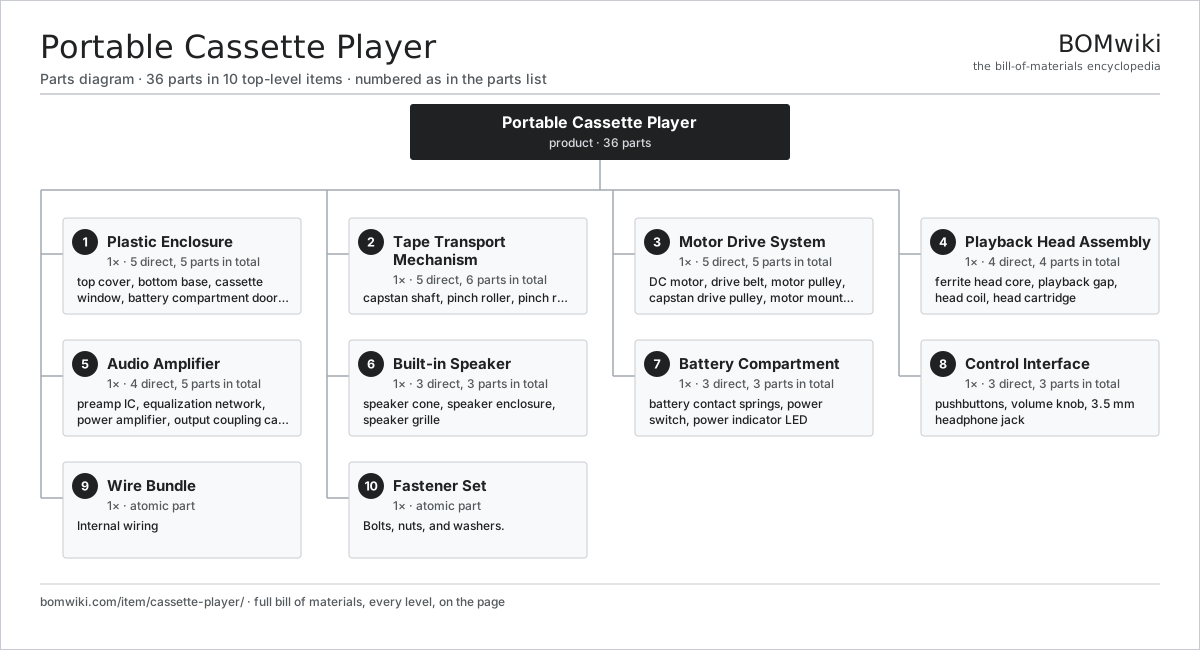
| # | Part | Qty | What it does |
|---|---|---|---|
| 1 | Plastic Enclosure 5 parts | 1× | Injection-molded ABS clamshell with deck window and battery compartment door. |
| 2 | Tape Transport Mechanism 5 parts | 1× | Mechanical system guiding tape past playback head with precise pressure and speed control. |
| 3 | Motor Drive System 5 parts | 1× | Single motor driving capstan via belt and gearbox. |
| 4 | Playback Head Assembly 4 parts | 1× | Magnetic read head extracting audio signal from tape. |
| 5 | Audio Amplifier 4 parts | 1× | Preamplifier and power amplifier driving speaker and headphone output. |
| 6 | Built-in Speaker 3 parts | 1× | Small 40 mm driver providing audio output. |
| 7 | Battery Compartment 3 parts | 1× | AA battery holder providing 1.5 V power supply. |
| 8 | Control Interface 3 parts | 1× | Buttons for play, stop, rewind, fast-forward, and volume adjustment. |
| 9 | Wire Bundle | 1× | Internal wiring |
| 10 | Fastener Set | 1× | Bolts, nuts, and washers. |
3D model
No 3D model yet. Have a CAD file of this? Add a 3D model. STL renders right on this page; STEP, FreeCAD, and OpenSCAD sources are welcome too (openly licensed, like all 3D models on BOMwiki).
Build & assembly graph
expand / collapse · shared sub-assemblies converge · links to related products · est. labourTap an assembly to expand/collapse · tap a part to open it · use “Open page” for any node · drag to pan, scroll to zoom.
Bill of materials for Portable Cassette Player
10 top-level lines · 42 rows shown · 36 parts total · indented to 3 levels| # | Item / sub-assembly | Part no. | Qty/assy | Ext. qty | Parts | Type |
|---|---|---|---|---|---|---|
| 1 | Plastic Enclosure 5 parts | cassette-player-housing | 1× | 1 | 5 | assembly |
| 1.1 | Top Cover | cassette-player-top-shell | 1× | 1 | · | part |
| 1.2 | Bottom Base | cassette-player-bottom-shell | 1× | 1 | · | part |
| 1.3 | Cassette Window | cassette-player-deck-window | 1× | 1 | · | part |
| 1.4 | Battery Compartment Door | cassette-player-battery-door | 1× | 1 | · | part |
| 1.5 | Hinge Assembly | cassette-player-hinge-pin | 1× | 1 | · | part |
| 2 | Tape Transport Mechanism 5 parts | cassette-player-tape-transport | 1× | 1 | 6 | assembly |
| 2.1 | Capstan Shaft | cassette-player-capstan | 1× | 1 | · | part |
| 2.2 | Pinch Roller | cassette-player-pinch-roller | 1× | 1 | · | part |
| 2.3 | Pinch Roller Spring | cassette-player-roller-spring | 1× | 1 | · | part |
| 2.4 | Guide Post | cassette-player-tape-guide-post | 2× | 2 | · | part |
| 2.5 | Tape Tension Spring | cassette-player-tension-spring | 1× | 1 | · | part |
| 3 | Motor Drive System 5 parts | cassette-player-motor-drivetrain | 1× | 1 | 5 | assembly |
| 3.1 | DC Motor | cassette-player-dc-motor | 1× | 1 | · | part |
| 3.2 | Drive Belt | cassette-player-drive-belt | 1× | 1 | · | part |
| 3.3 | Motor Pulley | cassette-player-motor-pulley | 1× | 1 | · | part |
| 3.4 | Capstan Drive Pulley | cassette-player-capstan-pulley | 1× | 1 | · | part |
| 3.5 | Motor Mount Bracket | cassette-player-motor-bracket | 1× | 1 | · | part |
| 4 | Playback Head Assembly 4 parts | cassette-player-playback-head | 1× | 1 | 4 | assembly |
| 4.1 | Ferrite Head Core | cassette-player-head-core | 1× | 1 | · | part |
| 4.2 | Playback Gap | cassette-player-head-gap | 1× | 1 | · | part |
| 4.3 | Head Coil | cassette-player-head-winding | 1× | 1 | · | part |
| 4.4 | Head Cartridge | cassette-player-head-bracket | 1× | 1 | · | part |
| 5 | Audio Amplifier 4 parts | cassette-player-amplifier | 1× | 1 | 5 | assembly |
| 5.1 | Preamp IC | cassette-player-preamp-ic | 1× | 1 | · | part |
| 5.2 | Equalization Network | cassette-player-eq-network | 1× | 1 | · | part |
| 5.3 | Power Amplifier | cassette-player-power-amp-ic | 1× | 1 | · | part |
| 5.4 | Output Coupling Capacitor | cassette-player-output-coupling | 2× | 2 | · | part |
| 6 | Built-in Speaker 3 parts | cassette-player-speaker | 1× | 1 | 3 | assembly |
| 6.1 | Speaker Cone | cassette-player-speaker-driver | 1× | 1 | · | part |
| 6.2 | Speaker Enclosure | cassette-player-speaker-enclosure | 1× | 1 | · | part |
| 6.3 | Speaker Grille | cassette-player-speaker-grill | 1× | 1 | · | part |
| 7 | Battery Compartment 3 parts | cassette-player-battery-holder | 1× | 1 | 3 | assembly |
| 7.1 | Battery Contact Springs | cassette-player-battery-springs | 1× | 1 | · | part |
| 7.2 | Power Switch | cassette-player-power-switch | 1× | 1 | · | part |
| 7.3 | Power Indicator LED | cassette-player-power-led | 1× | 1 | · | part |
| 8 | Control Interface 3 parts | cassette-player-controls | 1× | 1 | 3 | assembly |
| 8.1 | Pushbuttons | cassette-player-button-set | 1× | 1 | · | part |
| 8.2 | Volume Knob | cassette-player-volume-dial | 1× | 1 | · | part |
| 8.3 | 3.5 mm Headphone Jack | cassette-player-headphone-jack | 1× | 1 | · | part |
| 9 | Wire Bundle | wire-bundle | 1× | 1 | · | part |
| 10 | Fastener Set | fastener-set | 1× | 1 | · | part |
Something wrong in this list? Report a problem with this BOM.
Related products
same domain, ranked by shared parts Amateur Radio Transceiver
295 parts · shares 1 with this page
Amateur Radio Transceiver
295 parts · shares 1 with this page
 Bone Conduction Headphones
34 parts · shares 1 with this page
Bone Conduction Headphones
34 parts · shares 1 with this page
 Car FM Transmitter
240 parts · shares 1 with this page
Car FM Transmitter
240 parts · shares 1 with this page
 CB Radio
228 parts · shares 1 with this page
CB Radio
228 parts · shares 1 with this page
 Clamp Meter
27 parts · shares 1 with this page
Clamp Meter
27 parts · shares 1 with this page
 Digital Audio Player
267 parts · shares 1 with this page
Digital Audio Player
267 parts · shares 1 with this page
Sourcing: possible vendors
Browse the supplier directory → Prices, MOQ, and lead times are algorithmic estimates, not quotes, and not claims about these companies. Company mappings are curated by keyword; est. price band $50–$2k. How estimates work| Vendor | HQ | Specialty | MOQ | Lead time |
|---|---|---|---|---|
|
🇨🇳Foxconn
foxconn.com ↗
|
Shenzhen, CN | Electronics contract mfg | 1,000 units | 8–14 wks |
|
🇺🇸Jabil
jabil.com ↗
|
St. Petersburg, US | Electronics manufacturing | 1,000 units | 8–14 wks |
|
🇺🇸Flex
flex.com ↗
|
Austin, US | Electronics manufacturing | 1,000 units | 8–14 wks |
| celestica.com ↗ | Toronto, CA | Electronics manufacturing | 1,000 units | 8–14 wks |
|
🇺🇸Sanmina
sanmina.com ↗
|
San Jose, US | Electronics manufacturing | 1,000 units | 8–14 wks |
1,076-word article