Clamp Meter
ProductOverview
A clamp meter (or clamp ammeter, "amp clamp") is a specialized current-measuring device that non-destructively measures AC current flowing through an electrical conductor by clamping a hinged ferromagnetic jaw pair around the wire. Unlike conventional multimeters that require breaking a circuit to insert the meter in series (an inconvenient and potentially dangerous operation in live circuits), the clamp meter simply opens its jaw, places it over the current-carrying conductor, and closes the jaw, inductively coupling to the current through transformer action, with no electrical contact required.
The Clamp Meter is the tool of choice for field troubleshooting of branch circuits, motor loads, and multi-phase industrial systems, where measuring current at various points along distribution panels without de-energizing equipment is essential. A clamp meter can be operated with a single hand, and since no circuit modification is needed, it is far safer for measurements on live electrical systems than breaking open a circuit and inserting a conventional ammeter.
How it works
The Molded Plastic Body is a compact handheld enclosure with an integral jaw mechanism that opens and closes via the Clamp Hinge, a spring-loaded pivot driven by a trigger or manual lever. The two jaws, a fixed clamp-meter-fixed-jaw-core bonded to the front housing and a rotating clamp-meter-movable-jaw-core, are fabricated from soft iron (low-carbon steel), chosen for its high magnetic permeability (μ >> 1) and minimal hysteresis loss.
When the user positions the closed jaws around an AC current-carrying conductor, say, a wire branch from an electrical panel delivering power to a motor, the current in the wire creates a circular magnetic field via Ampère's law (field strength proportional to current magnitude). The soft-iron jaw pair forms a closed magnetic circuit, channeling this field through the toroidal core of the Current Sensing Core.
The Toroidal Transformer Core, a ferrite ring wound with two coils, acts as a current transformer. The primary "coil" is not actually wound on the ring; instead, the conductor being measured physically passes through the center of the toroid, so the conductor itself carries the primary current in a single turn (N=1). The Secondary Coil, typically 1000 or 2000 turns of wire wrapped around the toroid, develops a secondary voltage proportional to the primary current: V_secondary = (N_secondary / N_primary) × (primary current × impedance).
The secondary winding connects to a Hall-Effect Sensor, an integrated circuit containing a Hall-effect sensor embedded in a magnetic field. The Hall sensor responds to the magnetic flux passing through the toroid, generating a linear voltage output (typically 100 mV per ampere of primary current). This low-impedance voltage drives the Signal Conditioning Board board, where analog signal processing begins.
The Instrumentation Amplifier is a precision, low-input-offset amplifier configured with selectable gain (×100 for the 50 A range, ×10 for the 500 A range, etc.). The amplifier's output is then filtered by a Low-Pass Filter, a 2 kHz low-pass RC network rejecting harmonic distortion and 50/60 Hz ripple from the AC rectification stage.
For AC current measurement, the output of the amplifier is fed to a Peak Rectifier, which performs peak detection or RMS (root-mean-square) conversion. The classic analog approach uses a precision diode and capacitor to detect the peak voltage of the AC signal, displaying peak values. More modern clamp meters employ a fast ADC to sample the waveform and compute true RMS in firmware, important for distorted or non-sinusoidal currents (motor inrush, switching supplies) where the peak detector would overestimate.
The digitized measurement is displayed on a LCD Panel, a 3.5-digit LCD (0–1999 range) showing the current magnitude. The Range LED Array LEDs indicate which range is active (50 A / 500 A / 1000 A), and the Overload Warning LED illuminates red if the current exceeds the selected range's maximum, signaling the user to switch to a higher range.
Range selection is performed manually via the Function Selector, a rotary dial on the front that changes the input gain and voltage scaling of the Instrumentation Amplifier. Switching ranges alters which LED indicator lights and reconfigures the analog signal path, allowing measurement from tens of amperes up to thousands of amperes.
Power is supplied by a single 9 V Battery & Holder, regulated via the Signal Conditioning Board supply lines. The quiescent current draw (when clamped but inactive) is minimal, < 5 mW, extending battery life to 50+ hours of use between replacements.
The Molded Plastic Body is sealed to an IP54 rating, protecting against dust and light splashing (suitable for workshop and field environments). The hinged jaw design is durable: repeated opening and closing for years of use does not significantly change the spring constant or magnetic coupling efficiency, because the clamp-meter-fixed-jaw-core and clamp-meter-movable-jaw-core remain aligned and the ferrite toroid is rigid and stable.
Practical measurement scenario
An electrician is investigating a report of high power consumption in a building's branch circuit. Using the Clamp Meter, they select the 500 A range via the Function Selector, open the Clamp Jaw Assembly by pressing a trigger, and place the jaws around a 3/0 AWG feeder cable in the distribution panel. The jaw closes magnetically under the Jaw Spring, surrounding the conductor. The Toroidal Transformer Core immediately detects the magnetic field from the flowing current, the Hall-Effect Sensor generates a proportional voltage, and the Signal Conditioning Board amplifies it.
The Display & Indicator shows "320", indicating 320 A flowing through the feeder at that instant. The electrician checks multiple feeders in sequence, accumulating a load profile. If one feeder is drawing unexpectedly high current, they can trace that circuit to its load (a motor, heater, or lighting panel) and investigate why the load has increased.
Because the clamp meter is non-invasive, no wire breaking, no meter insertion, no temporary fault hazard, the measurement can be performed on live circuits while the building remains energized. This is a critical safety and operational advantage over conventional ammeters, which force an interruption and potential shock risk to technicians working on energized panels.
Advanced features and limitations
Modern clamp meters often add AC voltage measurement (a secondary capability using the same probes), power factor calculation, and even wireless data logging to smartphone apps. However, the fundamental limitation remains: clamp meters measure AC current only. Direct current (DC) cannot be measured because a DC current produces a static magnetic field, no changing flux, so the transformer secondary (and Hall sensor) output is zero.
For three-phase motor load analysis, technicians use three clamp meters simultaneously (one on each phase) or use clamp meters with built-in three-phase power calculation capability, multiplying per-phase current readings by the supply voltage and phase angle to estimate motor power draw and efficiency. This non-invasive diagnosis is invaluable in industrial settings, where downtime from circuit interruption carries significant cost.
Clamp Meter parts and their functions
9 top-level parts · 27 parts in total · full bill of materials below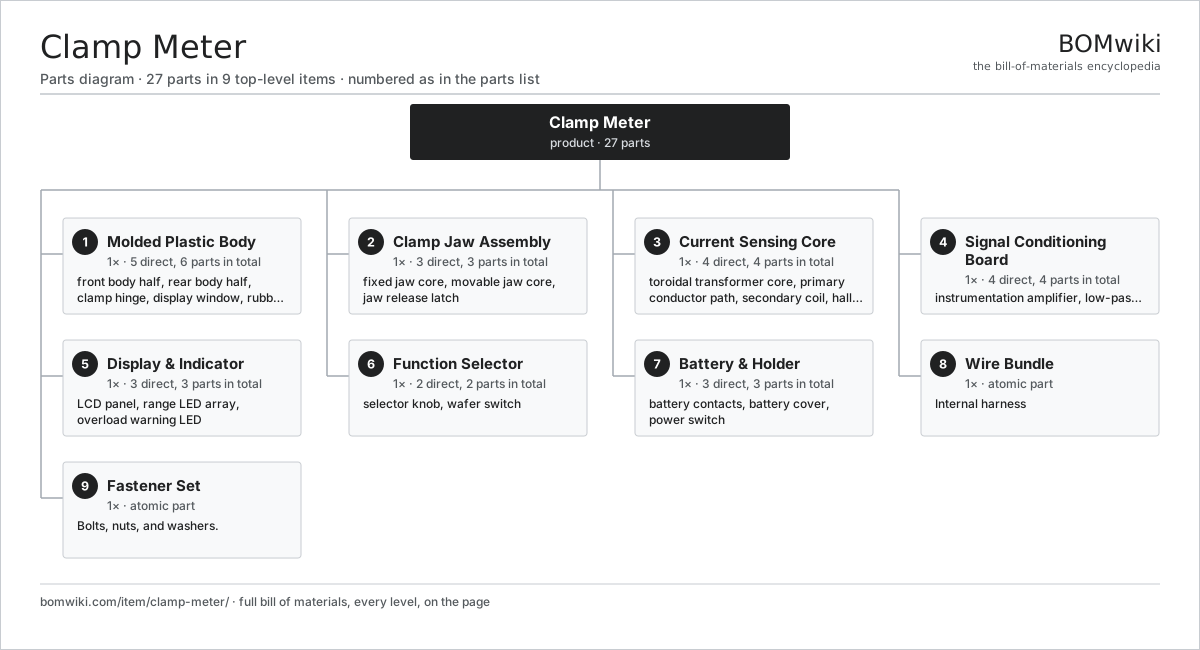
| # | Part | Qty | What it does |
|---|---|---|---|
| 1 | Molded Plastic Body 5 parts | 1× | Two-piece ABS enclosure with integral clamp mechanism frame and display panel. |
| 2 | Clamp Jaw Assembly 3 parts | 1× | Ferromagnetic core pair forming inductive pickup around current-carrying conductor. |
| 3 | Current Sensing Core 4 parts | 1× | Toroidal transformer and hall-effect or CT sensor converting current to voltage. |
| 4 | Signal Conditioning Board 4 parts | 1× | Amplification, filtering, and AC-to-DC conversion for ADC measurement. |
| 5 | Display & Indicator 3 parts | 1× | LCD showing RMS current and function status with range indicator lights. |
| 6 | Function Selector 2 parts | 1× | Rotary dial choosing AC current range and optional AC voltage measurement. |
| 7 | Battery & Holder 3 parts | 1× | Single 9 V alkaline battery powering meter electronics. |
| 8 | Wire Bundle | 1× | Internal harness |
| 9 | Fastener Set | 1× | Bolts, nuts, and washers. |
3D model
No 3D model yet. Have a CAD file of this? Add a 3D model. STL renders right on this page; STEP, FreeCAD, and OpenSCAD sources are welcome too (openly licensed, like all 3D models on BOMwiki).
Build & assembly graph
expand / collapse · shared sub-assemblies converge · links to related products · est. labourTap an assembly to expand/collapse · tap a part to open it · use “Open page” for any node · drag to pan, scroll to zoom.
Bill of materials for Clamp Meter
9 top-level lines · 35 rows shown · 27 parts total · indented to 3 levels| # | Item / sub-assembly | Part no. | Qty/assy | Ext. qty | Parts | Type |
|---|---|---|---|---|---|---|
| 1 | Molded Plastic Body 5 parts | clamp-meter-housing | 1× | 1 | 6 | assembly |
| 1.1 | Front Body Half | clamp-meter-front-clamshell | 1× | 1 | · | part |
| 1.2 | Rear Body Half | clamp-meter-rear-clamshell | 1× | 1 | · | part |
| 1.3 | Clamp Hinge 2 parts | clamp-meter-hinge-assembly | 1× | 1 | 2 | assembly |
| 1.3.1 | Hinge Pin | clamp-meter-hinge-pin | 1× | 1 | · | part |
| 1.3.2 | Jaw Spring | clamp-meter-spring-return | 1× | 1 | · | part |
| 1.4 | Display Window | clamp-meter-display-window | 1× | 1 | · | part |
| 1.5 | Rubberized Grip | clamp-meter-handle-grip | 1× | 1 | · | part |
| 2 | Clamp Jaw Assembly 3 parts | clamp-meter-clamp-jaws | 1× | 1 | 3 | assembly |
| 2.1 | Fixed Jaw Core | clamp-meter-fixed-jaw | 1× | 1 | · | part |
| 2.2 | Movable Jaw Core | clamp-meter-movable-jaw | 1× | 1 | · | part |
| 2.3 | Jaw Release Latch | clamp-meter-jaw-latch | 1× | 1 | · | part |
| 3 | Current Sensing Core 4 parts | clamp-meter-current-sensor | 1× | 1 | 4 | assembly |
| 3.1 | Toroidal Transformer Core | clamp-meter-toroid-core | 1× | 1 | · | part |
| 3.2 | Primary Conductor Path | clamp-meter-primary-conductor | 1× | 1 | · | part |
| 3.3 | Secondary Coil | clamp-meter-secondary-winding | 1× | 1 | · | part |
| 3.4 | Hall-Effect Sensor | clamp-meter-hall-sensor | 1× | 1 | · | part |
| 4 | Signal Conditioning Board 4 parts | clamp-meter-signal-conditioning | 1× | 1 | 4 | assembly |
| 4.1 | Instrumentation Amplifier | clamp-meter-instrumentation-amp | 1× | 1 | · | part |
| 4.2 | Low-Pass Filter | clamp-meter-filter-stage | 1× | 1 | · | part |
| 4.3 | Peak Rectifier | clamp-meter-rectifier-detector | 1× | 1 | · | part |
| 4.4 | Analog-Digital Converter | clamp-meter-adc-converter | 1× | 1 | · | part |
| 5 | Display & Indicator 3 parts | clamp-meter-display-unit | 1× | 1 | 3 | assembly |
| 5.1 | LCD Panel | lcd-panel | 1× | 1 | · | part |
| 5.2 | Range LED Array | clamp-meter-led-range-indicator | 1× | 1 | · | part |
| 5.3 | Overload Warning LED | clamp-meter-overload-led | 1× | 1 | · | part |
| 6 | Function Selector 2 parts | clamp-meter-selector-switch | 1× | 1 | 2 | assembly |
| 6.1 | Selector Knob | clamp-meter-selector-knob | 1× | 1 | · | part |
| 6.2 | Wafer Switch | clamp-meter-wafer-switch | 1× | 1 | · | part |
| 7 | Battery & Holder 3 parts | clamp-meter-battery-pack | 1× | 1 | 3 | assembly |
| 7.1 | Battery Contacts | clamp-meter-battery-clips | 1× | 1 | · | part |
| 7.2 | Battery Cover | clamp-meter-battery-door | 1× | 1 | · | part |
| 7.3 | Power Switch | clamp-meter-power-switch | 1× | 1 | · | part |
| 8 | Wire Bundle | wire-bundle | 1× | 1 | · | part |
| 9 | Fastener Set | fastener-set | 1× | 1 | · | part |
Something wrong in this list? Report a problem with this BOM.
Related products
same domain, ranked by shared parts Amateur Radio Transceiver
295 parts · shares 2 with this page
Amateur Radio Transceiver
295 parts · shares 2 with this page
 Car FM Transmitter
240 parts · shares 2 with this page
Digital Multimeter
32 parts · shares 2 with this page
Car FM Transmitter
240 parts · shares 2 with this page
Digital Multimeter
32 parts · shares 2 with this page
 Digital Photo Frame
31 parts · shares 2 with this page
Digital Photo Frame
31 parts · shares 2 with this page
 Frequency Counter
28 parts · shares 2 with this page
Frequency Counter
28 parts · shares 2 with this page
 Function Generator
28 parts · shares 2 with this page
Function Generator
28 parts · shares 2 with this page
Sourcing: possible vendors
Browse the supplier directory → Prices, MOQ, and lead times are algorithmic estimates, not quotes, and not claims about these companies. Company mappings are curated by keyword; est. price band $50–$2k. How estimates work| Vendor | HQ | Specialty | MOQ | Lead time |
|---|---|---|---|---|
|
🇨🇳Foxconn
foxconn.com ↗
|
Shenzhen, CN | Electronics contract mfg | 1,000 units | 8–14 wks |
|
🇺🇸Jabil
jabil.com ↗
|
St. Petersburg, US | Electronics manufacturing | 1,000 units | 8–14 wks |
|
🇺🇸Flex
flex.com ↗
|
Austin, US | Electronics manufacturing | 1,000 units | 8–14 wks |
| celestica.com ↗ | Toronto, CA | Electronics manufacturing | 1,000 units | 8–14 wks |
|
🇺🇸Sanmina
sanmina.com ↗
|
San Jose, US | Electronics manufacturing | 1,000 units | 8–14 wks |
1,190-word article