Digital Multimeter
ProductOverview
The digital multimeter (DMM) is the most widely used electronics diagnostic tool, combining three measurement functions, voltage, current, and resistance, in a single handheld instrument with a 3.5-digit LCD numerical display. The Digital Multimeter is ubiquitous in technician tool kits, engineering labs, and hobbyist workshops because it provides fast, visual numerical readouts (unlike analog pointer meters, which require interpolation) and automatic range selection, reducing operator error and test time.
A traditional multimeter required the user to manually select both the measurement function (AC voltage, DC current, etc.) and the numerical range (2 V, 20 V, 200 V, etc.) based on prior knowledge of the circuit being tested; selecting the wrong range could damage the meter or yield meaningless readings. Auto-ranging digital multimeters eliminate this burden: the user selects only the function (voltage / current / resistance), presses the test probes against the circuit nodes, and the meter automatically selects the most sensitive range that prevents overflow, displaying a four-digit number directly.
How it works
Power enters from a 9 V alkaline battery housed in the Battery Holder, switched on via the Power Switch at the rear. The battery feeds a digital-multimeter-power-regulator that provides ±15 V and +5 V supplies for analog and digital circuitry.
When the user selects a measurement function via the Range Selector Switch rotary knob, a Wafer Switch Element (a multi-contact mechanical switching disk) routes the test probe inputs and configures the input impedance and gain settings. The two test probes, one Probe equipped with red banana plugs and another with black (common/ground), connect to input jacks on the meter. Different functions use different input ports: voltage and resistance share the 10 MΩ input, while the 10 A current-measurement mode uses a dedicated high-current jack to bypass the series current-limiting resistor.
For voltage measurement, the analog signal from the probes enters the Input Protection Stage stage, which includes Fuses (a 250 mA fuse in series for low-current paths, and a 10 A fuse for the current jack), TVS Diode Array (TVS diodes clamping transient spikes), and Series Resistors (1 MΩ resistors in series dropping sustained overvoltages). These protect the downstream Input Preamplifier, a high-impedance op-amp configured as a voltage follower, which buffers the test voltage without drawing significant current from the circuit under test.
The buffered voltage is amplified by the Input Preamplifier with selectable gain (set by the Wafer Switch Element), so that different ranges (200 mV, 2 V, 20 V, 200 V, 600 V) all present a signal within the ADC Converter Chip's optimum input window (typically 0–100 mV). The Voltage Reference, a precision 1.2 V bandgap reference, establishes the ADC's voltage scale, ensuring measurement accuracy of approximately ±0.5% for DC voltage.
The ADC Converter Chip itself is a specialized integrated circuit, not a generic ADC, but a precision "3.5-digit LCD driver" that contains analog-to-digital conversion, automatic range selection logic, and direct LCD display driving capability in one chip. The ADC quantizes the input voltage at 200 Hz sample rate, producing a digital word proportional to the input. The auto-range logic examines the ADC output: if it exceeds 1999 counts (the maximum for a 4-digit display in a specific range), the IC automatically reduces the input gain, re-samples, and re-displays the value in the next higher range. This iteration occurs seamlessly to the user, appearing as an instantaneous range-selection.
For resistance measurement, the Ohms Measurement Stage generates a small constant current (typically 1 mA) sourced from the meter into the unknown resistor via the test probes, measures the resulting voltage across it, and computes resistance (R = V / I) via Ohm's law. The ADC Converter Chip internally performs the division, displaying the resistance directly in ohms.
For AC voltage and current measurement, the Input Preamplifier is configured with AC coupling (capacitive high-pass filter), isolating DC offset while passing the AC waveform. The signal is then rectified and averaged (RMS computation) by analog circuitry, or the ADC Converter Chip may sample the AC waveform at high rate and compute RMS digitally. AC voltage is typically accurate only at line frequencies (50 / 60 Hz) and audio frequencies (up to 5 kHz); higher-frequency AC signals and complex waveforms are measured poorly or not at all.
The LCD Display Module, a custom LCD segment glass with 4-digit numeric capability, receives multiplexed segment signals from the ADC Converter Chip. Each digit is scanned at 50 Hz, lighting appropriate segments to form numbers 0–9 and special symbols (−, Ω, V, A, mA) indicating units and polarity. Power consumption is minimal in display mode (< 1 mW LCD current), dominated by the ADC Converter Chip and preamp circuitry (< 5 mW total), extending battery life to 200+ hours of continuous operation on a single 9 V cell.
Typical measurement workflow
A technician is debugging a malfunctioning USB device. First, they verify mains power to the wall adapter using the multimeter: they select AC voltage on the Range Selector Switch, plug the red Probe into the AC socket's "hot" slot, and press the black probe to ground. The meter displays "120" on the LCD Display Module, indicating 120 V AC is present. They then move to the adapter's DC output, selecting the 20 V DC range on the dial, and verify the adapter outputs +5.2 V (nominal 5 V) and −12 mV (noise), indicating the adapter is functioning correctly.
Next, they measure current to the USB device. They break the circuit (unplugging the USB cable from the device's power connector), switch the meter to the 200 mA DC current range, plug the red probe into the 10 A current input jack, and insert the probes in series with the USB power line. Powering up, the meter displays "045", indicating 45 mA quiescent current, normal for a low-power device in idle state. If the current suddenly spiked, it would suggest a short circuit or failed component.
Finally, they measure a suspicious resistor. Desoldering a resistor from the board using a hot-air station or iron, they select the 2 kΩ resistance range on the Range Selector Switch, place the probes across the resistor, and read "1.47" on the LCD Display Module, indicating 1.47 kΩ. Against the expected 1.5 kΩ marking, it's within ±1% tolerance, so the resistor is likely good. (If it had read 0.01 kΩ or > 10 MΩ, the resistor would be suspected of failure.)
Limitations and evolution
The 3.5-digit display (0–1999 range) is the historical standard, providing sufficient resolution for most field testing but limiting precision to roughly ±0.5%. Laboratory-grade multimeters with 5+ digits (or digital data output) are required for accuracy better than 0.1%. The AC measurement capability is typically limited to sine waves at standard power/audio frequencies; distorted or RF signals are measured inaccurately. Modern multimeters add specialized modes (capacitance, frequency, temperature via thermocouples) via additional circuit modules, but the core Digital Multimeter remains the most cost-effective and practical troubleshooting instrument for electrical technicians.
Digital Multimeter parts and their functions
9 top-level parts · 32 parts in total · full bill of materials below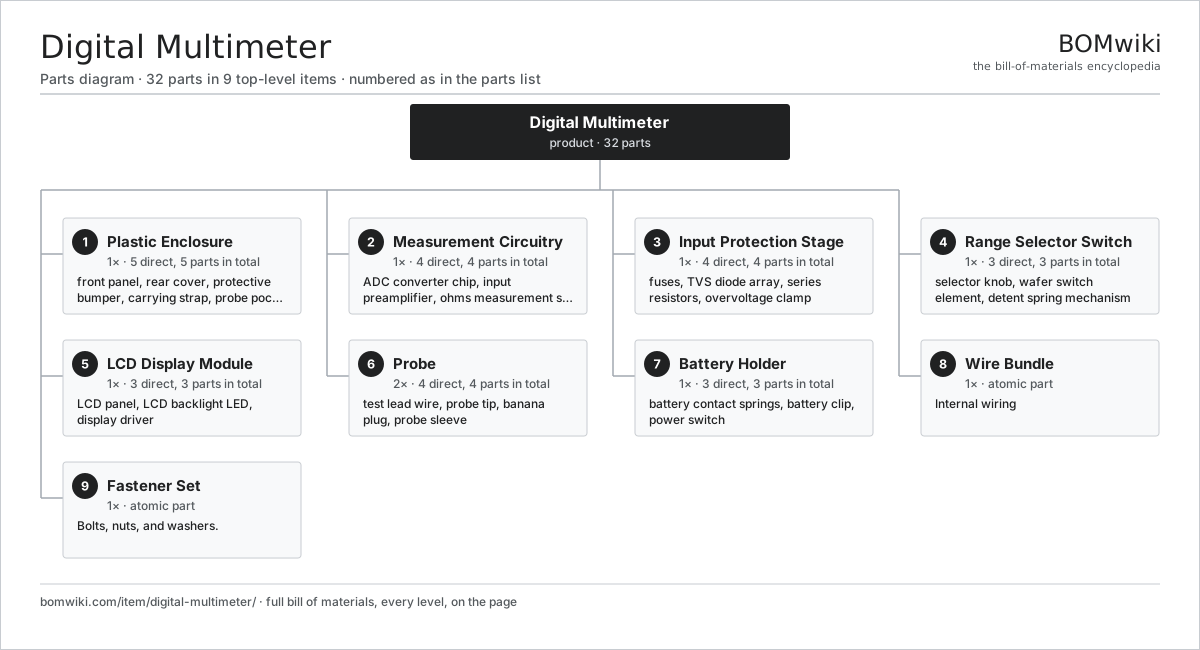
| # | Part | Qty | What it does |
|---|---|---|---|
| 1 | Plastic Enclosure 5 parts | 1× | Two-part molded ABS body with carrying strap and protective rubber bumper. |
| 2 | Measurement Circuitry 4 parts | 1× | ADC converter and measurement amplifiers quantizing input signals. |
| 3 | Input Protection Stage 4 parts | 1× | Fuses, diodes, and resistors limiting fault current and overvoltage to safe levels. |
| 4 | Range Selector Switch 3 parts | 1× | Rotary switch selecting measurement function and full-scale range. |
| 5 | LCD Display Module 3 parts | 1× | Liquid crystal numeric display with backlight and function indicators. |
| 6 | Probe 4 parts | 2× | Insulated test lead with color-coded plug connector. |
| 7 | Battery Holder 3 parts | 1× | 9 V alkaline battery providing power to display and measurement circuits. |
| 8 | Wire Bundle | 1× | Internal wiring |
| 9 | Fastener Set | 1× | Bolts, nuts, and washers. |
3D model
No 3D model yet. Have a CAD file of this? Add a 3D model. STL renders right on this page; STEP, FreeCAD, and OpenSCAD sources are welcome too (openly licensed, like all 3D models on BOMwiki).
Build & assembly graph
expand / collapse · shared sub-assemblies converge · links to related products · est. labourTap an assembly to expand/collapse · tap a part to open it · use “Open page” for any node · drag to pan, scroll to zoom.
Bill of materials for Digital Multimeter
9 top-level lines · 35 rows shown · 32 parts total · indented to 3 levels| # | Item / sub-assembly | Part no. | Qty/assy | Ext. qty | Parts | Type |
|---|---|---|---|---|---|---|
| 1 | Plastic Enclosure 5 parts | digital-multimeter-housing | 1× | 1 | 5 | assembly |
| 1.1 | Front Panel | digital-multimeter-front-cover | 1× | 1 | · | part |
| 1.2 | Rear Cover | digital-multimeter-rear-cover | 1× | 1 | · | part |
| 1.3 | Protective Bumper | digital-multimeter-rubber-boot | 1× | 1 | · | part |
| 1.4 | Carrying Strap | digital-multimeter-handle-strap | 1× | 1 | · | part |
| 1.5 | Probe Pockets | digital-multimeter-probe-storage | 1× | 1 | · | part |
| 2 | Measurement Circuitry 4 parts | digital-multimeter-measurement-circuit | 1× | 1 | 4 | assembly |
| 2.1 | ADC Converter Chip | digital-multimeter-adc-ic | 1× | 1 | · | part |
| 2.2 | Input Preamplifier | digital-multimeter-preamp-stage | 1× | 1 | · | part |
| 2.3 | Ohms Measurement Stage | digital-multimeter-ohms-circuit | 1× | 1 | · | part |
| 2.4 | Voltage Reference | digital-multimeter-reference-voltage | 1× | 1 | · | part |
| 3 | Input Protection Stage 4 parts | digital-multimeter-input-protection | 1× | 1 | 4 | assembly |
| 3.1 | Fuses | digital-multimeter-fuse-set | 1× | 1 | · | part |
| 3.2 | TVS Diode Array | digital-multimeter-transient-diodes | 1× | 1 | · | part |
| 3.3 | Series Resistors | digital-multimeter-current-limiting-resistors | 1× | 1 | · | part |
| 3.4 | Overvoltage Clamp | digital-multimeter-overvoltage-suppressor | 1× | 1 | · | part |
| 4 | Range Selector Switch 3 parts | digital-multimeter-range-selector | 1× | 1 | 3 | assembly |
| 4.1 | Selector Knob | digital-multimeter-selector-knob | 1× | 1 | · | part |
| 4.2 | Wafer Switch Element | digital-multimeter-selector-wafer | 1× | 1 | · | part |
| 4.3 | Detent Spring Mechanism | digital-multimeter-selector-detent | 1× | 1 | · | part |
| 5 | LCD Display Module 3 parts | digital-multimeter-display-module | 1× | 1 | 3 | assembly |
| 5.1 | LCD Panel | lcd-panel | 1× | 1 | · | part |
| 5.2 | LCD Backlight LED | digital-multimeter-display-backlight | 1× | 1 | · | part |
| 5.3 | Display Driver | digital-multimeter-display-driver | 1× | 1 | · | part |
| 6 | Probe 4 parts | digital-multimeter-probe-set | 2× | 2 | 4 | assembly |
| 6.1 | Test Lead Wire | digital-multimeter-probe-lead | 1× | 2 | · | part |
| 6.2 | Probe Tip | digital-multimeter-probe-tip | 1× | 2 | · | part |
| 6.3 | Banana Plug | digital-multimeter-probe-connector | 1× | 2 | · | part |
| 6.4 | Probe Sleeve | digital-multimeter-probe-insulation | 1× | 2 | · | part |
| 7 | Battery Holder 3 parts | digital-multimeter-battery-compartment | 1× | 1 | 3 | assembly |
| 7.1 | Battery Contact Springs | digital-multimeter-battery-springs | 1× | 1 | · | part |
| 7.2 | Battery Clip | digital-multimeter-battery-latch | 1× | 1 | · | part |
| 7.3 | Power Switch | digital-multimeter-power-switch | 1× | 1 | · | part |
| 8 | Wire Bundle | wire-bundle | 1× | 1 | · | part |
| 9 | Fastener Set | fastener-set | 1× | 1 | · | part |
Something wrong in this list? Report a problem with this BOM.
Used in 1 assembly
Related products
same domain, ranked by shared parts Amateur Radio Transceiver
295 parts · shares 2 with this page
Amateur Radio Transceiver
295 parts · shares 2 with this page
 Car FM Transmitter
240 parts · shares 2 with this page
Car FM Transmitter
240 parts · shares 2 with this page
 Clamp Meter
27 parts · shares 2 with this page
Clamp Meter
27 parts · shares 2 with this page
 Digital Photo Frame
31 parts · shares 2 with this page
Digital Photo Frame
31 parts · shares 2 with this page
 Frequency Counter
28 parts · shares 2 with this page
Frequency Counter
28 parts · shares 2 with this page
 Function Generator
28 parts · shares 2 with this page
Function Generator
28 parts · shares 2 with this page
Sourcing: possible vendors
Browse the supplier directory → Prices, MOQ, and lead times are algorithmic estimates, not quotes, and not claims about these companies. Company mappings are curated by keyword; est. price band $50–$2k. How estimates work| Vendor | HQ | Specialty | MOQ | Lead time |
|---|---|---|---|---|
|
🇨🇳Foxconn
foxconn.com ↗
|
Shenzhen, CN | Electronics contract mfg | 1,000 units | 8–14 wks |
|
🇺🇸Jabil
jabil.com ↗
|
St. Petersburg, US | Electronics manufacturing | 1,000 units | 8–14 wks |
|
🇺🇸Flex
flex.com ↗
|
Austin, US | Electronics manufacturing | 1,000 units | 8–14 wks |
| celestica.com ↗ | Toronto, CA | Electronics manufacturing | 1,000 units | 8–14 wks |
|
🇺🇸Sanmina
sanmina.com ↗
|
San Jose, US | Electronics manufacturing | 1,000 units | 8–14 wks |
1,231-word article