Driver Training Simulator
ProductOverview
A driver training simulator is a fixed-base or motion-equipped driving platform that replicates vehicle controls and environments for professional driver education, fleet training, and emergency response instruction. Unlike racing simulators that emphasize vehicle dynamics and competition, driving trainers focus on hazard recognition, decision-making, and real-world road scenarios.
The system comprises a vehicle-accurate cockpit with replica controls (steering, pedals, shifter), a multi-display surround visual system, optional motion feedback, and an instructor console for scenario editing and performance assessment. A high-performance PC runs realistic traffic and weather physics, allowing instructors to inject hazards, oncoming vehicles, pedestrians, sudden weather changes, at precise moments to test trainee reaction time and judgment.
Professional driver training schools (skip barber, racing academies, corporate fleet programs) use these systems to reduce accident rates by 20–40% and lower insurance premiums. Emergency services (police, fire, paramedics) use them for high-risk scenario training without endangering civilians.
How it works
The Control Systems Assembly (steering wheel, pedals, shifter) are instrumented with encoders and load cells. As the trainee steers or brakes, the Simulator Engine Computer reads inputs and updates the driving physics model in real time.
A typical scenario:
- Trainee approaches a traffic light at 50 km/h.
- Instructor triggers light change to red via instructor console.
- Trainee reacts, braking or accelerating decision.
- Simulator calculates vehicle response (deceleration, skid risk, tire grip).
- Visual system updates, showing brake lights on surrounding traffic.
- If trainee brakes too hard (>8 m/s²), wheels lock; simulator applies understeer to steering feedback.
- Scenario ends; instructor reviews metrics: brake reaction time 0.8 s, deceleration -7.2 m/s², no collision.
The instructor Instructor Console displays trainee video feed, performance timeline, and hazard checklist. The instructor can pause, rewind, and replay scenarios, critical for debrief and skill refinement.
Multi-display visual design
The Visual Display System uses 3–5 LCD panels or an optional dome projection system:
- Center panel: Windshield view, primary sightline
- Left panel: Left-side mirror and peripheral view
- Right panel: Right-side mirror and peripheral view
- Rearview: Miniature LCD in rearview mirror showing traffic behind
- Instrument cluster: Optional digital gauges (speedometer, RPM, fuel)
150°+ horizontal field of view is critical for mirror checking and lane awareness. Below 120°, drivers cannot develop realistic glance patterns.
Instructor control and scenarios
The instructor can dynamically inject hazards:
- Vehicles: Suddenly pull into lane, run red light, stall on roadway
- Pedestrians: Dart into intersection, children on sidewalk
- Weather: Rain, fog, ice transitions (reducing tire grip)
- Mechanical failures: Brake failure, power steering loss, tire blowout
- Light conditions: Dawn/dusk transitions, glare, darkness
Scenarios are pre-authored using a scenario editor tool, but skilled instructors also improvise, reacting to trainee errors in real time.
Performance metrics
Simulators log:
- Reaction time: Delay between hazard appearance and control input
- Lane position: Standard deviation from center
- Speed management: Over-speed detection on curves
- Safety violations: Red light running, wrong-way driving, tailgating
- Mirror checks: Gaze frequency per side mirror (via eye-tracking optional)
- Collision probability: Physics-based prediction of accident likelihood
These metrics feed training reports for instructor debriefs and supervisory review.
Motion feedback (optional)
Two to three axes of linear motion provide subtle heave (acceleration/braking) and pitch (grade) cues. This improves trainee comfort and realism but adds complexity and cost. Passive (gravity-based) systems are cheaper; active (motorized) systems are smoother but require constant power management.
Vehicle modularity
A training facility might have:
- A sedan cab for passenger car drivers
- A truck cab for commercial drivers
- An emergency vehicle cab for police/fire response training
These share common computer and instructor console infrastructure but swap cockpit modules. Quick-release mechanism can swap cabs in 30 minutes.
Training outcomes
Trainees show:
- Faster hazard recognition (+15–25% vs. classroom-only)
- Safer decision-making in complex scenarios
- Reduced accident rates in on-road follow-up (-20–40%)
- Lower insurance claims for corporate fleets
For emergency response, simulators enable high-risk training (high-speed pursuit, crash recovery) without risk to public or equipment.
Instructor expertise
The most effective training depends on instructor skill, they must recognize unsafe decisions, pause scenarios, and provide immediate corrective feedback. AI-powered scenario agents and automated coaching are emerging but not yet mature.
Standards and licensing
Some jurisdictions recognize simulator hours as credit toward professional driver licensing (CDL, HGV). Simulators must meet ISO 11592 (fidelity validation) and SAE standards for vehicle dynamics accuracy. Certification requires periodic re-validation of physics models against real-world test data.
Installation and operation
A typical driving school deployment: 2–4 simulators serving 100+ trainees per year. Operating costs are ~€2–4/hour (electricity, instructor labor, maintenance). Trainees pay €30–100/hour for training time, yielding positive ROI in 3–5 years.
Driver Training Simulator parts and their functions
7 top-level parts · 37 parts in total · full bill of materials below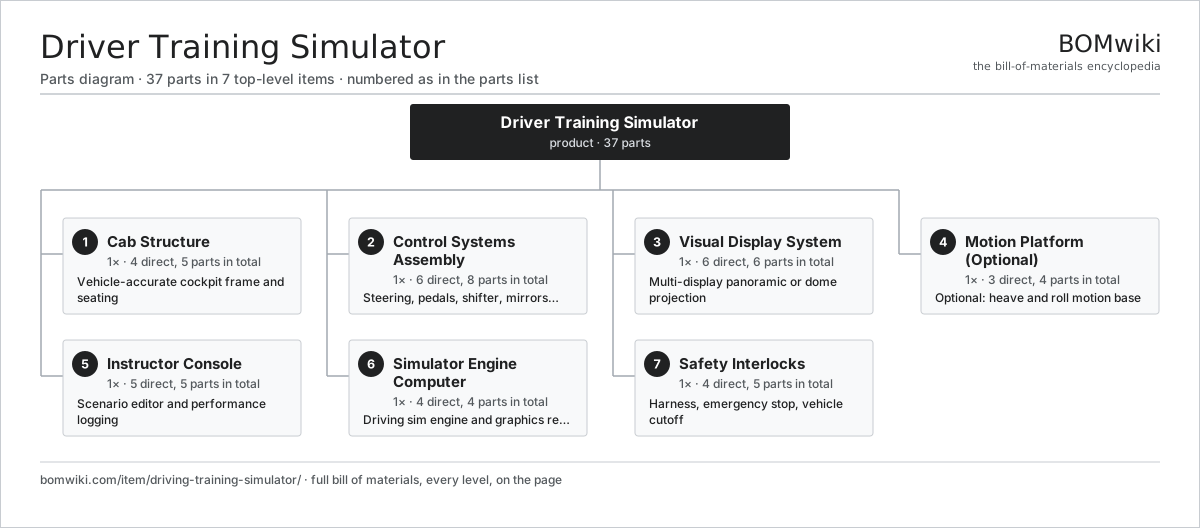
| # | Part | Qty | What it does |
|---|---|---|---|
| 1 | Cab Structure 4 parts | 1× | Vehicle-accurate cockpit frame and seating |
| 2 | Control Systems Assembly 6 parts | 1× | Steering, pedals, shifter, mirrors with full-range motion |
| 3 | Visual Display System 6 parts | 1× | Multi-display panoramic or dome projection |
| 4 | Motion Platform (Optional) 3 parts | 1× | Optional: heave and roll motion base |
| 5 | Instructor Console 5 parts | 1× | Scenario editor and performance logging |
| 6 | Simulator Engine Computer 4 parts | 1× | Driving sim engine and graphics rendering |
| 7 | Safety Interlocks 4 parts | 1× | Harness, emergency stop, vehicle cutoff |
3D model
No 3D model yet. Have a CAD file of this? Add a 3D model. STL renders right on this page; STEP, FreeCAD, and OpenSCAD sources are welcome too (openly licensed, like all 3D models on BOMwiki).
Build & assembly graph
expand / collapse · shared sub-assemblies converge · links to related products · est. labourTap an assembly to expand/collapse · tap a part to open it · use “Open page” for any node · drag to pan, scroll to zoom.
Bill of materials for Driver Training Simulator
7 top-level lines · 39 rows shown · 37 parts total · indented to 3 levels| # | Item / sub-assembly | Part no. | Qty/assy | Ext. qty | Parts | Type |
|---|---|---|---|---|---|---|
| 1 | Cab Structure 4 parts | driving-training-simulator-cab-structure | 1× | 1 | 5 | assembly |
| 1.1 | Steel Tube Frame | driving-training-simulator-frame-steel | 1× | 1 | · | part |
| 1.2 | Firewall Bulkhead | driving-training-simulator-firewall | 1× | 1 | · | part |
| 1.3 | Roof Panel | driving-training-simulator-roof-panel | 1× | 1 | · | part |
| 1.4 | Door Assembly | driving-training-simulator-door-frame | 2× | 2 | · | part |
| 2 | Control Systems Assembly 6 parts | driving-training-simulator-control-systems | 1× | 1 | 8 | assembly |
| 2.1 | Steering Wheel | driving-training-simulator-steering-wheel | 1× | 1 | · | part |
| 2.2 | Pedal Assembly | driving-training-simulator-pedal-set | 1× | 1 | · | part |
| 2.3 | Gear Shifter | driving-training-simulator-shifter | 1× | 1 | · | part |
| 2.4 | Handbrake | driving-training-simulator-handbrake | 1× | 1 | · | part |
| 2.5 | Mirror Assembly | driving-training-simulator-mirror-set | 3× | 3 | · | part |
| 2.6 | Control Multiplexer | driving-training-simulator-control-interface-pcb | 1× | 1 | · | part |
| 3 | Visual Display System 6 parts | driving-training-simulator-visual-system | 1× | 1 | 6 | assembly |
| 3.1 | Left Display Panel | driving-training-simulator-display-left | 1× | 1 | · | part |
| 3.2 | Center Display Panel | driving-training-simulator-display-center | 1× | 1 | · | part |
| 3.3 | Right Display Panel | driving-training-simulator-display-right | 1× | 1 | · | part |
| 3.4 | Rearview Mirror Display | driving-training-simulator-rearview-display | 1× | 1 | · | part |
| 3.5 | Display Mounting Frame | driving-training-simulator-display-mount | 1× | 1 | · | part |
| 3.6 | Projection System | driving-training-simulator-projection-option | 1× | 1 | · | part |
| 4 | Motion Platform (Optional) 3 parts | driving-training-simulator-motion-platform | 1× | 1 | 4 | assembly |
| 4.1 | Motion Actuator | driving-training-simulator-motion-actuator | 2× | 2 | · | part |
| 4.2 | Motion Support Frame | driving-training-simulator-motion-frame | 1× | 1 | · | part |
| 4.3 | Motion Driver Board | driving-training-simulator-motion-controller | 1× | 1 | · | part |
| 5 | Instructor Console 5 parts | driving-training-simulator-instructor-console | 1× | 1 | 5 | assembly |
| 5.1 | Instructor Workstation | driving-training-simulator-instructor-pc | 1× | 1 | · | part |
| 5.2 | Scenario Editor Monitor | driving-training-simulator-instructor-display-l | 1× | 1 | · | part |
| 5.3 | Trainee Feed Monitor | driving-training-simulator-instructor-display-r | 1× | 1 | · | part |
| 5.4 | Input Peripherals | driving-training-simulator-keyboard-trackball | 1× | 1 | · | part |
| 5.5 | Data Logging Server | driving-training-simulator-logging-server | 1× | 1 | · | part |
| 6 | Simulator Engine Computer 4 parts | driving-training-simulator-control-computer | 1× | 1 | 4 | assembly |
| 6.1 | CPU/GPU Module | driving-training-simulator-cpu-gpu | 1× | 1 | · | part |
| 6.2 | Power Supply | power-supply | 1× | 1 | · | part |
| 6.3 | Memory and Storage | driving-training-simulator-ram-storage | 1× | 1 | · | part |
| 6.4 | Networking Interface | driving-training-simulator-network-card | 1× | 1 | · | part |
| 7 | Safety Interlocks 4 parts | driving-training-simulator-safety-system | 1× | 1 | 5 | assembly |
| 7.1 | Safety Harness | driving-training-simulator-harness | 1× | 1 | · | part |
| 7.2 | Emergency Stop Button | driving-training-simulator-emergency-button | 2× | 2 | · | part |
| 7.3 | Power Interlock Relay | driving-training-simulator-power-interlock | 1× | 1 | · | part |
| 7.4 | Control Limiter Firmware | driving-training-simulator-control-governor | 1× | 1 | · | part |
Something wrong in this list? Report a problem with this BOM.
Related products
same domain, ranked by shared parts Amateur Radio Transceiver
295 parts · shares 1 with this page
Amateur Radio Transceiver
295 parts · shares 1 with this page
 Bone Conduction Headphones
34 parts · shares 1 with this page
Bone Conduction Headphones
34 parts · shares 1 with this page
 Car FM Transmitter
240 parts · shares 1 with this page
Car FM Transmitter
240 parts · shares 1 with this page
 CB Radio
228 parts · shares 1 with this page
CB Radio
228 parts · shares 1 with this page
 Digital Audio Player
267 parts · shares 1 with this page
Digital Audio Player
267 parts · shares 1 with this page
Sourcing: possible vendors
Browse the supplier directory → Prices, MOQ, and lead times are algorithmic estimates, not quotes, and not claims about these companies. Company mappings are curated by keyword; est. price band $50–$2k. How estimates work| Vendor | HQ | Specialty | MOQ | Lead time |
|---|---|---|---|---|
|
🇨🇳Foxconn
foxconn.com ↗
|
Shenzhen, CN | Electronics contract mfg | 1,000 units | 8–14 wks |
|
🇺🇸Jabil
jabil.com ↗
|
St. Petersburg, US | Electronics manufacturing | 1,000 units | 8–14 wks |
|
🇺🇸Flex
flex.com ↗
|
Austin, US | Electronics manufacturing | 1,000 units | 8–14 wks |
| celestica.com ↗ | Toronto, CA | Electronics manufacturing | 1,000 units | 8–14 wks |
|
🇺🇸Sanmina
sanmina.com ↗
|
San Jose, US | Electronics manufacturing | 1,000 units | 8–14 wks |
801-word article