Dry Cleaning Machine
ProductOverview
The dry cleaning machine is a closed-loop solvent cleaning system used exclusively in professional dry cleaning establishments. Unlike aqueous washing, dry cleaning uses organic solvents (typically perchloroethylene, PERC) to remove oils, soils, and stains from delicate fabrics without water damage. The machine circulates heated solvent through a rotating drum containing garments, then recovers and recycles the solvent via vacuum distillation to remove water and contaminants.
The system comprises a large solvent reservoir (800 L), a perforated rotating drum, a solvent circulation pump, a multi-cartridge filter system, and a distillation unit for solvent recovery. A PLC-based controller manages cycle timing, temperature, and safety interlocks.
The machine is environmentally compliant: solvent is fully recycled, not discharged; water and contaminants extracted during distillation are disposed of separately. A typical 800 L tank and supporting infrastructure costs 80,000–120,000 EUR but processes 5–8 loads per day, making it economically viable for busy dry cleaning operations.
How It Works
An operator loads clean hangers with soiled garments (dresses, suits, coats) into the rotating drum. The load is typically 15–20 kg dry weight. The operator closes the hinged door, which latches and triggers a safety microswitch signaling the PLC that the machine is ready.
The operator selects a cycle on the HMI display: typically "Delicate" (45°C, 30 min), "Standard" (50°C, 45 min), or "Heavy Soil" (50°C, 60 min). The PLC validates the selection and begins the cleaning cycle.
The solvent pump starts, drawing warm solvent (40–50°C) from the main tank and forcing it through the filter cartridges, which remove lint and soil particles. Filtered solvent enters the rotating drum through a stationary inlet port.
Inside the drum, internal lift buckets cascade solvent continuously over the load as the drum rotates at 72 rpm. The solvent dissolves oily stains, perspiration residue, and body soil from the fabric. After 5–10 minutes of circulation, the operator can observe the solvent color darkening, indicating soil dissolution.
After the preset circulation time (30–60 minutes depending on cycle), the PLC halts the pump. The drum continues rotating briefly, then slows. The vacuum pump is engaged, creating a partial vacuum (0.5 bar absolute, or 50 kPa below atmospheric) within the drum. Solvent drains through the perforated drum wall back to the tank, while the vacuum assists evaporation of residual solvent from garments, leaving them dry.
The drum then rotates at high speed (100 rpm) for 5 minutes, spinning remaining solvent out of the load via centrifugal force and the perforations. Exit air is drawn through a solvent vapor trap, preventing solvent escape to the atmosphere.
Next, the drum enters a cooling phase: ambient air (not solvent) circulates for 5–10 minutes, lowering garment temperature from 50°C to 30°C and removing residual solvent odor. Finally, an optional perfume or fragrance mist is sprayed (on some models) and the drum rotates gently for 2 minutes before the door unlock signal activates.
The operator removes the dried, cleaned garments (now odorless and ready to wear) and hangs them on a rail for air-drying and inspection.
Solvent Recovery and Distillation
Used solvent in the main tank contains dissolved soil, lint particles, and water (absorbed from garment moisture and humidity). Over time, this contamination reduces cleaning efficacy. The vacuum distillation system recycles used solvent continuously.
During low-demand hours (typically overnight), the PLC automatically initiates a distillation cycle if detected filter blockage indicates high contamination. A pump transfers used solvent from the main tank into the heated distillation chamber (100 L capacity). The electric heating jacket warms the solvent to its boiling point (48°C for PERC at atmospheric pressure, lower under vacuum).
The vacuum pump reduces chamber pressure to 0.5 bar absolute (50 kPa), lowering the boiling point to approximately 35°C. Solvent vapor rises and is condensed by the water-cooled condenser, where cold water passes through a tube bundle cooling the vapor back to liquid state. Pure solvent (free of water and lint) drips into the recovery tank.
Non-volatile contaminants (soil, lint, dyes) remain as a dark residue in the chamber, which is manually removed as "still bottoms" every 100–200 hours of operation. Water condenses in the receiver and is decanted separately as hazardous waste.
The recovered solvent is transferred back to the main tank, extending solvent service life from 6 months (without recovery) to 18–24 months with distillation. This dramatically reduces operating cost and environmental impact.
Temperature Control and Safety
The 15 kW immersion heater maintains tank solvent temperature at 40–50°C. The thermocouple controller modulates heater power to maintain ±2°C setpoint. Heating serves two purposes: (1) solvent at elevated temperature dissolves stains faster and more completely, and (2) warm solvent aids drying by rapid evaporation after the drum exits.
The pressure relief valve (set 1.5 bar) protects against overpressure if the pump discharge is accidentally blocked. The vacuum pump creates a safe partial vacuum (never exceeding 0.5 bar below atmospheric), preventing structural collapse of the drum or tank.
The hinged door is interlocked: the safety microswitch prevents the motor from starting unless the door is fully latched and closed. If the door opens during a cycle, the motor and pump immediately stop, halting the drum.
The solenoid emergency drain allows rapid discharge of all solvent in the tank in case of spill, fire, or mechanical failure. Pulling the e-stop button opens this valve, draining solvent into a containment pan under the machine.
Filtration and Solvent Life
Solvent circulating through the filter cartridges is continuously cleaned. The three pleated polyester cartridges (nominal 25 µm) trap lint, dyes, and fine soil particles. As contaminants accumulate, the differential pressure sensor detects increased backpressure (>0.5 bar). The HMI display alerts the operator: "Replace Filter Cartridges."
Cartridge replacement (approximately every 200–400 operating hours, or 3–6 months in busy operations) costs 100–150 EUR and takes 30 minutes. If cartridges become severely clogged, the bypass valve cracks open at 0.8 bar, allowing unfiltered solvent circulation to prevent system lockup. However, unfiltered solvent reduces garment quality, so cartridge replacement is prioritized.
The gear pump (1.5 kW) delivers 20 L/min solvent flow at 0.5 bar pressure. The pump is run only during active cleaning phases, not continuously, reducing wear. Pump seal life is approximately 3 years with proper solvent quality.
Environmental and Health Compliance
Perchloroethylene (PERC) is a suspected carcinogen. Modern dry cleaning machines operate as closed-loop systems, virtually eliminating worker exposure and environmental discharge. The solvent vapor trap on the vacuum pump exhaust captures and condenses any solvent vapor, preventing atmospheric release.
Water and still bottoms from distillation are hazardous waste, collected by certified waste contractors quarterly. A typical 800 L tank may generate 10–20 L of still bottoms and 5–10 L of water per year.
Some jurisdictions are phasing out PERC in favor of hydrocarbon solvents (DF-2000, EcoSolv) which are less toxic. This machine is compatible with most alternatives; only seal materials may require specification change (hydrocarbon-compatible vs. PERC-compatible).
Maintenance Schedule
Every 40 hours: Inspect drum bearings for leakage (solvent-stained drips indicate seal failure). Every 200 hours: Replace filter cartridges or when differential pressure exceeds 0.5 bar. Every 500 hours: Service circulation pump, check seal condition. Every 1000 hours: Drain and inspect main tank interior for water accumulation. Every 2000 hours: Perform major overhaul including condenser cleaning and vacuum pump seal inspection.
Typical operating life is 12–15 years. Capital cost 85,000 EUR; operating cost approximately 2–3 EUR per load in solvent, water disposal, and energy.
Dry Cleaning Machine parts and their functions
8 top-level parts · 45 parts in total · full bill of materials below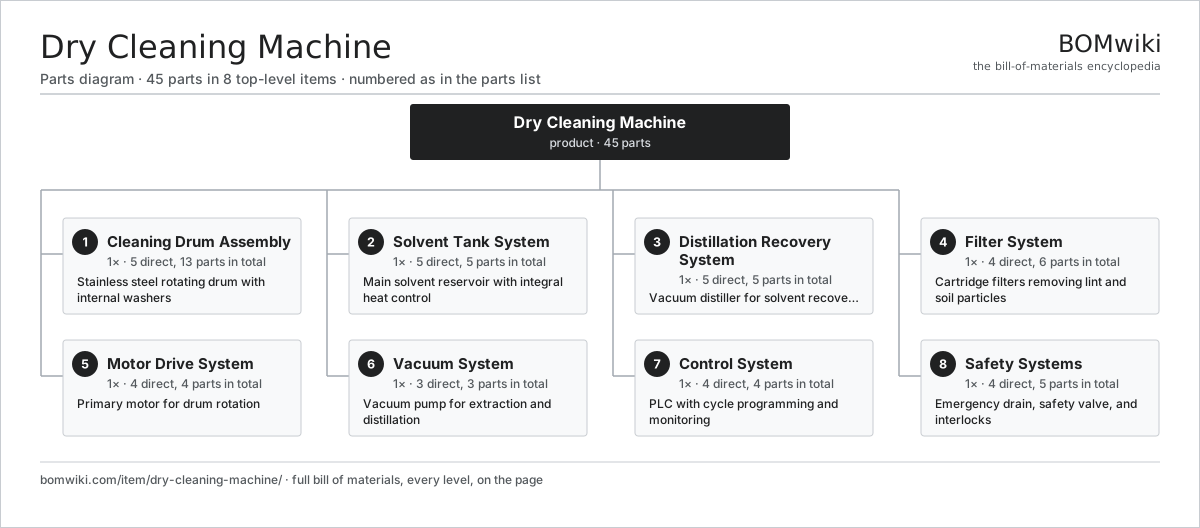
| # | Part | Qty | What it does |
|---|---|---|---|
| 1 | Cleaning Drum Assembly 5 parts | 1× | Stainless steel rotating drum with internal washers |
| 2 | Solvent Tank System 5 parts | 1× | Main solvent reservoir with integral heat control |
| 3 | Distillation Recovery System 5 parts | 1× | Vacuum distiller for solvent recovery and recycling |
| 4 | Filter System 4 parts | 1× | Cartridge filters removing lint and soil particles |
| 5 | Motor Drive System 4 parts | 1× | Primary motor for drum rotation |
| 6 | Vacuum System 3 parts | 1× | Vacuum pump for extraction and distillation |
| 7 | Control System 4 parts | 1× | PLC with cycle programming and monitoring |
| 8 | Safety Systems 4 parts | 1× | Emergency drain, safety valve, and interlocks |
3D model
No 3D model yet. Have a CAD file of this? Add a 3D model. STL renders right on this page; STEP, FreeCAD, and OpenSCAD sources are welcome too (openly licensed, like all 3D models on BOMwiki).
Build & assembly graph
expand / collapse · shared sub-assemblies converge · links to related products · est. labourTap an assembly to expand/collapse · tap a part to open it · use “Open page” for any node · drag to pan, scroll to zoom.
Bill of materials for Dry Cleaning Machine
8 top-level lines · 44 rows shown · 45 parts total · indented to 3 levels| # | Item / sub-assembly | Part no. | Qty/assy | Ext. qty | Parts | Type |
|---|---|---|---|---|---|---|
| 1 | Cleaning Drum Assembly 5 parts | dry-cleaning-machine-drum-assembly | 1× | 1 | 13 | assembly |
| 1.1 | Drum Shell | dry-cleaning-machine-drum-shell | 1× | 1 | · | part |
| 1.2 | Drum Bearing | dry-cleaning-machine-drum-bearing | 2× | 2 | · | part |
| 1.3 | Drum Solvent Seal | dry-cleaning-machine-drum-seal | 1× | 1 | · | part |
| 1.4 | Lift Bucket | dry-cleaning-machine-lift-bucket | 8× | 8 | · | part |
| 1.5 | Drum Shaft | dry-cleaning-machine-drum-shaft | 1× | 1 | · | part |
| 2 | Solvent Tank System 5 parts | dry-cleaning-machine-solvent-tank | 1× | 1 | 5 | assembly |
| 2.1 | Solvent Tank | dry-cleaning-machine-tank-shell | 1× | 1 | · | part |
| 2.2 | Tank Immersion Heater | dry-cleaning-machine-tank-heater | 1× | 1 | · | part |
| 2.3 | Temperature Controller | dry-cleaning-machine-temperature-sensor | 1× | 1 | · | part |
| 2.4 | Circulation Pump | dry-cleaning-machine-circulation-pump | 1× | 1 | · | part |
| 2.5 | Emergency Drain Valve | dry-cleaning-machine-drain-valve | 1× | 1 | · | part |
| 3 | Distillation Recovery System 5 parts | dry-cleaning-machine-distillation-unit | 1× | 1 | 5 | assembly |
| 3.1 | Distiller Chamber | dry-cleaning-machine-distiller-chamber | 1× | 1 | · | part |
| 3.2 | Vacuum Condenser | dry-cleaning-machine-condenser | 1× | 1 | · | part |
| 3.3 | Vacuum Pump | dry-cleaning-machine-vacuum-pump | 1× | 1 | · | part |
| 3.4 | Distillation Heater | dry-cleaning-machine-distillation-heater | 1× | 1 | · | part |
| 3.5 | Recovery Tank | dry-cleaning-machine-distillate-collection | 1× | 1 | · | part |
| 4 | Filter System 4 parts | dry-cleaning-machine-filter-system | 1× | 1 | 6 | assembly |
| 4.1 | Filter Housing | dry-cleaning-machine-filter-housing | 1× | 1 | · | part |
| 4.2 | Filter Cartridge | dry-cleaning-machine-filter-cartridge | 3× | 3 | · | part |
| 4.3 | Filter Blockage Sensor | dry-cleaning-machine-filter-differential-sensor | 1× | 1 | · | part |
| 4.4 | Filter Bypass Valve | dry-cleaning-machine-bypass-valve | 1× | 1 | · | part |
| 5 | Motor Drive System 4 parts | dry-cleaning-machine-motor-drive | 1× | 1 | 4 | assembly |
| 5.1 | Drive Motor | dry-cleaning-machine-motor | 1× | 1 | · | part |
| 5.2 | Drive Gearbox | dry-cleaning-machine-gearbox | 1× | 1 | · | part |
| 5.3 | Variable Frequency Drive | dry-cleaning-machine-vfd | 1× | 1 | · | part |
| 5.4 | Motor Coupling | dry-cleaning-machine-motor-coupling | 1× | 1 | · | part |
| 6 | Vacuum System 3 parts | dry-cleaning-machine-vacuum-system | 1× | 1 | 3 | assembly |
| 6.1 | Vacuum Pump | dry-cleaning-machine-vacuum-pump-unit | 1× | 1 | · | part |
| 6.2 | Vacuum Trap Separator | dry-cleaning-machine-vacuum-trap | 1× | 1 | · | part |
| 6.3 | Vacuum Ductwork | dry-cleaning-machine-vacuum-line | 1× | 1 | · | part |
| 7 | Control System 4 parts | dry-cleaning-machine-control-panel | 1× | 1 | 4 | assembly |
| 7.1 | Control PLC | dry-cleaning-machine-plc | 1× | 1 | · | part |
| 7.2 | HMI Display | dry-cleaning-machine-hmi-display | 1× | 1 | · | part |
| 7.3 | Cycle Selection Panel | dry-cleaning-machine-cycle-button-panel | 1× | 1 | · | part |
| 7.4 | Emergency Stop | dry-cleaning-machine-emergency-stop | 1× | 1 | · | part |
| 8 | Safety Systems 4 parts | dry-cleaning-machine-safety-systems | 1× | 1 | 5 | assembly |
| 8.1 | Door Assembly 2 parts | dry-cleaning-machine-door-assembly | 1× | 1 | 2 | assembly |
| 8.1.1 | Door Frame | dry-cleaning-machine-door-frame | 1× | 1 | · | part |
| 8.1.2 | Door Latch | dry-cleaning-machine-door-latch | 1× | 1 | · | part |
| 8.2 | Pressure Relief Valve | dry-cleaning-machine-pressure-relief | 1× | 1 | · | part |
| 8.3 | Emergency Drain Line | dry-cleaning-machine-emergency-drain-line | 1× | 1 | · | part |
| 8.4 | Drip Pan | dry-cleaning-machine-spill-containment | 1× | 1 | · | part |
Something wrong in this list? Report a problem with this BOM.
Sourcing: possible vendors
Browse the supplier directory → Prices, MOQ, and lead times are algorithmic estimates, not quotes, and not claims about these companies. Company mappings are curated by keyword; est. price band $150–$3k. How estimates work| Vendor | HQ | Specialty | MOQ | Lead time |
|---|---|---|---|---|
| whirlpoolcorp.com ↗ | Benton Harbor, US | Home appliances | 1,000 units | 8–14 wks |
| bsh-group.com ↗ | Munich, DE | Appliances (Bosch, Siemens) | 1,000 units | 8–14 wks |
| electroluxgroup.com ↗ | Stockholm, SE | Home appliances | 1,000 units | 8–14 wks |
| lg.com ↗ | Seoul, KR | Appliances & electronics | 1,000 units | 8–14 wks |
|
🇨🇳Haier
haier.com ↗
|
Qingdao, CN | Home appliances | 1,000 units | 8–14 wks |
1,558-word article