Earthquake Simulator
ProductOverview
An earthquake simulator (shake table) is a large-scale testing platform that reproduces seismic ground motion in the laboratory, allowing engineers and researchers to study structural response to earthquakes, validate design assumptions, and test building innovations before deployment.
The core component is a servo-hydraulic shake table, a massive reinforced deck mounted on hydraulic actuators that move in three or six degrees of freedom. The table is commanded to follow a target earthquake acceleration waveform, typically recorded from actual seismic events (e.g., 1995 Kobe, 2011 Christchurch) or synthetically generated per building codes.
Specimens mounted on the table might be a scale-model building (1/3 size), a full-scale structural component, or specialized equipment (bridges, industrial machinery, base-isolated systems). Real-time sensors measure specimen response, accelerations, displacements, strains, revealing failure modes and stress concentrations.
These facilities are found at major research universities (UC Berkeley, University of Tokyo), national labs, and specialized testing companies. A single test can cost €50,000–€500,000 including specimen fabrication, sensor preparation, and data analysis.
How it works
The Servo-Hydraulic Actuators consists of three servo-controlled actuators driven by a variable-displacement pump. A real-time feedback controller commands each actuator to match a target displacement profile.
A typical test sequence:
Waveform selection: The engineer selects a recorded earthquake (El Centro, Kobe) or synthetically generates one per seismic code (ASCE 7). The waveform is sampled at 1000 Hz or higher.
Specimen mounting: A building mockup or equipment is mounted on the Platform Deck using specialized fixtures. Sensors (accelerometers, displacement transducers, strain gauges) are bonded to critical points.
Test execution: The Motion Control System ramps the table to begin reproducing the earthquake waveform. The Servo Proportional Valve adjusts hydraulic flow in real time to track the target displacement. The Sensor Array continuously monitors table motion and specimen response.
Data logging: The Data Acquisition System system records all sensor signals at high bandwidth (20 kHz), capturing transient events (cracking, joint slip) that occur over milliseconds.
Post-test analysis: Engineers review displacement plots, compute response spectra, and identify failure modes. If the specimen survives the first earthquake, the table may run a sequence of aftershock-like pulses to assess cumulative damage.
Hydraulic actuation and control
Hydraulic systems are preferred for earthquake simulation because:
- High power density: A 1000 kN actuator delivering 500 mm displacement consumes ~200 kW, achievable at moderate pump speeds
- Smooth motion: Proportional valves can modulate pressure smoothly, avoiding step changes that would damage specimens
- Closed-loop feedback: Displacement sensors on the actuators enable real-time error correction, maintaining ±5% accuracy over the entire waveform
The Servo Proportional Valve is the critical component. It modulates oil flow to each actuator proportional to an electrical command signal. A real-time controller compares actual displacement (from the Displacement Transducer) to target displacement and adjusts the command signal in <10 ms loops.
Multi-axis testing
Most modern shake tables are 3-axis (X, Y, Z) or 6-axis (X, Y, Z + rotations). This is important because earthquakes produce motion in all directions simultaneously. A building designed for strong N-S shaking might be vulnerable to E-W or vertical motion that wasn't considered.
6-axis testing is significantly more complex: the table must synchronize rotational motion (pitch, roll, yaw) with translational motion, requiring coordinated commands to 6 actuators under real-time feedback.
Specimen types and research applications
Building mockups: 1/3-scale 3–4 story buildings test new structural systems (moment-resistant frames, braced frames, base isolation). Failure modes observed under shaking reveal design vulnerabilities.
Base isolation systems: Rubber bearings and friction pendulum systems that decouple buildings from ground motion are tested to validate damping properties and travel limits.
Equipment testing: Elevator systems, HVAC units, electrical switchgear mounted on tables to ensure they remain functional after earthquakes.
Soil-structure interaction: Building foundations are mounted on saturated sand or clay specimens to study liquefaction effects.
Real earthquake waveforms
Engineers typically use recorded motions from notable earthquakes:
- 1995 Kobe, Japan (JMA Kobe NS): Peak ground acceleration 8.16 m/s² (0.83 g), dominant frequencies 5–15 Hz
- 1999 Chi-Chi, Taiwan: PGA 10.45 m/s² (1.06 g), longer duration
- 2011 Christchurch, New Zealand: Multiple strong-motion records, complex frequency content
Code-prescribed synthetic waveforms (per ASCE 7, Eurocode 8) are also generated to match target response spectra, ensuring reproducible testing.
Data acquisition and analysis
The Sensor Array typically includes:
- Accelerometers: Mounted on table (reference signal) and specimen (response signal)
- Displacement transducers: Attached to actuators (closed-loop feedback) and specimen (drift measurement)
- Strain gauges: Bonded to structural elements to measure local stresses
The Data Acquisition System system records at 20 kHz aggregate, capturing even high-frequency resonances (up to ~10 kHz). A 30-second earthquake produces ~600 MB of data.
Post-test analysis includes:
- FFT analysis: Identify dominant frequencies in specimen response
- Response spectra: Compare measured building period against design assumptions
- Damage assessment: Visual inspection + comparison of pre- and post-test strain readings
Safety and regulatory compliance
Shake table testing is inherently hazardous, a specimen might suddenly fail and eject debris. The Safety Enclosure is a critical requirement:
- Protective cage surrounding the table
- Containment netting preventing fragments from exiting
- Interlocked access gates preventing table motion during specimen prep
- Dual E-stop buttons (one on table, one in control room)
Testing is governed by ISO 4871 (laboratory standards for earthquake simulators) and internal safety protocols approved by facility operators.
Limitations and complementary methods
Shake tables cannot test very large structures (bridges >50 m) due to payload and spatial constraints. Full-scale testing of large systems is impractical; instead, smaller specimens are tested and results are scaled using dimensional analysis and similarity laws.
Hybrid testing (combining hardware-in-the-loop testing with numerical simulation) is emerging as an alternative for very large systems.
Research impact
Shake table testing has directly informed building code improvements. After the 1995 Kobe earthquake, Japanese shake table tests revealed deficiencies in steel moment-resistant frame connections, leading to revised welding procedures and joint designs that are now standard worldwide.
Modern base-isolation systems, commonly used in hospitals and critical facilities, were validated through decades of shake table research. The technology has saved lives by preventing structural collapse in subsequent earthquakes.
Earthquake Simulator parts and their functions
7 top-level parts · 58 parts in total · full bill of materials below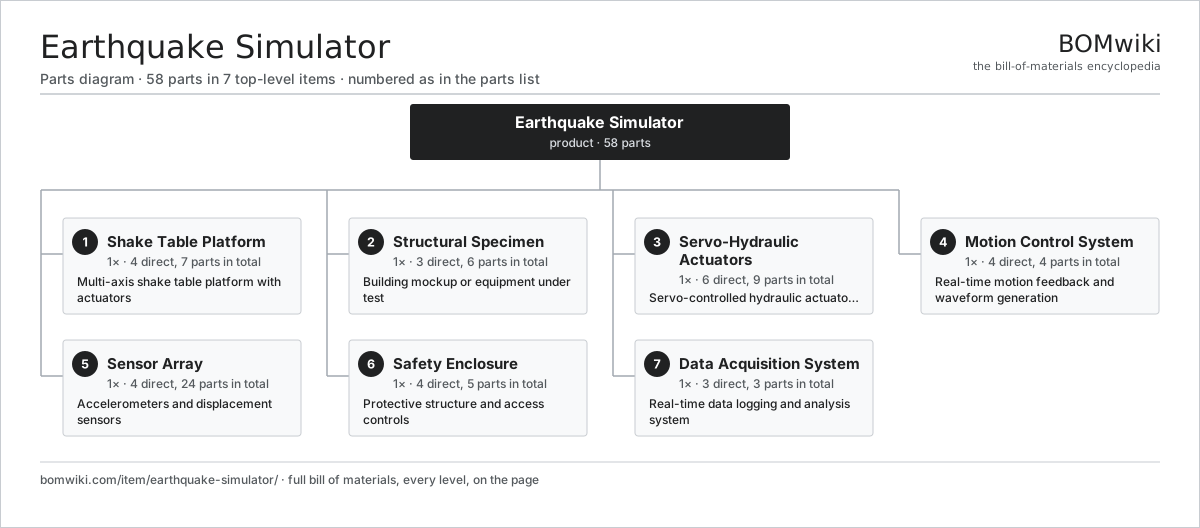
| # | Part | Qty | What it does |
|---|---|---|---|
| 1 | Shake Table Platform 4 parts | 1× | Multi-axis shake table platform with actuators |
| 2 | Structural Specimen 3 parts | 1× | Building mockup or equipment under test |
| 3 | Servo-Hydraulic Actuators 6 parts | 1× | Servo-controlled hydraulic actuators |
| 4 | Motion Control System 4 parts | 1× | Real-time motion feedback and waveform generation |
| 5 | Sensor Array 4 parts | 1× | Accelerometers and displacement sensors |
| 6 | Safety Enclosure 4 parts | 1× | Protective structure and access controls |
| 7 | Data Acquisition System 3 parts | 1× | Real-time data logging and analysis system |
3D model
No 3D model yet. Have a CAD file of this? Add a 3D model. STL renders right on this page; STEP, FreeCAD, and OpenSCAD sources are welcome too (openly licensed, like all 3D models on BOMwiki).
Build & assembly graph
expand / collapse · shared sub-assemblies converge · links to related products · est. labourTap an assembly to expand/collapse · tap a part to open it · use “Open page” for any node · drag to pan, scroll to zoom.
Bill of materials for Earthquake Simulator
7 top-level lines · 35 rows shown · 58 parts total · indented to 3 levels| # | Item / sub-assembly | Part no. | Qty/assy | Ext. qty | Parts | Type |
|---|---|---|---|---|---|---|
| 1 | Shake Table Platform 4 parts | earthquake-simulator-shake-table | 1× | 1 | 7 | assembly |
| 1.1 | Reaction Frame | earthquake-simulator-reaction-frame | 1× | 1 | · | part |
| 1.2 | Platform Deck | earthquake-simulator-platform-deck | 1× | 1 | · | part |
| 1.3 | Isolation Bearing | earthquake-simulator-isolation-bearing | 4× | 4 | · | part |
| 1.4 | Specimen Mounting Posts | earthquake-simulator-mounting-posts | 1× | 1 | · | part |
| 2 | Structural Specimen 3 parts | earthquake-simulator-specimen-structure | 1× | 1 | 6 | assembly |
| 2.1 | Test Specimen Structure | earthquake-simulator-test-frame | 1× | 1 | · | part |
| 2.2 | Sensor Mounting Brackets | earthquake-simulator-instrumentation-mount | 1× | 1 | · | part |
| 2.3 | Base Load Cells | earthquake-simulator-load-cells | 4× | 4 | · | part |
| 3 | Servo-Hydraulic Actuators 6 parts | earthquake-simulator-hydraulic-system | 1× | 1 | 9 | assembly |
| 3.1 | Main Horizontal Actuator | earthquake-simulator-main-actuator | 1× | 1 | · | part |
| 3.2 | Secondary Actuators | earthquake-simulator-secondary-actuators | 2× | 2 | · | part |
| 3.3 | Hydraulic Pump | earthquake-simulator-pump-motor | 1× | 1 | · | part |
| 3.4 | Servo Proportional Valve | earthquake-simulator-proportional-valve | 3× | 3 | · | part |
| 3.5 | Accumulator Tank | earthquake-simulator-accumulator | 1× | 1 | · | part |
| 3.6 | Hydraulic Hose Assembly | earthquake-simulator-hydraulic-hoses | 1× | 1 | · | part |
| 4 | Motion Control System 4 parts | earthquake-simulator-motion-controller | 1× | 1 | 4 | assembly |
| 4.1 | Real-Time Feedback Controller | earthquake-simulator-feedback-processor | 1× | 1 | · | part |
| 4.2 | Earthquake Waveform Generator | earthquake-simulator-waveform-generator | 1× | 1 | · | part |
| 4.3 | Servo Amplifier Module | earthquake-simulator-hydraulic-electronics | 1× | 1 | · | part |
| 4.4 | Network Interface | earthquake-simulator-udp-network | 1× | 1 | · | part |
| 5 | Sensor Array 4 parts | earthquake-simulator-sensing-array | 1× | 1 | 24 | assembly |
| 5.1 | Accelerometer | earthquake-simulator-accelerometer | 8× | 8 | · | part |
| 5.2 | Displacement Transducer | earthquake-simulator-displacement-sensor | 3× | 3 | · | part |
| 5.3 | Strain Gauge | earthquake-simulator-strain-gauge | 12× | 12 | · | part |
| 5.4 | Signal Conditioning Module | earthquake-simulator-signal-conditioner | 1× | 1 | · | part |
| 6 | Safety Enclosure 4 parts | earthquake-simulator-safety-enclosure | 1× | 1 | 5 | assembly |
| 6.1 | Protective Cage | earthquake-simulator-cage-frame | 1× | 1 | · | part |
| 6.2 | Containment Netting | earthquake-simulator-safety-netting | 1× | 1 | · | part |
| 6.3 | Access Control Gate | earthquake-simulator-access-gate | 1× | 1 | · | part |
| 6.4 | Emergency Stop | earthquake-simulator-emergency-stop | 2× | 2 | · | part |
| 7 | Data Acquisition System 3 parts | earthquake-simulator-data-acquisition | 1× | 1 | 3 | assembly |
| 7.1 | Data Acquisition Chassis | earthquake-simulator-daq-chassis | 1× | 1 | · | part |
| 7.2 | Data Storage Server | earthquake-simulator-storage-server | 1× | 1 | · | part |
| 7.3 | Analysis Software | earthquake-simulator-analysis-software | 1× | 1 | · | part |
Something wrong in this list? Report a problem with this BOM.
Sourcing: possible vendors
Browse the supplier directory → Prices, MOQ, and lead times are algorithmic estimates, not quotes, and not claims about these companies. Company mappings are curated by keyword; est. price band $50–$2k. How estimates work| Vendor | HQ | Specialty | MOQ | Lead time |
|---|---|---|---|---|
|
🇨🇳Foxconn
foxconn.com ↗
|
Shenzhen, CN | Electronics contract mfg | 1,000 units | 8–14 wks |
|
🇺🇸Jabil
jabil.com ↗
|
St. Petersburg, US | Electronics manufacturing | 1,000 units | 8–14 wks |
|
🇺🇸Flex
flex.com ↗
|
Austin, US | Electronics manufacturing | 1,000 units | 8–14 wks |
| celestica.com ↗ | Toronto, CA | Electronics manufacturing | 1,000 units | 8–14 wks |
|
🇺🇸Sanmina
sanmina.com ↗
|
San Jose, US | Electronics manufacturing | 1,000 units | 8–14 wks |
1,060-word article