Electric Arc Lighter
ProductOverview
An electric arc lighter generates a high-temperature plasma arc, a ionized column of air between two electrodes, that ignites gas, candles, or loose kindling without flame. Because the ignition mechanism is an electric arc, not a chemical flame, the lighter works in wind and at high altitude where oxygen is thin. The device is sealed against water ingress, making it suitable for camping and marine use.
The core innovation is a resonant step-up converter that transforms the battery's 3.7 V into a 4–8 kV pulse applied across a 2–3 mm air gap. When voltage exceeds the air breakdown threshold (~3 kV/mm), free electrons are accelerated by the electric field, collide with air molecules, and ionize them. This creates a conducting plasma channel, and current surges through, depositing tremendous energy density. The plasma glows white-hot and ignites nearby fuel by thermal conduction and radiation.
A simple MCU debounces the push button and enforces safety limits. When the user holds the button, the MCU repeatedly fires the arc at ~100 Hz. If the button is held for more than 10–15 seconds, the MCU cuts power to protect the battery and switching transistor from thermal stress.
How it works
On power-up, the MCU initializes the charging circuit and monitors the LiPo cell voltage via the fuel gauge IC. The status LED displays green (charged) or red (low battery).
When the user presses the button, the MCU checks battery voltage. If it exceeds a safe minimum (typically 3.0 V), the MCU enables the HV converter. The converter operates as a resonant boost topology:
- A gate driver switches a high-side power MOSFET at 400–600 kHz (determined by the LC resonant tank).
- As the MOSFET turns on, current ramps through the primary winding of the step-up coil, storing energy in the ferrite core.
- As the MOSFET turns off, the collapsing magnetic field induces a high voltage in the secondary winding.
- A HV rectifier diode (rated for kV) clamps the peak voltage and charges an output capacitor to ~4–8 kV.
The resonant tank tuning ensures voltage is maintained at the target arc-strike level (typically by sensing the secondary voltage and adjusting the switching frequency). When voltage reaches ~4 kV, it appears across the positive and negative electrodes in the arc chamber.
At 3 kV/mm gap spacing, the 2–3 mm air gap breaks down. Electrons are pulled from the negative electrode (cathode), accelerate through the gap, ionize air molecules, and electrons are injected into the positive electrode (anode). A self-sustaining plasma column forms, carrying 10–50 mA of current. The heat generated by this current and ion recombination melts the air to plasma state, glowing white-hot.
The user brings a cigarette, candle, or fireplace kindling into the arc. Heat from the plasma ignites the material. The arc remains active as long as the button is held and the converter supplies power.
If the button is held for >10 seconds, the MCU firmware disables the converter by stopping the MOSFET gate signal. This terminates the arc and prevents the transistor junction from reaching destructive temperatures. The user can press the button again immediately to re-strike.
The battery pack includes a protection circuit that cuts power if the cell voltage drops below 2.5 V (over-discharge) or exceeds 4.3 V (over-charge). The charging IC on the USB module regulates input current to ~500 mA and top voltage to 4.2 V nominal. Full recharge takes roughly one hour from empty.
The anodized aluminum casing is corrosion-resistant and provides EMI shielding for the high-voltage converter and arc circuit. Ventilation slots near the arc chamber allow heat dissipation. The gasket seals around the USB port and button keep moisture out, achieving IP67 rating when the cap is closed.
Electric Arc Lighter parts and their functions
9 top-level parts · 113 parts in total · full bill of materials below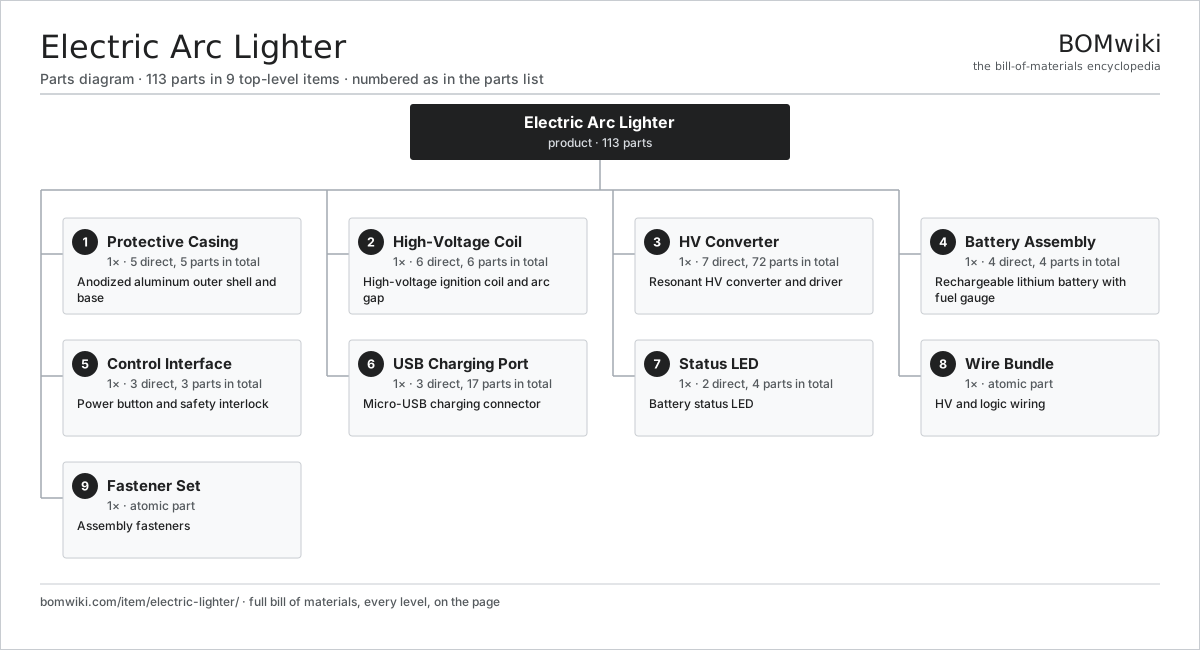
| # | Part | Qty | What it does |
|---|---|---|---|
| 1 | Protective Casing 5 parts | 1× | Anodized aluminum outer shell and base |
| 2 | High-Voltage Coil 6 parts | 1× | High-voltage ignition coil and arc gap |
| 3 | HV Converter 7 parts | 1× | Resonant HV converter and driver |
| 4 | Battery Assembly 4 parts | 1× | Rechargeable lithium battery with fuel gauge |
| 5 | Control Interface 3 parts | 1× | Power button and safety interlock |
| 6 | USB Charging Port 3 parts | 1× | Micro-USB charging connector |
| 7 | Status LED 2 parts | 1× | Battery status LED |
| 8 | Wire Bundle | 1× | HV and logic wiring |
| 9 | Fastener Set | 1× | Assembly fasteners |
3D model
No 3D model yet. Have a CAD file of this? Add a 3D model. STL renders right on this page; STEP, FreeCAD, and OpenSCAD sources are welcome too (openly licensed, like all 3D models on BOMwiki).
Build & assembly graph
expand / collapse · shared sub-assemblies converge · links to related products · est. labourTap an assembly to expand/collapse · tap a part to open it · use “Open page” for any node · drag to pan, scroll to zoom.
Bill of materials for Electric Arc Lighter
9 top-level lines · 39 rows shown · 113 parts total · indented to 3 levels| # | Item / sub-assembly | Part no. | Qty/assy | Ext. qty | Parts | Type |
|---|---|---|---|---|---|---|
| 1 | Protective Casing 5 parts | electric-lighter-housing | 1× | 1 | 5 | assembly |
| 1.1 | Body Tube | electric-lighter-body-tube | 1× | 1 | · | part |
| 1.2 | Cap/Cover | electric-lighter-cap-cover | 1× | 1 | · | part |
| 1.3 | Grip Coating | electric-lighter-grip-coating | 1× | 1 | · | part |
| 1.4 | Base Plate | electric-lighter-base-plate | 1× | 1 | · | part |
| 1.5 | Fastener Set | fastener-set | 1× | 1 | · | part |
| 2 | High-Voltage Coil 6 parts | electric-lighter-arc-coil | 1× | 1 | 6 | assembly |
| 2.1 | Ferrite Core | electric-lighter-coil-core | 1× | 1 | · | part |
| 2.2 | Primary Winding | electric-lighter-primary-winding | 1× | 1 | · | part |
| 2.3 | Secondary Winding | electric-lighter-secondary-winding | 1× | 1 | · | part |
| 2.4 | Positive Electrode | electric-lighter-electrode-positive | 1× | 1 | · | part |
| 2.5 | Negative Electrode | electric-lighter-electrode-negative | 1× | 1 | · | part |
| 2.6 | Insulation Sleeve | electric-lighter-insulator-sleeve | 1× | 1 | · | part |
| 3 | HV Converter 7 parts | electric-lighter-power-circuit | 1× | 1 | 72 | assembly |
| 3.1 | Gate Driver IC | electric-lighter-mosfet-driver | 1× | 1 | · | part |
| 3.2 | Power MOSFET | mosfet | 1× | 1 | · | part |
| 3.3 | Resonant LC Tank | electric-lighter-resonant-tank | 1× | 1 | · | part |
| 3.4 | HV Rectifier Diode | electric-lighter-high-voltage-diode | 1× | 1 | · | part |
| 3.5 | Feedback Network | electric-lighter-feedback-circuit | 1× | 1 | · | part |
| 3.6 | SMD Passive (R/C/L) | smd-passives | 65× | 65 | · | part |
| 3.7 | Connector | connector | 2× | 2 | · | part |
| 4 | Battery Assembly 4 parts | electric-lighter-battery-pack | 1× | 1 | 4 | assembly |
| 4.1 | LiPo Cell | lipo-cell | 1× | 1 | · | part |
| 4.2 | BMS Board | bms-board | 1× | 1 | · | part |
| 4.3 | Fuel Gauge IC | electric-lighter-fuel-gauge | 1× | 1 | · | part |
| 4.4 | Battery Contact Block | electric-lighter-battery-contact | 1× | 1 | · | part |
| 5 | Control Interface 3 parts | electric-lighter-controls | 1× | 1 | 3 | assembly |
| 5.1 | Push Button | electric-lighter-push-button | 1× | 1 | · | part |
| 5.2 | Interlock Spring | electric-lighter-interlock-spring | 1× | 1 | · | part |
| 5.3 | Control MCU | electric-lighter-mcu | 1× | 1 | · | part |
| 6 | USB Charging Port 3 parts | electric-lighter-usb-charger | 1× | 1 | 17 | assembly |
| 6.1 | Connector | connector | 1× | 1 | · | part |
| 6.2 | Charging IC | electric-lighter-charging-ic | 1× | 1 | · | part |
| 6.3 | SMD Passive (R/C/L) | smd-passives | 15× | 15 | · | part |
| 7 | Status LED 2 parts | electric-lighter-led-indicator | 1× | 1 | 4 | assembly |
| 7.1 | RGB/Dual-Color LED | electric-lighter-led | 1× | 1 | · | part |
| 7.2 | SMD Passive (R/C/L) | smd-passives | 3× | 3 | · | part |
| 8 | Wire Bundle | wire-bundle | 1× | 1 | · | part |
| 9 | Fastener Set | fastener-set | 1× | 1 | · | part |
Something wrong in this list? Report a problem with this BOM.
Related products
same domain, ranked by shared parts Wireless Charger
130 parts · shares 2 with this page
Wireless Charger
130 parts · shares 2 with this page
 Digital Audio Player
267 parts · shares 3 with this page
Digital Audio Player
267 parts · shares 3 with this page
 Game Console
114 parts · shares 3 with this page
Game Console
114 parts · shares 3 with this page
 GPS Tracker
225 parts · shares 3 with this page
GPS Tracker
225 parts · shares 3 with this page
Sourcing: possible vendors
Browse the supplier directory → Prices, MOQ, and lead times are algorithmic estimates, not quotes, and not claims about these companies. Company mappings are curated by keyword; est. price band $50–$2k. How estimates work| Vendor | HQ | Specialty | MOQ | Lead time |
|---|---|---|---|---|
|
🇨🇳Foxconn
foxconn.com ↗
|
Shenzhen, CN | Electronics contract mfg | 1,000 units | 8–14 wks |
|
🇺🇸Jabil
jabil.com ↗
|
St. Petersburg, US | Electronics manufacturing | 1,000 units | 8–14 wks |
|
🇺🇸Flex
flex.com ↗
|
Austin, US | Electronics manufacturing | 1,000 units | 8–14 wks |
| celestica.com ↗ | Toronto, CA | Electronics manufacturing | 1,000 units | 8–14 wks |
|
🇺🇸Sanmina
sanmina.com ↗
|
San Jose, US | Electronics manufacturing | 1,000 units | 8–14 wks |
732-word article