Flatwork Ironer
ProductOverview
The flatwork ironer is an essential machine in industrial laundries, hospitals, and hotels where volumes of sheets, towels, tablecloths, and flat textiles require efficient drying and pressing simultaneously. The machine consists of a large heated steel cylinder (heated internally by steam to 180°C) over which damp fabric is fed via a continuous belt. A counter-pressure roll presses the fabric against the hot cylinder surface, extracting moisture and creating a smooth, creased finish in one continuous operation.
The heated cylinder is 1.8 m wide and 0.8 m diameter, constructed of solid cast steel to distribute and retain heat uniformly. Fabric enters from the left side via a power-driven feeding belt system, passes through the nip between the heated cylinder and counter-pressure roll, and exits onto a folding chute where it is optionally cross-folded and stacked.
The machine is driven by a single main motor (15 kW) that synchronously drives both the cylinder and feeding belt. A separate feed motor (3 kW) allows independent control of feed speed. The temperature control system maintains the cylinder surface at 180°C using steam and proportional valve regulation.
Typical throughput is 600 kg/hour of dried and pressed flat textiles. The machine is particularly efficient for towels and linens, where the combination of heat and pressure removes 60–70% of residual moisture while creating a finished, pressed appearance without separate press tables.
How It Works
Damp fabric from the washing line is laid on the continuous feeding belt. The belt, driven by the feed motor at adjustable speed (typically 48 rpm), advances the fabric through upper and lower guide rollers that align and center the load.
As fabric approaches the heated cylinder, the infeed nip roller presses it lightly against the hot surface of the cylinder. The main motor rotates the cylinder at 48 rpm (geared down via a 30:1 reduction gearbox from 1450 rpm motor speed), and the counter-pressure roll simultaneously rotates at the same speed.
The fabric is now nipped between the 180°C cylinder and the elastomer-covered pressure roll, exerting 400 kPa pressure across the full 1.8 m width. As the cylinder rotates beneath the fabric, heat transfers from the steel surface into the textile fibers, evaporating moisture. The pressure of the nip physically squeezes water out, and the steam contained in the fabric is expelled upward into the exhaust plenum.
The contact time between fabric and heated cylinder is approximately 3–5 seconds (depending on feed speed). The fabric emerges from the nip 90% dry, warm to the touch, and with a smooth finish imparted by the cylinder surface. Residual heat continues evaporating surface moisture as the fabric travels the short distance to the output folder.
The exhaust fan motor continuously evacuates steam and moisture-laden air from the plenum above the cylinder, maintaining a slight vacuum (5–10 mm water column) that accelerates moisture removal. The exhaust ductwork directs humid air outdoors or to a heat recovery unit that pre-heats incoming process water.
Temperature and Pressure Control
The heated cylinder is maintained at 180°C by a proportional steam pressure reducing valve that meters 2.0 bar steam into the internal jacket. Two RTD temperature probes monitor actual surface temperature and provide feedback to the PID temperature controller.
The controller adjusts the proportional valve opening to maintain ±5°C setpoint. If temperature falls below setpoint (indicating heavy fabric load absorbing heat), the valve opens wider. If temperature rises, the valve throttles back. Response time is typically 30–60 seconds.
The nip pressure is set mechanically by four pneumatic cylinders (100 mm bore each) positioned beneath the pressure roll. Each cylinder delivers 50 kN force, totaling 200 kN nip force across 1.8 m width (400 kPa average pressure). Pressure adjustment is accomplished by changing the air supply pressure (typically 5–6 bar), allowing operators to accommodate different fabric thicknesses without mechanical rebuild.
The thermostatic condensate drain trap removes condensed water from the cylinder jacket without steam waste. Condensate temperature is typically 160°C and contains sensible heat. The heat exchanger passes this condensate through a plate-frame cooler, recovering 20–30% of steam energy to preheat fresh water for the laundry line.
Feeding and Exit
The feeding belt is 1.8 m wide, 25 m circumference, and made of reinforced rubber with a silicone surface to prevent sticking to the heated cylinder. The belt is tensioned to 50 kPa and runs at variable speed from 10 to 80 rpm, controlled by the 3 kW feed motor via a soft-start module.
Fabric is centered by four stainless steel guide rollers (two above, two below) that are 0.1 m diameter and span the full 1.8 m width. A mechanical alignment stop at the feed entrance prevents off-center loads.
As fabric exits the nip, it flows down the angled output chute and onto a cross-fold blade. The blade is swept by a pneumatic cylinder (80 mm bore, 6 bar air) that extends and retracts at a frequency synchronized to fabric throughput (typically once per second for 48 rpm feed). This folds the fabric in half widthwise, creating a neat rectangular package. The folded fabric lands on the stacker platform for operator removal.
The cross-folder can be disabled if operators prefer unfolded flat output (for example, when feeding a separate folder machine downstream).
Electrical and Safety
The main electrical panel houses a 30 A three-phase contactor controlling power to the motor circuits. A thermal overload relay protects the 15 kW drive motor by opening contacts if current exceeds 20 A continuously.
An emergency stop button (40 mm mushroom head) de-energizes the contactor and halts both the cylinder and feeding belt within 1 second. Pressing e-stop also closes the steam valve, stopping fresh steam flow.
The soft-start module limits inrush current to 150% of motor rating when power is applied, extending motor contact and controller life. Ramp time is adjustable from 2 to 20 seconds, typically set to 8 seconds for smooth acceleration.
Guard rails around the machine prevent operator contact with rotating cylinders. Interlocks are not fitted to the feeding belt access, as the belt speed is low enough (48 rpm, outer surface velocity 1.3 m/s) to permit hand entry if necessary for fabric alignment; this is considered an acceptable risk in manual laundry operations. Modern variants incorporate proximity sensors to alert operators of running equipment.
Maintenance and Duty Cycle
Bearing cartridges under the heated cylinder are inspected every 2000 hours. The Condensate Trap is cleaned every 500 hours to maintain condensate flow. The Exhaust Filter is washed weekly.
Typical operating duty is 6–8 hours per day in a laundry setting, with 2–3 day shutdown for maintenance. In continuous operations (24-hour hospitals), machines are run in 6-hour shifts with evening deep cleaning.
The machine consumes 150 kg/hr steam at 2.0 bar absolute (0.1 bar gauge), equivalent to 4.2 MW of thermal power. Energy efficiency is high relative to separate dryer and press operations because the combination of heat and pressure removes moisture in a single pass.
Flatwork Ironer parts and their functions
7 top-level parts · 39 parts in total · full bill of materials below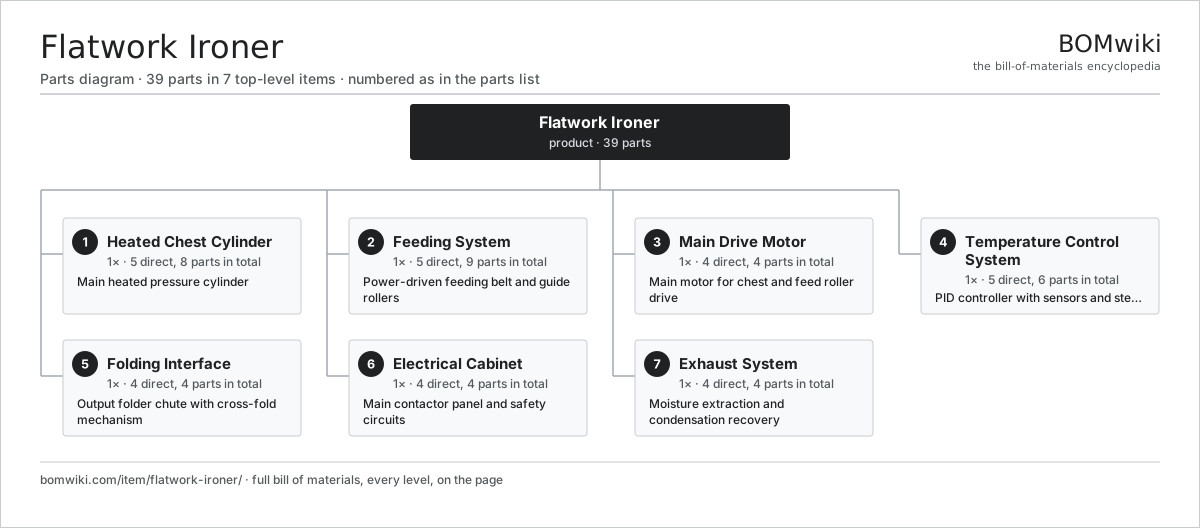
| # | Part | Qty | What it does |
|---|---|---|---|
| 1 | Heated Chest Cylinder 5 parts | 1× | Main heated pressure cylinder |
| 2 | Feeding System 5 parts | 1× | Power-driven feeding belt and guide rollers |
| 3 | Main Drive Motor 4 parts | 1× | Main motor for chest and feed roller drive |
| 4 | Temperature Control System 5 parts | 1× | PID controller with sensors and steam system |
| 5 | Folding Interface 4 parts | 1× | Output folder chute with cross-fold mechanism |
| 6 | Electrical Cabinet 4 parts | 1× | Main contactor panel and safety circuits |
| 7 | Exhaust System 4 parts | 1× | Moisture extraction and condensation recovery |
3D model
No 3D model yet. Have a CAD file of this? Add a 3D model. STL renders right on this page; STEP, FreeCAD, and OpenSCAD sources are welcome too (openly licensed, like all 3D models on BOMwiki).
Build & assembly graph
expand / collapse · shared sub-assemblies converge · links to related products · est. labourTap an assembly to expand/collapse · tap a part to open it · use “Open page” for any node · drag to pan, scroll to zoom.
Bill of materials for Flatwork Ironer
7 top-level lines · 38 rows shown · 39 parts total · indented to 3 levels| # | Item / sub-assembly | Part no. | Qty/assy | Ext. qty | Parts | Type |
|---|---|---|---|---|---|---|
| 1 | Heated Chest Cylinder 5 parts | flatwork-ironer-heated-chest | 1× | 1 | 8 | assembly |
| 1.1 | Heated Cylinder | flatwork-ironer-chest-cylinder | 1× | 1 | · | part |
| 1.2 | Pressure Counter-Roll | flatwork-ironer-pressure-roll | 1× | 1 | · | part |
| 1.3 | Chest Bearing Cartridge | flatwork-ironer-chest-bearing | 4× | 4 | · | part |
| 1.4 | Steam Manifold | flatwork-ironer-steam-manifold | 1× | 1 | · | part |
| 1.5 | Nip Control Mechanism | flatwork-ironer-nip-adjustment | 1× | 1 | · | part |
| 2 | Feeding System 5 parts | flatwork-ironer-feeding-system | 1× | 1 | 9 | assembly |
| 2.1 | Feed Motor | flatwork-ironer-feed-motor | 1× | 1 | · | part |
| 2.2 | Feed Belt | flatwork-ironer-feed-belt | 1× | 1 | · | part |
| 2.3 | Feed Pulley | flatwork-ironer-feed-pulley | 2× | 2 | · | part |
| 2.4 | Guide Roller | flatwork-ironer-guide-roller | 4× | 4 | · | part |
| 2.5 | Infeed Nip Roller | flatwork-ironer-nip-roller | 1× | 1 | · | part |
| 3 | Main Drive Motor 4 parts | flatwork-ironer-drive-motor | 1× | 1 | 4 | assembly |
| 3.1 | Main Motor | flatwork-ironer-motor | 1× | 1 | · | part |
| 3.2 | Drive Gearbox | flatwork-ironer-drive-gearbox | 1× | 1 | · | part |
| 3.3 | Main Drive Shaft | flatwork-ironer-main-shaft | 1× | 1 | · | part |
| 3.4 | Motor Flexible Coupling | flatwork-ironer-motor-coupling | 1× | 1 | · | part |
| 4 | Temperature Control System 5 parts | flatwork-ironer-temperature-control | 1× | 1 | 6 | assembly |
| 4.1 | Steam Regulator Valve | flatwork-ironer-steam-regulator | 1× | 1 | · | part |
| 4.2 | Temperature Probe RTD | flatwork-ironer-temperature-probe | 2× | 2 | · | part |
| 4.3 | Condensate Trap | flatwork-ironer-steam-trap | 1× | 1 | · | part |
| 4.4 | Temperature Controller | flatwork-ironer-control-module | 1× | 1 | · | part |
| 4.5 | Condensate Heat Exchanger | flatwork-ironer-condensate-recovery | 1× | 1 | · | part |
| 5 | Folding Interface 4 parts | flatwork-ironer-folding-interface | 1× | 1 | 4 | assembly |
| 5.1 | Folder Chute | flatwork-ironer-folder-chute | 1× | 1 | · | part |
| 5.2 | Cross-Fold Blade | flatwork-ironer-cross-folder | 1× | 1 | · | part |
| 5.3 | Folder Pneumatic Cylinder | flatwork-ironer-folder-actuator | 1× | 1 | · | part |
| 5.4 | Stacker Platform | flatwork-ironer-stacker-base | 1× | 1 | · | part |
| 6 | Electrical Cabinet 4 parts | flatwork-ironer-electrical-cabinet | 1× | 1 | 4 | assembly |
| 6.1 | Main Contactor | flatwork-ironer-main-contactor | 1× | 1 | · | part |
| 6.2 | Thermal Overload Relay | flatwork-ironer-thermal-relay | 1× | 1 | · | part |
| 6.3 | Emergency Stop Button | flatwork-ironer-emergency-stop | 1× | 1 | · | part |
| 6.4 | Soft Starter Module | flatwork-ironer-motor-starter | 1× | 1 | · | part |
| 7 | Exhaust System 4 parts | flatwork-ironer-exhaust-system | 1× | 1 | 4 | assembly |
| 7.1 | Exhaust Plenum | flatwork-ironer-exhaust-plenum | 1× | 1 | · | part |
| 7.2 | Exhaust Fan Motor | flatwork-ironer-exhaust-motor | 1× | 1 | · | part |
| 7.3 | Exhaust Filter | flatwork-ironer-exhaust-filter | 1× | 1 | · | part |
| 7.4 | Exhaust Ductwork | flatwork-ironer-exhaust-duct | 1× | 1 | · | part |
Something wrong in this list? Report a problem with this BOM.
Sourcing: possible vendors
Browse the supplier directory → Prices, MOQ, and lead times are algorithmic estimates, not quotes, and not claims about these companies. Company mappings are curated by keyword; est. price band $150–$3k. How estimates work| Vendor | HQ | Specialty | MOQ | Lead time |
|---|---|---|---|---|
| whirlpoolcorp.com ↗ | Benton Harbor, US | Home appliances | 1,000 units | 8–14 wks |
| bsh-group.com ↗ | Munich, DE | Appliances (Bosch, Siemens) | 1,000 units | 8–14 wks |
| electroluxgroup.com ↗ | Stockholm, SE | Home appliances | 1,000 units | 8–14 wks |
| lg.com ↗ | Seoul, KR | Appliances & electronics | 1,000 units | 8–14 wks |
|
🇨🇳Haier
haier.com ↗
|
Qingdao, CN | Home appliances | 1,000 units | 8–14 wks |
1,378-word article