Frequency Counter
ProductOverview
A frequency counter is a laboratory instrument that measures the frequency of periodic electrical signals by counting the number of pulses (or zero-crossings) occurring in a precise time interval. The Frequency Counter is the gold standard for frequency measurement across a range of ten decades, from sub-hertz low-frequency signals (like a rotating shaft's pulse) to hundreds of megahertz RF signals, making it indispensable in RF engineering, clock synchronization, oscillator characterization, and any application requiring precise frequency verification.
The architecture pivots on two elements: (1) a precision timebase, typically an oven-controlled crystal oscillator (OCXO), that provides an absolutely stable 10 MHz reference, and (2) a high-speed digital counter that tallies input pulses during a gate window generated from the timebase. Dividing the pulse count by the gate time yields frequency.
How it works
The Timebase Reference is the foundation. An OCXO Module, an oven-controlled crystal oscillator rated at 10.00 MHz ±0.5 ppb per year, generates a master reference clock. Crystal oscillators are inherently more stable than LC resonators, because quartz has a very high mechanical Q (quality factor > 100,000), making its resonant frequency insensitive to small component variations or temperature changes. The Oven Heater maintains the crystal at a fixed 75 °C, deep within the crystal's thermal turn-around region, where temperature coefficient of frequency (TCF) is near zero, the "inversion point" where positive and negative TCF contributions cancel. This oven-stabilization is why OCXO frequency drifts minimally over ambient temperature swings: as outside temperature varies by ±40 °C, the oven interior remains rock-steady at 75 °C, and the oscillator frequency remains within a few parts per billion of 10 MHz.
A Frequency Trim Potentiometer, a mechanically adjustable capacitor in the crystal resonator circuit, allows one-time calibration of the oscillator frequency to exactly 10.00 MHz by comparison against an external primary standard (atomic clock or GPS reference). Users typically calibrate their counter once per year or less frequently, as aging causes < 1 ppm drift over a decade.
The 10 MHz master output of the Clock Buffer, a CMOS gate buffering the raw oscillator output, is distributed to two functional blocks: (1) the Gate Timer, which creates time-window pulses of 1, 10, or 100 seconds, and (2) the Frequency Divider Counters, which creates lower-frequency test signals (1 MHz, 100 kHz, 10 kHz, 1 kHz, 100 Hz, 10 Hz, 1 Hz) for self-testing and as auxiliary outputs.
The unknown input signal enters the RF Input Stage, where it is heavily processed. The Input Attenuator applies a selectable attenuation ratio (×1, ×10, ×100) via a manual rotary switch, reducing high-amplitude signals (up to 300 V) to logic levels. The Preamplifier is a broadband preamplifier providing 20 dB gain with automatic gain control (AGC), ensuring that input sensitivity remains roughly constant (100–500 mV RMS) across the 10 Hz to 500 MHz frequency span. At VHF and microwave frequencies, the input impedance is typically switched to 50 Ω matching (via a BNC connector option) for minimal reflection.
The amplified signal is then passed to the Schmitt Comparator, a Schmitt trigger, a comparator with hysteresis, that converts the sinusoidal input into clean logic pulses (0 V / 5 V TTL/CMOS levels). The Hysteresis Resistors sets the comparator threshold at, say, 1 V, and hysteresis of ±100 mV, such that once the sine wave crosses the upper threshold (+1.1 V) the comparator output goes high, and stays high until the signal drops back below the lower threshold (+0.9 V). This eliminates false pulses from noise riding on the sine wave near the threshold.
The cleaned pulse train then enters the Counter & Gate Logic. A Binary Counter Array, a 32-bit binary counter implemented as a cascaded set of high-speed TTL or ECL logic chips, counts input pulses. Simultaneously, the Gate Timer, driven by the 10 MHz timebase, generates a control signal that enables or disables the counter for exactly 1, 10, or 100 seconds (user-selectable).
For example, if the user selects a 1-second gate and the input signal is 12.345 MHz, then during that 1-second window exactly 12,345,000 pulses arrive, the counter accumulates to 12345000, and the gate window closes. The counter latches its result, and the display shows "12345000", i.e., 12.345000 MHz (eight digits, one decimal implied between the 5th and 6th digit by the display firmware, so "12345000" is interpreted as "12.345 MHz").
If the user selects a 10-second gate, the counter integrates for 10 seconds, accumulating 123,450,000 counts, displayed as "123450000", i.e., 12.3450000 MHz (eight significant figures). The longer gate allows finer resolution: 1 second gives 1 Hz resolution, 10 seconds gives 0.1 Hz, 100 seconds gives 0.01 Hz. This illustrates a fundamental tradeoff: longer measurement time yields finer frequency resolution, but slower measurement updates, a 100-second gate is impractical for quick measurements.
For frequency measurements below about 1 Hz, or for signals with low repetition rates, the counter can switch to period measurement: it measures the time between pulse edges (using the 10 MHz timebase clock as the timebase), and displays 1/time (reciprocal frequency). A once-per-second heartbeat signal, for instance, would take 1 second between rising edges, displayed as "1.000000" (meaning 1 Hz period = 1 second/count).
Higher frequencies, above 500 MHz, require a Prescaler Divider, an optional external module containing a frequency-counter-prescaler-divider (either ÷10 or ÷100), which reduces the input frequency before feeding the counter. With a ÷10 prescaler, a 1000 MHz signal is divided to 100 MHz (within the counter's direct range), the counter measures 100 MHz, and firmware multiplies the displayed result by 10, showing the actual 1000 MHz input frequency. Prescalers extend range at the cost of sensitivity loss (the prescaler introduces some noise figure) and require calibration to account for prescaler propagation delay.
The Display & Readout is a simple 8-digit LCD driven by a dedicated controller IC. The firmware updates the display after each gate window closes, typically every 1–100 seconds depending on gate selection. Additional Mode LEDs show the selected measurement unit and gate time.
Power is supplied by a traditional linear Power Supply: a Power Transformer (30 VA) with a 24–0–24 V secondary, full-wave Full-Wave Rectifier, Power Supply Filter (smoothing), and finally Regulated Output Supplies (LM7815 / LM7915 for ±15 V op-amp supplies, LM7805 for +5 V digital logic). The oven heater for the OCXO draws several watts during warm-up (roughly 5 minutes to reach thermal equilibrium from cold start), after which heater current drops to a trickle (< 500 mA) maintaining the setpoint.
Typical application scenario
A broadcast engineer is maintaining an FM transmitter and needs to verify that the transmitter frequency is locked to within ±20 Hz of the FCC-assigned 101.5 MHz carrier. They connect a small antenna to the frequency counter's input (via a preamplifier, if the RF signal is weak), select the 1-second gate, and observe the counter display "101500000", i.e., 101.500000 MHz. The display updates every second. If any drift is observed (e.g., "101500010" appearing after a few minutes), the transmitter's frequency control is out of adjustment, and the engineer knows to recalibrate the oscillator's digital tuning voltage.
For another application, a technician is commissioning a new GPS-disciplined oscillator (GPSDO). They connect the GPSDO's 10 MHz output to the frequency counter's external reference input (BNC, rear panel) and the counter's OCXO to a spectrum analyzer. The frequency counter compares its internal OCXO against the GPSDO reference, and the spectrum analyzer monitors the OCXO output for phase noise. Over several hours, the technician confirms that the counter's frequency stabilizes to better than ±1 ppm when disciplined by the GPSDO, indicating successful GPS lock.
Limitations and modern variants
The 8-digit display limits frequency resolution: a 500 MHz signal is shown as "500000000" (9 digits needed), forcing loss of lower significant figures. Modern counters use 10–12 digit displays for better resolution. The counter is passive, it does not inject a signal, so it can measure signals from essentially any source without affecting the source (unlike a scope probe, which loads slightly due to impedance). However, the counter measures only frequency, not other signal properties like amplitude, phase, or distortion, so it is typically used alongside a spectrum analyzer or oscilloscope in comprehensive RF testing.
The OCXO timebase, while extremely stable, is overkill for simple frequency measurement to ±0.1% accuracy; more affordable frequency counters use ordinary crystal oscillators (cheaper, less stable, but sufficient for non-precision work). High-end counters designed for scientific metrology combine OCXO timebases with atomic clock disciplining (Cesium or Rubidium), achieving sub-ppb accuracy and serving as primary frequency standards in calibration labs.
Frequency Counter parts and their functions
9 top-level parts · 28 parts in total · full bill of materials below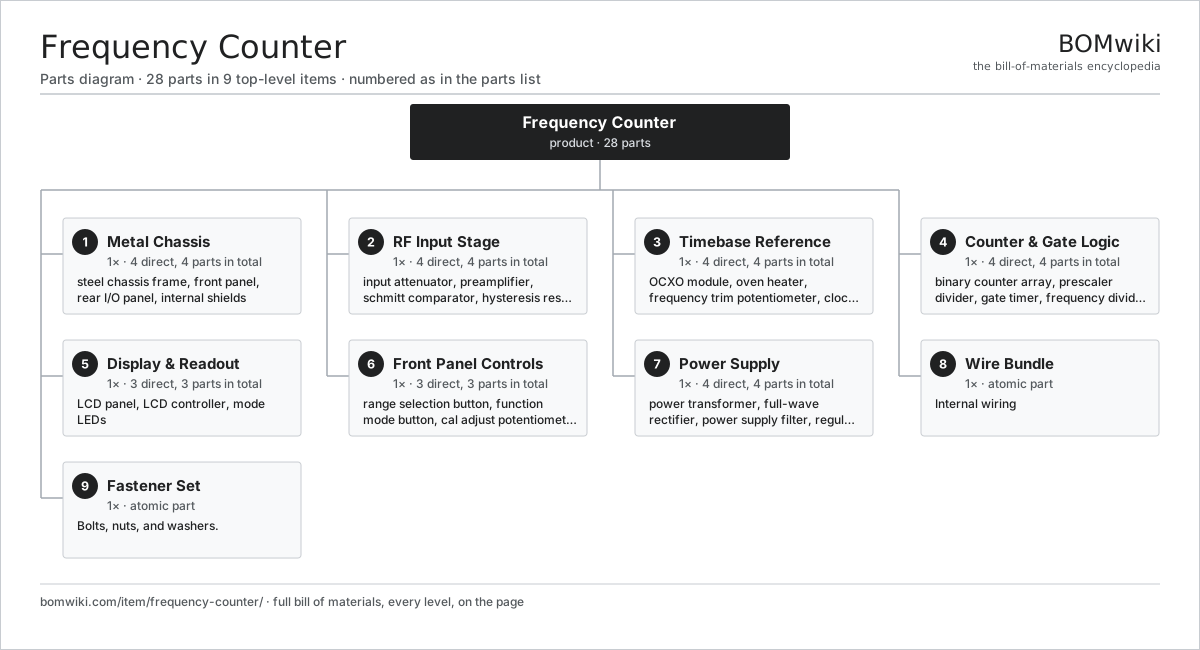
| # | Part | Qty | What it does |
|---|---|---|---|
| 1 | Metal Chassis 4 parts | 1× | Steel enclosure with front panel, rear connectors, and internal shielding for RF isolation. |
| 2 | RF Input Stage 4 parts | 1× | Attenuator, amplifier, and comparator shaping signal into clean logic pulses. |
| 3 | Timebase Reference 4 parts | 1× | Precision crystal oscillator generating stable 10 MHz reference clock. |
| 4 | Counter & Gate Logic 4 parts | 1× | Digital counters and time-gate circuits measuring frequency over 1–10 second intervals. |
| 5 | Display & Readout 3 parts | 1× | LCD numerically displaying frequency, period, or ratio measurements. |
| 6 | Front Panel Controls 3 parts | 1× | Buttons for function selection, range switching, and calibration adjustments. |
| 7 | Power Supply 4 parts | 1× | Linear power converting AC mains to regulated ±15 V and +5 V rails. |
| 8 | Wire Bundle | 1× | Internal wiring |
| 9 | Fastener Set | 1× | Bolts, nuts, and washers. |
3D model
No 3D model yet. Have a CAD file of this? Add a 3D model. STL renders right on this page; STEP, FreeCAD, and OpenSCAD sources are welcome too (openly licensed, like all 3D models on BOMwiki).
Build & assembly graph
expand / collapse · shared sub-assemblies converge · links to related products · est. labourTap an assembly to expand/collapse · tap a part to open it · use “Open page” for any node · drag to pan, scroll to zoom.
Bill of materials for Frequency Counter
9 top-level lines · 35 rows shown · 28 parts total · indented to 3 levels| # | Item / sub-assembly | Part no. | Qty/assy | Ext. qty | Parts | Type |
|---|---|---|---|---|---|---|
| 1 | Metal Chassis 4 parts | frequency-counter-housing | 1× | 1 | 4 | assembly |
| 1.1 | Steel Chassis Frame | frequency-counter-frame | 1× | 1 | · | part |
| 1.2 | Front Panel | frequency-counter-faceplate | 1× | 1 | · | part |
| 1.3 | Rear I/O Panel | frequency-counter-rear-connector-panel | 1× | 1 | · | part |
| 1.4 | Internal Shields | frequency-counter-shield-dividers | 1× | 1 | · | part |
| 2 | RF Input Stage 4 parts | frequency-counter-input-conditioner | 1× | 1 | 4 | assembly |
| 2.1 | Input Attenuator | frequency-counter-input-attenuator | 1× | 1 | · | part |
| 2.2 | Preamplifier | frequency-counter-input-amplifier | 1× | 1 | · | part |
| 2.3 | Schmitt Comparator | frequency-counter-comparator | 1× | 1 | · | part |
| 2.4 | Hysteresis Resistors | frequency-counter-hysteresis-network | 1× | 1 | · | part |
| 3 | Timebase Reference 4 parts | frequency-counter-timebase | 1× | 1 | 4 | assembly |
| 3.1 | OCXO Module | frequency-counter-ocxo-oscillator | 1× | 1 | · | part |
| 3.2 | Oven Heater | frequency-counter-ocxo-heater | 1× | 1 | · | part |
| 3.3 | Frequency Trim Potentiometer | frequency-counter-trimmer-capacitor | 1× | 1 | · | part |
| 3.4 | Clock Buffer | frequency-counter-oscillator-output-buffer | 1× | 1 | · | part |
| 4 | Counter & Gate Logic 4 parts | frequency-counter-measurement-logic | 1× | 1 | 4 | assembly |
| 4.1 | Binary Counter Array | frequency-counter-main-counter | 1× | 1 | · | part |
| 4.2 | Prescaler Divider | frequency-counter-prescaler | 1× | 1 | · | part |
| 4.3 | Gate Timer | frequency-counter-time-gate-generator | 1× | 1 | · | part |
| 4.4 | Frequency Divider Counters | frequency-counter-divider-chain | 1× | 1 | · | part |
| 5 | Display & Readout 3 parts | frequency-counter-display-module | 1× | 1 | 3 | assembly |
| 5.1 | LCD Panel | lcd-panel | 1× | 1 | · | part |
| 5.2 | LCD Controller | frequency-counter-display-driver-ic | 1× | 1 | · | part |
| 5.3 | Mode LEDs | frequency-counter-mode-indicator-leds | 1× | 1 | · | part |
| 6 | Front Panel Controls 3 parts | frequency-counter-control-interface | 1× | 1 | 3 | assembly |
| 6.1 | Range Selection Button | frequency-counter-range-button | 1× | 1 | · | part |
| 6.2 | Function Mode Button | frequency-counter-mode-button | 1× | 1 | · | part |
| 6.3 | Cal Adjust Potentiometer | frequency-counter-calibration-potentiometer | 1× | 1 | · | part |
| 7 | Power Supply 4 parts | frequency-counter-power-supply | 1× | 1 | 4 | assembly |
| 7.1 | Power Transformer | frequency-counter-main-transformer | 1× | 1 | · | part |
| 7.2 | Full-Wave Rectifier | frequency-counter-rectifier-bridge | 1× | 1 | · | part |
| 7.3 | Power Supply Filter | frequency-counter-filter-capacitor-bank | 1× | 1 | · | part |
| 7.4 | Regulated Output Supplies | frequency-counter-voltage-regulators | 1× | 1 | · | part |
| 8 | Wire Bundle | wire-bundle | 1× | 1 | · | part |
| 9 | Fastener Set | fastener-set | 1× | 1 | · | part |
Something wrong in this list? Report a problem with this BOM.
Related products
same domain, ranked by shared parts Amateur Radio Transceiver
295 parts · shares 2 with this page
Amateur Radio Transceiver
295 parts · shares 2 with this page
 Car FM Transmitter
240 parts · shares 2 with this page
Car FM Transmitter
240 parts · shares 2 with this page
 Clamp Meter
27 parts · shares 2 with this page
Digital Multimeter
32 parts · shares 2 with this page
Clamp Meter
27 parts · shares 2 with this page
Digital Multimeter
32 parts · shares 2 with this page
 Digital Photo Frame
31 parts · shares 2 with this page
Digital Photo Frame
31 parts · shares 2 with this page
 Function Generator
28 parts · shares 2 with this page
Function Generator
28 parts · shares 2 with this page
Sourcing: possible vendors
Browse the supplier directory → Prices, MOQ, and lead times are algorithmic estimates, not quotes, and not claims about these companies. Company mappings are curated by keyword; est. price band $50–$2k. How estimates work| Vendor | HQ | Specialty | MOQ | Lead time |
|---|---|---|---|---|
|
🇨🇳Foxconn
foxconn.com ↗
|
Shenzhen, CN | Electronics contract mfg | 1,000 units | 8–14 wks |
|
🇺🇸Jabil
jabil.com ↗
|
St. Petersburg, US | Electronics manufacturing | 1,000 units | 8–14 wks |
|
🇺🇸Flex
flex.com ↗
|
Austin, US | Electronics manufacturing | 1,000 units | 8–14 wks |
| celestica.com ↗ | Toronto, CA | Electronics manufacturing | 1,000 units | 8–14 wks |
|
🇺🇸Sanmina
sanmina.com ↗
|
San Jose, US | Electronics manufacturing | 1,000 units | 8–14 wks |
1,522-word article