Function Generator
ProductOverview
A function generator (or signal generator) is a benchtop electronic instrument that produces electrical waveforms, sine, square, triangle, and other shapes, at user-selectable frequencies and amplitudes. The Function Generator is fundamental to electronics design, verification, and troubleshooting: circuit designers use it to inject test signals into circuits under development, verify frequency response and stability margins, simulate sensor inputs, and detect oscillation or instability issues.
The architecture of the Function Generator rests on direct digital synthesis (DDS), a modern technique that generates waveforms entirely in the digital domain, then converts them back to analog form. Unlike older analog function generators that used LC oscillators and analog waveform shapers (which were difficult to tune and stabilize), DDS generators offer precise frequency programmability, extremely low phase noise, and rapid frequency switching, making them ideal for applications spanning audio testing (20 Hz–20 kHz) to RF component characterization (up to gigahertz ranges in advanced instruments).
How it works
The DDS Waveform Engine is the core. At its heart is the DDS IC, a specialized digital IC containing a phase accumulator, a 32-bit counter that increments by a programmable value called the frequency tuning word (FTW) on each clock cycle. An external 75 MHz function-generator-oscillator-clock (derived from a crystal reference) clocks the phase accumulator at extremely high speed. If the FTW is set to (desired frequency / 75 MHz) × 2^32, the accumulator output, a 32-bit phase value, overflows at a rate proportional to the desired output frequency.
For example, to generate a 1 kHz sine wave:
FTW = (1000 Hz / 75 MHz) × 2^32 ≈ 57,295 (in fixed-point arithmetic)
The accumulator increments by 57,295 on each clock tick, overflowing (and rolling back to zero) every 75,000 clock cycles, which corresponds to 1000 cycles per second, precisely 1 kHz.
The 32-bit phase output of the accumulator serves as an address bus to a Waveform ROM, a 4 kB read-only memory containing a precomputed lookup table of sine, square, and triangle waveform samples. Each phase value (0°–360°) maps to a memory location storing the corresponding waveform amplitude. For a sine wave, the ROM might contain:
- Address 0: sin(0°) = 0x80 (midscale, assuming 8-bit depth)
- Address 64: sin(90°) = 0xFF (maximum)
- Address 128: sin(180°) = 0x80 (midscale)
- Address 192: sin(270°) = 0x00 (minimum)
- ... (256 total addresses for 8-bit resolution)
As the phase accumulator advances, its output sweeps through the ROM addresses sequentially, reading out sine values that increase, peak, decrease, and dip, creating a smooth sinusoidal shape. Square and triangle waveforms use different ROM tables, square is pure high/low (0xFF / 0x00), while triangle ramps linearly (0x00 to 0xFF, then 0xFF to 0x00).
The ROM output feeds a Digital-Analog Converter, a 12-bit digital-to-analog converter clocked at 50 MHz. The DAC converts the digital amplitude values into an analog voltage, typically a current-mode output that an external resistor converts to voltage. The resulting analog signal is a rough approximation of the desired waveform, a staircase of discrete values at 50 MHz. A smoothing low-pass filter (not explicitly modeled here, but present downstream) removes the high-frequency quantization noise, leaving a clean sinusoid or triangle wave.
The filtered analog waveform is then sent to the Output Amplification, where an Output Amplifier, a precision high-slew amplifier, amplifies or attenuates it according to the Output Buffer Stage gain setting. The Digital Attenuator, a digitally-controlled resistor network (often a discrete resistor array with relay switching or a more modern solid-state analog switch array), reduces the output amplitude to any value between a few millivolts and ±10 V peak-to-peak.
A Output Transformer / Filter network (often simply a 50 Ω series resistor for match to typical test equipment loads, or an optional transformer for lower impedance coupling) provides impedance transformation and EMI filtering, ensuring the generator output is 50 Ω matched to reduce reflection and ringing when driving coaxial cables and high-frequency components.
The user interface includes a Rotary Encoder with detents, allowing frequency selection with high resolution: rotate to increment the frequency digit-by-digit. Pushbuttons buttons select waveform shape and operating mode (continuous, burst, sweep). Three Analog Controls analog controls provide independent adjustment of frequency fine-tuning, amplitude (coarse), and DC offset (vertical shift of the waveform to a bias level).
The function-generator-display-unit shows the current frequency, amplitude, and mode on a LCD Panel, updating in real-time as the user adjusts controls. The display simplifies operation compared to older analog function generators, where frequency was read from obscure dial markings and required mental multiplication by a range switch.
Power is supplied by a Power Supply & Regulation, a traditional 60 VA transformer-based linear supply converting AC mains to regulated ±15 V and +5 V rails via Linear Regulators. The ±15 V supplies the precision op-amps used in the output stage and attenuator circuits; the +5 V supplies the digital logic (DDS chip, DAC, MCU). A Transformer Shield, a mu-metal enclosure, reduces magnetic coupling from the power transformer to sensitive analog circuits, improving the output signal purity.
Typical measurement scenario
A circuit designer is verifying a 3.3 V logic input filter on a microprocessor development board. They set the Function Generator to output a 1 MHz square wave with 3.3 V amplitude and 1 V DC offset, generating a 1 MHz digital signal that swings between 0.5 V and 3.5 V, straddling the CMOS logic threshold of approximately 1.65 V.
Via a coaxial cable, they connect the generator output to the processor's input. An oscilloscope probe at the input and a probe downstream (after filtering or buffering) display how the filter's transient response shapes the square wave: the output may show rounded edges, overshoot, or ringing depending on the filter topology. By sweeping the Function Generator frequency from 100 kHz to 100 MHz (via the Rotary Encoder), the designer observes how the -3dB cutoff frequency appears on the scope display, the frequency where the output amplitude drops to 70% of the input. This sweep measurement is central to filter verification.
For another application, the designer is testing an analog mixing circuit. They set the Function Generator to produce a 1 kHz sine wave at 200 mV amplitude. They use a second identical function generator (or a second output channel if the generator supports it) set to 10 kHz at 500 mV amplitude. Both signals feed into the mixer circuit, and the output is displayed on a spectrum analyzer. The designer confirms that the mixer produces the expected sum (11 kHz) and difference (9 kHz) products with correct amplitude relationships, verifying that the mixer's nonlinearity is operating as designed.
Advanced features and modern variations
Modern function generators often include:
- Arbitrary waveform generation: users can upload custom waveform tables (e.g., recorded audio samples) to be played back.
- Frequency sweep and modulation: the generator automatically ramps frequency linearly (chirp) or sinusoidally (FM) over time, useful for frequency-response measurement.
- Burst mode: output a fixed number of cycles then stop, useful for measuring transient response.
- Phase lock to external reference: synchronize the generator output to an external clock or another generator for phase-coherent multi-signal testing.
The Function Generator has become essential as microcontroller clock rates and data rates have climbed into the gigahertz range, demanding signal sources capable of precise, low-jitter waveforms. DDS architecture scales naturally: increasing the clock frequency and FTW word width extends the maximum output frequency and reduces phase quantization noise, making DDS the dominant architecture for modern signal generation.
Function Generator parts and their functions
8 top-level parts · 28 parts in total · full bill of materials below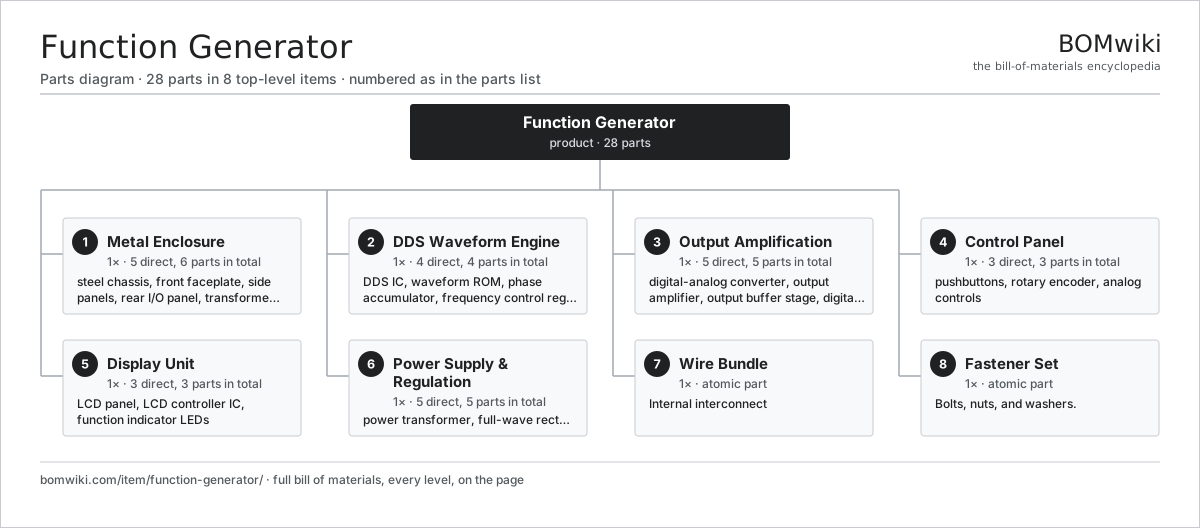
| # | Part | Qty | What it does |
|---|---|---|---|
| 1 | Metal Enclosure 5 parts | 1× | Steel chassis with ventilation slots and front panel, providing EMI shielding. |
| 2 | DDS Waveform Engine 4 parts | 1× | Direct Digital Synthesis chip and ROM lookup table generating precision waveforms. |
| 3 | Output Amplification 5 parts | 1× | DAC, analog amplifier, and attenuator chain with 50 Ω output impedance. |
| 4 | Control Panel 3 parts | 1× | Buttons, rotary encoder, and potentiometers for frequency, amplitude, and offset adjustment. |
| 5 | Display Unit 3 parts | 1× | LCD showing frequency, amplitude, and function settings with front-panel readout. |
| 6 | Power Supply & Regulation 5 parts | 1× | Linear regulated power delivering dual ±15 V and +5 V rails. |
| 7 | Wire Bundle | 1× | Internal interconnect |
| 8 | Fastener Set | 1× | Bolts, nuts, and washers. |
3D model
No 3D model yet. Have a CAD file of this? Add a 3D model. STL renders right on this page; STEP, FreeCAD, and OpenSCAD sources are welcome too (openly licensed, like all 3D models on BOMwiki).
Build & assembly graph
expand / collapse · shared sub-assemblies converge · links to related products · est. labourTap an assembly to expand/collapse · tap a part to open it · use “Open page” for any node · drag to pan, scroll to zoom.
Bill of materials for Function Generator
8 top-level lines · 33 rows shown · 28 parts total · indented to 3 levels| # | Item / sub-assembly | Part no. | Qty/assy | Ext. qty | Parts | Type |
|---|---|---|---|---|---|---|
| 1 | Metal Enclosure 5 parts | function-generator-housing | 1× | 1 | 6 | assembly |
| 1.1 | Steel Chassis | function-generator-chassis-frame | 1× | 1 | · | part |
| 1.2 | Front Faceplate | function-generator-front-panel | 1× | 1 | · | part |
| 1.3 | Side Panels | function-generator-side-panels | 2× | 2 | · | part |
| 1.4 | Rear I/O Panel | function-generator-rear-panel | 1× | 1 | · | part |
| 1.5 | Transformer Shield | function-generator-transformer-shield | 1× | 1 | · | part |
| 2 | DDS Waveform Engine 4 parts | function-generator-dds-engine | 1× | 1 | 4 | assembly |
| 2.1 | DDS IC | function-generator-dds-chip | 1× | 1 | · | part |
| 2.2 | Waveform ROM | function-generator-dds-rom | 1× | 1 | · | part |
| 2.3 | Phase Accumulator | function-generator-phase-accumulator | 1× | 1 | · | part |
| 2.4 | Frequency Control Register | function-generator-frequency-tuning-word | 1× | 1 | · | part |
| 3 | Output Amplification 5 parts | function-generator-output-stage | 1× | 1 | 5 | assembly |
| 3.1 | Digital-Analog Converter | function-generator-dac-ic | 1× | 1 | · | part |
| 3.2 | Output Amplifier | function-generator-output-opamp | 1× | 1 | · | part |
| 3.3 | Output Buffer Stage | function-generator-output-buffer | 1× | 1 | · | part |
| 3.4 | Digital Attenuator | function-generator-programmable-attenuator | 1× | 1 | · | part |
| 3.5 | Output Transformer / Filter | function-generator-output-impedance-matching | 1× | 1 | · | part |
| 4 | Control Panel 3 parts | function-generator-user-interface | 1× | 1 | 3 | assembly |
| 4.1 | Pushbuttons | function-generator-button-set | 1× | 1 | · | part |
| 4.2 | Rotary Encoder | function-generator-rotary-encoder | 1× | 1 | · | part |
| 4.3 | Analog Controls | function-generator-potentiometer-set | 1× | 1 | · | part |
| 5 | Display Unit 3 parts | function-generator-display-panel | 1× | 1 | 3 | assembly |
| 5.1 | LCD Panel | lcd-panel | 1× | 1 | · | part |
| 5.2 | LCD Controller IC | function-generator-lcd-driver | 1× | 1 | · | part |
| 5.3 | Function Indicator LEDs | function-generator-led-indicator | 1× | 1 | · | part |
| 6 | Power Supply & Regulation 5 parts | function-generator-power-supply | 1× | 1 | 5 | assembly |
| 6.1 | Power Transformer | function-generator-transformer | 1× | 1 | · | part |
| 6.2 | Full-Wave Rectifier | function-generator-rectifier-diodes | 1× | 1 | · | part |
| 6.3 | Bulk Filter Caps | function-generator-filter-capacitors | 1× | 1 | · | part |
| 6.4 | Linear Regulators | function-generator-linear-regulators | 1× | 1 | · | part |
| 6.5 | Thermal Fuse | function-generator-thermal-fuse | 1× | 1 | · | part |
| 7 | Wire Bundle | wire-bundle | 1× | 1 | · | part |
| 8 | Fastener Set | fastener-set | 1× | 1 | · | part |
Something wrong in this list? Report a problem with this BOM.
Related products
same domain, ranked by shared parts Amateur Radio Transceiver
295 parts · shares 2 with this page
Amateur Radio Transceiver
295 parts · shares 2 with this page
 Car FM Transmitter
240 parts · shares 2 with this page
Car FM Transmitter
240 parts · shares 2 with this page
 Clamp Meter
27 parts · shares 2 with this page
Digital Multimeter
32 parts · shares 2 with this page
Clamp Meter
27 parts · shares 2 with this page
Digital Multimeter
32 parts · shares 2 with this page
 Digital Photo Frame
31 parts · shares 2 with this page
Digital Photo Frame
31 parts · shares 2 with this page
 Frequency Counter
28 parts · shares 2 with this page
Frequency Counter
28 parts · shares 2 with this page
Sourcing: possible vendors
Browse the supplier directory → Prices, MOQ, and lead times are algorithmic estimates, not quotes, and not claims about these companies. Company mappings are curated by keyword; est. price band $50–$2k. How estimates work| Vendor | HQ | Specialty | MOQ | Lead time |
|---|---|---|---|---|
|
🇨🇳Foxconn
foxconn.com ↗
|
Shenzhen, CN | Electronics contract mfg | 1,000 units | 8–14 wks |
|
🇺🇸Jabil
jabil.com ↗
|
St. Petersburg, US | Electronics manufacturing | 1,000 units | 8–14 wks |
|
🇺🇸Flex
flex.com ↗
|
Austin, US | Electronics manufacturing | 1,000 units | 8–14 wks |
| celestica.com ↗ | Toronto, CA | Electronics manufacturing | 1,000 units | 8–14 wks |
|
🇺🇸Sanmina
sanmina.com ↗
|
San Jose, US | Electronics manufacturing | 1,000 units | 8–14 wks |
1,296-word article