Garment Steam Press
ProductOverview
A garment press is a commercial laundry appliance designed to press shirts, trousers, and dresses with a combination of heat and pressure. The machine features a heated Heated Pressing Platen (a flat metal plate reaching 120–200°C), a Steam Generation System that produces moist heat, and a Garment Hanger Frame that holds the garment in place during pressing.
The operator hangs a damp or dry garment on the Adjustable Garment Hanger Hook, adjusts the Control Panel to set platen and steam temperatures, then presses a Foot Pedal Actuator or activates a timer. The Heated Pressing Platen descends and presses the garment against the hanger for 10–30 seconds while steam penetrates the fabric. The platen then rises automatically, and the garment emerges crisp, wrinkle-free, and freshly pressed.
This is standard equipment in commercial laundries, dry cleaners, and hotel housekeeping departments, saving labor hours compared to hand-pressing with an iron.
How it works
Mains power (220–240 V, 50 Hz) flows through the Power Cord and Mains Plug into the Control Panel. The control panel houses a Main Power Switch and two independent thermostat circuits: one for the Heated Pressing Platen and one for the Steam Generation System.
Platen Heating:
When the user turns on the main power switch, current is routed to the platen heating circuit. A Heating Element embedded in the Stainless Steel Platen (stainless steel, ~400 × 300 mm) begins to heat. The user adjusts the Platen Temperature Dial, which sets the target temperature (typically 160–180°C for cotton, lower for synthetics). A Platen Thermostat compares the temperature measured by a Temperature Sensor Probe against the setpoint and cycles the element on/off to maintain the target.
The platen plate is covered with a Teflon Non-Stick Platen Cover, usually Teflon or silicone, to prevent fabric from sticking and burning. Beneath the platen, Thermal Backing Insulation reduces heat loss to the cabinet frame.
Steam Generation:
A separate heating element in the Boiler Chamber heats water from the Water Reservoir (2–3 L capacity) to produce steam. The Steam Temperature Dial on the control panel sets the boiler target (typically 100–160°C, which produces saturated steam at corresponding pressures). A Boiler Thermostat monitors boiler temperature and cycles heating on/off. Steam produced rises through the Steam Supply Hose, a hose that directs steam into the pressing zone.
Pressing Mechanism:
The Garment Hanger Frame is a pull-out or rotating frame mounted at the front of the machine. It holds a Hanger Rail Rod (horizontal rod) with an Adjustable Garment Hanger Hook hook where the garment is hung. The operator positions the garment on the hanger and closes the cabinet door or positions the platen against the hanging garment.
The Pressing Mechanism is typically pedal-operated or timer-based:
- Pedal: The operator presses the Foot Pedal Actuator with their foot, which mechanically lowers the Heated Pressing Platen via a Press Lever Arm and Return Spring (return springs that restore the platen to its raised position once the pedal is released).
- Timer: Modern machines use a Press Duration Timer on the control panel: the operator presses a button or turns a dial to set the press duration (10–30 seconds), then activates pressing. An electric solenoid or pneumatic actuator lowers the platen automatically, and a mechanical timer or electronic counter raises it after the preset time.
Pressing Process:
Once the platen descends, it makes full contact with the garment hanging on the hanger frame. The weight of the platen (typically 15–20 kg) plus the mechanical advantage of the lever system creates pressing force. Simultaneously, steam from the Steam Supply Hose is injected into the pressing zone, penetrating the fabric. The combination of heat, moisture, and pressure relaxes fabric fibers, removing wrinkles.
After the cycle completes, the platen retracts (either by the operator releasing the pedal or the timer expiring), and the garment is removed. The fabric emerges pressed, with a crisp appearance and set creases (on trousers, for example).
Temperature Control:
Dual thermostat circuits ensure:
- Platen temp stays in the 120–200°C range (user-selectable; lower for delicates, higher for heavy cotton).
- Boiler temp produces steam at the desired dryness (saturated steam at ~100°C for delicate fabrics; drier, hotter steam at ~160°C for cotton and linen).
If platen temperature drops below setpoint, the heating element energizes; if it exceeds setpoint, it de-energizes. Similarly for the boiler. This cycling maintains stable operating conditions throughout the pressing session.
Hanger Frame Design:
The Garment Hanger Frame is designed for quick load/unload:
- It may be pull-out (the frame slides forward out of the cabinet on rails, allowing the operator to hang the garment outside the machine, then slide it back in for pressing).
- Or it may be hinged/rotating (the frame swings forward or to the side, reducing the space required to hang and unload garments).
The Adjustable Garment Hanger Hook hook slides vertically on the Hanger Rail Rod, so collars can be positioned at the right height for platen contact.
Indicator Lights:
The Status Indicator Light Array on the control panel indicate:
- Platen ready (green): the platen has reached target temperature.
- Steam ready (green): the boiler has reached steam temperature.
- Press active (amber): the platen is currently down and pressing.
This feedback helps the operator manage the workflow: they can load the next garment while the current one is being pressed.
Cycle Time and Capacity:
A single press cycle takes 10–30 seconds, depending on fabric weight and fiber content. In a commercial setting, a press operator can handle 8–10 garments per minute, or 500–600 per hour. This dramatically speeds up garment finishing compared to hand-pressing with a portable iron.
Safety:
The platen descends at a controlled speed (via mechanical damping in the lever or pneumatic/solenoid actuation). This speed is slow enough that if a hand or garment edge gets caught, it does not cause injury. The Coil Springs in the return mechanism provide a cushioning effect.
A thermostat limiting the maximum platen temperature (typically ~210°C hardcoded) prevents scorching. Fabric touching the hot platen will not ignite at these temperatures for the brief contact period.
Maintenance:
The Teflon Non-Stick Platen Cover (Teflon or silicone) wears over time and should be replaced annually or when residue accumulates. The Water Reservoir should be emptied and refilled daily with distilled or deionized water to prevent mineral buildup in the boiler. The Steam Supply Hose should be inspected for cracks or blockages.
Garment Steam Press parts and their functions
9 top-level parts · 36 parts in total · full bill of materials below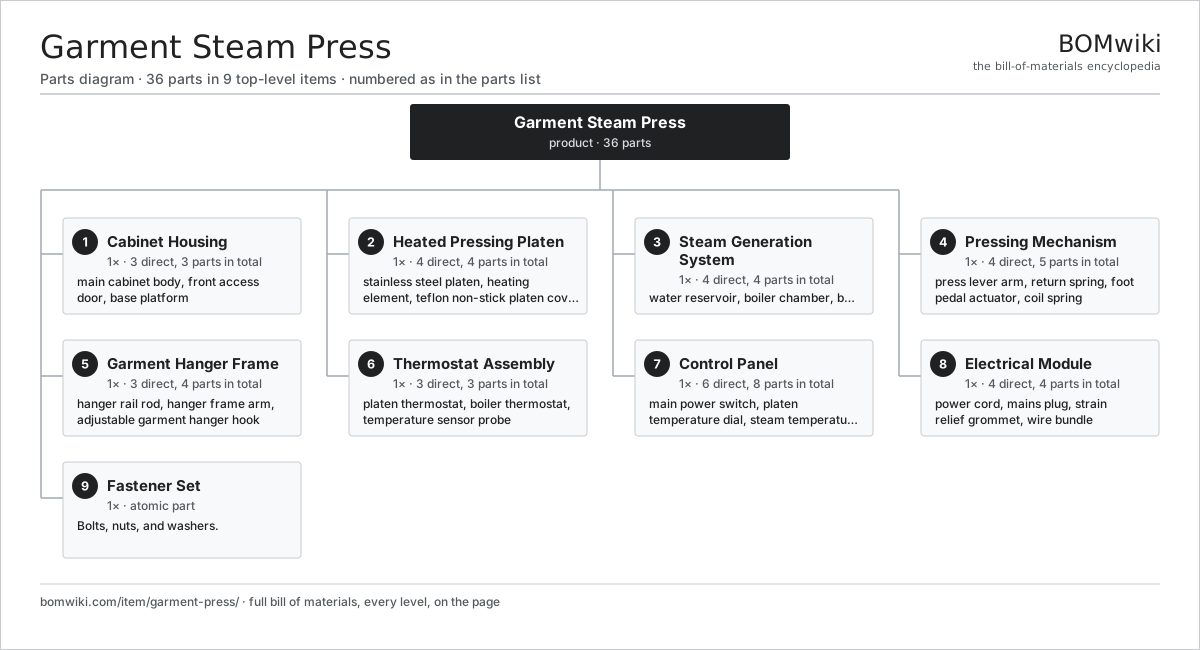
| # | Part | Qty | What it does |
|---|---|---|---|
| 1 | Cabinet Housing 3 parts | 1× | Stainless steel or plastic enclosure containing all components. |
| 2 | Heated Pressing Platen 4 parts | 1× | Flat heated surface that presses garments against a hanger. |
| 3 | Steam Generation System 4 parts | 1× | Boiler that heats and vaporizes water for fabric steaming. |
| 4 | Pressing Mechanism 4 parts | 1× | Pedal-operated or timer-controlled actuator that lowers the platen. |
| 5 | Garment Hanger Frame 3 parts | 1× | Pull-out or rotating frame that holds garments for pressing. |
| 6 | Thermostat Assembly 3 parts | 1× | Temperature control for both platen and boiler. |
| 7 | Control Panel 6 parts | 1× | Power switch, temperature dials, timer, and indicator lights. |
| 8 | Electrical Module 4 parts | 1× | Mains cord, plug, and internal wiring harness. |
| 9 | Fastener Set | 1× | Bolts, nuts, and washers. |
3D model
No 3D model yet. Have a CAD file of this? Add a 3D model. STL renders right on this page; STEP, FreeCAD, and OpenSCAD sources are welcome too (openly licensed, like all 3D models on BOMwiki).
Build & assembly graph
expand / collapse · shared sub-assemblies converge · links to related products · est. labourTap an assembly to expand/collapse · tap a part to open it · use “Open page” for any node · drag to pan, scroll to zoom.
Bill of materials for Garment Steam Press
9 top-level lines · 40 rows shown · 36 parts total · indented to 3 levels| # | Item / sub-assembly | Part no. | Qty/assy | Ext. qty | Parts | Type |
|---|---|---|---|---|---|---|
| 1 | Cabinet Housing 3 parts | garment-press-cabinet | 1× | 1 | 3 | assembly |
| 1.1 | Main Cabinet Body | garment-press-main-body | 1× | 1 | · | part |
| 1.2 | Front Access Door | garment-press-door-panel | 1× | 1 | · | part |
| 1.3 | Base Platform | garment-press-base-panel | 1× | 1 | · | part |
| 2 | Heated Pressing Platen 4 parts | garment-press-heated-platen | 1× | 1 | 4 | assembly |
| 2.1 | Stainless Steel Platen | garment-press-platen-plate | 1× | 1 | · | part |
| 2.2 | Heating Element | heating-element | 1× | 1 | · | part |
| 2.3 | Teflon Non-Stick Platen Cover | garment-press-platen-cover | 1× | 1 | · | part |
| 2.4 | Thermal Backing Insulation | garment-press-platen-insulation | 1× | 1 | · | part |
| 3 | Steam Generation System 4 parts | garment-press-steam-generator | 1× | 1 | 4 | assembly |
| 3.1 | Water Reservoir | garment-press-water-tank | 1× | 1 | · | part |
| 3.2 | Boiler Chamber | garment-press-boiler-chamber | 1× | 1 | · | part |
| 3.3 | Boiler Heating Element | garment-press-heating-element-steam | 1× | 1 | · | part |
| 3.4 | Steam Supply Hose | garment-press-steam-line | 1× | 1 | · | part |
| 4 | Pressing Mechanism 4 parts | garment-press-press-mechanism | 1× | 1 | 5 | assembly |
| 4.1 | Press Lever Arm | garment-press-press-lever | 1× | 1 | · | part |
| 4.2 | Return Spring | garment-press-press-spring | 2× | 2 | · | part |
| 4.3 | Foot Pedal Actuator | garment-press-pedal | 1× | 1 | · | part |
| 4.4 | Coil Spring | coil-spring | 1× | 1 | · | part |
| 5 | Garment Hanger Frame 3 parts | garment-press-hanger-frame | 1× | 1 | 4 | assembly |
| 5.1 | Hanger Rail Rod | garment-press-hanger-rail | 1× | 1 | · | part |
| 5.2 | Hanger Frame Arm | garment-press-hanger-arm | 2× | 2 | · | part |
| 5.3 | Adjustable Garment Hanger Hook | garment-press-adjustable-hanger | 1× | 1 | · | part |
| 6 | Thermostat Assembly 3 parts | garment-press-thermostat-system | 1× | 1 | 3 | assembly |
| 6.1 | Platen Thermostat | garment-press-platen-thermostat | 1× | 1 | · | part |
| 6.2 | Boiler Thermostat | garment-press-boiler-thermostat | 1× | 1 | · | part |
| 6.3 | Temperature Sensor Probe | garment-press-temp-sensor | 1× | 1 | · | part |
| 7 | Control Panel 6 parts | garment-press-control-panel | 1× | 1 | 8 | assembly |
| 7.1 | Main Power Switch | garment-press-power-switch | 1× | 1 | · | part |
| 7.2 | Platen Temperature Dial | garment-press-platen-temp-dial | 1× | 1 | · | part |
| 7.3 | Steam Temperature Dial | garment-press-steam-temp-dial | 1× | 1 | · | part |
| 7.4 | Press Duration Timer | garment-press-press-timer | 1× | 1 | · | part |
| 7.5 | Status Indicator Light Array | garment-press-indicator-lights | 1× | 1 | · | part |
| 7.6 | Connector | connector | 3× | 3 | · | part |
| 8 | Electrical Module 4 parts | garment-press-power-module | 1× | 1 | 4 | assembly |
| 8.1 | Power Cord | garment-press-mains-cord | 1× | 1 | · | part |
| 8.2 | Mains Plug | garment-press-plug | 1× | 1 | · | part |
| 8.3 | Strain Relief Grommet | garment-press-strain-relief | 1× | 1 | · | part |
| 8.4 | Wire Bundle | wire-bundle | 1× | 1 | · | part |
| 9 | Fastener Set | fastener-set | 1× | 1 | · | part |
Something wrong in this list? Report a problem with this BOM.
Related products
same domain, ranked by shared parts Induction Range
387 parts · shares 2 with this page
Induction Range
387 parts · shares 2 with this page
 Ironing Press
56 parts · shares 2 with this page
Ironing Press
56 parts · shares 2 with this page
 Bladeless Fan
64 parts · shares 1 with this page
Bladeless Fan
64 parts · shares 1 with this page
 Central Vacuum System
180 parts · shares 1 with this page
Central Vacuum System
180 parts · shares 1 with this page
 Chest Freezer
70 parts · shares 1 with this page
Chest Freezer
70 parts · shares 1 with this page
Sourcing: possible vendors
Browse the supplier directory → Prices, MOQ, and lead times are algorithmic estimates, not quotes, and not claims about these companies. Company mappings are curated by keyword; est. price band $150–$3k. How estimates work| Vendor | HQ | Specialty | MOQ | Lead time |
|---|---|---|---|---|
| whirlpoolcorp.com ↗ | Benton Harbor, US | Home appliances | 1,000 units | 8–14 wks |
| bsh-group.com ↗ | Munich, DE | Appliances (Bosch, Siemens) | 1,000 units | 8–14 wks |
| electroluxgroup.com ↗ | Stockholm, SE | Home appliances | 1,000 units | 8–14 wks |
| lg.com ↗ | Seoul, KR | Appliances & electronics | 1,000 units | 8–14 wks |
|
🇨🇳Haier
haier.com ↗
|
Qingdao, CN | Home appliances | 1,000 units | 8–14 wks |
1,126-word article