Golf Simulator
ProductOverview
A golf simulator is an indoor golf system that captures ball flight data at impact and projects a realistic golf course environment on a screen, allowing golfers to play virtual rounds in any weather condition. The core innovation is the Launch Monitor, which measures ball velocity, spin rate, and launch angle within milliseconds of impact, enabling real-time trajectory calculation.
Unlike putting mats or video game golf, simulators use physics-based ballistics models, a low-spin drive and a high-spin short shot follow realistic aerodynamic curves. This fidelity makes simulators valuable for amateur golfer improvement (feedback on swing mechanics) and professional player development (course management, pressure scenarios).
Golf simulators are deployed in commercial facilities (indoor golf clubs, country clubs, arcades), home installations, and professional training academies. A round of golf takes 3–4 hours on a real course; on a simulator, the same 18 holes can be played in 60–90 minutes, enabling higher utilization and player throughput.
How it works
The golfer stands on the Hitting Mat Platform, a synthetic turf mat shock-absorbing real club impacts. As the club contacts the ball, the Launch Monitor (Doppler radar or dual high-speed cameras) measures:
- Ball velocity: Clubhead speed translated into ball speed (e.g., 100 mph club = 150 mph ball)
- Launch angle: Angle above horizontal (0–50°)
- Spin rate: Backspin or topspin (0–8,000+ RPM)
- Club head path: Angle relative to target line (helps diagnose slicing or hooking)
This data is fed to the Simulator Engine Computer, which solves the ballistics equation:
x(t) = v₀tcos(θ) / (1 + c_dvt)
where the drag coefficient accounts for spin-induced Magnus force. Within 100 ms, the ball's landing position, distance, and break are calculated and displayed on the projection screen.
The Projection and Display displays a photorealistic golf course, fairway, bunkers, hazards, as seen from the ball's landing spot. The golfer then selects the next club and takes another shot. No walking, no ball retrieval, no lost balls.
Launch monitor technologies
Doppler radar (used by TrackMan, Flightscope):
- Sends 10.525 GHz radio waves
- Measures frequency shift of reflected wave from moving ball
- Advantages: works in any light, extremely fast (<3 ms latency)
- Disadvantage: cannot measure club face angle directly
Dual high-speed camera (used by Foresight Sports GCQuad):
- Infrared cameras at 1000+ fps capture ball and club image
- Computer vision extracts spin axis, clubhead path, impact dynamics
- Advantages: measures club angle, face impact location
- Disadvantage: less robust in outdoor light, higher processing load
Most professional simulators use radar for speed and simplicity.
Swing analysis and feedback
Premium simulators include optional Swing Analysis Sensor (pressure mat) and swing plane analysis:
- Weight transfer: Pressure-sensitive mat detects stance and weight shift during swing
- Tempo: Time from address to impact (ideal: 1.5–2 s for full swing)
- Swing plane: 9-axis IMU estimates the plane of the swing rotation
- Consistency metrics: Repeatability of swing mechanics across multiple shots
This feedback helps golfers identify flaws, early weight transfer, steep plane, rushed tempo, that cause poor consistency.
Course library and gameplay
Modern simulators include 50+ realistic golf courses scanned via laser and photogrammetry (St. Andrews, Pebble Beach, Augusta National). Courses are rendered from the player's perspective, showing fairway shape, bunker positions, green elevation, and distance markers.
Multiplayer modes enable:
- Tournament play: Four players competing, handicap-adjusted scoring
- Pressure scenarios: Sudden-death playoffs, match play situations
- Skill challenges: Closest-to-the-pin, long-drive competitions
- Online play: Real-time competition against remote players
Commercial applications
Golf clubs: Indoor facilities in cold climates extend the season year-round. A simulator can generate €5,000–€10,000/month revenue at €30–50/hour per player.
Country clubs: Premium members play practice rounds before important real matches, developing course familiarity without club travel costs.
Training academies: Teaching pros use simulators for immediate student feedback. A swing can be reviewed in slow-motion, with ball flight overlaid on the planned shot, invaluable for junior development.
Home and casual installations
Consumer-grade simulators (RetailMeNot, SkyTrak) cost €3,000–€8,000 and operate on reduced sensor precision (e.g., camera-only vs. radar). Enthusiasts use these for winter practice and casual rounds.
Installation and setup
Golf simulators require:
- Space: 4 m × 3 m × 3 m minimum bay (hitting area + screen clearance)
- Power: 2–3 kW per simulator (projector, PC, ball feeder)
- Network: Ethernet for online play and software updates
- Ceiling: Launch monitor mounted 3 m ahead and 1–2 m to the side of hitting line
Installation takes 1–2 weeks for commercial facilities due to cable runs and screen tensioning.
Ball recovery and maintenance
The Ball Recovery System system uses a Ball Return Chute beneath the impact screen to return balls to a hopper. The Ball Feeder dispenses one ball per shot, controlled by software.
Balls degrade after 5,000–10,000 impacts. Range facilities typically replace balls monthly, incurring ~€500–1,000 annual cost per simulator.
Accuracy and limitations
Launch monitors are highly accurate for distance and spin (±0.5% velocity, ±50 RPM spin). However, they cannot measure:
- Wind effect: Real courses have ambient wind; simulators assume still air
- Green speed and slope: Virtual greens are simplified models, not photogrammetric scans
- Psychological pressure: Video game golf lacks the pressure of real money and gallery observation
Serious golfers use simulators for practice and feedback, but real-course performance ultimately depends on on-course play.
Standards and validation
Professional tour operators validate launch monitor accuracy against controlled tests (hitting balls into nets, measuring actual distance). Simulators used for training or handicap scoring must meet PGA Tour standards or equivalent.
Future directions
Augmented reality overlays are emerging, real-world footage of a player's favorite course, with ball trajectory and landing position overlaid on actual video. This bridges the gap between simulator convenience and real-world realism.
Golf Simulator parts and their functions
7 top-level parts · 30 parts in total · full bill of materials below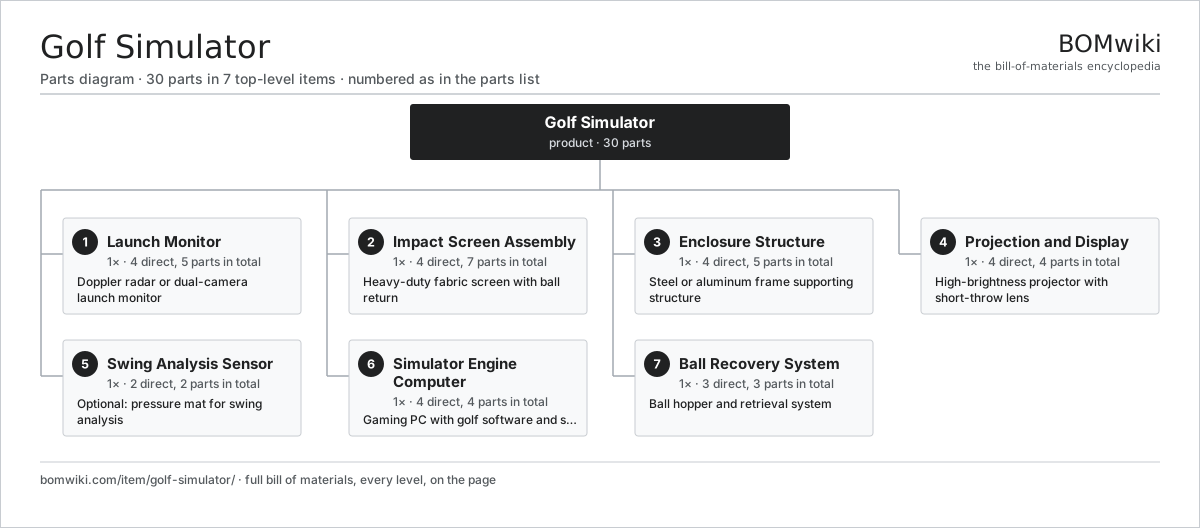
| # | Part | Qty | What it does |
|---|---|---|---|
| 1 | Launch Monitor 4 parts | 1× | Doppler radar or dual-camera launch monitor |
| 2 | Impact Screen Assembly 4 parts | 1× | Heavy-duty fabric screen with ball return |
| 3 | Enclosure Structure 4 parts | 1× | Steel or aluminum frame supporting structure |
| 4 | Projection and Display 4 parts | 1× | High-brightness projector with short-throw lens |
| 5 | Swing Analysis Sensor 2 parts | 1× | Optional: pressure mat for swing analysis |
| 6 | Simulator Engine Computer 4 parts | 1× | Gaming PC with golf software and swing analysis |
| 7 | Ball Recovery System 3 parts | 1× | Ball hopper and retrieval system |
3D model
No 3D model yet. Have a CAD file of this? Add a 3D model. STL renders right on this page; STEP, FreeCAD, and OpenSCAD sources are welcome too (openly licensed, like all 3D models on BOMwiki).
Build & assembly graph
expand / collapse · shared sub-assemblies converge · links to related products · est. labourTap an assembly to expand/collapse · tap a part to open it · use “Open page” for any node · drag to pan, scroll to zoom.
Bill of materials for Golf Simulator
7 top-level lines · 32 rows shown · 30 parts total · indented to 3 levels| # | Item / sub-assembly | Part no. | Qty/assy | Ext. qty | Parts | Type |
|---|---|---|---|---|---|---|
| 1 | Launch Monitor 4 parts | golf-simulator-launch-monitor | 1× | 1 | 5 | assembly |
| 1.1 | Doppler Radar Unit | golf-simulator-radar-module | 1× | 1 | · | part |
| 1.2 | High-Speed Camera | golf-simulator-camera-module | 2× | 2 | · | part |
| 1.3 | Launch Monitor CPU | golf-simulator-monitor-processor | 1× | 1 | · | part |
| 1.4 | Precision Optics | golf-simulator-optical-lens | 1× | 1 | · | part |
| 2 | Impact Screen Assembly 4 parts | golf-simulator-impact-screen | 1× | 1 | 7 | assembly |
| 2.1 | Screen Fabric | golf-simulator-screen-fabric | 1× | 1 | · | part |
| 2.2 | Screen Frame | golf-simulator-screen-frame | 1× | 1 | · | part |
| 2.3 | Ball Return Chute | golf-simulator-ball-return-chute | 1× | 1 | · | part |
| 2.4 | Shock Absorber | golf-simulator-shock-absorber | 4× | 4 | · | part |
| 3 | Enclosure Structure 4 parts | golf-simulator-enclosure-frame | 1× | 1 | 5 | assembly |
| 3.1 | Main Aluminum Frame | golf-simulator-frame-main | 1× | 1 | · | part |
| 3.2 | Hitting Mat Platform | golf-simulator-hitting-platform | 1× | 1 | · | part |
| 3.3 | Side Containment Netting | golf-simulator-side-panels | 2× | 2 | · | part |
| 3.4 | Cable Conduit | golf-simulator-cable-management | 1× | 1 | · | part |
| 4 | Projection and Display 4 parts | golf-simulator-projection-system | 1× | 1 | 4 | assembly |
| 4.1 | Projector Unit | golf-simulator-projector | 1× | 1 | · | part |
| 4.2 | Projector Lens | golf-simulator-projector-lens | 1× | 1 | · | part |
| 4.3 | Projection Screen | golf-simulator-projection-screen | 1× | 1 | · | part |
| 4.4 | Ambient Light Control | golf-simulator-light-controller | 1× | 1 | · | part |
| 5 | Swing Analysis Sensor 2 parts | golf-simulator-sensing-floor | 1× | 1 | 2 | assembly |
| 5.1 | Pressure-Sensitive Mat | golf-simulator-pressure-mat | 1× | 1 | · | part |
| 5.2 | Swing Analysis Board | golf-simulator-swing-processor | 1× | 1 | · | part |
| 6 | Simulator Engine Computer 4 parts | golf-simulator-control-computer | 1× | 1 | 4 | assembly |
| 6.1 | Simulator CPU/GPU | golf-simulator-cpu-gpu | 1× | 1 | · | part |
| 6.2 | Power Supply | power-supply | 1× | 1 | · | part |
| 6.3 | Memory and Storage | golf-simulator-ram-storage | 1× | 1 | · | part |
| 6.4 | Network Card | golf-simulator-network-interface | 1× | 1 | · | part |
| 7 | Ball Recovery System 3 parts | golf-simulator-ball-collection | 1× | 1 | 3 | assembly |
| 7.1 | Ball Hopper | golf-simulator-hopper-reservoir | 1× | 1 | · | part |
| 7.2 | Ball Lift Motor | golf-simulator-ball-lift-motor | 1× | 1 | · | part |
| 7.3 | Ball Feeder | golf-simulator-ball-feeder | 1× | 1 | · | part |
Something wrong in this list? Report a problem with this BOM.
Related products
same domain, ranked by shared parts Amateur Radio Transceiver
295 parts · shares 1 with this page
Amateur Radio Transceiver
295 parts · shares 1 with this page
 Bone Conduction Headphones
34 parts · shares 1 with this page
Bone Conduction Headphones
34 parts · shares 1 with this page
 Car FM Transmitter
240 parts · shares 1 with this page
Car FM Transmitter
240 parts · shares 1 with this page
 CB Radio
228 parts · shares 1 with this page
CB Radio
228 parts · shares 1 with this page
 Digital Audio Player
267 parts · shares 1 with this page
Digital Audio Player
267 parts · shares 1 with this page
Sourcing: possible vendors
Browse the supplier directory → Prices, MOQ, and lead times are algorithmic estimates, not quotes, and not claims about these companies. Company mappings are curated by keyword; est. price band $50–$2k. How estimates work| Vendor | HQ | Specialty | MOQ | Lead time |
|---|---|---|---|---|
|
🇨🇳Foxconn
foxconn.com ↗
|
Shenzhen, CN | Electronics contract mfg | 1,000 units | 8–14 wks |
|
🇺🇸Jabil
jabil.com ↗
|
St. Petersburg, US | Electronics manufacturing | 1,000 units | 8–14 wks |
|
🇺🇸Flex
flex.com ↗
|
Austin, US | Electronics manufacturing | 1,000 units | 8–14 wks |
| celestica.com ↗ | Toronto, CA | Electronics manufacturing | 1,000 units | 8–14 wks |
|
🇺🇸Sanmina
sanmina.com ↗
|
San Jose, US | Electronics manufacturing | 1,000 units | 8–14 wks |
984-word article