Haptic Feedback Vest
ProductOverview
A haptic feedback vest is a wearable garment embedded with vibrotactile actuators (vibrating motors) distributed across the torso, delivering synchronized haptic feedback during VR, augmented reality, or audio experiences. Unlike handheld controllers that vibrate the hands, a haptic vest targets the large somatosensory surface area of the chest and back, enabling spatial feedback (e.g., "feeling" a bullet impact on the right shoulder).
The system consists of a lightweight neoprene vest with 24 small motors (coin-cell and linear resonant actuators), a wireless Bluetooth receiver, and a rechargeable battery pack worn as a hip pouch. A game engine or haptics middleware sends commands wirelessly, specifying which motors fire and with what intensity.
Professional applications include VR training (military, medical), immersive entertainment (arcades, theme parks), and therapeutic pain management (gate control theory). Consumer variants are marketed by bHaptics and others for consumer VR gaming.
How it works
The Garment Structure is a form-fitting sleeveless vest with mounting pockets for 24 vibrotactile motors. Sixteen small coin-cell motors provide broad-area vibration feedback (rumble, sustained vibration), while eight linear resonant actuators (LRAs) deliver crisp transient pulses (impact, texture).
The motors are distributed across anatomical regions:
- Chest: 8 motors for front-facing impacts
- Sides: 4 motors for lateral feedback
- Back: 8 motors for rear impacts
- Shoulders: 4 motors for sustained support cues
Each motor is controlled by an independent PWM channel on the Control and Driver Board microcontroller. The Wireless Receiver Module receives Bluetooth commands from a VR application, decoding motor intensities (0–255) and durations (1–500 ms).
A typical interaction: a VR game fires a weapon, the game engine triggers "chest motors 3–6 at 200 intensity, 150 ms duration," the vest vibrates all four chest motors in a burst, creating the sensation of recoil impact.
The Power and Battery System provides 30 minutes of runtime at full intensity. A 2-hour USB-C charge tops it back up. The battery management system prevents over-discharge and over-current to the motor drivers.
Tactile perception
Humans perceive vibrotactile feedback via two sensory channels:
RA (Rapidly Adapting) receptors respond to high-frequency transients (100–300 Hz). LRAs are tuned to this range, creating crisp "texture" feedback. Users perceive these as discrete taps or impacts.
SA (Slowly Adapting) receptors respond to sustained vibration (10–50 Hz). Coin-cell motors operate at this frequency, creating rumble and continuous pressure sensations.
By combining both, a haptic vest can deliver rich tactile narratives, sudden impacts coupled with sustained vibration create immersive illusions of, for example, a taser or explosive blast.
VR and gaming integration
Game engines (Unreal Engine, Unity) integrate haptic middleware. The bHaptics SDK provides a pattern library (gunshot, punch, electrocution) that maps to vest motor arrays. Developers call hapticFire("gunshot", intensity: 0.8) in code, and the middleware handles motor routing.
Open standards like OpenHaptics are emerging, but bHaptics dominates the consumer market. Custom protocols (UDP, MQTT) are also supported for research applications.
Military and police training
Tactical response teams use haptic vests during scenario training. A simulated gunshot on the right side triggers right-side motors, training muscle memory for cover and response. Studies show that adding haptic feedback to VR firearms training reduces transition time to real weapons by 15–20%.
Medical applications
Gate control theory (Melzack & Wall, 1965) suggests that vibrotactile stimulation at the site of chronic pain can suppress pain signaling. Clinical trials are ongoing for haptic vests in post-operative pain management and phantom-limb syndrome treatment.
Comfort and fit
Form-fitting neoprene is critical. A loose vest causes motors to move away from skin during activity, reducing coupling and sensation. Neoprene provides compression (helpful for proprioception) and moisture-wicking (important during active VR).
Motor mount clips use elastomer damping pads to prevent the motors' structural vibration from coupling to the garment frame. Without damping, the vest would vibrate structurally, reducing localized sensation and increasing user fatigue.
Power consumption
A single coin-cell motor draws 20 mA at 3V under load (0.06W). Sixteen motors firing simultaneously consume 0.96W. A 3S LiPo battery (2500 mAh) at 11.1V nominal stores 27.75 Wh. At 1W continuous, runtime is ~28 hours; at 1.5W average, ~19 hours. Most VR sessions are 20–30 minutes, so one charge covers 1–3 sessions.
Manufacturing and costs
Haptic vests are labor-intensive to assemble: hand-wiring 24 motors, custom-fitting the garment, and potting sensitive electronics. Consumer variants retail at €250–€500; professional training systems cost €1,200–€3,000 due to durability and software licensing.
Lead times: 8–12 weeks for custom orders with branded garments.
Standards and safety
Haptic intensity is typically capped at human perception threshold (200–250 Hz, ~0.5 mm displacement) to avoid skin abrasion or unpleasant sensation. FDA guidance on haptic devices is evolving; most systems are classified as non-medical consumer electronics.
Thermal management is important, sustained high-intensity vibration can cause motors to overheat. The BMS includes thermal throttling, reducing intensity if motor drivers exceed 80°C.
Haptic Feedback Vest parts and their functions
6 top-level parts · 133 parts in total · full bill of materials below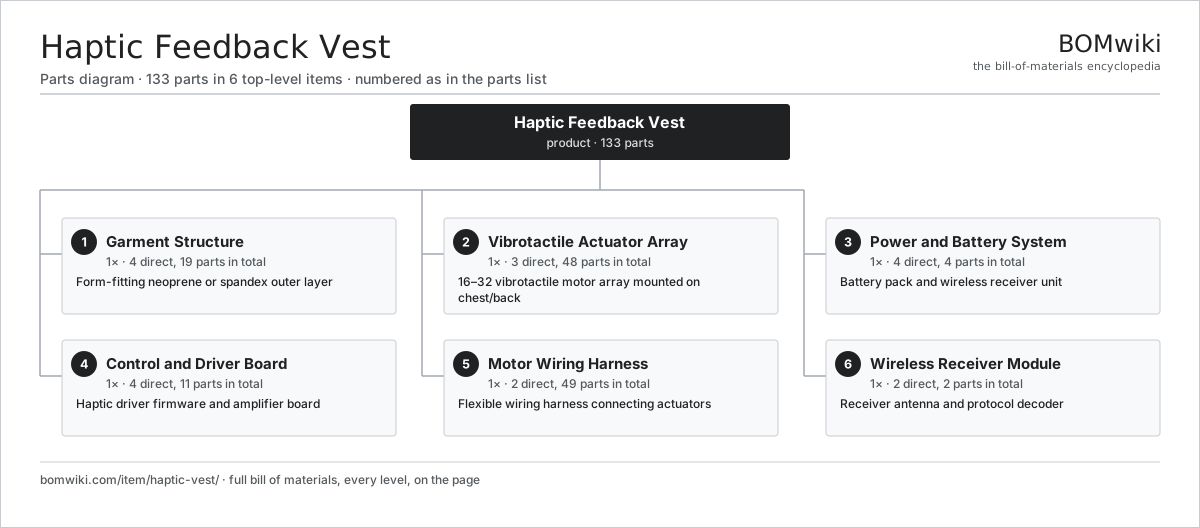
| # | Part | Qty | What it does |
|---|---|---|---|
| 1 | Garment Structure 4 parts | 1× | Form-fitting neoprene or spandex outer layer |
| 2 | Vibrotactile Actuator Array 3 parts | 1× | 16–32 vibrotactile motor array mounted on chest/back |
| 3 | Power and Battery System 4 parts | 1× | Battery pack and wireless receiver unit |
| 4 | Control and Driver Board 4 parts | 1× | Haptic driver firmware and amplifier board |
| 5 | Motor Wiring Harness 2 parts | 1× | Flexible wiring harness connecting actuators |
| 6 | Wireless Receiver Module 2 parts | 1× | Receiver antenna and protocol decoder |
3D model
No 3D model yet. Have a CAD file of this? Add a 3D model. STL renders right on this page; STEP, FreeCAD, and OpenSCAD sources are welcome too (openly licensed, like all 3D models on BOMwiki).
Build & assembly graph
expand / collapse · shared sub-assemblies converge · links to related products · est. labourTap an assembly to expand/collapse · tap a part to open it · use “Open page” for any node · drag to pan, scroll to zoom.
Bill of materials for Haptic Feedback Vest
6 top-level lines · 25 rows shown · 133 parts total · indented to 3 levels| # | Item / sub-assembly | Part no. | Qty/assy | Ext. qty | Parts | Type |
|---|---|---|---|---|---|---|
| 1 | Garment Structure 4 parts | haptic-vest-fabric-shell | 1× | 1 | 19 | assembly |
| 1.1 | Neoprene Fabric | haptic-vest-neoprene-base | 1× | 1 | · | part |
| 1.2 | Adhesive Velcro Loops | haptic-vest-velcro-patches | 16× | 16 | · | part |
| 1.3 | Front Zipper | haptic-vest-zipper-front | 1× | 1 | · | part |
| 1.4 | Polyester Thread | haptic-vest-stitching-thread | 1× | 1 | · | part |
| 2 | Vibrotactile Actuator Array 3 parts | haptic-vest-actuator-array | 1× | 1 | 48 | assembly |
| 2.1 | Coin-Cell Vibration Motor | haptic-vest-coin-motor | 16× | 16 | · | part |
| 2.2 | Linear Resonant Actuator | haptic-vest-lra-motor | 8× | 8 | · | part |
| 2.3 | Motor Mount Clip | haptic-vest-motor-mounts | 24× | 24 | · | part |
| 3 | Power and Battery System 4 parts | haptic-vest-power-module | 1× | 1 | 4 | assembly |
| 3.1 | LiPo Battery Pack | haptic-vest-lipo-battery | 1× | 1 | · | part |
| 3.2 | Battery Management IC | haptic-vest-battery-bms | 1× | 1 | · | part |
| 3.3 | Bluetooth Receiver Module | haptic-vest-wireless-receiver | 1× | 1 | · | part |
| 3.4 | Battery Enclosure | haptic-vest-power-enclosure | 1× | 1 | · | part |
| 4 | Control and Driver Board 4 parts | haptic-vest-control-electronics | 1× | 1 | 11 | assembly |
| 4.1 | Microcontroller | mcu | 1× | 1 | · | part |
| 4.2 | MOSFET Driver Array | haptic-vest-mosfet-driver | 8× | 8 | · | part |
| 4.3 | SMD Passive (R/C/L) | smd-passives | 1× | 1 | · | part |
| 4.4 | Connector Breakout Board | haptic-vest-connector-matrix | 1× | 1 | · | part |
| 5 | Motor Wiring Harness 2 parts | haptic-vest-transmission-harness | 1× | 1 | 49 | assembly |
| 5.1 | Braided Cable | haptic-vest-cable-loom | 1× | 1 | · | part |
| 5.2 | Crimp Terminals | haptic-vest-connector-terminals | 48× | 48 | · | part |
| 6 | Wireless Receiver Module 2 parts | haptic-vest-wireless-interface | 1× | 1 | 2 | assembly |
| 6.1 | Bluetooth 5.0 Module | haptic-vest-ble-module | 1× | 1 | · | part |
| 6.2 | Protocol Firmware | haptic-vest-protocol-decoder | 1× | 1 | · | part |
Something wrong in this list? Report a problem with this BOM.
Sourcing: possible vendors
Browse the supplier directory → Prices, MOQ, and lead times are algorithmic estimates, not quotes, and not claims about these companies. Company mappings are curated by keyword; est. price band $50–$2k. How estimates work| Vendor | HQ | Specialty | MOQ | Lead time |
|---|---|---|---|---|
|
🇨🇳Foxconn
foxconn.com ↗
|
Shenzhen, CN | Electronics contract mfg | 1,000 units | 8–14 wks |
|
🇺🇸Jabil
jabil.com ↗
|
St. Petersburg, US | Electronics manufacturing | 1,000 units | 8–14 wks |
|
🇺🇸Flex
flex.com ↗
|
Austin, US | Electronics manufacturing | 1,000 units | 8–14 wks |
| celestica.com ↗ | Toronto, CA | Electronics manufacturing | 1,000 units | 8–14 wks |
|
🇺🇸Sanmina
sanmina.com ↗
|
San Jose, US | Electronics manufacturing | 1,000 units | 8–14 wks |
838-word article