Laundry Folding Machine
ProductOverview
The automatic laundry folding machine is the final stage in high-volume laundry operations, converting dried (and often pressed) flat textiles into neatly stacked rectangular packages ready for delivery. The machine uses a combination of mechanical blade folding and compressed air jets to achieve clean, consistent folds without wrinkles or creases.
The machine operates continuously: fabric is fed manually or via conveyor onto a powered input belt, passes through a longitudinal fold station where a rotating blade creates a lengthwise fold, then proceeds to a transverse fold station that folds the already-folded package in half, producing a rectangular stack-ready package. Finally, stacker conveyor delivers the packages to an output platform.
The entire fold sequence is orchestrated by a PLC control system that synchronizes the feed speed, blade rotation frequency, and air jet timing. Operators select fold mode (rectangle, half-fold, or custom) via a touchscreen display and adjust speed from 10 to 50 m/min based on fabric type and operator preference.
Typical output is 150–300 pieces/hour, equivalent to 600–1200 kg/hour of flat textiles, making this machine ideal for hotels, hospitals, and laundries processing 10+ kg/day per fold machine.
How It Works
Fabric is laid manually on the input conveyor and centered by adjustable edge guides. The feed motor drives the conveyor at a speed selected on the HMI display. The fabric advances smoothly toward the longitudinal fold station.
At the fold station, the stainless steel fold blade rotates ±90° at 0.5 Hz frequency (once per second), driven by a pneumatic cylinder actuator. As the blade sweeps across, it gathers the fabric and folds it lengthwise along a mechanical axis. Simultaneously, four compressed air jets (operating at 5 bar) direct high-velocity air streams toward the fold line, separating the two layers and ensuring a crisp, wrinkle-free fold. The rotary screw compressor delivers air on demand; the pressure regulator maintains consistent jet pressure despite variable airflow.
The longitudinally folded fabric exits the blade and falls into the fold chute, a curved metal guide that directs it smoothly toward the transverse fold station.
At the cross-fold station, the transverse fold blade performs a similar sweep, now folding the package perpendicular to the first fold, creating a rectangular shape. Two cross-fold jets assist the transverse fold with 0.3 m³/min air at 5 bar. The servo motor driving this blade operates at a slower frequency (0.3 Hz, or every 3.3 seconds) to allow time for the second fold geometry to settle and align.
The cross-folded package (now a neat rectangle, roughly 0.3 m × 0.5 m × 0.15 m for a sheet) exits via the Cross-Fold Output Chute and lands gently on the output stacker conveyor. The stacker belt, driven by a 1.5 kW motor, moves at 15 m/min, advancing folded packages onto a tilting platform where they accumulate in a vertical stack. When the stack reaches a predetermined height (usually 20–30 packages), the operator manually removes the stack and places it in a cart for transport.
Fold Mechanics and Air Jets
The longitudinal and transverse folds are created purely mechanically: the Fold Blade physically lifts fabric and rotates it around a fixed pivot axis. However, the precision of the fold, ensuring both layers separate cleanly and no creases form, depends on the air jets.
When the blade is at the pivot point (0° rotation), the four longitudinal jets direct air at 0.4 m³/min from all sides perpendicular to the fold line. This air separation prevents the two layers from sticking together, which would create permanent creases. The air velocity at the nozzle exit is approximately 30 m/s, creating a directed "blast" rather than a gentle breeze.
For the transverse fold, the two cross-jets operate with lower flow (0.3 m³/min each) because the fabric has already been stiffened by the first fold, requiring less air force. The refrigerant air dryer ensures the compressed air has a dew point of −5°C, preventing moisture from accumulating on the fabric or blocking the 12 mm jet nozzles over time.
The 4/2 solenoid valves controlling the pneumatic actuators are triggered by the PLC at precise moments in the fold cycle. The PLC monitors fabric position via proximity sensors positioned at each station and synchronizes blade motion with fabric arrival, ensuring folds are aligned and consistent.
Speed Control and Cycle Adjustment
Operators adjust fold speed via the control buttons or touchscreen. The variable frequency drive modulates the main motor frequency, which is mechanically linked to the feed conveyor speed via the 10:1 gearbox.
At 10 m/min, fabric travels the length of the machine slowly, allowing extra time for air jets to settle folds and ensuring clean output quality. This speed is used for delicate fabrics or when operators are training. At 50 m/min, the machine reaches near-maximum throughput for standard linens and towels.
The fold blade frequencies (0.5 Hz longitudinal, 0.3 Hz transverse) remain constant regardless of fabric speed; synchronization is achieved by the PLC, which monitors fabric position and triggers solenoid valve pulses to align blade motion with fabric arrival. If fabric arrives too quickly, the PLC delays the next fold until fabric position is correct, preventing misaligned folds.
Operators can select different "fold modes" via the HMI: Rectangle (two folds as described), Half-Fold (only longitudinal fold for smaller output), or Custom (user-programmed fold timing). Changing modes requires only a button press; no mechanical rebuild is necessary.
Compressed Air System
The air supply system centers on a 5.5 kW rotary screw compressor delivering 0.9 m³/min at 6 bar absolute pressure. The compressor outlet feeds a 150 L storage tank that buffers pressure fluctuations during peak demand (when both longitudinal and transverse folds operate simultaneously).
The pilot-operated pressure regulator reduces supply pressure to 5.5 bar setpoint and provides a vent port for manual pressure release. The refrigerant dryer cools compressed air to 5°C, condensing moisture, then reheats it to 40°C before delivery to the jets. This maintains dew point at −5°C, preventing ice crystal formation in jet nozzles during winter operation.
Air consumption is variable: at 10 m/min feed speed, fold events occur roughly every 1.2 seconds for 1.2 m fabric length, consuming approximately 0.3 m³/min average (accounting for cycle timing). At 50 m/min speed, consumption approaches 0.6 m³/min, well within the compressor capacity of 0.9 m³/min, so the compressor runs continuously without duty-cycling.
Output and Stacking
The stacker system is simple: a rubber conveyor belt driven by a 1.5 kW motor that advances packages at 15 m/min onto a tilting output platform. As packages accumulate, the platform tilts slightly to prevent toppling. Once 20–30 packages are stacked, the operator releases a latch, and the platform tilts fully, discharging the stack into a waiting cart.
Alternatively, the stacker can feed a downstream automated bagging system or cart-loading robot in high-volume operations.
Maintenance and Duty
The fold blades and cross-fold blade are replaced every 2000 hours due to wear from repeated fabric contact. The solenoid valves are cleaned every 500 hours of operation. The air dryer desiccant cartridge is replaced every 1000 hours or when a dew-point indicator turns pink.
Typical operating duty is 6–8 hours per day in standard laundries, 24-hour operation in hospitals. Downtime is scheduled for lunch breaks (1 hour) and end-of-shift cleaning (30 min). Annual maintenance includes bearing inspection, motor winding resistance check, and compressor oil change.
Power consumption is approximately 4–5 kW continuous (motors + compressor) at full speed, making the machine energy-efficient for the volume processed.
Laundry Folding Machine parts and their functions
7 top-level parts · 37 parts in total · full bill of materials below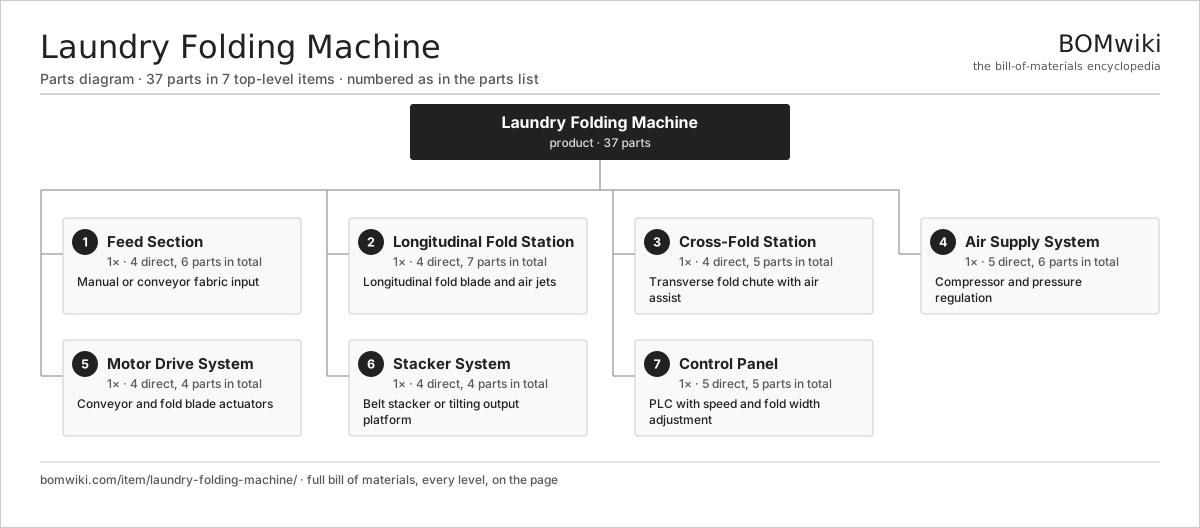
| # | Part | Qty | What it does |
|---|---|---|---|
| 1 | Feed Section 4 parts | 1× | Manual or conveyor fabric input |
| 2 | Longitudinal Fold Station 4 parts | 1× | Longitudinal fold blade and air jets |
| 3 | Cross-Fold Station 4 parts | 1× | Transverse fold chute with air assist |
| 4 | Air Supply System 5 parts | 1× | Compressor and pressure regulation |
| 5 | Motor Drive System 4 parts | 1× | Conveyor and fold blade actuators |
| 6 | Stacker System 4 parts | 1× | Belt stacker or tilting output platform |
| 7 | Control Panel 5 parts | 1× | PLC with speed and fold width adjustment |
3D model
No 3D model yet. Have a CAD file of this? Add a 3D model. STL renders right on this page; STEP, FreeCAD, and OpenSCAD sources are welcome too (openly licensed, like all 3D models on BOMwiki).
Build & assembly graph
expand / collapse · shared sub-assemblies converge · links to related products · est. labourTap an assembly to expand/collapse · tap a part to open it · use “Open page” for any node · drag to pan, scroll to zoom.
Bill of materials for Laundry Folding Machine
7 top-level lines · 37 rows shown · 37 parts total · indented to 3 levels| # | Item / sub-assembly | Part no. | Qty/assy | Ext. qty | Parts | Type |
|---|---|---|---|---|---|---|
| 1 | Feed Section 4 parts | laundry-folding-machine-feed-section | 1× | 1 | 6 | assembly |
| 1.1 | Feed Conveyor Belt | laundry-folding-machine-feed-conveyor | 1× | 1 | · | part |
| 1.2 | Feed Motor | laundry-folding-machine-feed-motor | 1× | 1 | · | part |
| 1.3 | Feed Pulley | laundry-folding-machine-feed-pulley | 2× | 2 | · | part |
| 1.4 | Edge Guide Rail | laundry-folding-machine-edge-guide | 2× | 2 | · | part |
| 2 | Longitudinal Fold Station 4 parts | laundry-folding-machine-first-fold-station | 1× | 1 | 7 | assembly |
| 2.1 | Fold Blade | laundry-folding-machine-fold-blade | 1× | 1 | · | part |
| 2.2 | Blade Pivot Actuator | laundry-folding-machine-blade-pivot | 1× | 1 | · | part |
| 2.3 | Fold Jet Nozzle | laundry-folding-machine-fold-jet | 4× | 4 | · | part |
| 2.4 | Fold Chute | laundry-folding-machine-fold-chute | 1× | 1 | · | part |
| 3 | Cross-Fold Station 4 parts | laundry-folding-machine-cross-fold-station | 1× | 1 | 5 | assembly |
| 3.1 | Cross-Fold Blade | laundry-folding-machine-cross-blade | 1× | 1 | · | part |
| 3.2 | Cross-Blade Motor | laundry-folding-machine-cross-blade-motor | 1× | 1 | · | part |
| 3.3 | Cross-Fold Jet | laundry-folding-machine-cross-jet | 2× | 2 | · | part |
| 3.4 | Cross-Fold Output Chute | laundry-folding-machine-cross-chute | 1× | 1 | · | part |
| 4 | Air Supply System 5 parts | laundry-folding-machine-air-supply | 1× | 1 | 6 | assembly |
| 4.1 | Rotary Screw Compressor | laundry-folding-machine-compressor | 1× | 1 | · | part |
| 4.2 | Air Receiver Tank | laundry-folding-machine-air-receiver | 1× | 1 | · | part |
| 4.3 | Pressure Regulator | laundry-folding-machine-regulator | 1× | 1 | · | part |
| 4.4 | Solenoid Valve | laundry-folding-machine-solenoid-valve | 2× | 2 | · | part |
| 4.5 | Air Dryer | laundry-folding-machine-air-dryer | 1× | 1 | · | part |
| 5 | Motor Drive System 4 parts | laundry-folding-machine-motor-drive | 1× | 1 | 4 | assembly |
| 5.1 | Main Drive Motor | laundry-folding-machine-main-motor | 1× | 1 | · | part |
| 5.2 | Motor Gearbox | laundry-folding-machine-motor-gearbox | 1× | 1 | · | part |
| 5.3 | Motor Coupling | laundry-folding-machine-motor-coupling | 1× | 1 | · | part |
| 5.4 | Variable Frequency Drive | laundry-folding-machine-vfd | 1× | 1 | · | part |
| 6 | Stacker System 4 parts | laundry-folding-machine-stacker | 1× | 1 | 4 | assembly |
| 6.1 | Stacker Conveyor Belt | laundry-folding-machine-stacker-belt | 1× | 1 | · | part |
| 6.2 | Stacker Motor | laundry-folding-machine-stacker-motor | 1× | 1 | · | part |
| 6.3 | Stacker Drive Train | laundry-folding-machine-stacker-belt-drive | 1× | 1 | · | part |
| 6.4 | Output Platform | laundry-folding-machine-stacker-platform | 1× | 1 | · | part |
| 7 | Control Panel 5 parts | laundry-folding-machine-control-panel | 1× | 1 | 5 | assembly |
| 7.1 | Control PLC | laundry-folding-machine-plc | 1× | 1 | · | part |
| 7.2 | HMI Display | laundry-folding-machine-display | 1× | 1 | · | part |
| 7.3 | Control Buttons | laundry-folding-machine-pushbutton-panel | 1× | 1 | · | part |
| 7.4 | Emergency Stop Contactor | laundry-folding-machine-emergency-stop | 1× | 1 | · | part |
| 7.5 | Main Power Switch | laundry-folding-machine-main-switch | 1× | 1 | · | part |
Something wrong in this list? Report a problem with this BOM.
Sourcing: possible vendors
Browse the supplier directory → Prices, MOQ, and lead times are algorithmic estimates, not quotes, and not claims about these companies. Company mappings are curated by keyword; est. price band $150–$3k. How estimates work| Vendor | HQ | Specialty | MOQ | Lead time |
|---|---|---|---|---|
| whirlpoolcorp.com ↗ | Benton Harbor, US | Home appliances | 1,000 units | 8–14 wks |
| bsh-group.com ↗ | Munich, DE | Appliances (Bosch, Siemens) | 1,000 units | 8–14 wks |
| electroluxgroup.com ↗ | Stockholm, SE | Home appliances | 1,000 units | 8–14 wks |
| lg.com ↗ | Seoul, KR | Appliances & electronics | 1,000 units | 8–14 wks |
|
🇨🇳Haier
haier.com ↗
|
Qingdao, CN | Home appliances | 1,000 units | 8–14 wks |
1,549-word article