LCR Meter
ProductOverview
An LCR meter is a precision handheld instrument measuring the three fundamental passive electrical components, inductance (L), capacitance (C), and resistance (R), using a digital auto-balancing bridge principle. Unlike multimeters that measure only DC resistance, the LCR Meter operates at an AC test frequency (typically 1 kHz), allowing measurement of reactive elements (inductors and capacitors) whose impedance depends critically on frequency and signal level.
The LCR Meter is essential for quality assurance in electronics manufacturing, where every component lot must be verified against specification before assembly. It is also used in field repair and troubleshooting to quickly diagnose suspect components without desoldering them from a board (via the Kelvin fixture probes). Component values are displayed directly on the LCD, and dual-parameter mode can simultaneously display the measured component value and its equivalent series resistance (ESR), dissipation factor (D), or quality factor (Q), revealing aging, moisture absorption, or manufacturing defects invisible to simple DC resistance measurement.
How it works
At the core is the Test Signal Oscillator, which generates a precision 1 kHz sinusoidal test signal. A Crystal Oscillator, a 1.024 MHz quartz oscillator, is divided by 1024 (using digital counters in firmware or in dedicated divider logic) to produce exactly 1000 Hz. An Sinewave Generator, an active low-pass filter, converts the divided square wave into a sinusoid by suppressing harmonics, yielding a pure 1 kHz sine wave. The Signal Output Amp buffers this oscillator output to 0.5 V RMS amplitude, delivered to the test fixture via the meter's output terminals.
The unknown component under test is connected via the Test Fixture Pair, a pair of Kelvin-configured probes with four terminals (two for injection, two for sensing). This four-wire arrangement eliminates the error introduced by the probe resistance and cable capacitance: the injection pair carries the test current into and out of the component; the sense pair measures voltage directly across the component with minimal loading (high-impedance voltmeter input), making the measurement independent of lead resistance.
The test signal and component impedance form a voltage divider: if the component is a capacitor, it presents a reactance Xc = 1 / (2π × 1 kHz × C). For a 100 nF capacitor:
Xc = 1 / (2π × 1000 × 100 × 10^-9) ≈ 1590 Ω
The voltage across the capacitor, measured by the Kelvin sense probes, depends on this impedance.
The measured voltage is fed into the Synchronous Demodulator, a synchronous demodulator (also called a lock-in amplifier) that exploits the fact that the unknown impedance is driven by the 1 kHz oscillator. The demodulator multiplies the measured voltage against a reference signal derived from the oscillator (at 0° phase) and also against a 90° phase-shifted version. The products are then integrated (low-pass filtered), yielding two DC values: one proportional to the in-phase (resistive) component of impedance, and the other proportional to the quadrature (reactive) component. This synchronous detection rejects noise at other frequencies and extracts only the 1 kHz signal of interest.
The demodulated in-phase and quadrature components feed into the Measurement Logic & Calculation, a microcontroller that performs the auto-balancing bridge algorithm. The Auto-Balance Bridge conceptually consists of four impedance arms arranged in a balanced Wheatstone bridge configuration: an unknown impedance (the component under test) is placed at one arm, a precision known reference impedance at an opposite arm, and the other two arms are configured with adjustable resistance and capacitance networks.
In the classic ac bridge, balance is achieved when:
Z_unknown × Z_reference = Z_adjustable_1 × Z_adjustable_2
Rearranging:
Z_unknown = (Z_reference × Z_adjustable_1) / Z_adjustable_2
The Measurement Logic & Calculation performs a digital servo: it compares the magnitude and phase of the null detector output (a voltage proportional to impedance imbalance) against a target of zero, and iteratively adjusts the Variable Impedance Network, a digitally-controlled resistance and capacitance network with relays or solid-state switches, to null the detector output. Once null is achieved (detector < 1 mV), the values of the programmable arm directly give the unknown component's impedance.
For example, if the Variable Impedance Network settles at 47 Ω resistance and 1000 pF capacitance, and the component is purely capacitive (inductor arm ≈ 0), the meter recognizes this as a capacitor and computes the capacitance from the measured reactance at 1 kHz:
C = 1 / (2π × 1000 × Xc)
The display shows "100" (interpreting 100 in the nanofarad range if the meter is in nF mode).
Dual-parameter measurement is a powerful feature: the Measurement Logic & Calculation simultaneously reports the primary value (capacitance C) and a secondary parameter such as equivalent series resistance (ESR). The ESR reveals electrolytic capacitor aging: as a capacitor ages or absorbs moisture from humidity, its ESR increases from, say, 50 mΩ (new) to 500 mΩ (aged), a tenfold rise that would appear on the meter's secondary display while the capacitance value remains nearly unchanged. This early warning allows technicians to replace aging components before they fail in service.
The LCD Display & Readout is a simple 3.5-digit LCD showing the measured value with units (μH, mH, H for inductance; pF, nF, μF for capacitance; Ω, kΩ, MΩ for resistance). A mode button cycles through dual-parameter displays (L + Q, C + D, R + L or C + ESR).
Power is supplied by a 9 V alkaline battery in the Power Supply, managed by the Measurement Logic & Calculation. Quiescent current is low (< 10 mA), extending battery life beyond 200 hours of intermittent use. The lcr-meter-charging-dock is a passive accessory for the battery, not a power dock for the meter itself (the meter does not charge, as it uses disposable alkaline cells).
Practical measurement scenario
A technician is replacing electrolytic capacitors in an aging audio amplifier. Before desoldering each capacitor, they measure it in-situ (without removal, using the Test Fixture Pair) to baseline its capacitance and ESR. A 100 μF 50 V capacitor that originally had a ESR of 80 mΩ now measures 450 mΩ, significantly degraded. The capacitance value has dropped from 100 μF to 87 μF, indicating both electrolyte evaporation and increased internal resistance. The technician marks this capacitor for replacement.
They measure the same capacitor value on a new part from the same manufacturer and confirm it is 100 μF @ 65 mΩ ESR, within specification. After desoldering the old capacitor and soldering in the new one, they re-measure to confirm the new capacitor is still within spec (soldering heat can age capacitors), and then move to the next component.
For inductor testing, a technician is verifying coil inductance on a custom RF module. They select the inductance mode on the LCR Meter, connect the Kelvin probes across the coil, and trigger the measurement. The Auto-Balance Bridge balances, and the display shows "2.47 mH" with a secondary Q value of 42, indicating a low-loss inductor. If another sample coil showed 2.40 mH @ Q = 15, the technician would recognize that coil as possessing excessive copper losses (lower Q), possibly due to manufacturing defect.
Advantages and limitations
The LCR meter measures component parameters at the 1 kHz test frequency, which is appropriate for low-frequency applications (audio, power supplies). However, at higher frequencies (RF, switching supplies), component behavior changes dramatically: a capacitor's impedance increases due to parasitic inductance (especially in through-hole components with long leads), and inductors' effective impedance is modified by distributed capacitance (self-resonance). RF measurements require specialized high-frequency impedance analyzers or vector network analyzers (VNAs).
The LCR Meter is non-invasive when using the Kelvin probes on in-circuit components, because the 0.5 V RMS test signal is too small to forward-bias diodes or transistors in the surrounding circuit. However, if the circuit's bias point is sensitive to the test current (rare), in-circuit measurements can yield incorrect results; desoldering and testing out-of-circuit is the safest approach.
The bridge balance time (< 2 seconds) is a practical limitation: fast production-line testing demands faster measurement, driving adoption of RF impedance analyzers that sweep frequency and display complex impedance (Z = R + jX) graphically. But for technician-level troubleshooting and component verification, the LCR Meter remains the most practical, durable, and cost-effective tool.
LCR Meter parts and their functions
10 top-level parts · 31 parts in total · full bill of materials below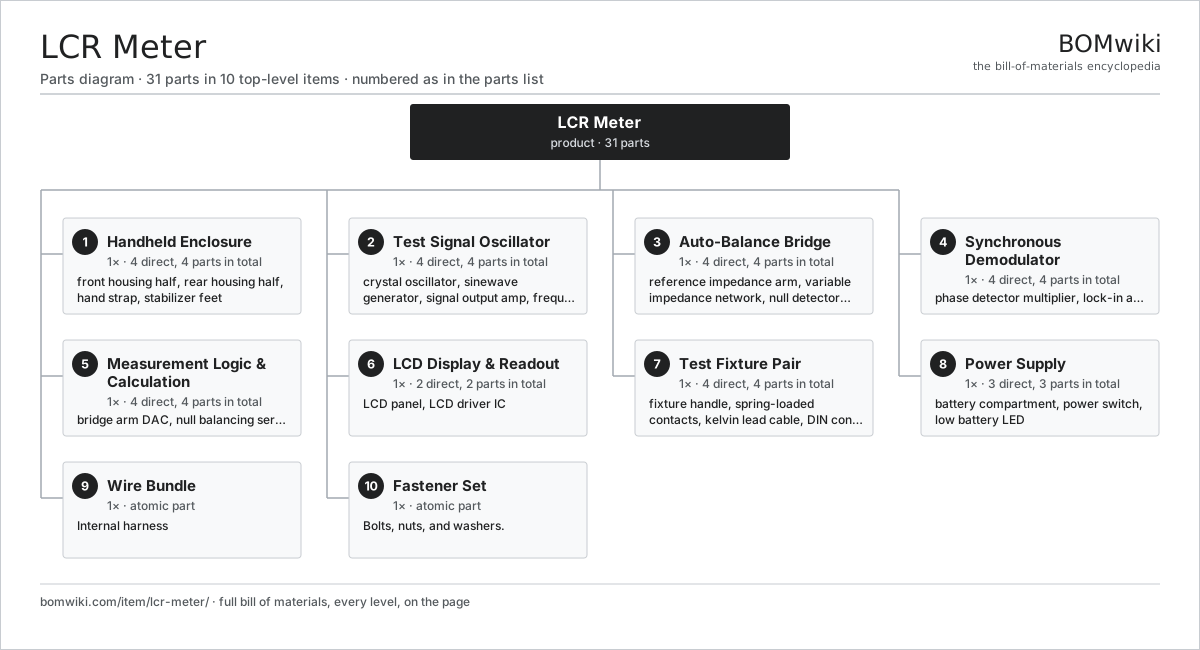
| # | Part | Qty | What it does |
|---|---|---|---|
| 1 | Handheld Enclosure 4 parts | 1× | Molded ABS plastic body with top display panel and rear battery compartment. |
| 2 | Test Signal Oscillator 4 parts | 1× | Precision 1 kHz oscillator generating stable sinusoidal test signal. |
| 3 | Auto-Balance Bridge 4 parts | 1× | AC bridge with programmable impedance arms achieving zero balance at unknown component. |
| 4 | Synchronous Demodulator 4 parts | 1× | Phase-locked detector converting bridge null voltage to DC measurement signal. |
| 5 | Measurement Logic & Calculation 4 parts | 1× | Microcontroller performing bridge balance iterations and converting readings to L/C/R values. |
| 6 | LCD Display & Readout 2 parts | 1× | Numeric display showing measured inductance, capacitance, or resistance with tolerance band. |
| 7 | Test Fixture Pair 4 parts | 1× | Kelvin fixture probes for direct component contact or PCB measurements. |
| 8 | Power Supply 3 parts | 1× | Alkaline battery providing uninterruptible measurement power. |
| 9 | Wire Bundle | 1× | Internal harness |
| 10 | Fastener Set | 1× | Bolts, nuts, and washers. |
3D model
No 3D model yet. Have a CAD file of this? Add a 3D model. STL renders right on this page; STEP, FreeCAD, and OpenSCAD sources are welcome too (openly licensed, like all 3D models on BOMwiki).
Build & assembly graph
expand / collapse · shared sub-assemblies converge · links to related products · est. labourTap an assembly to expand/collapse · tap a part to open it · use “Open page” for any node · drag to pan, scroll to zoom.
Bill of materials for LCR Meter
10 top-level lines · 39 rows shown · 31 parts total · indented to 3 levels| # | Item / sub-assembly | Part no. | Qty/assy | Ext. qty | Parts | Type |
|---|---|---|---|---|---|---|
| 1 | Handheld Enclosure 4 parts | lcr-meter-housing | 1× | 1 | 4 | assembly |
| 1.1 | Front Housing Half | lcr-meter-front-shell | 1× | 1 | · | part |
| 1.2 | Rear Housing Half | lcr-meter-rear-shell | 1× | 1 | · | part |
| 1.3 | Hand Strap | lcr-meter-hand-strap | 1× | 1 | · | part |
| 1.4 | Stabilizer Feet | lcr-meter-rubber-feet | 1× | 1 | · | part |
| 2 | Test Signal Oscillator 4 parts | lcr-meter-oscillator-stage | 1× | 1 | 4 | assembly |
| 2.1 | Crystal Oscillator | lcr-meter-crystal-oscillator | 1× | 1 | · | part |
| 2.2 | Sinewave Generator | lcr-meter-oscillator-shaper | 1× | 1 | · | part |
| 2.3 | Signal Output Amp | lcr-meter-output-amplifier | 1× | 1 | · | part |
| 2.4 | Frequency Adjustment Potentiometer | lcr-meter-frequency-trimmer | 1× | 1 | · | part |
| 3 | Auto-Balance Bridge 4 parts | lcr-meter-bridge-circuit | 1× | 1 | 4 | assembly |
| 3.1 | Reference Impedance Arm | lcr-meter-fixed-arm | 1× | 1 | · | part |
| 3.2 | Variable Impedance Network | lcr-meter-programmable-arm | 1× | 1 | · | part |
| 3.3 | Null Detector | lcr-meter-balance-detector | 1× | 1 | · | part |
| 3.4 | Kelvin Four-Wire Adapter | lcr-meter-kelvin-fixture-connection | 1× | 1 | · | part |
| 4 | Synchronous Demodulator 4 parts | lcr-meter-detection-stage | 1× | 1 | 4 | assembly |
| 4.1 | Phase Detector Multiplier | lcr-meter-phase-detector | 1× | 1 | · | part |
| 4.2 | Lock-In Amplifier | lcr-meter-lock-in-amplifier | 1× | 1 | · | part |
| 4.3 | Integration Filter | lcr-meter-filter-integrator | 1× | 1 | · | part |
| 4.4 | Pilot Carrier Reference | lcr-meter-pilot-carrier-recovery | 1× | 1 | · | part |
| 5 | Measurement Logic & Calculation 4 parts | lcr-meter-measurement-processor | 1× | 1 | 4 | assembly |
| 5.1 | Bridge Arm DAC | lcr-meter-arm-control-dac | 1× | 1 | · | part |
| 5.2 | Null Balancing Servo | lcr-meter-null-feedback-loop | 1× | 1 | · | part |
| 5.3 | Measurement Microcontroller | lcr-meter-mcu-processor | 1× | 1 | · | part |
| 5.4 | Analog Input ADC | lcr-meter-adc-input | 1× | 1 | · | part |
| 6 | LCD Display & Readout 2 parts | lcr-meter-display-module | 1× | 1 | 2 | assembly |
| 6.1 | LCD Panel | lcd-panel | 1× | 1 | · | part |
| 6.2 | LCD Driver IC | lcr-meter-display-control | 1× | 1 | · | part |
| 7 | Test Fixture Pair 4 parts | lcr-meter-test-fixtures | 1× | 1 | 4 | assembly |
| 7.1 | Fixture Handle | lcr-meter-fixture-housing | 1× | 1 | · | part |
| 7.2 | Spring-Loaded Contacts | lcr-meter-spring-probe-set | 1× | 1 | · | part |
| 7.3 | Kelvin Lead Cable | lcr-meter-fixture-cable | 1× | 1 | · | part |
| 7.4 | DIN Connector Coupling | lcr-meter-fixture-connector | 1× | 1 | · | part |
| 8 | Power Supply 3 parts | lcr-meter-battery-pack | 1× | 1 | 3 | assembly |
| 8.1 | Battery Compartment | lcr-meter-battery-holder | 1× | 1 | · | part |
| 8.2 | Power Switch | lcr-meter-power-switch | 1× | 1 | · | part |
| 8.3 | Low Battery LED | lcr-meter-low-battery-indicator | 1× | 1 | · | part |
| 9 | Wire Bundle | wire-bundle | 1× | 1 | · | part |
| 10 | Fastener Set | fastener-set | 1× | 1 | · | part |
Something wrong in this list? Report a problem with this BOM.
Related products
same domain, ranked by shared parts Amateur Radio Transceiver
295 parts · shares 2 with this page
Amateur Radio Transceiver
295 parts · shares 2 with this page
 Car FM Transmitter
240 parts · shares 2 with this page
Car FM Transmitter
240 parts · shares 2 with this page
 Clamp Meter
27 parts · shares 2 with this page
Digital Multimeter
32 parts · shares 2 with this page
Clamp Meter
27 parts · shares 2 with this page
Digital Multimeter
32 parts · shares 2 with this page
 Digital Photo Frame
31 parts · shares 2 with this page
Digital Photo Frame
31 parts · shares 2 with this page
 Frequency Counter
28 parts · shares 2 with this page
Frequency Counter
28 parts · shares 2 with this page
Sourcing: possible vendors
Browse the supplier directory → Prices, MOQ, and lead times are algorithmic estimates, not quotes, and not claims about these companies. Company mappings are curated by keyword; est. price band $50–$2k. How estimates work| Vendor | HQ | Specialty | MOQ | Lead time |
|---|---|---|---|---|
|
🇨🇳Foxconn
foxconn.com ↗
|
Shenzhen, CN | Electronics contract mfg | 1,000 units | 8–14 wks |
|
🇺🇸Jabil
jabil.com ↗
|
St. Petersburg, US | Electronics manufacturing | 1,000 units | 8–14 wks |
|
🇺🇸Flex
flex.com ↗
|
Austin, US | Electronics manufacturing | 1,000 units | 8–14 wks |
| celestica.com ↗ | Toronto, CA | Electronics manufacturing | 1,000 units | 8–14 wks |
|
🇺🇸Sanmina
sanmina.com ↗
|
San Jose, US | Electronics manufacturing | 1,000 units | 8–14 wks |
1,373-word article