LED Curtain Display
ProductOverview
LED curtain displays are flexible mesh or strip displays hung like theatrical backdrops, showing full-color video with some transparency. They are increasingly popular for:
- Concerts and live events (stage backdrop)
- Fashion shows and trade show booths
- Retail storefronts and mall installations
- Building facade installations
- TV studio sets
The key advantage over rigid LED billboards is flexibility, strips can be draped, curved, or hung on irregular surfaces. They also allow partial transparency, so the background can be seen through the display, creating a visual effect distinct from an opaque billboard.
Construction
The display consists of flexible LED strips, each carrying 60 individually-addressable RGB LEDs. Strips are suspended vertically using suspension hardware (rods, clamps, cables). The strips hang like curtains, spaced to provide even horizontal coverage.
For a 10m × 5m display with 5mm LED pitch, 2000 pixels horizontally × 1000 pixels vertically requires 2000 strips of 50 LEDs each. Strip count scales with desired resolution and LED pitch.
All strips are daisy-chained together: data flows serially from strip to strip (SPI protocol), and power is supplied in parallel via vertical distribution rails.
Power distribution
A typical 10m × 5m display at full brightness (all white LEDs) draws 1 kW. This is supplied by four 1.5 kW 24V power supplies in parallel, each delivering 60 A through individual circuit breakers. This redundancy ensures the display continues operating even if one PSU fails (operating at 75% brightness).
The four PSUs are interleaved, each feeds every fourth vertical column of strips. This distributes thermal load and balances current draw.
Video processing
The video processor (ARM SoC + FPGA) receives HDMI or NDI (Network Device Interface) video from a media server or live camera feed. The FPGA accelerates H.264 decoding in real time. The ARM processor converts the decoded video frame into LED commands: for each LED, a 24-bit color value is computed and transmitted.
Latency is critical in live events: if there is a 1-second delay between the performer's movement and the display update, the effect is broken. The video processor achieves <100 millisecond latency from input to LED output.
Multiple video sources can be mixed: one feed for the main content, another for a lower-brightness accent. Transition effects (fade, wipe) are rendered in real time.
Transparency and viewing
LED strips are spaced 100–200 mm apart vertically and horizontally, depending on the chosen pitch. At P5 (5mm), strips are very dense and the mesh is nearly opaque. At P20 (20mm), the mesh is 50–60% transparent, allowing the background to be visible.
This transparency enables creative effects:
- Stage background blurs as video plays in front of it
- Storefront display shows products behind the glass
- Facade video appears to float on top of the building
Transparency also reduces power draw, at 50% opacity, only ~50% of LEDs are lit at any time.
Rigging and installation
Strips are suspended from a top beam using cables or rigid rods. Each strip is held vertically by a clamp, allowing ±5 mm adjustment for alignment. The clamp incorporates a silicone pad to prevent flex noise during wind.
Installation of a 10m × 5m display takes 2–3 days:
- Anchor top beam to roof or rigging points
- Route vertical support rods
- Hang 2000 LED strips and secure clamps
- Wire power and signal daisy-chain
- Route HDMI/Ethernet from video processor
- Calibrate brightness and color
- Test video playback and transitions
The display can be taken down and reassembled at a new location (it is not permanent installation). Some touring shows carry the same curtain display across multiple venues.
Thermal management
The flexible strips are silicone-potted, which dissipates heat through the silicone. There is no active cooling needed. At peak brightness, the strips reach ~60°C, within safe limits. The video processor runs at 40–50°C, kept cool by a small passive heatsink.
Maintenance
LED strips degrade at 5–10% brightness per 50,000 hours. A touring display might accumulate 100–200 hours per year, so strips last 10+ years before noticeable dimming. Entire strips can be swapped by removing clamps and unplugging the daisy-chain connectors, 5 minutes per strip.
Power supplies are field-serviceable (standard industrial units). Video processor is a sealed box; if it fails, it is replaced as a unit.
Contrast and color accuracy
LED strips have limited color accuracy compared to LCD panels. Warm whites and cool whites are distinct hues rather than a true continuous spectrum. This is acceptable for entertainment (vibrant colors are preferred over accuracy), but limits use in color-critical applications like broadcast studios.
Peak brightness is 1000–5000 nits depending on the chosen LEDs. For indoor venues, 1000 nits is sufficient. Outdoor installations in bright daylight need 5000 nits.
Design considerations
The pitch (LED spacing) determines viewing distance:
- P5: 5mm spacing, viewable from 5+ meters
- P10: 10mm spacing, viewable from 10+ meters
- P20: 20mm spacing, viewable from 20+ meters
A concert venue with stage 20 meters from the audience should use at least P10 pitch. A storefront display viewed from 2–3 meters should use P5.
The transparency percentage determines the visual impact of the background. P5 is nearly opaque (background barely visible). P20 is 50% transparent (background and video equally visible). Design choice depends on the creative intent.
LED Curtain Display parts and their functions
5 top-level parts · 356 parts in total · full bill of materials below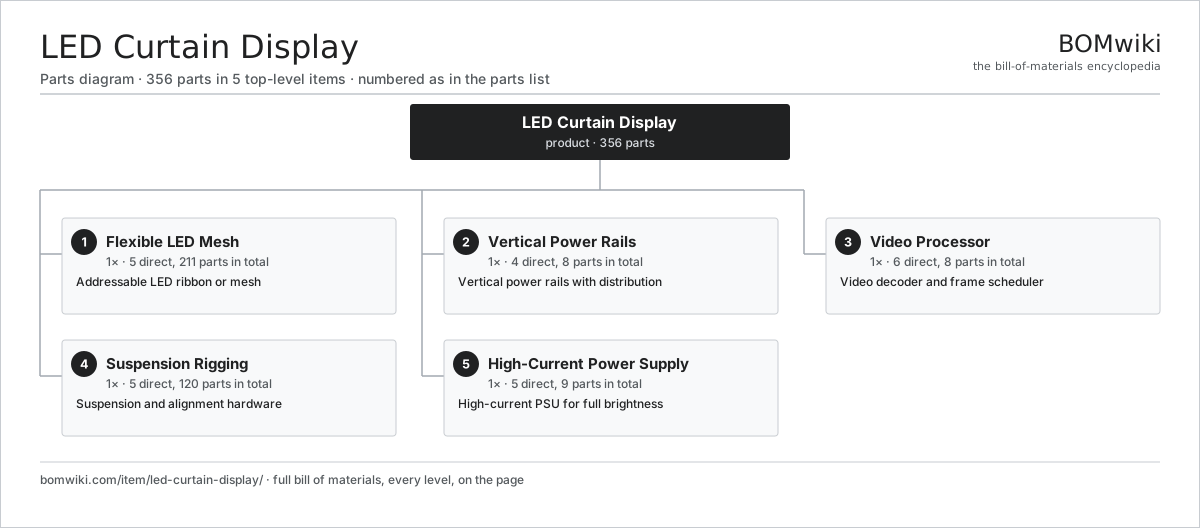
| # | Part | Qty | What it does |
|---|---|---|---|
| 1 | Flexible LED Mesh 5 parts | 1× | Addressable LED ribbon or mesh |
| 2 | Vertical Power Rails 4 parts | 1× | Vertical power rails with distribution |
| 3 | Video Processor 6 parts | 1× | Video decoder and frame scheduler |
| 4 | Suspension Rigging 5 parts | 1× | Suspension and alignment hardware |
| 5 | High-Current Power Supply 5 parts | 1× | High-current PSU for full brightness |
3D model
No 3D model yet. Have a CAD file of this? Add a 3D model. STL renders right on this page; STEP, FreeCAD, and OpenSCAD sources are welcome too (openly licensed, like all 3D models on BOMwiki).
Build & assembly graph
expand / collapse · shared sub-assemblies converge · links to related products · est. labourTap an assembly to expand/collapse · tap a part to open it · use “Open page” for any node · drag to pan, scroll to zoom.
Bill of materials for LED Curtain Display
5 top-level lines · 30 rows shown · 356 parts total · indented to 3 levels| # | Item / sub-assembly | Part no. | Qty/assy | Ext. qty | Parts | Type |
|---|---|---|---|---|---|---|
| 1 | Flexible LED Mesh 5 parts | led-curtain-display-flexible-strips | 1× | 1 | 211 | assembly |
| 1.1 | LED Strip Segment | led-curtain-display-strip-segment | 50× | 50 | · | part |
| 1.2 | Silicone Encapsulant | led-curtain-display-silicone-coating | 1× | 1 | · | part |
| 1.3 | Connector | connector | 100× | 100 | · | part |
| 1.4 | Wire Bundle | wire-bundle | 10× | 10 | · | part |
| 1.5 | O-Ring Set | oring-set | 50× | 50 | · | part |
| 2 | Vertical Power Rails 4 parts | led-curtain-display-power-spine | 1× | 1 | 8 | assembly |
| 2.1 | Distribution Busbar | led-curtain-display-main-rail | 2× | 2 | · | part |
| 2.2 | Distribution Connector | led-curtain-display-feed-connector | 4× | 4 | · | part |
| 2.3 | Fastener Set | fastener-set | 1× | 1 | · | part |
| 2.4 | Sheet Metal Panel | sheet-panel | 1× | 1 | · | part |
| 3 | Video Processor 6 parts | led-curtain-display-data-processor | 1× | 1 | 8 | assembly |
| 3.1 | Compute SoC Module | soc-module | 1× | 1 | · | part |
| 3.2 | Video Accelerator FPGA | led-curtain-display-fpga-accelerator | 1× | 1 | · | part |
| 3.3 | Media Library SSD | led-curtain-display-storage | 1× | 1 | · | part |
| 3.4 | Connector | connector | 3× | 3 | · | part |
| 3.5 | Power Supply | power-supply | 1× | 1 | · | part |
| 3.6 | Microcontroller | mcu | 1× | 1 | · | part |
| 4 | Suspension Rigging 5 parts | led-curtain-display-rigging-system | 1× | 1 | 120 | assembly |
| 4.1 | Support Rod | led-curtain-display-vertical-rod | 10× | 10 | · | part |
| 4.2 | Top Beam | led-curtain-display-horizontal-beam | 2× | 2 | · | part |
| 4.3 | Strip Clamp | led-curtain-display-cable-clamp | 100× | 100 | · | part |
| 4.4 | Wire Bundle | wire-bundle | 5× | 5 | · | part |
| 4.5 | Fastener Set | fastener-set | 3× | 3 | · | part |
| 5 | High-Current Power Supply 5 parts | led-curtain-display-power-supply | 1× | 1 | 9 | assembly |
| 5.1 | Power Supply | power-supply | 4× | 4 | · | part |
| 5.2 | Power Distributor | led-curtain-display-distribution-module | 1× | 1 | · | part |
| 5.3 | Breaker Panel | led-curtain-display-breaker-panel | 1× | 1 | · | part |
| 5.4 | Connector | connector | 2× | 2 | · | part |
| 5.5 | Fastener Set | fastener-set | 1× | 1 | · | part |
Something wrong in this list? Report a problem with this BOM.
Related products
same domain, ranked by shared parts Digital Billboard
131 parts · shares 3 with this page
Digital Billboard
131 parts · shares 3 with this page
 Interactive Touch Table
130 parts · shares 3 with this page
Interactive Touch Table
130 parts · shares 3 with this page
 LED Television
737 parts · shares 3 with this page
LED Television
737 parts · shares 3 with this page
 Highway Variable Message Sign
208 parts · shares 2 with this page
Highway Variable Message Sign
208 parts · shares 2 with this page
 Smart Speaker
379 parts · shares 4 with this page
Smart Speaker
379 parts · shares 4 with this page
Sourcing: possible vendors
Browse the supplier directory → Prices, MOQ, and lead times are algorithmic estimates, not quotes, and not claims about these companies. Company mappings are curated by keyword; est. price band $50–$2k. How estimates work| Vendor | HQ | Specialty | MOQ | Lead time |
|---|---|---|---|---|
|
🇨🇳Foxconn
foxconn.com ↗
|
Shenzhen, CN | Electronics contract mfg | 1,000 units | 8–14 wks |
|
🇺🇸Jabil
jabil.com ↗
|
St. Petersburg, US | Electronics manufacturing | 1,000 units | 8–14 wks |
|
🇺🇸Flex
flex.com ↗
|
Austin, US | Electronics manufacturing | 1,000 units | 8–14 wks |
| celestica.com ↗ | Toronto, CA | Electronics manufacturing | 1,000 units | 8–14 wks |
|
🇺🇸Sanmina
sanmina.com ↗
|
San Jose, US | Electronics manufacturing | 1,000 units | 8–14 wks |
882-word article