Lunar Lander
ProductOverview
A lunar lander solves one problem: the Moon has no atmosphere, so every metre per second of orbital velocity, about 1,700 of them, must be removed by rocket thrust, finishing at zero exactly at the surface. The vehicle is therefore mostly propellant. Of a typical 1,900 kg separated mass, more than 1,100 kg is the MMH and MON-3 stored in the four spheres of the Propellant Tanks & Pressurization, leaving a dry structure, avionics, and up to a tonne of payload on the Payload Deck.
The propulsion is deliberately simple. There are no turbopumps: helium from the Helium Pressurant Bottle bottles, stepped down by the Helium Pressure Regulator, squeezes propellant out of the tanks at about 16 bar. Hypergolic propellants ignite on contact, so there is no igniter to fail, and the engines restart as many times as guidance asks.
The descent engine
The defining component is the throttleable Throttleable Main Engine. A fixed-thrust rocket cannot land: as propellant burns off the vehicle gets lighter, and the final approach needs thrust barely above lunar weight. The engine throttles 10:1 using a Pintle Injector, a single coaxial element whose central sleeve slides to vary the injection area, keeping injection velocity (and therefore mixing and combustion stability) roughly constant from 3.5 kN down to 350 N. The Throttle Valve pair meters flow upstream, and the Engine Control Unit closes the thrust loop on chamber pressure at 100 Hz.
Cooling is passive: the Combustion Chamber is silica-phenolic ablative, charring at a known rate over the 12-minute burn, and the Engine Nozzle Extension is a columbium extension that simply glows. Each engine swings ±6° on Gimbal Actuator pairs for steering, fed through bellows-jointed Flex Feedline runs.
Navigation to a safe spot
Powered descent starts about 15 km up. The Inertial Measurement Unit propagates the state, but inertial navigation alone drifts kilometres over a descent, so the Terrain Navigation Camera matches surface images against stored orbital maps, pinning position to tens of metres, terrain-relative navigation. From 20 km down, the Doppler Landing Radar measures altitude and three-axis velocity directly off the surface by Doppler.
At about 500 m the vehicle pitches vertical and the Hazard Detection Lidar scans the landing ellipse, building a 5 cm elevation map. The Flight Computer pair grades it for slopes and boulders, selects the safest reachable point, and flies the divert. Sixteen RCS Thruster units in four RCS Thruster Pod clusters null residual horizontal velocity. When a Surface Contact Probe touches regolith, guidance cuts the engines roughly a metre up, landing under thrust would blast a crater under the vehicle and cook the deck with reflected plume, which is also why the Plume Shield foils protect the tank bottoms.
Touchdown and surface operations
Each Landing Leg Assembly absorbs its share of the impact not with a hydraulic damper but a Crushable Honeycomb Cartridge: an aluminium honeycomb column inside the Primary Strut that crushes once at a controlled force. It is single-use, light, and works at any temperature. The Secondary Strut pairs triangulate the leg, the Leg Downlock Latch rigidizes it after the Leg Deployment Mechanism swings it down, and the broad Footpad keeps bearing pressure low enough that the pads sink only centimetres into regolith. The geometry tolerates a 10° slope with one pad on a 30 cm rock.
On the surface, the three body-fixed Solar Panel faces deliver about 450 W, recharging the Descent Battery drawn down during descent. The Steerable Medium-Gain Antenna tracks Earth for a ~2 Mbit/s X-band payload downlink through the Solid-State Power Amplifier, while the Low-Gain Omni Antenna pair guarantees commandability regardless of attitude. Payloads bolt to the deck's insert grid; a rover drives off on the Rover Egress Ramp rails.
The baseline mission ends with the lunar night: 14 days at down to −180 °C exceeds what the Thermal Control Subsystem heaters can hold off on battery energy alone, so most landers of this class are designed for one daylight period, with night survival an extended-mission goal rather than a requirement.
Lunar Lander parts and their functions
9 top-level parts · 1,803 parts in total · full bill of materials below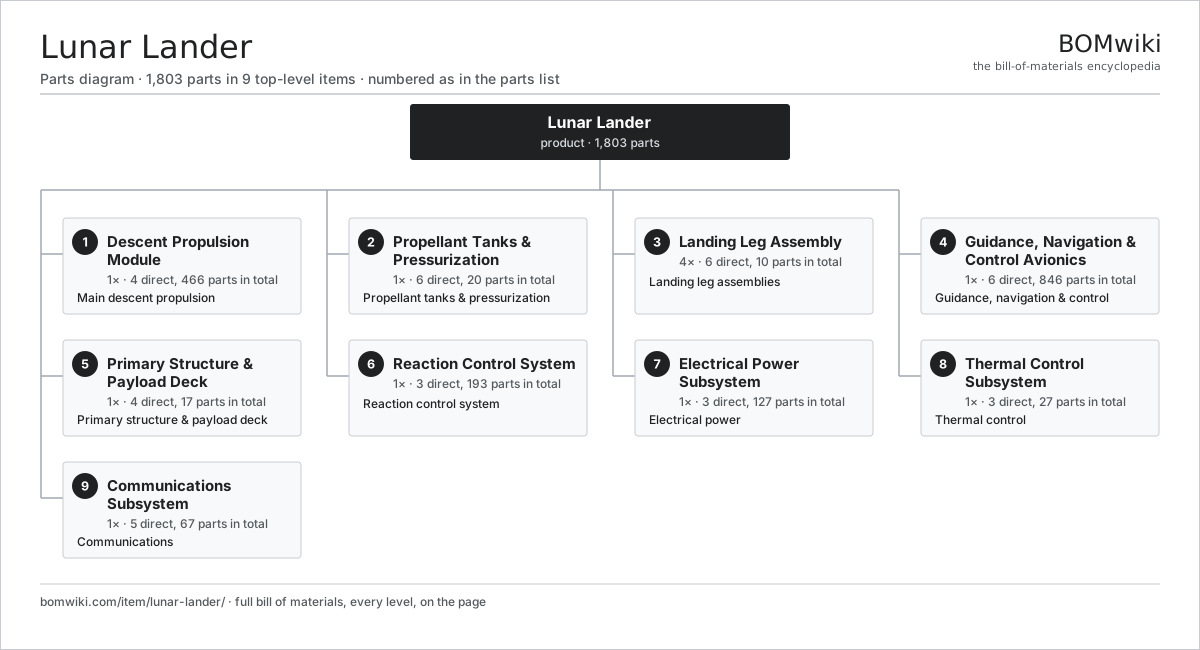
| # | Part | Qty | What it does |
|---|---|---|---|
| 1 | Descent Propulsion Module 4 parts | 1× | Main descent propulsion |
| 2 | Propellant Tanks & Pressurization 6 parts | 1× | Propellant tanks & pressurization |
| 3 | Landing Leg Assembly 6 parts | 4× | Landing leg assemblies |
| 4 | Guidance, Navigation & Control Avionics 6 parts | 1× | Guidance, navigation & control |
| 5 | Primary Structure & Payload Deck 4 parts | 1× | Primary structure & payload deck |
| 6 | Reaction Control System 3 parts | 1× | Reaction control system |
| 7 | Electrical Power Subsystem 3 parts | 1× | Electrical power |
| 8 | Thermal Control Subsystem 3 parts | 1× | Thermal control |
| 9 | Communications Subsystem 5 parts | 1× | Communications |
Diagrams & photos

3D model
No 3D model yet. Have a CAD file of this? Add a 3D model. STL renders right on this page; STEP, FreeCAD, and OpenSCAD sources are welcome too (openly licensed, like all 3D models on BOMwiki).
Build & assembly graph
expand / collapse · shared sub-assemblies converge · links to related products · est. labourTap an assembly to expand/collapse · tap a part to open it · use “Open page” for any node · drag to pan, scroll to zoom.
Bill of materials for Lunar Lander
9 top-level lines · 85 rows shown · 1,803 parts total · indented to 3 levels| # | Item / sub-assembly | Part no. | Qty/assy | Ext. qty | Parts | Type |
|---|---|---|---|---|---|---|
| 1 | Descent Propulsion Module 4 parts | lunar-lander-descent-propulsion | 1× | 1 | 466 | assembly |
| 1.1 | Throttleable Main Engine 5 parts | lunar-lander-main-engine | 3× | 3 | 6 | assembly |
| 1.1.1 | Pintle Injector | lunar-lander-pintle-injector | 1× | 3 | · | part |
| 1.1.2 | Combustion Chamber | lunar-lander-combustion-chamber | 1× | 3 | · | part |
| 1.1.3 | Engine Nozzle Extension | lunar-lander-engine-nozzle | 1× | 3 | · | part |
| 1.1.4 | Throttle Valve | lunar-lander-throttle-valve | 2× | 6 | · | part |
| 1.1.5 | O-Ring Set | oring-set | 1× | 3 | · | part |
| 1.2 | Engine Control Unit 5 parts | lunar-lander-engine-controller | 1× | 1 | 274 | assembly |
| 1.2.1 | Bare PCB | pcb-bare | 2× | 2 | · | part |
| 1.2.2 | Microcontroller | mcu | 2× | 2 | · | part |
| 1.2.3 | Power MOSFET | mosfet | 12× | 12 | · | part |
| 1.2.4 | SMD Passive (R/C/L) | smd-passives | 250× | 250 | · | part |
| 1.2.5 | Connector | connector | 8× | 8 | · | part |
| 1.3 | Gimbal Actuator 4 parts | lunar-lander-gimbal-actuator | 6× | 6 | 28 | assembly |
| 1.3.1 | Servo Motor 4 parts + deeper › | servo-motor | 1× | 6 | 24 | assembly |
| 1.3.2 | Ball Screw | ball-screw | 1× | 6 | · | part |
| 1.3.3 | Encoder | encoder | 1× | 6 | · | part |
| 1.3.4 | Ball Bearing | ball-bearing | 2× | 12 | · | part |
| 1.4 | Flex Feedline | lunar-lander-injector-feedline | 6× | 6 | · | part |
| 2 | Propellant Tanks & Pressurization 6 parts | lunar-lander-tank-farm | 1× | 1 | 20 | assembly |
| 2.1 | Fuel Tank | lunar-lander-fuel-tank | 2× | 2 | · | part |
| 2.2 | Oxidizer Tank | lunar-lander-ox-tank | 2× | 2 | · | part |
| 2.3 | Helium Pressurant Bottle | lunar-lander-helium-tank | 2× | 2 | · | part |
| 2.4 | Helium Pressure Regulator | lunar-lander-pressure-regulator | 2× | 2 | · | part |
| 2.5 | Pressure Sensor | pressure-sensor | 8× | 8 | · | part |
| 2.6 | O-Ring Set | oring-set | 4× | 4 | · | part |
| 3 | Landing Leg Assembly 6 parts | lunar-lander-landing-gear | 4× | 4 | 10 | assembly |
| 3.1 | Primary Strut | lunar-lander-primary-strut | 1× | 4 | · | part |
| 3.2 | Secondary Strut | lunar-lander-secondary-strut | 2× | 8 | · | part |
| 3.3 | Footpad | lunar-lander-footpad | 1× | 4 | · | part |
| 3.4 | Crushable Honeycomb Cartridge | lunar-lander-honeycomb-cartridge | 1× | 4 | · | part |
| 3.5 | Leg Deployment Mechanism 3 parts | lunar-lander-deploy-spring | 1× | 4 | 4 | assembly |
| 3.5.1 | Coil Spring | coil-spring | 2× | 8 | · | part |
| 3.5.2 | Leg Downlock Latch | lunar-lander-downlock | 1× | 4 | · | part |
| 3.5.3 | Fastener Set | fastener-set | 1× | 4 | · | part |
| 3.6 | Surface Contact Probe | lunar-lander-contact-probe | 1× | 4 | · | part |
| 4 | Guidance, Navigation & Control Avionics 6 parts | lunar-lander-avionics | 1× | 1 | 846 | assembly |
| 4.1 | Flight Computer 5 parts | lunar-lander-flight-computer | 2× | 2 | 416 | assembly |
| 4.1.1 | Bare PCB | pcb-bare | 3× | 6 | · | part |
| 4.1.2 | Compute SoC Module | soc-module | 1× | 2 | · | part |
| 4.1.3 | Microcontroller | mcu | 2× | 4 | · | part |
| 4.1.4 | SMD Passive (R/C/L) | smd-passives | 400× | 800 | · | part |
| 4.1.5 | Connector | connector | 10× | 20 | · | part |
| 4.2 | Inertial Measurement Unit | lunar-lander-imu | 2× | 2 | · | part |
| 4.3 | Doppler Landing Radar | lunar-lander-landing-radar | 1× | 1 | · | part |
| 4.4 | Hazard Detection Lidar | lunar-lander-lidar | 1× | 1 | · | part |
| 4.5 | Terrain Navigation Camera 4 parts | lunar-lander-trn-camera | 2× | 2 | 4 | assembly |
| 4.5.1 | CMOS Image Sensor | image-sensor | 1× | 2 | · | part |
| 4.5.2 | Lens Assembly | camera-lens | 1× | 2 | · | part |
| 4.5.3 | Bare PCB | pcb-bare | 1× | 2 | · | part |
| 4.5.4 | Compute SoC Module | soc-module | 1× | 2 | · | part |
| 4.6 | Wire Bundle | wire-bundle | 2× | 2 | · | part |
| 5 | Primary Structure & Payload Deck 4 parts | lunar-lander-structure | 1× | 1 | 17 | assembly |
| 5.1 | Payload Deck | lunar-lander-payload-deck | 1× | 1 | · | part |
| 5.2 | Sheet Metal Panel | sheet-panel | 8× | 8 | · | part |
| 5.3 | Rover Egress Ramp | lunar-lander-payload-ramp | 2× | 2 | · | part |
| 5.4 | Fastener Set | fastener-set | 6× | 6 | · | part |
| 6 | Reaction Control System 3 parts | lunar-lander-rcs | 1× | 1 | 193 | assembly |
| 6.1 | RCS Thruster | lunar-lander-rcs-thruster | 16× | 16 | · | part |
| 6.2 | RCS Thruster Pod | lunar-lander-rcs-pod | 4× | 4 | · | part |
| 6.3 | RCS Valve Driver 4 parts | lunar-lander-rcs-valve-driver | 1× | 1 | 173 | assembly |
| 6.3.1 | Bare PCB | pcb-bare | 1× | 1 | · | part |
| 6.3.2 | Power MOSFET | mosfet | 16× | 16 | · | part |
| 6.3.3 | SMD Passive (R/C/L) | smd-passives | 150× | 150 | · | part |
| 6.3.4 | Connector | connector | 6× | 6 | · | part |
| 7 | Electrical Power Subsystem 3 parts | lunar-lander-eps | 1× | 1 | 127 | assembly |
| 7.1 | Solar Panel | lunar-lander-solar-panel | 3× | 3 | · | part |
| 7.2 | Descent Battery 2 parts | lunar-lander-battery | 1× | 1 | 122 | assembly |
| 7.2.1 | Li-ion Cell, 18650 | li-cell-18650 | 120× | 120 | · | part |
| 7.2.2 | BMS Board | bms-board | 2× | 2 | · | part |
| 7.3 | Wire Bundle | wire-bundle | 2× | 2 | · | part |
| 8 | Thermal Control Subsystem 3 parts | lunar-lander-thermal | 1× | 1 | 27 | assembly |
| 8.1 | Heating Element | heating-element | 16× | 16 | · | part |
| 8.2 | Thermal Fuse | thermal-fuse | 8× | 8 | · | part |
| 8.3 | Plume Shield | lunar-lander-plume-shield | 3× | 3 | · | part |
| 9 | Communications Subsystem 5 parts | lunar-lander-comms | 1× | 1 | 67 | assembly |
| 9.1 | X-band Transponder | lunar-lander-x-transponder | 2× | 2 | · | part |
| 9.2 | Solid-State Power Amplifier | lunar-lander-power-amp | 2× | 2 | · | part |
| 9.3 | Steerable Medium-Gain Antenna 4 parts | lunar-lander-mga | 1× | 1 | 55 | assembly |
| 9.3.1 | Servo Motor 4 parts + deeper › | servo-motor | 2× | 2 | 24 | assembly |
| 9.3.2 | Encoder | encoder | 2× | 2 | · | part |
| 9.3.3 | Ball Bearing | ball-bearing | 4× | 4 | · | part |
| 9.3.4 | Fastener Set | fastener-set | 1× | 1 | · | part |
| 9.4 | Low-Gain Omni Antenna | lunar-lander-omni | 2× | 2 | · | part |
| 9.5 | Connector | connector | 6× | 6 | · | part |
Something wrong in this list? Report a problem with this BOM.
Related products
same domain, ranked by shared parts Crewed Space Capsule
7,222 parts · shares 20 with this page
Crewed Space Capsule
7,222 parts · shares 20 with this page
 GPS Navigation Satellite
2,640 parts · shares 22 with this page
GPS Navigation Satellite
2,640 parts · shares 22 with this page
 Weather Satellite
1,765 parts · shares 21 with this page
Weather Satellite
1,765 parts · shares 21 with this page
 Rocket Upper Stage
1,459 parts · shares 19 with this page
Rocket Upper Stage
1,459 parts · shares 19 with this page
 Cargo Resupply Spacecraft
574 parts · shares 18 with this page
Cargo Resupply Spacecraft
574 parts · shares 18 with this page
 Mars Science Rover
1,624 parts · shares 14 with this page
Mars Science Rover
1,624 parts · shares 14 with this page
Sourcing: possible vendors
Browse the supplier directory → Prices, MOQ, and lead times are algorithmic estimates, not quotes, and not claims about these companies. Company mappings are curated by keyword; est. price band $50k–$500M. How estimates work| Vendor | HQ | Specialty | MOQ | Lead time |
|---|---|---|---|---|
|
🇺🇸SpaceX
spacex.com ↗
|
Hawthorne, US | Launch & spacecraft | made to order | 52–104 wks |
| northropgrumman.com ↗ | Falls Church, US | Space & defense | made to order | 52–104 wks |
|
🇫🇷Airbus
airbus.com ↗
|
Toulouse, FR | Aerospace OEM | made to order | 52–104 wks |
| rocketlabusa.com ↗ | Long Beach, US | Launch & spacecraft | made to order | 52–104 wks |
| thalesaleniaspace.com ↗ | Cannes, FR | Satellites | made to order | 52–104 wks |
727-word article