Motion Cinema Seat
ProductOverview
A motion cinema seat is a specialized entertainment platform designed for immersive theme-park attractions, museums, and arcade venues. Each seat independently combines three environmental feedback modalities, motion actuation, pneumatic effects (air jets), and tactile stimulation (vibration, water spray), synchronized to synchronized video content, music, and lighting cues.
Unlike theme-park motion simulator rides (which move groups of 20–50 people), motion cinema seats are individual units, allowing venues to vary intensity per patron. A ride-shy visitor can disable motion while a thrill-seeker selects aggressive G-force profiles. This flexibility increases revenue per venue footprint because seats can be reconfigured for different age groups and risk tolerances.
The core innovation is the distributed control architecture: each seat runs a local CAN-bus controller that responds to show-wide DMX or timecode signals, but implements motion profiles autonomously. This decouples motion latency from network congestion, critical for 20+ synchronized seats in a single theater.
How it works
The Show Control Processor is mounted in a theater control rack and receives timecode (SMPTE LTC or MTC) from the media server or projection system. As the show plays, the processor broadcasts DMX-512 commands to all seats and optionally sends motion profiles via Ethernet.
Each seat's local Main Control Board decodes incoming DMX and time-aligned motion data, then schedules the Motion Actuator Array and Environmental Effects Module in real time. For example:
At timecode 00:02:15, a scene cut to a car crash triggers:
- 200 ms heave pulse (seat drop + rise)
- 8-channel air jet burst (face, neck, legs)
- 2-second rumble vibration
- Optional water mist spray
Each motion cue is pre-authored during show production and stored in the seat's local SSD, reducing latency. The CAN controller interpolates motion profiles at 100 Hz, smoothing discrete commands into natural motion.
The Seat Upholstery Assembly is upholstered in fire-rated polyester and padded to absorb shock. Armrests house wiring conduit and user controls (volume, motion intensity slider).
Applications and venues
Theme parks: Universal, Disney, and Six Flags deploy motion seats in flat-ride attractions (4-D theaters). A 15-minute show can rotate 60+ guests per hour at €15–25 per seat.
Museums: Natural history and science centers use motion seats for educational content (dinosaur experiences, space travel simulations).
Arcades and bowling centers: Retrofitted into existing venues for revenue diversification.
Environmental effects explained
Air jets simulate wind, explosions, or creature touch. Eight nozzles (face, neck, underarms, legs) create spatial immersion. Pressure is typically 2–5 bar, controlled via PWM solenoid dimmers.
Water spray is optional and requires a sealed reservoir (500 mL per show cycle). Peristaltic pumps avoid priming issues and contamination.
Vibration transducers provide bass-frequency rumble (infrasound), synchronized to explosion or impact sounds. This is subliminal feedback that amplifies audio perception.
Leg ticklers (pneumatic or solenoid) create tactile surprise, very effective for horror content.
Show production workflow
Content creators (park attractions teams) use software like MediaMaster or Disguise to trigger DMX/timecode events. Motion profiles are authored in proprietary show-authoring tools, then downloaded to seat SSDs before opening. Real-time tuning happens via a local control panel (velocity ramps, force limits).
Safety and standards
Motion cinema seats are regulated under EN 13814 (amusement ride safety). Seats include dual-channel emergency-stop relays, load sensors to prevent over-stressing elderly guests, and automatic cutoff if motion commands exceed safe limits. Venues typically disable motion for riders under 10 years old.
Auditoriums with 10+ seats implement watchdog timers to detect and isolate failed seats without cascading failure.
Production costs and ROI
A single motion cinema seat costs €25,000–€45,000 depending on effects modularity. A 10-seat installation is €300,000–€500,000 plus integration labor. Typical payback is 2–3 years in high-traffic venues.
Motion Cinema Seat parts and their functions
7 top-level parts · 41 parts in total · full bill of materials below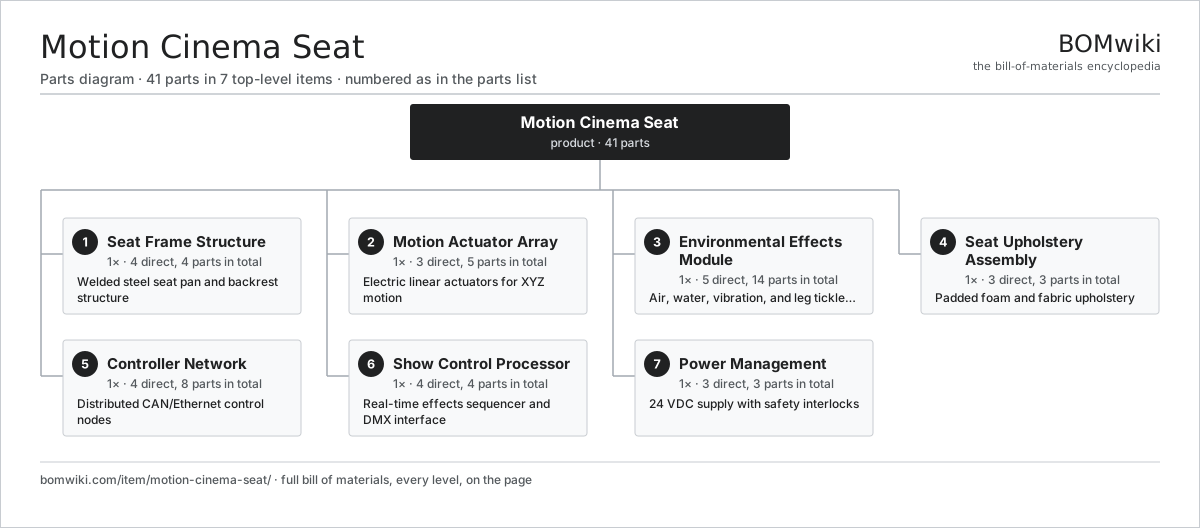
| # | Part | Qty | What it does |
|---|---|---|---|
| 1 | Seat Frame Structure 4 parts | 1× | Welded steel seat pan and backrest structure |
| 2 | Motion Actuator Array 3 parts | 1× | Electric linear actuators for XYZ motion |
| 3 | Environmental Effects Module 5 parts | 1× | Air, water, vibration, and leg tickler controllers |
| 4 | Seat Upholstery Assembly 3 parts | 1× | Padded foam and fabric upholstery |
| 5 | Controller Network 4 parts | 1× | Distributed CAN/Ethernet control nodes |
| 6 | Show Control Processor 4 parts | 1× | Real-time effects sequencer and DMX interface |
| 7 | Power Management 3 parts | 1× | 24 VDC supply with safety interlocks |
3D model
No 3D model yet. Have a CAD file of this? Add a 3D model. STL renders right on this page; STEP, FreeCAD, and OpenSCAD sources are welcome too (openly licensed, like all 3D models on BOMwiki).
Build & assembly graph
expand / collapse · shared sub-assemblies converge · links to related products · est. labourTap an assembly to expand/collapse · tap a part to open it · use “Open page” for any node · drag to pan, scroll to zoom.
Bill of materials for Motion Cinema Seat
7 top-level lines · 33 rows shown · 41 parts total · indented to 3 levels| # | Item / sub-assembly | Part no. | Qty/assy | Ext. qty | Parts | Type |
|---|---|---|---|---|---|---|
| 1 | Seat Frame Structure 4 parts | motion-cinema-seat-frame | 1× | 1 | 4 | assembly |
| 1.1 | Seat Pan | motion-cinema-seat-frame-pan | 1× | 1 | · | part |
| 1.2 | Backrest Frame | motion-cinema-seat-backrest-frame | 1× | 1 | · | part |
| 1.3 | Armrests | motion-cinema-seat-armrests | 1× | 1 | · | part |
| 1.4 | Fastener Set | fastener-set | 1× | 1 | · | part |
| 2 | Motion Actuator Array 3 parts | motion-cinema-seat-actuators | 1× | 1 | 5 | assembly |
| 2.1 | Linear Actuator | motion-cinema-seat-linear-actuator | 3× | 3 | · | part |
| 2.2 | Actuator Mounts | motion-cinema-seat-actuator-mounts | 1× | 1 | · | part |
| 2.3 | Motion Driver Board | motion-cinema-seat-motion-controller | 1× | 1 | · | part |
| 3 | Environmental Effects Module 5 parts | motion-cinema-seat-effects-module | 1× | 1 | 14 | assembly |
| 3.1 | Solenoid Valve Block | motion-cinema-seat-air-jet-manifold | 1× | 1 | · | part |
| 3.2 | Air Jet Nozzles | motion-cinema-seat-air-nozzles | 8× | 8 | · | part |
| 3.3 | Water Pump | motion-cinema-seat-water-pump | 1× | 1 | · | part |
| 3.4 | Vibration Motor | motion-cinema-seat-vibro-motor | 2× | 2 | · | part |
| 3.5 | Leg Tickler | motion-cinema-seat-tickler-solenoid | 2× | 2 | · | part |
| 4 | Seat Upholstery Assembly 3 parts | motion-cinema-seat-seat-shell | 1× | 1 | 3 | assembly |
| 4.1 | Foam Shell | motion-cinema-seat-foam-shell | 1× | 1 | · | part |
| 4.2 | Upholstery Fabric | motion-cinema-seat-fabric-cover | 1× | 1 | · | part |
| 4.3 | Headrest | motion-cinema-seat-headrest-pad | 1× | 1 | · | part |
| 5 | Controller Network 4 parts | motion-cinema-seat-controller-network | 1× | 1 | 8 | assembly |
| 5.1 | Main Control Board | motion-cinema-seat-main-controller | 1× | 1 | · | part |
| 5.2 | Effect Driver Node | motion-cinema-seat-effect-node | 2× | 2 | · | part |
| 5.3 | Safety Relay Module | motion-cinema-seat-safety-relay | 1× | 1 | · | part |
| 5.4 | Connector | connector | 4× | 4 | · | part |
| 6 | Show Control Processor 4 parts | motion-cinema-seat-show-processor | 1× | 1 | 4 | assembly |
| 6.1 | Show Processor PC | motion-cinema-seat-processor-unit | 1× | 1 | · | part |
| 6.2 | DMX/AES Interface | motion-cinema-seat-dmx-receiver | 1× | 1 | · | part |
| 6.3 | Timecode Reader | motion-cinema-seat-timecode-module | 1× | 1 | · | part |
| 6.4 | Show Storage | motion-cinema-seat-show-storage | 1× | 1 | · | part |
| 7 | Power Management 3 parts | motion-cinema-seat-power-supply | 1× | 1 | 3 | assembly |
| 7.1 | 24V Power Supply | motion-cinema-seat-dcdc-converter | 1× | 1 | · | part |
| 7.2 | Circuit Breaker | motion-cinema-seat-circuit-breaker | 1× | 1 | · | part |
| 7.3 | Auxiliary Supply | motion-cinema-seat-control-voltage-tap | 1× | 1 | · | part |
Something wrong in this list? Report a problem with this BOM.
Sourcing: possible vendors
Browse the supplier directory → Prices, MOQ, and lead times are algorithmic estimates, not quotes, and not claims about these companies. Company mappings are curated by keyword; est. price band $50–$2k. How estimates work| Vendor | HQ | Specialty | MOQ | Lead time |
|---|---|---|---|---|
|
🇨🇳Foxconn
foxconn.com ↗
|
Shenzhen, CN | Electronics contract mfg | 1,000 units | 8–14 wks |
|
🇺🇸Jabil
jabil.com ↗
|
St. Petersburg, US | Electronics manufacturing | 1,000 units | 8–14 wks |
|
🇺🇸Flex
flex.com ↗
|
Austin, US | Electronics manufacturing | 1,000 units | 8–14 wks |
| celestica.com ↗ | Toronto, CA | Electronics manufacturing | 1,000 units | 8–14 wks |
|
🇺🇸Sanmina
sanmina.com ↗
|
San Jose, US | Electronics manufacturing | 1,000 units | 8–14 wks |
640-word article