Racing Simulator Rig
ProductOverview
A racing simulator rig is a high-fidelity driver-training platform that replicates the physical controls and visual environment of a race car cockpit. Unlike arcade-style consumer sim rigs, professional-grade simulators use industrial-strength force-feedback steering wheels, load-cell pedals with haptic resistance, and surround-view display systems to deliver training transfer rates comparable to real vehicle driving.
The core architecture comprises four independent input systems: the steering wheel with servo-driven force feedback, three instrumented pedals (brake, throttle, clutch) with load cells, a gear shifter with positional sensing, and typically a three-monitor surround display at 150° horizontal field of view. A high-end gaming PC runs specialized racing simulation software (Assetto Corsa, rFactor 2, or iRacing) and interfaces each input device in real time.
Professional sim rigs are deployed by racing schools, automotive manufacturers for driver development, and esports facilities. They reduce training time by 20–40% compared to classroom-only instruction, because muscle memory for throttle modulation, braking pressure, and steering smoothness develops through repetitive feedback loops.
How it works
The driver sits in an automotive racing bucket seat and grips the force-feedback wheel. At the moment they turn, a rotary encoder in the wheel base reports the angle to the PC. The racing sim software calculates road friction (tire grip), suspension response, and aerodynamic forces, then commands the steering servo motor to apply opposing torque, heavier in high-speed corners, lighter on straights. This haptic feedback cues the driver's nervous system to the current driving state.
The pedal assembly works similarly: pressing the brake pedal compresses a load cell mounted under the pedal platform. The software reads this analog signal, calculates deceleration dynamics, and may apply back-pressure through the pedal mechanism (passive springs, or active haptic motors in higher-end rigs). Load-cell architecture is critical, unlike potentiometer-based pedals, load cells are immune to dust contamination and hysteresis.
The Shifter Module is typically a simple detent mechanism with a rotary encoder that reports gear position. The software uses this to engage the appropriate gear physics (engine braking, power delivery curve).
Display content renders at the GPU via the Control Computer. The three monitors are arranged at 45° angles (left and right flanking the center) to present a 150° field of view. This replicates a real windshield, allowing drivers to use peripheral vision for reference points and apex cues.
Optional: A 2–3 axis motion platform beneath the seat provides subtle heave (acceleration/braking) and pitch (cornering) feedback. This is expensive and lower-priority than wheel/pedal realism, but studies show it accelerates skill transfer by another 10–15%.
Racing applications
Formula 1 teams use high-fidelity sims for driver development and setup optimization before track testing. McLaren, Mercedes, and Red Bull have spent €5+ million on their in-house simulators. Racing schools like Skip Barber and Carlos Sainz racing academy use commercial rigs to teach line selection and racecraft without risk. Esports competitors train on rigs to develop reflexes for competitive titles like iRacing.
The advantage of sims: repetition without cost. A track day costs €1,000–€5,000. A sim session costs €10–€30/hour. Drivers can log 100s of hours on the same virtual circuit, perfecting technique.
Key hardware components
The Steering System is the most critical component. Industrial direct-drive motors (Fanatec, Simucube) deliver 30+ Nm of torque and maintain linearity across the 0–900° range. Cheaper belt-driven bases exhibit deadband and hysteresis, limiting training value.
The Pedal Module with load cells ensures that throttle and brake modulation feel natural. Consumer potentiometer pedals lack the tactile feedback of real brakes and lead to jerky inputs.
The Display System should run at minimum 144 Hz. Below 60 Hz, the driver sees aliasing artifacts on guardrails and curbing, disrupting spatial perception. 144 Hz reduces perceived latency by 3 ms relative to 60 Hz, which is meaningful for lap-time consistency.
Standards and certification
Automotive suppliers (Ford, Honda) qualify sim rigs per ISO 11592 (flight simulator evaluation) and bespoke validation protocols. Drivers trained on a validated rig can transfer skills to real vehicles without intermediate supervised track time.
Consumer rigs lack formal certification but are often validated against published iRacing or rFactor 2 physics engines. Community feedback on lap-time accuracy and vehicle feel is the de facto quality metric.
Racing Simulator Rig parts and their functions
7 top-level parts · 33 parts in total · full bill of materials below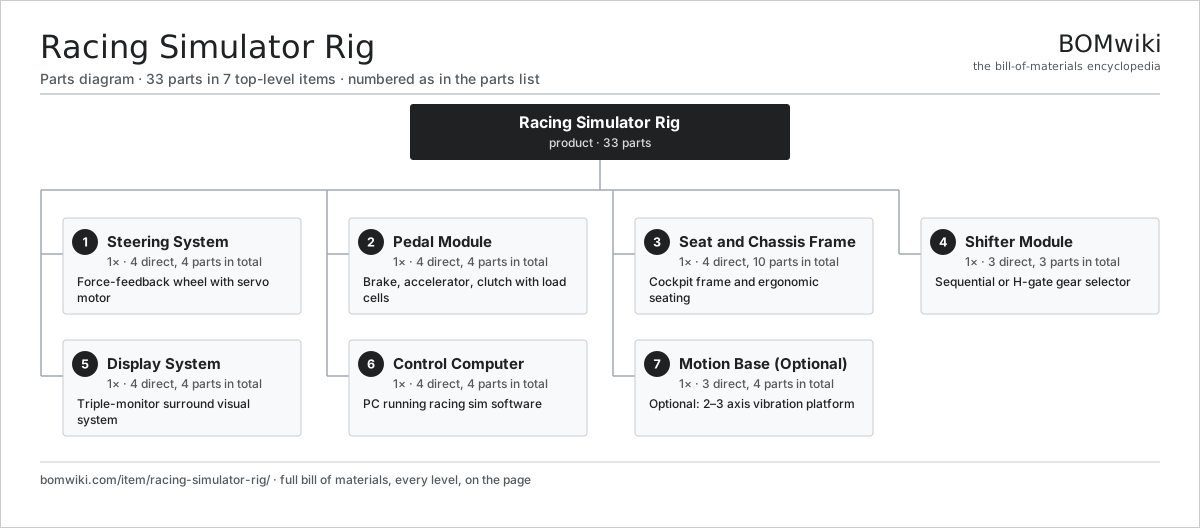
| # | Part | Qty | What it does |
|---|---|---|---|
| 1 | Steering System 4 parts | 1× | Force-feedback wheel with servo motor |
| 2 | Pedal Module 4 parts | 1× | Brake, accelerator, clutch with load cells |
| 3 | Seat and Chassis Frame 4 parts | 1× | Cockpit frame and ergonomic seating |
| 4 | Shifter Module 3 parts | 1× | Sequential or H-gate gear selector |
| 5 | Display System 4 parts | 1× | Triple-monitor surround visual system |
| 6 | Control Computer 4 parts | 1× | PC running racing sim software |
| 7 | Motion Base (Optional) 3 parts | 1× | Optional: 2–3 axis vibration platform |
3D model
No 3D model yet. Have a CAD file of this? Add a 3D model. STL renders right on this page; STEP, FreeCAD, and OpenSCAD sources are welcome too (openly licensed, like all 3D models on BOMwiki).
Build & assembly graph
expand / collapse · shared sub-assemblies converge · links to related products · est. labourTap an assembly to expand/collapse · tap a part to open it · use “Open page” for any node · drag to pan, scroll to zoom.
Bill of materials for Racing Simulator Rig
7 top-level lines · 38 rows shown · 33 parts total · indented to 3 levels| # | Item / sub-assembly | Part no. | Qty/assy | Ext. qty | Parts | Type |
|---|---|---|---|---|---|---|
| 1 | Steering System 4 parts | racing-simulator-rig-steering-system | 1× | 1 | 4 | assembly |
| 1.1 | Wheel Base Housing | racing-simulator-rig-wheel-base-housing | 1× | 1 | · | part |
| 1.2 | Steering Servo Motor | racing-simulator-rig-steering-motor | 1× | 1 | · | part |
| 1.3 | Steering Encoder | racing-simulator-rig-steering-encoder | 1× | 1 | · | part |
| 1.4 | Steering Wheel | racing-simulator-rig-steering-wheel-rim | 1× | 1 | · | part |
| 2 | Pedal Module 4 parts | racing-simulator-rig-pedal-assembly | 1× | 1 | 4 | assembly |
| 2.1 | Pedal Platform | racing-simulator-rig-pedal-frame | 1× | 1 | · | part |
| 2.2 | Brake Pedal | racing-simulator-rig-brake-pedal | 1× | 1 | · | part |
| 2.3 | Throttle Pedal | racing-simulator-rig-throttle-pedal | 1× | 1 | · | part |
| 2.4 | Clutch Pedal | racing-simulator-rig-clutch-pedal | 1× | 1 | · | part |
| 3 | Seat and Chassis Frame 4 parts | racing-simulator-rig-seat-chassis | 1× | 1 | 10 | assembly |
| 3.1 | Seat Assembly 5 parts | seat-assembly | 1× | 1 | 7 | assembly |
| 3.1.1 | Seat Frame | seat-frame | 1× | 1 | · | part |
| 3.1.2 | Seat Foam | seat-foam | 2× | 2 | · | part |
| 3.1.3 | Seat Cover | seat-cover | 1× | 1 | · | part |
| 3.1.4 | Seat Motor | seat-motor | 2× | 2 | · | part |
| 3.1.5 | Seat Heater Mat | seat-heater | 1× | 1 | · | part |
| 3.2 | Main Frame | racing-simulator-rig-frame-main | 1× | 1 | · | part |
| 3.3 | Shifter Mount Bracket | racing-simulator-rig-shifter-bracket | 1× | 1 | · | part |
| 3.4 | Cable Shielding | racing-simulator-rig-cable-conduit | 1× | 1 | · | part |
| 4 | Shifter Module 3 parts | racing-simulator-rig-shifter-system | 1× | 1 | 3 | assembly |
| 4.1 | Shifter Gate Mechanism | racing-simulator-rig-shifter-mechanism | 1× | 1 | · | part |
| 4.2 | Shifter Encoder | racing-simulator-rig-shifter-encoder | 1× | 1 | · | part |
| 4.3 | Shifter Handle | racing-simulator-rig-shifter-grip | 1× | 1 | · | part |
| 5 | Display System 4 parts | racing-simulator-rig-display-cluster | 1× | 1 | 4 | assembly |
| 5.1 | Left Monitor | racing-simulator-rig-monitor-left | 1× | 1 | · | part |
| 5.2 | Center Monitor | racing-simulator-rig-monitor-center | 1× | 1 | · | part |
| 5.3 | Right Monitor | racing-simulator-rig-monitor-right | 1× | 1 | · | part |
| 5.4 | Monitor Mounting Frame | racing-simulator-rig-monitor-stand | 1× | 1 | · | part |
| 6 | Control Computer 4 parts | racing-simulator-rig-control-computer | 1× | 1 | 4 | assembly |
| 6.1 | CPU/GPU Module | racing-simulator-rig-cpu-gpu | 1× | 1 | · | part |
| 6.2 | Power Supply | power-supply | 1× | 1 | · | part |
| 6.3 | Memory and Storage | racing-simulator-rig-ram-storage | 1× | 1 | · | part |
| 6.4 | Control Interface Board | racing-simulator-rig-io-interface | 1× | 1 | · | part |
| 7 | Motion Base (Optional) 3 parts | racing-simulator-rig-motion-option | 1× | 1 | 4 | assembly |
| 7.1 | Motion Actuator | racing-simulator-rig-motion-actuator | 2× | 2 | · | part |
| 7.2 | Motion Mount Plate | racing-simulator-rig-motion-frame | 1× | 1 | · | part |
| 7.3 | Motion Control Module | racing-simulator-rig-motion-controller | 1× | 1 | · | part |
Something wrong in this list? Report a problem with this BOM.
Related products
same domain, ranked by shared parts VR Motion Simulator
49 parts · shares 7 with this page
Air Quality Monitor
365 parts · shares 1 with this page
VR Motion Simulator
49 parts · shares 7 with this page
Air Quality Monitor
365 parts · shares 1 with this page
 Amateur Radio Transceiver
295 parts · shares 1 with this page
Amateur Radio Transceiver
295 parts · shares 1 with this page
 Bone Conduction Headphones
34 parts · shares 1 with this page
Bone Conduction Headphones
34 parts · shares 1 with this page
 Car FM Transmitter
240 parts · shares 1 with this page
Car FM Transmitter
240 parts · shares 1 with this page
 CB Radio
228 parts · shares 1 with this page
CB Radio
228 parts · shares 1 with this page
Sourcing: possible vendors
Browse the supplier directory → Prices, MOQ, and lead times are algorithmic estimates, not quotes, and not claims about these companies. Company mappings are curated by keyword; est. price band $50–$2k. How estimates work| Vendor | HQ | Specialty | MOQ | Lead time |
|---|---|---|---|---|
|
🇨🇳Foxconn
foxconn.com ↗
|
Shenzhen, CN | Electronics contract mfg | 1,000 units | 8–14 wks |
|
🇺🇸Jabil
jabil.com ↗
|
St. Petersburg, US | Electronics manufacturing | 1,000 units | 8–14 wks |
|
🇺🇸Flex
flex.com ↗
|
Austin, US | Electronics manufacturing | 1,000 units | 8–14 wks |
| celestica.com ↗ | Toronto, CA | Electronics manufacturing | 1,000 units | 8–14 wks |
|
🇺🇸Sanmina
sanmina.com ↗
|
San Jose, US | Electronics manufacturing | 1,000 units | 8–14 wks |
738-word article