Radar Detector
ProductOverview
A radar detector is an automotive electronic device that senses and alerts drivers to radar signals emitted by law-enforcement speed-measurement equipment. Unlike radar guns that actively measure vehicle speed, radar detectors are passive receivers: they listen for the electromagnetic pulses or continuous-wave signals used by police radar, laser, or newer automatic number plate recognition (ANPR) systems, and display warnings to help drivers avoid speed-enforcement penalties.
The Radar Detector uses a superheterodyne radio receiver architecture, a classic radio design dating to the 1920s but refined for the 9–35 GHz microwave bands where automotive radar operates. The unit monitors three primary police radar bands: X-band (10.525 GHz, older radar), K-band (24.125 GHz, modern handheld guns), and Ka-band (35.5 GHz, newest Doppler radar). Upon detecting a signal, the detector displays which band was hit and generates audio/visual alerts, often integrated with a GPS module that logs detection locations for speed-trap mapping.
How it works
The radar-detector-antenna, a corrugated horn optimized for 9.5–35.5 GHz, collects incoming radar signals and directs them to the Receiver Frontend. The first stage is the Low-Noise Amplifier, a low-noise amplifier providing 20 dB gain with a noise figure below 4 dB, critical because radar signals arriving at the vehicle are extremely weak (–75 dBm or lower). Immediately downstream is the Band Filter Set, a set of cascaded microwave bandpass filters isolating X, K, and Ka frequency bands. Each X-Band Filter, K-Band Filter, and Ka-Band Filter is a cavity resonator with extremely high Q (quality factor), rejecting out-of-band energy by 30+ dB and preventing desensitization from strong nearby FM radio transmitters or cell towers.
The filtered signals pass through a Band Preselection Switch, either a relay-based or PIN-diode switch, that routes the selected band to the Superheterodyne Converter. Here, a Schottky Mixer Diode combines the RF signal with a locally generated oscillator signal from the LO Synthesizer, downconverting the high-frequency radar to a lower IF Amplifier (intermediate frequency) centered at 1.3 GHz. This intermediate frequency is chosen as a compromise: high enough to avoid 1 MHz audio interference, low enough for practical IF amplifier bandwidths and frequency synthesis. The IF Bandpass Filter, a surface acoustic wave (SAW) filter, provides a 50 MHz bandpass centered on the IF, removing noise outside the radar band.
The downconverted IF signal is amplified by the IF Amplifier and sent to the Signal Processor, where analog detection begins. An Envelope Detector (diode and RC circuit) extracts the envelope, the time-varying power modulation, of the received radar pulses. This envelope is digitized by an Analog-to-Digital Converter (12-bit, 100 kHz sampling), and the resulting digital waveform is analyzed by a Signal Processing DSP (digital signal processor).
The DSP performs critical false-alarm rejection. Police radar produces distinctive modulation signatures: X-band pulses repeat at 30–2500 Hz with microsecond durations; K-band uses Doppler-shifted continuous waves; Ka-band transmits chirped pulses. The DSP correlates the captured waveform against known patterns, rejecting random noise, cellular base-station harmonics, and other spurious RF that would otherwise trigger constant false alerts. Only signals matching expected radar modulation patterns advance to trigger an audio alert.
When a radar match is detected, a Threshold Comparator comparator threshold is exceeded, and the Display & Controls is updated. The LCD Panel shows the detected band (X / K / Ka) alphanumerically, and separate Band LED Array LEDs illuminate in red for each detected band. A Audio Alert Buzzer emits an 85 dB alarm tone, which can be silenced by button press without disabling future detection. The GPS Module simultaneously logs the vehicle's GPS coordinates via its Active GPS Antenna, storing each detection event in the Incident Logger (typically a flash EEPROM), allowing the driver to review and map detected radar sources later.
The Power Supply converts the vehicle's 12 V DC power to regulated supplies: the Buck Converter IC (a buck converter) produces 5 V for logic and microcontroller, while isolated rails ±15 V are generated for RF amplifier stages, protecting sensitive analog circuits from automotive electrical transients (alternator load-dump, engine spark noise).
Practical operation
A driver heading down a highway with the radar detector mounted on the windshield via its Suction Cup Bracket will see the Sun Visor Shield sun visor snap-on reducing LCD glare in bright daylight. The detector continuously scans all bands, displaying signal strength graphically and muting the buzzer in "city mode" to reduce nuisance alerts from automatic garage door openers, speed-radar signs, and traffic-light sensors that emit false positives.
When the Display & Controls flashes and the Audio Alert Buzzer sounds, say, a K-band detection, the driver recognizes an active radar in the vicinity. By consulting the GPS Module historical logs, frequent detections at a specific intersection become apparent, revealing a routine speed-enforcement location. Modern detectors integrate with smartphone apps that crowd-source detection reports, creating a community database of enforcement patterns.
Limitations and evolution
Radar detectors are legal in most U.S. states but illegal in some (Virginia, Washington D.C.) and in many foreign countries. Modern police have countered detection through use of instant-on radar (brief signal pulses rather than continuous sweeping), rendering reaction time insufficient for speed adjustment. Newer law-enforcement methods such as ANPR (automatic number-plate recognition using cameras) and laser-based speed guns are invisible to traditional radar detectors, spurring detector manufacturers to add laser-detection modules (separate photoreceptor arrays sensitive to near-infrared laser light). The Radar Detector architecture described here remains the most common implementation for radio-frequency radar detection, though integrated lidar (light detection and ranging) detection is increasingly merged into high-end consumer units.
Radar Detector parts and their functions
9 top-level parts · 31 parts in total · full bill of materials below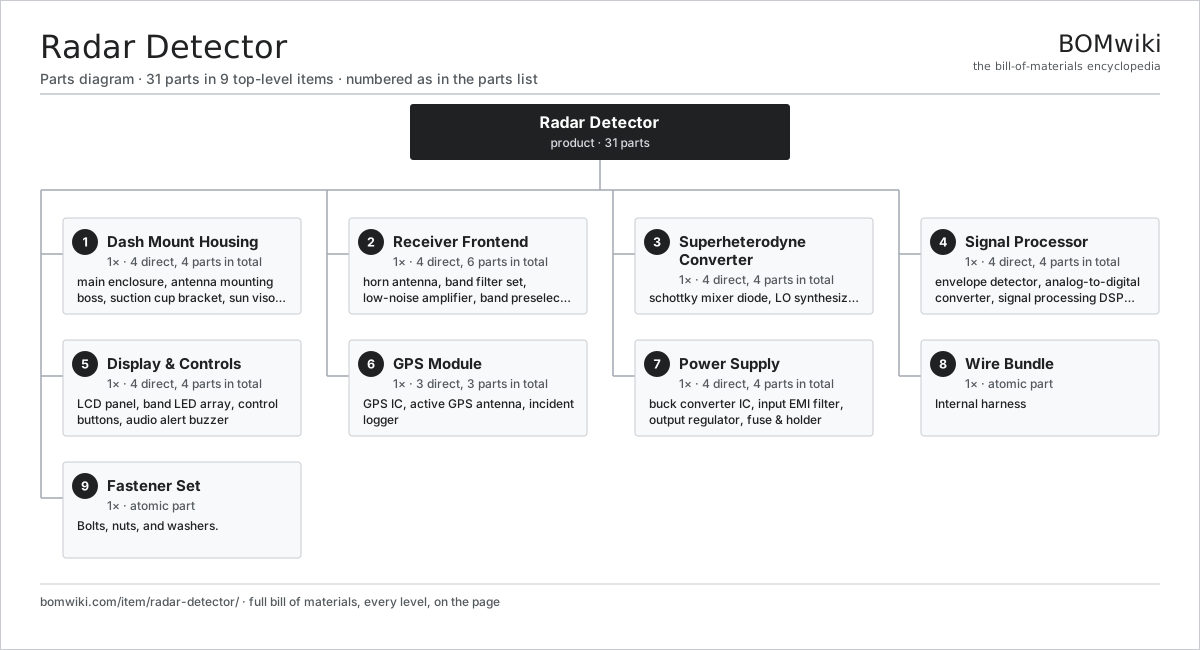
| # | Part | Qty | What it does |
|---|---|---|---|
| 1 | Dash Mount Housing 4 parts | 1× | Plastic windshield-mounted enclosure with integrated horn antenna and suction cup bracket. |
| 2 | Receiver Frontend 4 parts | 1× | Low-noise RF receiver with selective filters for X, K, Ka, and Ku frequency bands. |
| 3 | Superheterodyne Converter 4 parts | 1× | Mixer, local oscillator, and IF amplifier downconverting microwave signals to baseband. |
| 4 | Signal Processor 4 parts | 1× | Detector, ADC, and signal processing chain distinguishing radar from noise. |
| 5 | Display & Controls 4 parts | 1× | LCD showing detected bands, signal strength, and alert mode with manual tuning controls. |
| 6 | GPS Module 3 parts | 1× | Receiver logging detector coordinates for red-light camera and speed-trap mapping. |
| 7 | Power Supply 4 parts | 1× | DC-DC converter stepping down vehicle 12 V to regulated supply for RF and logic. |
| 8 | Wire Bundle | 1× | Internal harness |
| 9 | Fastener Set | 1× | Bolts, nuts, and washers. |
3D model
No 3D model yet. Have a CAD file of this? Add a 3D model. STL renders right on this page; STEP, FreeCAD, and OpenSCAD sources are welcome too (openly licensed, like all 3D models on BOMwiki).
Build & assembly graph
expand / collapse · shared sub-assemblies converge · links to related products · est. labourTap an assembly to expand/collapse · tap a part to open it · use “Open page” for any node · drag to pan, scroll to zoom.
Bill of materials for Radar Detector
9 top-level lines · 39 rows shown · 31 parts total · indented to 3 levels| # | Item / sub-assembly | Part no. | Qty/assy | Ext. qty | Parts | Type |
|---|---|---|---|---|---|---|
| 1 | Dash Mount Housing 4 parts | radar-detector-housing | 1× | 1 | 4 | assembly |
| 1.1 | Main Enclosure | radar-detector-main-shell | 1× | 1 | · | part |
| 1.2 | Antenna Mounting Boss | radar-detector-antenna-boss | 1× | 1 | · | part |
| 1.3 | Suction Cup Bracket | radar-detector-suction-mount | 1× | 1 | · | part |
| 1.4 | Sun Visor Shield | radar-detector-visor-shield | 1× | 1 | · | part |
| 2 | Receiver Frontend 4 parts | radar-detector-receiver-frontend | 1× | 1 | 6 | assembly |
| 2.1 | Horn Antenna | radar-detector-horn-antenna | 1× | 1 | · | part |
| 2.2 | Band Filter Set 3 parts | radar-detector-band-filter-assembly | 1× | 1 | 3 | assembly |
| 2.2.1 | X-Band Filter | radar-detector-x-band-filter | 1× | 1 | · | part |
| 2.2.2 | K-Band Filter | radar-detector-k-band-filter | 1× | 1 | · | part |
| 2.2.3 | Ka-Band Filter | radar-detector-ka-band-filter | 1× | 1 | · | part |
| 2.3 | Low-Noise Amplifier | radar-detector-lna-stage | 1× | 1 | · | part |
| 2.4 | Band Preselection Switch | radar-detector-preselector-switch | 1× | 1 | · | part |
| 3 | Superheterodyne Converter 4 parts | radar-detector-superheterodyne-chain | 1× | 1 | 4 | assembly |
| 3.1 | Schottky Mixer Diode | radar-detector-mixer | 1× | 1 | · | part |
| 3.2 | LO Synthesizer | radar-detector-lo-synthesizer | 1× | 1 | · | part |
| 3.3 | IF Amplifier | radar-detector-if-amplifier | 1× | 1 | · | part |
| 3.4 | IF Bandpass Filter | radar-detector-if-filter | 1× | 1 | · | part |
| 4 | Signal Processor 4 parts | radar-detector-signal-processor | 1× | 1 | 4 | assembly |
| 4.1 | Envelope Detector | radar-detector-envelope-detector | 1× | 1 | · | part |
| 4.2 | Analog-to-Digital Converter | radar-detector-adc | 1× | 1 | · | part |
| 4.3 | Signal Processing DSP | radar-detector-dsp-chip | 1× | 1 | · | part |
| 4.4 | Threshold Comparator | radar-detector-threshold-ic | 1× | 1 | · | part |
| 5 | Display & Controls 4 parts | radar-detector-display-unit | 1× | 1 | 4 | assembly |
| 5.1 | LCD Panel | lcd-panel | 1× | 1 | · | part |
| 5.2 | Band LED Array | radar-detector-led-indicator | 1× | 1 | · | part |
| 5.3 | Control Buttons | radar-detector-button-set | 1× | 1 | · | part |
| 5.4 | Audio Alert Buzzer | radar-detector-buzzer | 1× | 1 | · | part |
| 6 | GPS Module 3 parts | radar-detector-gps-module | 1× | 1 | 3 | assembly |
| 6.1 | GPS IC | radar-detector-gps-receiver | 1× | 1 | · | part |
| 6.2 | Active GPS Antenna | radar-detector-gps-antenna | 1× | 1 | · | part |
| 6.3 | Incident Logger | radar-detector-data-storage | 1× | 1 | · | part |
| 7 | Power Supply 4 parts | radar-detector-power-circuit | 1× | 1 | 4 | assembly |
| 7.1 | Buck Converter IC | radar-detector-converter-ic | 1× | 1 | · | part |
| 7.2 | Input EMI Filter | radar-detector-input-filter | 1× | 1 | · | part |
| 7.3 | Output Regulator | radar-detector-output-filter | 1× | 1 | · | part |
| 7.4 | Fuse & Holder | radar-detector-fuse-holder | 1× | 1 | · | part |
| 8 | Wire Bundle | wire-bundle | 1× | 1 | · | part |
| 9 | Fastener Set | fastener-set | 1× | 1 | · | part |
Something wrong in this list? Report a problem with this BOM.
Related products
same domain, ranked by shared parts Amateur Radio Transceiver
295 parts · shares 2 with this page
Amateur Radio Transceiver
295 parts · shares 2 with this page
 Car FM Transmitter
240 parts · shares 2 with this page
Car FM Transmitter
240 parts · shares 2 with this page
 Clamp Meter
27 parts · shares 2 with this page
Digital Multimeter
32 parts · shares 2 with this page
Clamp Meter
27 parts · shares 2 with this page
Digital Multimeter
32 parts · shares 2 with this page
 Digital Photo Frame
31 parts · shares 2 with this page
Digital Photo Frame
31 parts · shares 2 with this page
 Frequency Counter
28 parts · shares 2 with this page
Frequency Counter
28 parts · shares 2 with this page
Sourcing: possible vendors
Browse the supplier directory → Prices, MOQ, and lead times are algorithmic estimates, not quotes, and not claims about these companies. Company mappings are curated by keyword; est. price band $50–$2k. How estimates work| Vendor | HQ | Specialty | MOQ | Lead time |
|---|---|---|---|---|
|
🇨🇳Foxconn
foxconn.com ↗
|
Shenzhen, CN | Electronics contract mfg | 1,000 units | 8–14 wks |
|
🇺🇸Jabil
jabil.com ↗
|
St. Petersburg, US | Electronics manufacturing | 1,000 units | 8–14 wks |
|
🇺🇸Flex
flex.com ↗
|
Austin, US | Electronics manufacturing | 1,000 units | 8–14 wks |
| celestica.com ↗ | Toronto, CA | Electronics manufacturing | 1,000 units | 8–14 wks |
|
🇺🇸Sanmina
sanmina.com ↗
|
San Jose, US | Electronics manufacturing | 1,000 units | 8–14 wks |
1,009-word article