Smart Mirror
ProductOverview
A smart mirror is a bathroom or bedroom mirror augmented with a digital display, processing power, and sensors, enabling real-time information display, voice control, and gesture recognition. Behind a semi-reflective dichroic glass surface sits a full-HD or 4K display that projects weather, calendar, time, news, and health data. The device runs a custom or open-source interface (often Linux-based) and integrates with home automation platforms like Amazon Alexa or Google Home.
Smart mirrors combine reflective function (traditional mirror) with display capability, making them a convergence of IoT and bathroom/bedroom fixtures. Beyond aesthetics, they serve functional roles: voice-activated routines, video calls, fitness tracking, and smart home control.
How It Works
At the optical level, the Two-Way Mirror Glass is a dichroic or partially silvered mirror. Its coating reflects roughly 40–60% of ambient light (allowing normal mirror reflection), while transmitting the remaining light from the Embedded Display Panel behind it. The LCD Display Panel, a standard full-HD or 4K panel, sits 20–50 mm behind the glass, backlit by LED Backlight Unit LEDs.
The Computing Module runs a Linux or Android OS on an ARM processor (e.g., Raspberry Pi 4 or Qualcomm Snapdragon). This SoC manages the display via HDMI, controls peripheral sensors, and handles WiFi connectivity via the WiFi & BLE Radio. The user sees text, images, and widgets overlaid on their mirror reflection.
Interaction happens via two primary modes:
Voice Commands: The Mic Array Module, typically 2–4 far-field MEMS microphones, captures voice at 1–2 meters distance. The Audio Codec IC streams audio to the processor, which applies noise cancellation and forwards packets to a voice service (Alexa, Google Assistant, or local speech recognition). The Speaker outputs audio responses.
Gestures & Touchless UI: The RGB-D Camera Module (5–8MP RGB + IR depth sensor) enables hand tracking and gesture recognition. Waving at the mirror, for instance, can wake the display or trigger menus. Face detection algorithms determine if someone is present, supporting automatic display wake/sleep.
The Environmental Sensors measures ambient temperature, humidity, and light level. These feed into the OS to auto-adjust display brightness and inform widgets (e.g., "bathroom humidity is 85%, ventilate").
All intelligence lives on-device: a single-board computer or SoM handles local processing, with optional cloud connectivity for weather, news feeds, and account integration.
Optical Properties and Installation
The Reflective Coating is critical: too reflective (60%+) and the display becomes dim; too dark (≤20% reflective) and mirror function is lost. Industry standard is 30–50% reflectivity, balancing both roles.
Anti-Fog Coating coatings are essential for bathroom installation. Without them, steam during showers causes condensation on the mirror surface and behind the glass, fogging the display. Hydrophilic treatments (e.g., silicon-based coatings) cause water beads to slide off rather than pool.
Installation is typically VESA wall-mounted or recessed into wall cavities. Mirrors ≥40 inches require significant structural support (50–100 lbs) and power (100–120V outlet nearby or hardwired 12V DC).
Computing and Software Stack
Most consumer smart mirrors run custom Linux distributions (often Raspbian on Raspberry Pi hardware) or lightweight Android. Open-source projects like "MirrorMirror" or "Magic Mirror" provide web-based frameworks for widget management and voice integration. Premium commercial products (e.g., Kohler smart mirrors) use closed proprietary stacks.
The Compute SoC Module may include Alexa voice service licenses, or the user runs open-source ASR locally. Internet connectivity allows real-time data (weather, calendar sync, traffic) but is not strictly required for core mirror and gesture functions.
The Storage Drive (32–128 GB) holds the OS, app bundle, and caches. Over-the-air updates are common, requiring regular WiFi connectivity for security patches.
Sensors and Smart Features
The RGB-D Camera Module enables biometric features: counting people in the bathroom, detecting sleep-deprivation facial patterns, or estimating age/mood. Privacy is a significant concern; most commercial units offer privacy modes (disabling the camera) and local-only processing (no cloud analytics). IR-based depth sensing (rather than RGB face recognition) is favored for privacy-first designs.
The environmental sensor suite (temperature, humidity) supports use cases like "turn on exhaust fan if humidity > 80%" via home automation integration. Some models add air-quality sensors (VOC, CO₂) useful in bedrooms or offices.
Durability and Maintenance
The Two-Way Mirror Glass is tempered for safety; breakage is rare under normal conditions but shatters completely if cracked. Cleaning uses mild soap and water, abrasive cleaners damage the Anti-Fog Coating coating.
The display panel has a finite lifespan (~3–5 years for LED backlights before dimming below usable levels). The LED Backlight Unit is the most failure-prone component; LED strips degrade and hot-spots develop. Some models allow backlight replacement; others require full-unit replacement.
Electronics are sealed against moisture; bathroom humidity shortens lifespan of exposed PCBs. Premium models use conformal coating and potted connectors to survive humid environments.
Variants and Market Positioning
Budget smart mirrors (USD 500–1,000) use Raspberry Pi compute modules and open-source software. Mid-market units (USD 1,500–3,000) add full-HD resolution and commercial OS support. Premium (USD 3,000+) incorporate high-quality displays (4K, high brightness), premium audio systems, and integrated home automation hubs.
Niche variants target fitness studios (showing workout metrics), medical facilities (telehealth video calls), and luxury hospitality (personalized greeting and concierge services). Some add heated glass to prevent fogging entirely, eliminating the need for anti-fog coatings.
Smart Mirror parts and their functions
8 top-level parts · 33 parts in total · full bill of materials below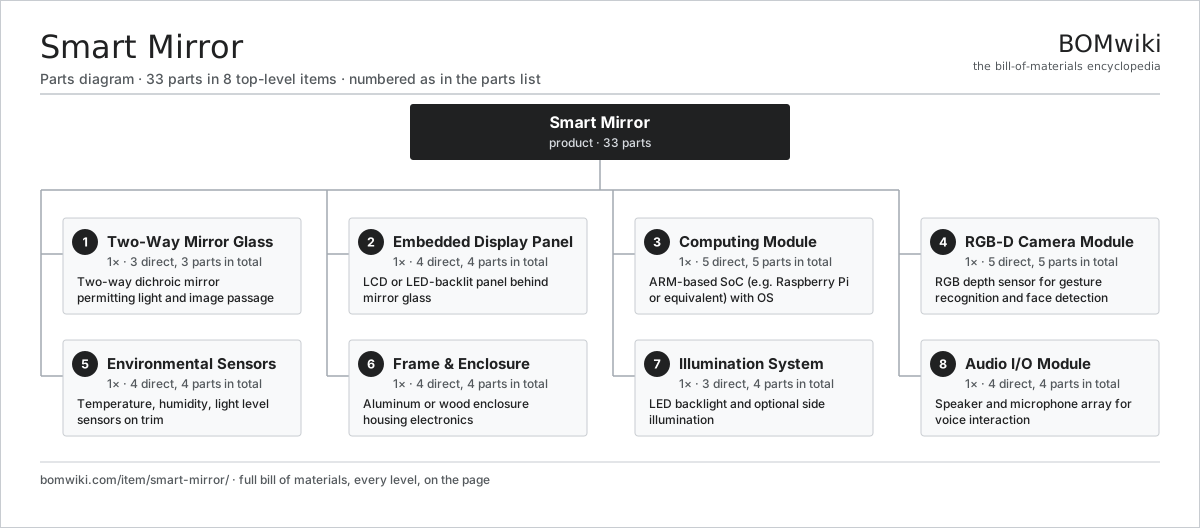
| # | Part | Qty | What it does |
|---|---|---|---|
| 1 | Two-Way Mirror Glass 3 parts | 1× | Two-way dichroic mirror permitting light and image passage |
| 2 | Embedded Display Panel 4 parts | 1× | LCD or LED-backlit panel behind mirror glass |
| 3 | Computing Module 5 parts | 1× | ARM-based SoC (e.g. Raspberry Pi or equivalent) with OS |
| 4 | RGB-D Camera Module 5 parts | 1× | RGB depth sensor for gesture recognition and face detection |
| 5 | Environmental Sensors 4 parts | 1× | Temperature, humidity, light level sensors on trim |
| 6 | Frame & Enclosure 4 parts | 1× | Aluminum or wood enclosure housing electronics |
| 7 | Illumination System 3 parts | 1× | LED backlight and optional side illumination |
| 8 | Audio I/O Module 4 parts | 1× | Speaker and microphone array for voice interaction |
3D model
No 3D model yet. Have a CAD file of this? Add a 3D model. STL renders right on this page; STEP, FreeCAD, and OpenSCAD sources are welcome too (openly licensed, like all 3D models on BOMwiki).
Build & assembly graph
expand / collapse · shared sub-assemblies converge · links to related products · est. labourTap an assembly to expand/collapse · tap a part to open it · use “Open page” for any node · drag to pan, scroll to zoom.
Bill of materials for Smart Mirror
8 top-level lines · 40 rows shown · 33 parts total · indented to 3 levels| # | Item / sub-assembly | Part no. | Qty/assy | Ext. qty | Parts | Type |
|---|---|---|---|---|---|---|
| 1 | Two-Way Mirror Glass 3 parts | smart-mirror-glass-panel | 1× | 1 | 3 | assembly |
| 1.1 | Mirror Substrate | smart-mirror-glass-sheet | 1× | 1 | · | part |
| 1.2 | Reflective Coating | smart-mirror-dichroic-coating | 1× | 1 | · | part |
| 1.3 | Anti-Fog Coating | smart-mirror-anti-fog | 1× | 1 | · | part |
| 2 | Embedded Display Panel 4 parts | smart-mirror-display | 1× | 1 | 4 | assembly |
| 2.1 | LCD Display Panel | smart-mirror-lcd-panel | 1× | 1 | · | part |
| 2.2 | LED Backlight Unit | smart-mirror-backlight-array | 1× | 1 | · | part |
| 2.3 | Display Receiver IC | smart-mirror-display-driver | 1× | 1 | · | part |
| 2.4 | T-CON Board | smart-mirror-timing-controller | 1× | 1 | · | part |
| 3 | Computing Module 5 parts | smart-mirror-compute-module | 1× | 1 | 5 | assembly |
| 3.1 | Compute SoC Module | soc-module | 1× | 1 | · | part |
| 3.2 | System RAM | smart-mirror-ram | 1× | 1 | · | part |
| 3.3 | Storage Drive | smart-mirror-storage | 1× | 1 | · | part |
| 3.4 | WiFi & BLE Radio | smart-mirror-wifi-module | 1× | 1 | · | part |
| 3.5 | Power Management PCB | smart-mirror-power-board | 1× | 1 | · | part |
| 4 | RGB-D Camera Module 5 parts | smart-mirror-camera | 1× | 1 | 5 | assembly |
| 4.1 | CMOS Image Sensor | image-sensor | 1× | 1 | · | part |
| 4.2 | Lens Assembly | camera-lens | 1× | 1 | · | part |
| 4.3 | Depth Sensor Module | smart-mirror-depth-sensor | 1× | 1 | · | part |
| 4.4 | IR Light Emitter | smart-mirror-ir-emitter | 1× | 1 | · | part |
| 4.5 | Camera Cable | smart-mirror-camera-connector | 1× | 1 | · | part |
| 5 | Environmental Sensors 4 parts | smart-mirror-sensor-array | 1× | 1 | 4 | assembly |
| 5.1 | Temperature Sensor | smart-mirror-temp-sensor | 1× | 1 | · | part |
| 5.2 | Humidity Sensor | smart-mirror-humidity-sensor | 1× | 1 | · | part |
| 5.3 | Ambient Light Sensor | smart-mirror-light-sensor | 1× | 1 | · | part |
| 5.4 | Sensor ADC/I2C | smart-mirror-sensor-adc | 1× | 1 | · | part |
| 6 | Frame & Enclosure 4 parts | smart-mirror-frame-assembly | 1× | 1 | 4 | assembly |
| 6.1 | Frame Profile | smart-mirror-frame-extrusion | 1× | 1 | · | part |
| 6.2 | Backing Panel | smart-mirror-back-panel | 1× | 1 | · | part |
| 6.3 | Wall Mount | smart-mirror-mounting-bracket | 1× | 1 | · | part |
| 6.4 | Fastener Set | fastener-set | 1× | 1 | · | part |
| 7 | Illumination System 3 parts | smart-mirror-lighting | 1× | 1 | 4 | assembly |
| 7.1 | Backlight LED Strip | smart-mirror-backlight-led | 1× | 1 | · | part |
| 7.2 | LED Brightness Driver | smart-mirror-led-driver | 1× | 1 | · | part |
| 7.3 | Accent LED Strips | smart-mirror-side-lights | 2× | 2 | · | part |
| 8 | Audio I/O Module 4 parts | smart-mirror-audio | 1× | 1 | 4 | assembly |
| 8.1 | Speaker | speaker | 1× | 1 | · | part |
| 8.2 | Mic Array Module | smart-mirror-microphone-array | 1× | 1 | · | part |
| 8.3 | Audio Codec IC | smart-mirror-audio-codec | 1× | 1 | · | part |
| 8.4 | Class D Audio Amp | smart-mirror-amp | 1× | 1 | · | part |
Something wrong in this list? Report a problem with this BOM.
Related products
same domain, ranked by shared parts AR Glasses
242 parts · shares 4 with this page
AR Glasses
242 parts · shares 4 with this page
 Smartphone
1,418 parts · shares 4 with this page
Smartphone
1,418 parts · shares 4 with this page
 Video Baby Monitor
234 parts · shares 4 with this page
Video Baby Monitor
234 parts · shares 4 with this page
 VR Headset
457 parts · shares 4 with this page
VR Headset
457 parts · shares 4 with this page
 Smart Display
42 parts · shares 2 with this page
Portable Bluetooth Projector
294 parts · shares 3 with this page
Smart Display
42 parts · shares 2 with this page
Portable Bluetooth Projector
294 parts · shares 3 with this page
Sourcing: possible vendors
Browse the supplier directory → Prices, MOQ, and lead times are algorithmic estimates, not quotes, and not claims about these companies. Company mappings are curated by keyword; est. price band $50–$2k. How estimates work| Vendor | HQ | Specialty | MOQ | Lead time |
|---|---|---|---|---|
|
🇨🇳Foxconn
foxconn.com ↗
|
Shenzhen, CN | Electronics contract mfg | 1,000 units | 8–14 wks |
|
🇺🇸Jabil
jabil.com ↗
|
St. Petersburg, US | Electronics manufacturing | 1,000 units | 8–14 wks |
|
🇺🇸Flex
flex.com ↗
|
Austin, US | Electronics manufacturing | 1,000 units | 8–14 wks |
| celestica.com ↗ | Toronto, CA | Electronics manufacturing | 1,000 units | 8–14 wks |
|
🇺🇸Sanmina
sanmina.com ↗
|
San Jose, US | Electronics manufacturing | 1,000 units | 8–14 wks |
922-word article