Stadium Ribbon Display
ProductOverview
Stadium ribbon displays are continuous LED bands wrapping around the interior or exterior of sports stadiums, showing game updates, sponsor logos, and entertainment content. They are iconic features of modern arenas, present in NHL, NBA, NFL, and soccer stadiums worldwide.
A typical 200-meter ribbon display contains 200 modular LED panels (1m × 0.25m each) daisy-chained together. The system is fed by primary and backup servers running real-time graphics software, generating live score overlays, player stats, instant replay clips, and sponsor advertisements.
Architecture and modularity
The ribbon is built from plug-and-play 1-meter modules. Each module is self-contained: it has its own LED drivers, power connectors, and signal input. Modules are snapped together using keyed quick-disconnect connectors, so the entire display can be reconfigured, removed, or replaced without tools.
This modularity is critical for stadium sports venues:
- Segments can be individually replaced if damaged (shot puck, accidental damage)
- The display can be installed in phases (start with 100 meters, expand later)
- The display can be removed during off-seasons for maintenance
All 200 modules must remain synchronized: the pixel clocks, row drivers, and refresh cycles are locked together by a master FPGA. Phase drift of more than 1 microsecond becomes visible as a "seam" or horizontal distortion where segments meet. The FPGA continuously measures phase error and adjusts the phase delay on each segment to maintain sub-microsecond alignment.
Power distribution
A 200-meter ribbon at full white brightness draws 300 kW (1500 amps at 48V). This is equivalent to the power draw of 300 American households. Power is distributed via a copper busbar running around the stadium perimeter, with 40 tap points supplying smaller feeder cables to clusters of segments.
Four 3 kW industrial power supplies in parallel deliver 12 kW total. If one supply fails, the other three continue, operating at 75% brightness, the display remains visible and functional.
Circuit protection at each power tap uses individual 60A breakers. If a tap receives a short circuit (e.g., water damage on a segment), the breaker isolates the fault and the rest of the ribbon continues operating.
Video processing and graphics
The primary server runs real-time graphics software. A GPU (NVIDIA RTX 4090) renders live content:
- Score and clock overlay: Extracted from the broadcast feed via a 4K HDR capture card
- Instant replays: 30-second clips triggered by referee whistles or plays, pulled from the SSD clip library
- Player stats: 3D animated graphics showing active player names, jerseys, and stats
- Sponsor transitions: Smooth crossfades between sponsor logos (each on screen for 10–20 seconds during timeouts)
- Entertainment: Pre-rendered video reels, crowd prompts, and audio cues
The primary server streams video at 4K 60 Hz over HDMI to the video distribution engine (the FPGA processor). The FPGA downsamples to the ribbon resolution (200 × 50 effective pixels) and distributes it across all 200 segments in real time, with latency <100 milliseconds.
A backup server (identical hardware) runs in hot-standby mode. If the primary server fails, the backup automatically takes over within <100 milliseconds. Viewers may see a brief flicker, but continuous content flow is maintained.
Synchronization with live sports
The display must synchronize with live events:
- When a goal is scored, the replay starts immediately (within 2–3 seconds)
- The scoreboard updates in real time as referees make calls
- Timeouts trigger sponsor ads or entertainment content automatically
This is achieved by:
- The capture card reads the broadcast feed and extracts events (score, clock, penalties)
- The graphics engine responds to events within 1–2 frames (~33 milliseconds)
- The FPGA distributes updated video to all segments within <100 milliseconds
The display is slave to the live event, not the other way around.
Sports-specific content
Hockey: Fast-paced replays (goal, fight, near-miss), crowd prompts ("CLAP CLAP CLAP"), and penalty animations.
Basketball: Player stats, sponsor logos during timeouts, and animations for 3-pointers.
Soccer/Football: Goal replays, offside visualizations, and sponsor rotations during halftime.
The SSD library stores 100+ pre-rendered clips (each 30 seconds at 1920×960 resolution), totaling 2 TB. New clips can be added without stopping the display (clips are loaded into RAM as needed).
Structural considerations
The aluminum support channel running around the stadium must be structurally strong and vibration-damped. Each of the 200 LED modules weighs 40 kg (8 tons total). Wind load is significant in outdoor stadiums (e.g., open-air soccer stadiums). The channel is bolted to the stadium roof structure at multiple points, transferring loads to the roof frame.
Vibration damping is critical: if the channel resonates at a particular frequency (wind gust, crowd noise), the display flickers. Rubber isolation feet on each segment clamp dampen vibration and decouple the display from the structure.
Maintenance and operations
Stadium operators run the display 24/7 during the season (3–9 months depending on sport). A single technical operator can run the display from a tablet or laptop using a web interface. Pre-approved graphics and clips are pushed via the menu system.
LED module degradation is 5% brightness per 50,000 hours. After 5 years of continuous operation (40,000 hours), noticeable dimming occurs. Modules are replaced in batches, every 5 years, all 200 modules are swapped out.
Power supplies are swapped on a 10-year schedule (or preventatively if a backup is needed).
The capture card and GPU are upgraded every 4–5 years to support new video codecs (HEVC, AV1) and higher resolution.
Cost and ROI
A 200-meter stadium ribbon display costs $2–5 million including:
- LED modules: $40,000
- Power infrastructure: $200,000
- Server hardware: $150,000
- Installation and integration: $500,000+
Sponsorship revenue can exceed $1 million per year, making payback ~2–3 years. The display also enhances fan engagement and broadcast production value.
Competitive advantages
Modern stadiums compete on fan experience. A high-quality ribbon display is expected in NHL, NBA, and Premier League venues. Older stadiums upgrading to a ribbon display report increased attendance and merchandise sales.
Replay quality is a primary differentiator. Stadiums with 4K 60 fps replays can show slow-motion replays of close calls, reducing fan frustration and improving perceived fairness of officiating.
Stadium Ribbon Display parts and their functions
6 top-level parts · 1,326 parts in total · full bill of materials below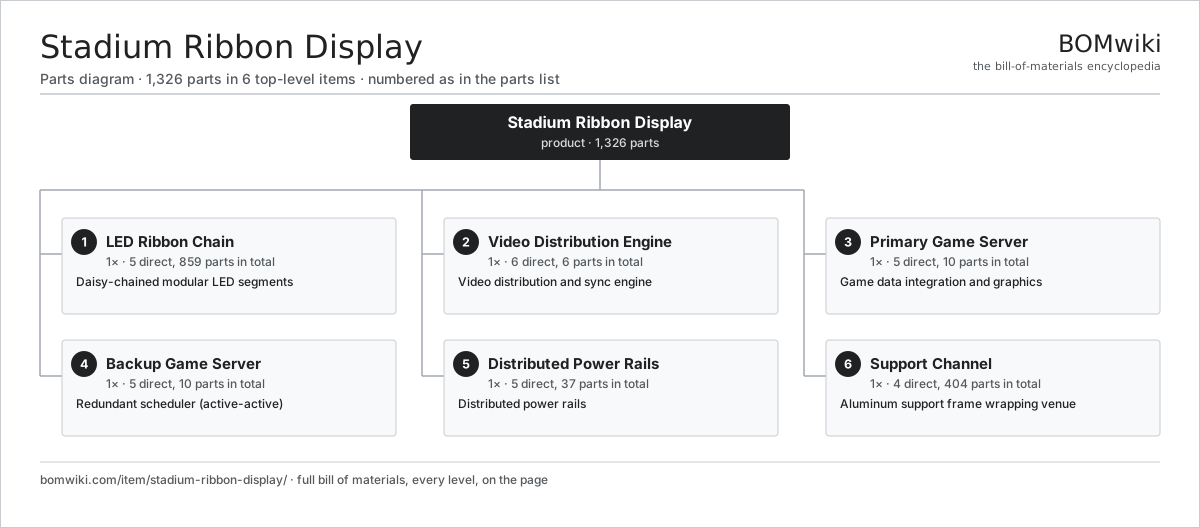
| # | Part | Qty | What it does |
|---|---|---|---|
| 1 | LED Ribbon Chain 5 parts | 1× | Daisy-chained modular LED segments |
| 2 | Video Distribution Engine 6 parts | 1× | Video distribution and sync engine |
| 3 | Primary Game Server 5 parts | 1× | Game data integration and graphics |
| 4 | Backup Game Server 5 parts | 1× | Redundant scheduler (active-active) |
| 5 | Distributed Power Rails 5 parts | 1× | Distributed power rails |
| 6 | Support Channel 4 parts | 1× | Aluminum support frame wrapping venue |
3D model
No 3D model yet. Have a CAD file of this? Add a 3D model. STL renders right on this page; STEP, FreeCAD, and OpenSCAD sources are welcome too (openly licensed, like all 3D models on BOMwiki).
Build & assembly graph
expand / collapse · shared sub-assemblies converge · links to related products · est. labourTap an assembly to expand/collapse · tap a part to open it · use “Open page” for any node · drag to pan, scroll to zoom.
Bill of materials for Stadium Ribbon Display
6 top-level lines · 36 rows shown · 1,326 parts total · indented to 3 levels| # | Item / sub-assembly | Part no. | Qty/assy | Ext. qty | Parts | Type |
|---|---|---|---|---|---|---|
| 1 | LED Ribbon Chain 5 parts | stadium-ribbon-display-led-module-chain | 1× | 1 | 859 | assembly |
| 1.1 | LED Ribbon Segment | stadium-ribbon-display-segment | 200× | 200 | · | part |
| 1.2 | Segment Connector | stadium-ribbon-display-interconnect-socket | 199× | 199 | · | part |
| 1.3 | Power Distribution Tap | stadium-ribbon-display-power-tap | 40× | 40 | · | part |
| 1.4 | Connector | connector | 400× | 400 | · | part |
| 1.5 | Wire Bundle | wire-bundle | 20× | 20 | · | part |
| 2 | Video Distribution Engine 6 parts | stadium-ribbon-display-display-processor | 1× | 1 | 6 | assembly |
| 2.1 | Compute SoC Module | soc-module | 1× | 1 | · | part |
| 2.2 | Timing Synchronizer FPGA | stadium-ribbon-display-fpga-sync | 1× | 1 | · | part |
| 2.3 | 10GbE Switch | stadium-ribbon-display-ethernet-switch | 1× | 1 | · | part |
| 2.4 | Clip Library SSD | stadium-ribbon-display-storage | 1× | 1 | · | part |
| 2.5 | Power Supply | power-supply | 1× | 1 | · | part |
| 2.6 | Microcontroller | mcu | 1× | 1 | · | part |
| 3 | Primary Game Server 5 parts | stadium-ribbon-display-primary-server | 1× | 1 | 10 | assembly |
| 3.1 | Compute SoC Module | soc-module | 1× | 1 | · | part |
| 3.2 | Graphics GPU | stadium-ribbon-display-gpu-card | 2× | 2 | · | part |
| 3.3 | Video Capture Card | stadium-ribbon-display-capture-card | 1× | 1 | · | part |
| 3.4 | Connector | connector | 4× | 4 | · | part |
| 3.5 | Power Supply | power-supply | 2× | 2 | · | part |
| 4 | Backup Game Server 5 parts | stadium-ribbon-display-backup-server | 1× | 1 | 10 | assembly |
| 4.1 | Compute SoC Module | soc-module | 1× | 1 | · | part |
| 4.2 | Graphics GPU | stadium-ribbon-display-gpu-card | 2× | 2 | · | part |
| 4.3 | Video Capture Card | stadium-ribbon-display-capture-card | 1× | 1 | · | part |
| 4.4 | Connector | connector | 4× | 4 | · | part |
| 4.5 | Power Supply | power-supply | 2× | 2 | · | part |
| 5 | Distributed Power Rails 5 parts | stadium-ribbon-display-power-infrastructure | 1× | 1 | 37 | assembly |
| 5.1 | Industrial PSU | stadium-ribbon-display-main-supply | 4× | 4 | · | part |
| 5.2 | Stadium Busbar | stadium-ribbon-display-distribution-busbar | 1× | 1 | · | part |
| 5.3 | Power Tap Breaker | stadium-ribbon-display-breaker-modules | 10× | 10 | · | part |
| 5.4 | Wire Bundle | wire-bundle | 20× | 20 | · | part |
| 5.5 | Fastener Set | fastener-set | 2× | 2 | · | part |
| 6 | Support Channel 4 parts | stadium-ribbon-display-structural-channel | 1× | 1 | 404 | assembly |
| 6.1 | Support Channel | stadium-ribbon-display-channel-profile | 200× | 200 | · | part |
| 6.2 | Module Mount Clamp | stadium-ribbon-display-segment-clamp | 200× | 200 | · | part |
| 6.3 | Fastener Set | fastener-set | 3× | 3 | · | part |
| 6.4 | Sheet Metal Panel | sheet-panel | 1× | 1 | · | part |
Something wrong in this list? Report a problem with this BOM.
Related products
same domain, ranked by shared parts LED Curtain Display
356 parts · shares 4 with this page
LED Curtain Display
356 parts · shares 4 with this page
 Interactive Touch Table
130 parts · shares 3 with this page
Interactive Touch Table
130 parts · shares 3 with this page
 LED Television
737 parts · shares 3 with this page
LED Television
737 parts · shares 3 with this page
 Digital Billboard
131 parts · shares 2 with this page
Digital Billboard
131 parts · shares 2 with this page
 Highway Variable Message Sign
208 parts · shares 1 with this page
Highway Variable Message Sign
208 parts · shares 1 with this page
 Car FM Transmitter
240 parts · shares 3 with this page
Car FM Transmitter
240 parts · shares 3 with this page
Sourcing: possible vendors
Browse the supplier directory → Prices, MOQ, and lead times are algorithmic estimates, not quotes, and not claims about these companies. Company mappings are curated by keyword; est. price band $50–$2k. How estimates work| Vendor | HQ | Specialty | MOQ | Lead time |
|---|---|---|---|---|
|
🇨🇳Foxconn
foxconn.com ↗
|
Shenzhen, CN | Electronics contract mfg | 1,000 units | 8–14 wks |
|
🇺🇸Jabil
jabil.com ↗
|
St. Petersburg, US | Electronics manufacturing | 1,000 units | 8–14 wks |
|
🇺🇸Flex
flex.com ↗
|
Austin, US | Electronics manufacturing | 1,000 units | 8–14 wks |
| celestica.com ↗ | Toronto, CA | Electronics manufacturing | 1,000 units | 8–14 wks |
|
🇺🇸Sanmina
sanmina.com ↗
|
San Jose, US | Electronics manufacturing | 1,000 units | 8–14 wks |
1,031-word article