Steam Iron
ProductOverview
A steam iron is a household appliance that removes wrinkles from fabrics using heat and pressurized steam. Unlike dry irons (heat alone), steam irons generate internal pressure (1–3 bar) in a boiler chamber, forcing superheated water vapor through the Flat Plate Base, a heated flat metal base. The combination of heat, moisture, and pressure relaxes fabric fibers, allowing them to reshape without wrinkles.
Steam irons are ubiquitous in homes, professional dry-cleaning shops, and garment factories. They operate on a simple thermodynamic principle: sustained heat and moisture soften cotton, linen, and synthetic fibers, making them malleable. Pressing with the heated soleplate sets the new (wrinkle-free) shape as the fabric cools.
How It Works
Water fills the Water Tank (200–400 mL capacity) via the fill cap. When the iron is plugged into mains power (110–240V AC), the Nichrome Heater, a nichrome resistance wire rated 1500–2500W, energizes. Heat rapidly transfers to the Boiler Vessel, a sealed metal vessel holding ≈300 mL of water.
The Temperature Control monitors soleplate temperature using a bi-metallic disc or electronic sensor. Once the soleplate (coupled thermally to the boiler) reaches 160–180°C, the thermostat cuts main heater power (but keeps it on standby). A small light on the iron (the Heat Indicator Light) illuminates while active heating occurs.
When the user presses the steam trigger (usually a button on the handle), the Water Feed Pump, a small 3–5W DC motor driving a peristaltic chamber, draws water from the reservoir through Pump Tube into the boiler. The Pump Check Valve prevents backflow of steam.
Inside the boiler, water at 100°C vaporizes instantly in the presence of the much hotter walls (already 160°C+). This pressurization forces steam out through the Boiler Steam Outlet and into the Steam Solenoid, a 2–3W electromagnetic valve that gates the steam flow.
Activating the trigger also energizes the solenoid, opening the valve. Steam flows through Steam Conduit directly beneath the Flat Plate Base, exiting through Vent Holes, small ≈2 mm diameter holes drilled in the soleplate base. The steam penetrates the fabric, relaxing fibers and carrying away static electricity.
Simultaneously, the user may activate the Mist Spray System, a manual or automatic cold-water spray, to pre-dampen fabric for superior wrinkle penetration. The cold spray mist interacts with the hot steam, accelerating moisture absorption.
Soleplate Materials and Design
The Flat Plate Base is the critical precision component. Most consumer irons use cast aluminum (≈90% of irons) for weight and thermal conductivity. Premium models use stainless steel (≥1.5 mm thickness), which resists corrosion from mineral deposits in steam and lasts longer (5+ years vs. 3–4 years for aluminum).
The Non-Stick Surface, a thin PTFE non-stick layer, is essential to prevent fabric from sticking during pressing, especially synthetics like polyester and nylon. Without Teflon, high friction causes fabric to bunch and burns or scorch marks develop. The coating wears gradually; aggressive scouring with abrasive pads accelerates wear.
Sole-plate flatness is critical: warping (even 0.5 mm) causes uneven heat distribution and poor results. Premium irons are precision-ground to ≥95% flatness across the base.
Steam Generation and Pressure
The Internal Boiler Chamber's pressure relief valve (typically set to 2–3 bar) prevents catastrophic rupture. Operating pressures are modest (1–3 bar), compared to industrial pressing machines (10+ bar). This limits steam output to 20–40 g/minute, sufficient for home pressing but slow for production environments.
Heat-up time varies: older irons with large boilers (≈500 mL) need 60–90 seconds; modern compact boilers (≈300 mL) ready in 30–45 seconds. Once ready, steaming can continue for 30–60 minutes before the tank empties.
Hard water (high mineral content) damages boilers over time: calcium and magnesium ions precipitate as scale on internal surfaces, reducing heat transfer and increasing heating time. Using distilled or demineralized water extends boiler life significantly.
Thermostat and Temperature Control
The Temperature Switch is a mechanical bi-metallic disc in budget models or an electronic NTC thermistor in premium units. As soleplate temperature rises, the disc warps, breaking electrical contact. Once the iron cools below threshold, contact closes again, re-energizing the heater.
This cycling is continuous during use: the iron oscillates between 140°C and 180°C, maintaining ideal pressing temperature. Too hot (>200°C) scorches delicate fabrics; too cool (<140°C) steaming is ineffective.
Premium irons add electronic controllers (MCU + relay) enabling multi-temperature presets: "cotton" (200°C), "synthetic" (140°C), "silk" (110°C). The user selects a setting, and the controller maintains exact temperature via PWM (pulse-width modulation) of the Power Relay.
Water and Maintenance
Mineral buildup in the boiler is the primary failure mode. Scale reduces thermal conductivity, increasing heating time and energy consumption. Most irons include a "descale" cycle: users pour a chemical descaler (citric acid or commercial solution) into the Water Tank, heat the iron, and press the steam trigger repeatedly to flush the boiler. This dissolves scale and expels it as sludge and water.
The Water Feed Pump is mechanically simple and rarely fails, but peristaltic tubes wear after years of use (1,000+ pump cycles). Replacement of the pump module is a field-service item (USD 20–50).
The Flat Plate Base Teflon coating degrades with aggressive scouring. Hand-washing with mild soap preserves coating; using abrasive cleaners or steel wool accelerates failure.
Fabric Compatibility
Cotton and linen (natural fibers) benefit most from steam: the fabric absorbs moisture readily, and steam relaxes fibers effectively. Pressing cotton at 200°C with heavy steam produces a crisp finish lasting until the next wash.
Synthetics (polyester, nylon) are more temperature-sensitive. Over-heating (>160°C) melts or scorches fibers. Using the "synthetic" setting (140°C, light steam) prevents damage.
Silk and delicate fabrics require extreme caution: press at low temperature (≤120°C), often with a pressing cloth (thin cotton fabric placed over the garment to diffuse heat). Many irons include a "delicate" or "low" setting for this.
Energy and Efficiency
Continuous operation at max setting consumes 1500–2500W, making irons among the highest-power household appliances. A typical pressing session (10 minutes) uses ≈250 Wh, costing roughly USD 0.02–0.03 per session.
Variants and Premium Features
Budget irons (USD 20–50) offer single temperature and manual steam trigger. Mid-range (USD 50–150) add variable temperature control and spray mist. Premium units (USD 150+) feature:
- Multiple temperature presets accessible via touch buttons
- Auto-shutoff (2–10 minutes inactivity)
- Anti-scale or auto-descale functions
- Ceramic or titanium soleplates for durability
- Cordless rechargeable models (steam stored in internal reservoir, unplugged operation for 5–10 minutes)
Vertical steamers (industrial-style) are a variant: fabric hangs from a rack, and a handheld wand applies steam and pressure. These avoid direct contact damage and suit delicate/expensive garments.
Steam Iron parts and their functions
8 top-level parts · 27 parts in total · full bill of materials below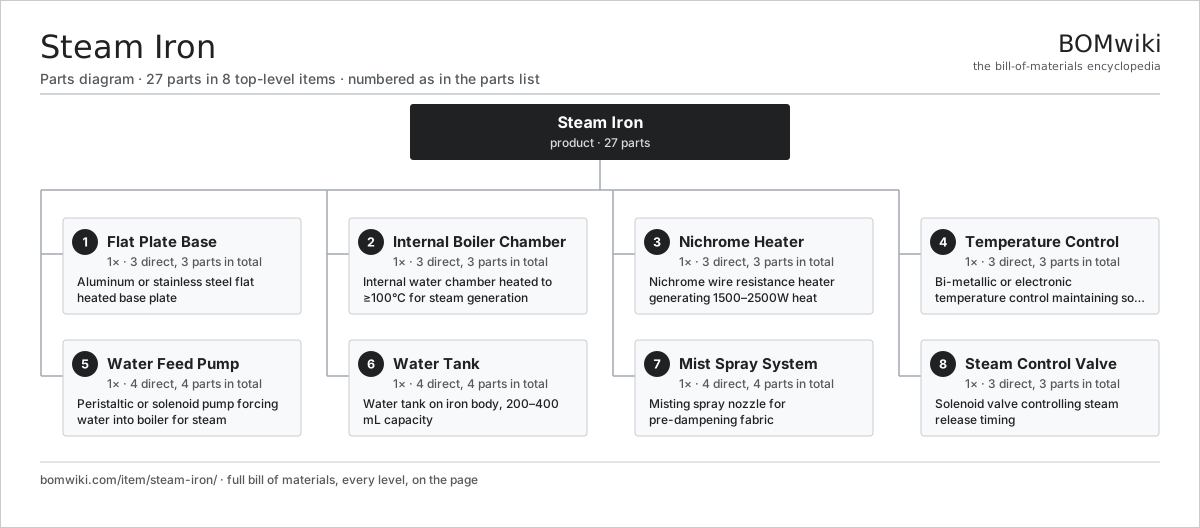
| # | Part | Qty | What it does |
|---|---|---|---|
| 1 | Flat Plate Base 3 parts | 1× | Aluminum or stainless steel flat heated base plate |
| 2 | Internal Boiler Chamber 3 parts | 1× | Internal water chamber heated to ≥100°C for steam generation |
| 3 | Nichrome Heater 3 parts | 1× | Nichrome wire resistance heater generating 1500–2500W heat |
| 4 | Temperature Control 3 parts | 1× | Bi-metallic or electronic temperature control maintaining soleplate heat |
| 5 | Water Feed Pump 4 parts | 1× | Peristaltic or solenoid pump forcing water into boiler for steam |
| 6 | Water Tank 4 parts | 1× | Water tank on iron body, 200–400 mL capacity |
| 7 | Mist Spray System 4 parts | 1× | Misting spray nozzle for pre-dampening fabric |
| 8 | Steam Control Valve 3 parts | 1× | Solenoid valve controlling steam release timing |
3D model
No 3D model yet. Have a CAD file of this? Add a 3D model. STL renders right on this page; STEP, FreeCAD, and OpenSCAD sources are welcome too (openly licensed, like all 3D models on BOMwiki).
Build & assembly graph
expand / collapse · shared sub-assemblies converge · links to related products · est. labourTap an assembly to expand/collapse · tap a part to open it · use “Open page” for any node · drag to pan, scroll to zoom.
Bill of materials for Steam Iron
8 top-level lines · 35 rows shown · 27 parts total · indented to 3 levels| # | Item / sub-assembly | Part no. | Qty/assy | Ext. qty | Parts | Type |
|---|---|---|---|---|---|---|
| 1 | Flat Plate Base 3 parts | steam-iron-soleplate | 1× | 1 | 3 | assembly |
| 1.1 | Soleplate Metal | steam-iron-plate-base | 1× | 1 | · | part |
| 1.2 | Vent Holes | steam-iron-steam-vents | 1× | 1 | · | part |
| 1.3 | Non-Stick Surface | steam-iron-teflon-coating | 1× | 1 | · | part |
| 2 | Internal Boiler Chamber 3 parts | steam-iron-boiler | 1× | 1 | 3 | assembly |
| 2.1 | Boiler Vessel | steam-iron-boiler-chamber | 1× | 1 | · | part |
| 2.2 | Boiler Water Inlet | steam-iron-boiler-inlet | 1× | 1 | · | part |
| 2.3 | Boiler Steam Outlet | steam-iron-boiler-outlet | 1× | 1 | · | part |
| 3 | Nichrome Heater 3 parts | steam-iron-heating-element | 1× | 1 | 3 | assembly |
| 3.1 | Nichrome Heating Wire | steam-iron-heating-coil | 1× | 1 | · | part |
| 3.2 | Heater Core | steam-iron-heater-block | 1× | 1 | · | part |
| 3.3 | Thermal Insulation | steam-iron-insulation | 1× | 1 | · | part |
| 4 | Temperature Control 3 parts | steam-iron-thermostat | 1× | 1 | 3 | assembly |
| 4.1 | Temperature Switch | steam-iron-thermostat-switch | 1× | 1 | · | part |
| 4.2 | Power Relay | steam-iron-control-relay | 1× | 1 | · | part |
| 4.3 | Heat Indicator Light | steam-iron-temperature-indicator | 1× | 1 | · | part |
| 5 | Water Feed Pump 4 parts | steam-iron-pump | 1× | 1 | 4 | assembly |
| 5.1 | Pump Drive Motor | steam-iron-pump-motor | 1× | 1 | · | part |
| 5.2 | Pump Body | steam-iron-pump-chamber | 1× | 1 | · | part |
| 5.3 | Pump Tube | steam-iron-pump-tubing | 1× | 1 | · | part |
| 5.4 | Pump Check Valve | steam-iron-pump-check-valve | 1× | 1 | · | part |
| 6 | Water Tank 4 parts | steam-iron-reservoir | 1× | 1 | 4 | assembly |
| 6.1 | Reservoir Tank | steam-iron-tank-shell | 1× | 1 | · | part |
| 6.2 | Fill Cap | steam-iron-tank-cap | 1× | 1 | · | part |
| 6.3 | Float Indicator | steam-iron-tank-float | 1× | 1 | · | part |
| 6.4 | Connector | connector | 1× | 1 | · | part |
| 7 | Mist Spray System 4 parts | steam-iron-spray-nozzle | 1× | 1 | 4 | assembly |
| 7.1 | Spray Button | steam-iron-spray-trigger | 1× | 1 | · | part |
| 7.2 | Spray Pump Motor | steam-iron-spray-motor | 1× | 1 | · | part |
| 7.3 | Spray Nozzle | steam-iron-nozzle-tip | 1× | 1 | · | part |
| 7.4 | Spray Water Tank | steam-iron-spray-reservoir | 1× | 1 | · | part |
| 8 | Steam Control Valve 3 parts | steam-iron-steam-valve | 1× | 1 | 3 | assembly |
| 8.1 | Steam Solenoid | steam-iron-solenoid-valve | 1× | 1 | · | part |
| 8.2 | Pressure Limiter | steam-iron-pressure-regulator | 1× | 1 | · | part |
| 8.3 | Steam Conduit | steam-iron-steam-tubing | 1× | 1 | · | part |
Something wrong in this list? Report a problem with this BOM.
Sourcing: possible vendors
Browse the supplier directory → Prices, MOQ, and lead times are algorithmic estimates, not quotes, and not claims about these companies. Company mappings are curated by keyword; est. price band $150–$3k. How estimates work| Vendor | HQ | Specialty | MOQ | Lead time |
|---|---|---|---|---|
| whirlpoolcorp.com ↗ | Benton Harbor, US | Home appliances | 1,000 units | 8–14 wks |
| bsh-group.com ↗ | Munich, DE | Appliances (Bosch, Siemens) | 1,000 units | 8–14 wks |
| electroluxgroup.com ↗ | Stockholm, SE | Home appliances | 1,000 units | 8–14 wks |
| lg.com ↗ | Seoul, KR | Appliances & electronics | 1,000 units | 8–14 wks |
|
🇨🇳Haier
haier.com ↗
|
Qingdao, CN | Home appliances | 1,000 units | 8–14 wks |
1,163-word article